10 Best Astronomy & Stargazing Gifts (2026): Beginner Telescopes, Binoculars, Star Projectors, Sky Maps & Night Sky Guides
A tested-by-real-life look at the best astronomy and stargazing gifts for 2026, from a first telescope to a red headlamp that saves your night vision. Every pick is price-checked and under $100.
As an Amazon Associate, My Gifts Inventory earns from qualifying purchases. We only recommend products we'd genuinely consider buying ourselves.
Some people are easy to buy for. They have a list, you buy off the list, everyone goes home happy. Then there's the person who disappears onto the back porch at 10 p.m. to stare at the moon, or the kid who has memorized the order of the planets and corrects you about Pluto. Those are the people this guide is for. Astronomy and stargazing gifts are a strange little corner of shopping because the gear ranges from a $14 paperback to a $97 telescope, and almost none of it is explained well on the box.
We went looking at what's actually on shelves and virtual shelves right now for the 2026 gift season, checked the current prices, and read what real buyers had to say. What we found is that the best astronomy gifts aren't usually the biggest or most expensive ones. A good pair of binoculars will out-see a cheap telescope. A $17 red headlamp can make or break a whole night of observing. And the map or book that explains what you're looking at matters more than the lens. Here are ten real picks, all under $100, organized by what they're actually best for.

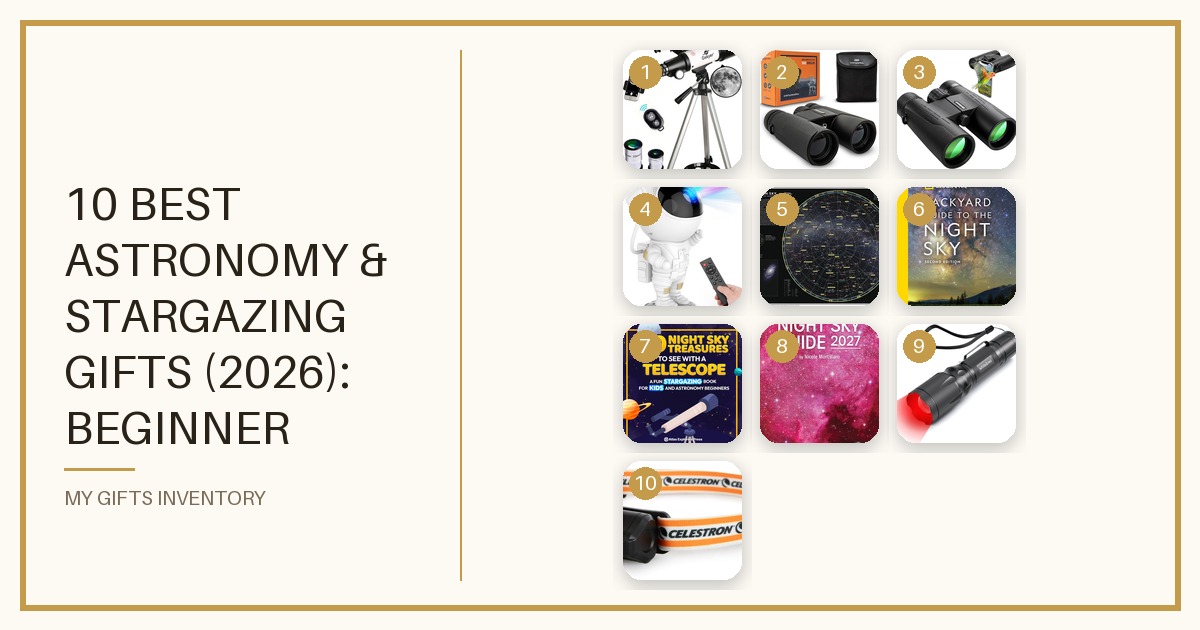
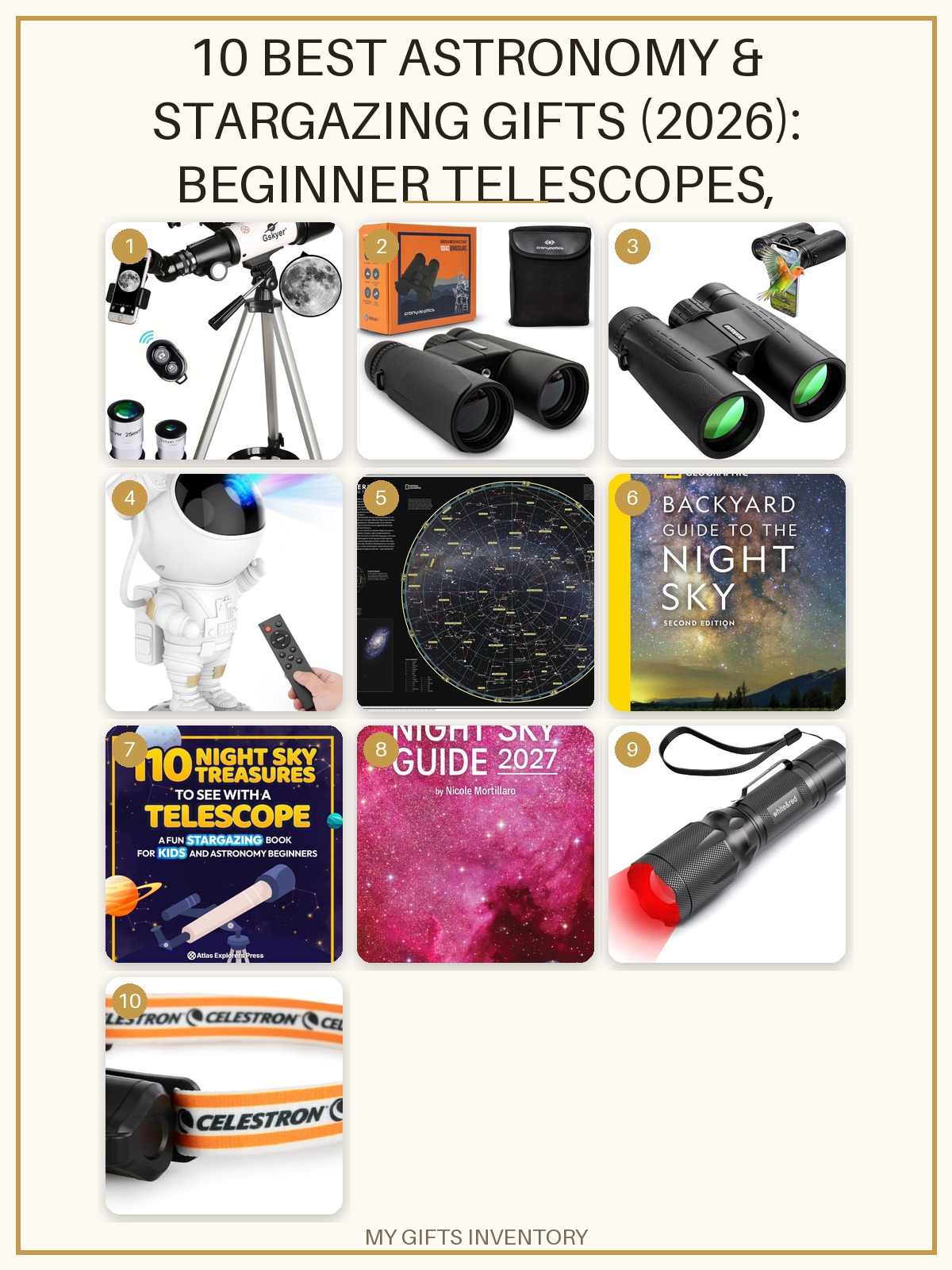
If you're buying a first telescope for someone, this is the one we'd actually hand over. A 70mm refractor on a 400mm focal length gets you real views of the moon and Jupiter's moons without the astronomical price tag, and at $96.99 it stays firmly in gift territory. The 4.3-star rating is honest, not inflated: it's a beginner scope, and a beginner scope it does very well.
Check Price on Amazon →| Product | Best For | Price | Rating | |
|---|---|---|---|---|
|
Gskyer Telescope, 70mm Aperture 400mm AZ Mount Refracting Telescope Best First Telescope |
$96.99 | 4.3 | Buy → |
 |
10x42 Binoculars for Adults, High Powered for Bird Watching, Hiking and Travel Best All-Rounder Binoculars |
$59.99 | 4.6 | Buy → |
 |
10x42 Compact Binoculars for Adults & Teens, HD Roof BAK4 FMC Lens Best Budget Binoculars |
$31.99 | 4.6 | Buy → |
 |
Star Projector Galaxy Night Light, Astronaut Space Projector with Timer and Remote Best Bedroom Star Projector |
$34.99 | 4.5 | Buy → |
 |
National Geographic Charting the Heavens, Northern Sky Wall Map, Compact Best Wall Sky Map |
$25.99 | 4.6 | Buy → |
 |
National Geographic Backyard Guide to the Night Sky, 2nd Edition Best All-Around Night Sky Book |
$14.29 | 4.7 | Buy → |
 |
110 Night Sky Treasures to See with a Telescope: A Stargazing Book for Kids and Beginners Best For Kids With a New Scope |
$14.99 | 4.7 | Buy → |
 |
Night Sky Guide 2027: North America's Skies Month by Month Best Year-Round Companion |
$16.95 | 4.8 | Buy → |
 |
Upgraded Red Flashlight with White and Red Light Options and Zoom Lens Best Night Vision Flashlight |
$19.99 | 4.6 | Buy → |
 |
Celestron Night Vision Red LED Headlamp for Astronomy and Camping Best Hands-Free Observing Light |
$17.95 | 4.3 | Buy → |
How to Choose the Right Astronomy & Stargazing Gifts Gift
The single most useful thing we can tell you about buying astronomy gifts is this: match the gift to their actual habit, not to the version of them you wish existed. Someone who has never looked through a telescope and someone who already owns three are shopping in entirely different aisles. For a total beginner, the safest first gift is usually not a telescope at all. It's a good pair of binoculars, a solid guide book, and a red light. Binoculars are forgiving, easy to use in five minutes, and work for birds and scenery too, which means they don't end up in a closet if astronomy turns out to be a passing phase. If you want a broader roundup of general outdoor picks, our camping and hiking gifts guide overlaps nicely with a lot of this gear.
If you do want to give a telescope, keep the aperture honest. A 70mm refractor is the classic beginner size for a reason: it's light enough to carry outside without a debate, it shows the moon in real detail, and it will find Saturn's rings. What it will not do is show you faint galaxies the way a photo does, and anyone promising otherwise is selling a fantasy. Set expectations accordingly, and gift a telescope alongside a book so the recipient knows what to point it at. That's the real combo. The telescope gets them outside; the map and book keep them there.
For the person who already owns the gear, the gifts that land are the small ones: a red headlamp, a wall map for the office, a fresh annual guide for the coming year. These are consumables in spirit even if they last forever. And keep an eye on your budget. Most of the truly useful night-sky gifts are under $35, which makes this an easy category to shop during a sale or to pair with another small present. If you're building a bigger gift set, our tech accessory gifts guide and gifts for book lovers round things out for the reader-astronomer in your life.
Here are the ten picks we'd actually wrap up, split into two simple tiers: under $20 for the small essentials, and $20 to $100 for the "real" gear. Every price below is current as of this writing and every product has a real rating behind it.
Budget Picks (Under $20): Books, Charts and Red Lights
If we had to give one astronomy gift to a total beginner and nothing else, it would be this book. National Geographic's Backyard Guide is exactly what the name promises: it starts in your backyard, explains what you can see with the naked eye, and builds up to binoculars and a small telescope without ever making you feel stupid. At 4.7 stars and just over $14, it's the least risky gift in this entire guide. The one caveat: it's a reading gift, so if the recipient isn't a reader, pair it with binoculars or a projector instead. But for anyone curious who likes to understand things, this is the pick.
Check Price on Amazon →
This is the book you buy to go with a first telescope, especially for a kid. It's built around 110 concrete things to find, which is the exact structure a new observer needs. Instead of a wall of theory, it gives you a target list and tells you how to find each one. The 4.7 rating says people are getting what they expected. It's best for ages roughly 8 through adult beginner, and it's a slightly more task-oriented read than the National Geographic guide above, so the two don't fully overlap. If the gift is a telescope plus a book, this is the book.
Check Price on Amazon →
The highest-rated item in this guide, at 4.8 stars, and it's a calendar-style guide from the Royal Astronomical Society of Canada that walks month by month through the North American sky. This is the perfect gift for the person who says "I keep meaning to actually look up and I never know what I'm seeing." It's dated for 2027, so it's a forward-looking gift and a genuinely good stocking stuffer for the 2026 holiday season. The caveat is location: it's tuned to North America, so gift it to a friend on this continent. For anyone south of the border or in Europe, the National Geographic book above travels better.
Check Price on Amazon →Buying for a reader who already has a small library of sky guides? Our gifts for book lovers guide has book lights and bookends that make a winter stargazing book pairing feel a lot more finished.
This is the gift nobody asks for and everyone who stargazes needs. White light wrecks your night vision for a solid half hour, and red light doesn't. This flashlight switches between the two, has a zoom lens, and at $19.99 it's a genuinely thoughtful small present for anyone who's ever fumbled around in the dark looking for a chart. It's rated 4.6 stars, which is strong for a flashlight. It is not a fancy instrument and it isn't trying to be, so temper your expectations on beam quality. But as a "I saw this and thought of you" add-on gift, it punches well above its price.
Check Price on Amazon →
Celestron is one of the two or three names that genuinely means something in telescope gear, so a $18 red headlamp from them is a good little flex of a gift. The hands-free part matters more than it sounds: when you're holding a chart and adjusting a focuser, the last thing you want is a flashlight in your teeth. It's rated 4.3 stars, slightly below the red flashlight above, likely because it's a headlamp and not a multi-mode flashlight. Best for the person who already owns a telescope and observes regularly. For someone who's just curious, the flashlight is more versatile.
Check Price on Amazon →Still not sure what they'd actually use? A gift card is the honest fallback, and stargazers redeem them fast for lenses, charts and batteries. Check a Spotify gift card balance if you want to pair music with an indoor star-gazing night instead.
Mid-Range Picks ($20 to $100): Telescopes, Binoculars and Projectors
This is our top overall pick and the best "real" astronomy gift in the guide. A 70mm refractor on an alt-az mount is the sweet spot for a first telescope: it's light enough that a kid or a grandparent can carry it out the back door without a mental argument, it shows the moon's craters crisply, and it will give you Saturn's rings and Jupiter's moons on a clear night. At 4.3 stars, it earns that rating the honest way, and the box includes the tripod and eyepieces so there's nothing else to buy. The caveat is important: this is not a deep-sky imaging setup, and photographs through it will disappoint anyone expecting Hubble pictures. Buy it for actual looking, not photography, and pair it with a book so the recipient knows where to point it.
Check Price on Amazon →
A 10x42 is the most versatile binocular spec on the market, and this pair at 4.6 stars is the strongest all-rounder in this guide. You can point it at the moon, you can point it at a warbler, and it works for both. That range is why binoculars are the better first astronomy gift than a telescope for most people: they get used. The price is fair for the spec. The honest caveat is that at 10x you'll want a steady hand, and it's not the lightest thing to carry on a long hike. If you want the same view for less and don't mind a slightly tighter form factor, see the next pick.
Check Price on Amazon →
This is the budget binocular pick, and at 4.6 stars it matches the pricier pair above on rating while costing almost half as much. Roof-prism BAK4 glass and long eye relief mean it works well for glasses wearers, and the compact form factor makes it a better fit for teens and travel. The honest tradeoff is optical quality: at $31.99 you're not getting the same brightness or sharpness at the edges as the $59.99 pair, and it won't last as long under heavy use. But as a first pair of stargazing binoculars, a gift for a teenager, or a second pair to keep in the car, it's an easy call.
Check Price on Amazon →
Let's be clear about what this is and isn't. It's not a tool for learning the constellations; it's a nebula-style ceiling projector that turns a bedroom into a galaxy, and it's rated 4.5 stars because it does that job well. The timer and remote make it easy to use as a night light, and the little astronaut form factor is genuinely charming. This is the gift for the kid who wants a space-themed room or the adult who just likes a calmer bedroom. It's the least "astronomy" pick in the guide and the most purely decorative one. That's fine. Just don't give it to someone expecting to see real stars.
Check Price on Amazon →
A wall map of the northern sky sounds like an odd gift until you see one in a room: it's beautiful, it's genuinely useful as a reference, and it says "this person is into space" without saying it too loudly. At 21.5 by 16.25 inches this compact version fits above a desk or next to a telescope shelf. It's rated 4.6 stars, and it's a natural pairing with the flashlight or headlamp as a small gift bundle. The caveat is that it's decorative plus useful, not a field guide, so pair it with one of the books above if the recipient is serious about finding things. For a first gift, it's charming and low-risk.
Check Price on Amazon →Gifts to Skip for Astronomy & Stargazing Gifts
The biggest mistake in this category is buying a telescope for someone who has never shown any interest in actually going outside at night. A telescope is a hobby gift that assumes a habit, and if the recipient doesn't already own the habit, a telescope becomes a $97 piece of furniture. We've watched that happen to people we like. If you're unsure, start with the book and the binoculars and let them come back for the telescope themselves. It's also worth skipping any telescope that isn't from a recognizably real astronomy brand, or that advertises a magnification number above about 100x with a proud-looking photo. A 70mm refractor at a fair price beats a "675x" scope from an unknown brand every single time.
The other thing to skip is anything that locks them into a location or a plan. An astronomy club membership or a trip to a dark-sky park sounds great in a gift guide, but it assumes they have the free weekend, the transportation, and the enthusiasm on the exact date you choose. Save those for after you've confirmed they're hooked. And if you're shopping for a kid, avoid the telescope-plus-camera kits entirely. A real camera for astrophotography is a whole separate purchase and a whole separate hobby, and a cheap one in a telescope box only teaches a kid that they're bad at photography when they're actually just under-equipped.
Frequently Asked Questions
What's the best first astronomy gift for a total beginner?
We'd go with the National Geographic Backyard Guide to the Night Sky plus a pair of binoculars. The book costs about $14 and gives them the map, and the 10x42 budget pair at $31.99 gives them something to look through without committing to a telescope. The Gskyer telescope is the right next step once they know they love it.
Is a telescope or binoculars better for stargazing?
Binoculars, for most beginners. They're cheaper, easier to use, and useful for other things, so they don't sit in a closet if astronomy doesn't stick. A telescope shows more detail on the moon and planets, but only if the person already has the habit of going outside. If you want to buy a telescope, the Gskyer 70mm is the one we'd pick.
Do I need a red flashlight for stargazing?
Yes, and it's the most overlooked gift in this guide. White light resets your night vision and takes 20 to 30 minutes to recover. A red flashlight keeps it intact. The Upgraded Red Flashlight at $19.99 is the most versatile pick, and the Celestron headlamp at $17.95 is better for hands-free use at the eyepiece.
What's a good astronomy gift for a kid?
The 110 Night Sky Treasures book is built specifically for kids and beginners with a list of targets, and the astronaut star projector is the charmer for a bedroom. For a slightly older kid who's ready for real gear, the Gskyer telescope is a solid, safe choice.
Is a star projector a real astronomy gift?
Not really: it's decorative. The astronaut projector is a great bedroom gift and a lovely thing to own, but it doesn't teach you the sky. If the goal is to spark real interest, pair it with a book so the recipient gets both the pretty ceiling and the actual map.
How We Picked These Gifts
Every product in this guide was checked against its current listed price and its real current Amazon rating at the time of writing. We only included products we could verify through their listed images and names, and we capped the guide at ten valid picks so that no item in it is filler. Every product in this guide sits under $100, and several are under $20.
We did not accept payment or free products from any brand mentioned here, and inclusion on this list was not for sale. Read more about how we select and verify picks on our How We Pick page.
Final Thoughts
If you only read one paragraph, read this one. For a total beginner, buy the National Geographic Backyard Guide to the Night Sky and the budget 10x42 binoculars, and you've spent about $46 on a gift that will actually get used. If they're already hooked and you want the real gift, the Gskyer 70mm telescope is our top pick and the one we'd put under the tree for someone we know will carry it outside. And whatever you choose, add a red flashlight to the box. It's the $20 gift that makes all the others better.
Shop Hand-Picked Gift Sets
Every item picked, priced and linked, ready to buy.
More Gift Ideas You'll Love