Gift Tax Exemption Explained: How Much You Can Give Tax-Free in 2026
The annual gift tax exclusion is $19,000 per person in 2026, with a $15 million lifetime exemption. Here’s how the rules work for everyday gifting, big presents, and family transfers so you stay clear of surprises.

As an Amazon Associate, My Gifts Inventory earns from qualifying purchases. We only recommend products we'd genuinely consider buying ourselves.
You’re eyeing a big birthday check for your kid, helping with a down payment, or just wondering if that fancy watch for your partner will land you in tax trouble. Most of us give gifts all year without a second thought about the IRS, then suddenly a larger transfer makes the “gift tax” phrase pop up in a search bar. We put together the current rules so you can give confidently and know exactly when a form (or a professional) becomes necessary.
This is general information based on IRS figures for 2025 and 2026, not personalized tax advice. Rules can shift and your situation may have state wrinkles or special circumstances, so check with a tax pro or the latest IRS guidance when the numbers get large.
What the Gift Tax Exemption Actually Means
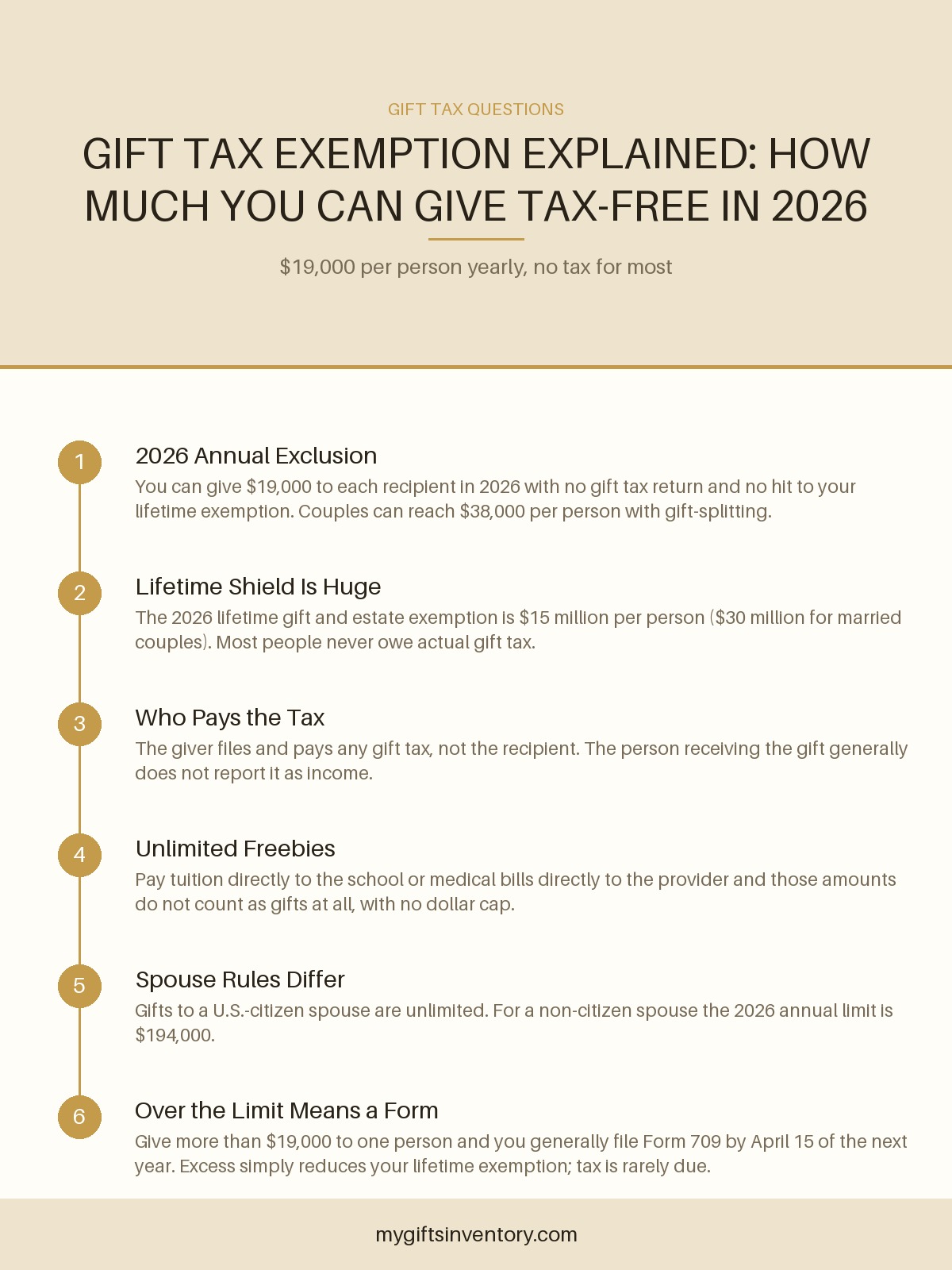
Two different numbers matter. The first is the annual gift tax exclusion: the amount you can give one person in a single calendar year without filing a gift tax return or touching your lifetime exemption. For both 2025 and 2026 that figure is $19,000 per recipient per donor.
The second is the lifetime gift and estate tax exemption (sometimes called the basic exclusion amount). For 2026 it is $15 million per individual. Married couples can effectively shield up to $30 million when portability and proper elections are in place. Only after you use up that lifetime amount through taxable gifts (amounts above the annual exclusion) would actual gift tax at the top rate of 40% come into play. Very few households ever reach it.
The annual exclusion is “use it or lose it.” It resets every January 1 and unused portions do not carry forward. There is no limit on how many different people you can give $19,000 to in the same year. Give $19,000 to your daughter, $19,000 to your son, $19,000 to a close friend, and none of it requires Form 709 or reduces the $15 million lifetime shield.
How Much Married Couples Can Give
Each spouse has their own $19,000 annual exclusion. Together you can move $38,000 to the same recipient in 2026 if you each write a separate check or transfer, or if you elect gift-splitting on Form 709. Gift-splitting treats gifts made by one spouse as made half by each, but both usually need to consent and file. Keep clean records either way.
Gifts to a U.S.-citizen spouse are generally unlimited thanks to the marital deduction. No annual cap, no Form 709 in most straightforward cases. If your spouse is not a U.S. citizen, the special annual exclusion for 2026 is $194,000 (up from $190,000 in 2025). Track transfers carefully if you are retitling a house or moving large sums.
What Counts as a Gift (and What Does Not)
The IRS views a gift as any transfer of money or property for less than full and adequate consideration. Cash, stocks, a car, jewelry, real estate interest, forgiving a debt, or even a below-market loan can all qualify. Fair market value is what matters, not what you paid years ago.
Several important categories sit completely outside the gift tax rules:
- Tuition paid directly to an educational institution (room and board usually does not qualify the same way).
- Medical expenses paid directly to the provider or insurer.
- Gifts to political organizations and certain qualified charities (those are handled under different deduction rules).
- Most transfers to a U.S.-citizen spouse.
Write the tuition check to the college, not to your grandchild, and it never touches the $19,000 limit. Same idea with hospital bills. That flexibility is one of the cleanest ways grandparents help without creating paperwork.
Everyday presents almost never trigger anything. A birthday dinner, holiday wrapping paper full of thoughtful picks under $50, or even a nicer splurge in the $50–$150 range stays well under the radar. When you want ideas that feel special without approaching tax thresholds, our roundup of splurge-worthy gifts between $50 and $150 keeps things practical and fun.
When You Need to File Form 709
Cross the $19,000 annual exclusion to any one person (other than a qualifying spouse) and you generally file Form 709, the United States Gift (and Generation-Skipping Transfer) Tax Return. The form is due by April 15 of the year after the gift, the same calendar as your income tax return. An extension for your Form 1040 usually covers Form 709 too.
Filing does not mean you owe tax. The amount over $19,000 simply reduces your remaining lifetime exemption. You only write a check to the IRS once cumulative taxable gifts exceed the lifetime figure. Keep copies of the return and supporting valuations; adequate disclosure starts the statute of limitations running.
Future interests (gifts the recipient cannot enjoy right away) usually require a return even if the value is under $19,000. Present-interest gifts that stay under the annual exclusion usually do not.
Real-World Scenarios We See All the Time
Helping with a house or big life milestone
Parents or grandparents often want to contribute toward a down payment or wedding. One person can give $19,000. A married couple can give $38,000. Want to do more in the same year? The excess is reported on Form 709 and chips away at the lifetime exemption, but no tax is due for most families. Spread gifts across calendar years or involve both sets of grandparents to stay under annual limits if that feels simpler.
Luxury or high-value presents
A watch, designer bag, or piece of jewelry over $19,000 to one recipient triggers the filing requirement for the giver. If you are shopping in that range, our guide to luxury gifts worth the splurge can help you choose something memorable while you decide how to structure the transfer. Cash or a check for the same amount works the same way for tax purposes.
Multiple smaller gifts to the same person
Birthday, holiday, and random “just because” gifts all count toward the $19,000 total for that recipient in the calendar year. Track the running total if you are generous throughout the year. A stack of thoughtful under-$30 or under-$50 presents rarely adds up to a problem, but a few larger ones can.
Corporate or client gifting
Business gifts follow additional deduction limits on the company side, separate from personal gift tax rules. Keep personal and business gifts distinct. For team or client ideas that stay modest and professional, see our corporate gift ideas under $50.
529 college savings plans
Contributions to a 529 count as gifts, but you can elect to spread a larger contribution over five years for annual exclusion purposes (up to five times the annual amount in one year, subject to the rules). Direct tuition payments remain the cleanest unlimited route.
Practical Ways to Stay Comfortably Under the Limits
Most gift-giving never comes close to $19,000 per person. Focus on thoughtfulness instead of dollar amount. A well-chosen experience, a personalized item, or a carefully curated basket often lands better than a large check anyway. When you want inspiration that stays firmly in safe territory, browse thoughtful gifts under $30 or our broader guide to choosing the perfect gift for any person and occasion.
If you do plan larger transfers:
- Write separate checks from each spouse when aiming for the combined $38,000.
- Pay schools and medical providers directly whenever possible.
- Document fair market value for non-cash gifts (appraisals for real estate, art, or closely held business interests).
- Keep a simple spreadsheet of gifts to each recipient by year.
- File Form 709 on time even if no tax is due; it protects everyone later.
State rules can differ. A handful of states have their own estate or inheritance taxes with lower thresholds. Gift tax itself is primarily federal, but large transfers can still affect state estate planning. Local advice helps if you live in a high-tax state or own property across state lines.
Common Myths That Cause Unnecessary Worry
“If I give more than $19,000 the recipient has to pay tax.” No. The donor is responsible for any gift tax and for filing.
“The gift counts as income to the person who receives it.” Generally no. Gifts are not taxable income to the recipient under federal rules.
“I have to report every birthday present.” Only if the total to that person exceeds the annual exclusion (or other filing triggers apply).
“The lifetime exemption is about to disappear so I must give everything now.” The higher exemption amounts were made more durable by recent legislation and continue to adjust with inflation, though future Congresses can always change tax law. Planning still matters, but panic gifting rarely does.
For the vast majority of us, the gift tax exemption simply means we can be generous with family and friends year after year without paperwork or tax bills. Stay under $19,000 per person when you want zero friction, use the unlimited education and medical payment routes when they fit, and treat anything larger as a planning conversation with your advisor rather than a crisis.
Give the gift, enjoy the moment, and keep a light paper trail. That combination covers almost every real-world situation we run into.
Frequently Asked Questions
What is the gift tax exclusion amount for 2026?
The annual gift tax exclusion for 2026 is $19,000 per recipient per donor, the same as 2025. A married couple can give up to $38,000 to the same person using both exclusions or gift-splitting. Gifts at or below that amount require no Form 709 and do not reduce your lifetime exemption.
Do I have to pay tax if I give someone more than $19,000?
Usually no. You file Form 709 to report the excess, and that excess reduces your remaining lifetime gift and estate tax exemption ($15 million per person in 2026). Actual gift tax is owed only after you exhaust the lifetime amount. Most people never reach that point.
Does the person receiving the gift have to report it or pay tax?
No. The recipient generally does not include a gift in taxable income and does not pay the gift tax. The donor is responsible for any filing and any tax that might eventually apply.
Are there gifts that never count against the annual exclusion?
Yes. Tuition paid directly to a qualified educational institution and medical expenses paid directly to the provider do not count as gifts at all, with no dollar limit. Gifts to a U.S.-citizen spouse are also generally unlimited. Charitable gifts follow separate rules.
Can I give $19,000 to as many people as I want in one year?
Yes. The $19,000 annual exclusion applies per recipient. You can give that amount to your children, grandchildren, friends, and anyone else without filing or using lifetime exemption, as long as each individual stays at or under the limit.
