Are October Prime Day Deals Good for Holiday Gifts? What to Buy Now vs. Wait for Black Friday
October Prime Day can genuinely save you money on holiday gifts, but only for the right categories. Here is what to buy now, what to hold for Black Friday, and how to avoid the traps.
As an Amazon Associate, My Gifts Inventory earns from qualifying purchases. We only recommend products we'd genuinely consider buying ourselves.
It is mid-October, your phone is full of Prime Day banners, and somewhere in the back of your mind a small voice is asking whether buying holiday gifts right now makes you smart or makes you a sucker. Both feelings are reasonable. The honest answer is that October Prime Day is a genuinely good gift-buying window for some categories and a waste of money for others, and the difference comes down to what you are buying, who you are buying for, and how much you care about getting the absolute lowest price.
We have bought gifts in both windows and regretted both kinds of purchases. Here is how we think through it now.
What October Prime Day Actually Is
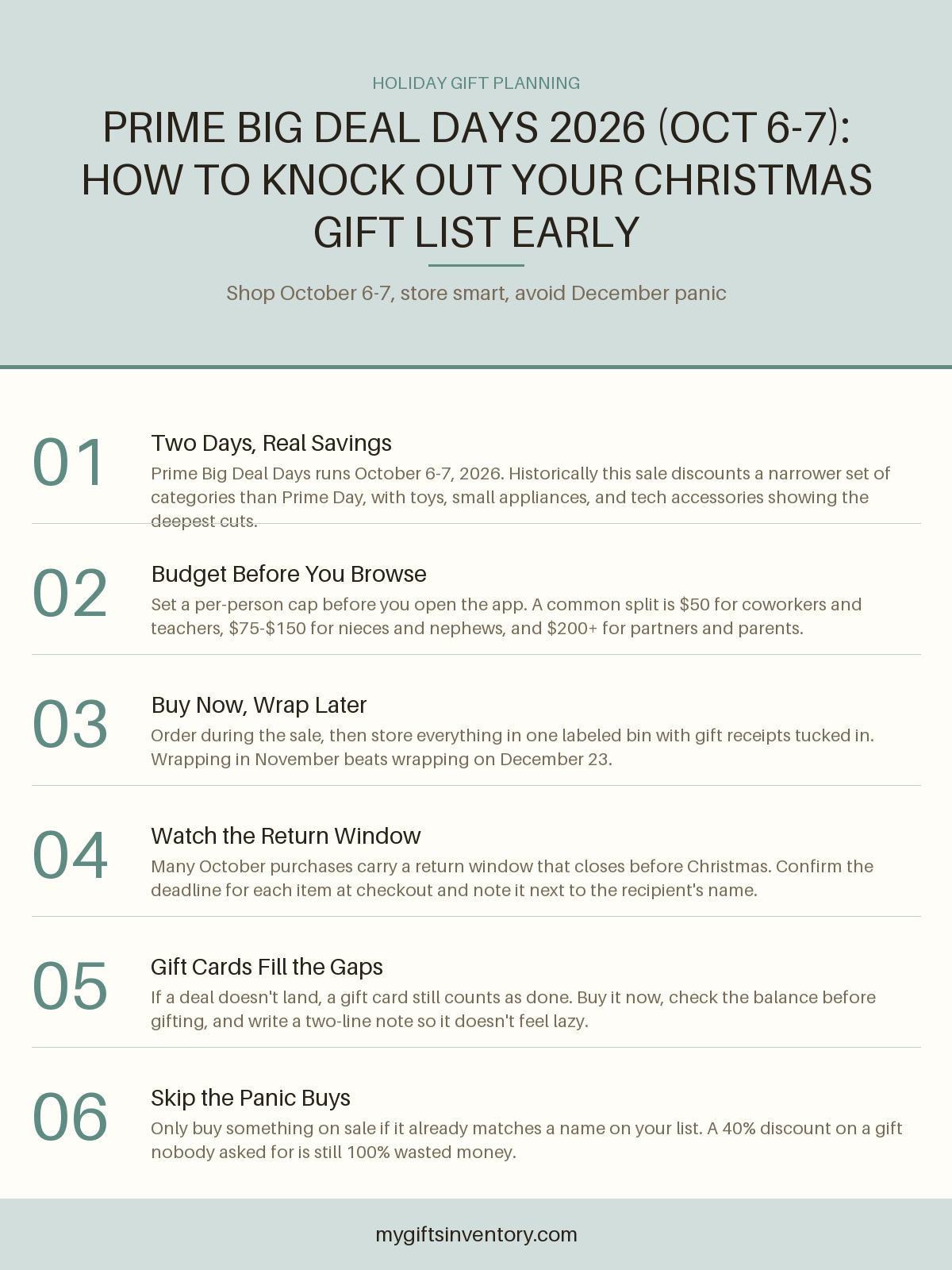
October Prime Day is Amazon's second big Prime-exclusive sale event of the year, typically running two days in early-to-mid October. Other major retailers run competing sales during the same window, which is the part most people miss. Target, Walmart, and Best Buy all tend to price-match or undercut the event with their own promotions, so the practical advice is not "shop Amazon on Tuesday," it is "shop the October sales period across several retailers and compare."
The important thing for gift-buyers is that October Prime Day is a clearance and inventory-clearing event as much as a discount event. Retailers are making room for holiday stock. That means the deals cluster in predictable places: last-generation electronics, overstocked toys, small home goods, and Amazon's own house brands. It also means some of what you see is not actually a discount, just a normal price with a red slash graphic next to it.
What to Buy Now During October Prime Day
Electronics and tech accessories
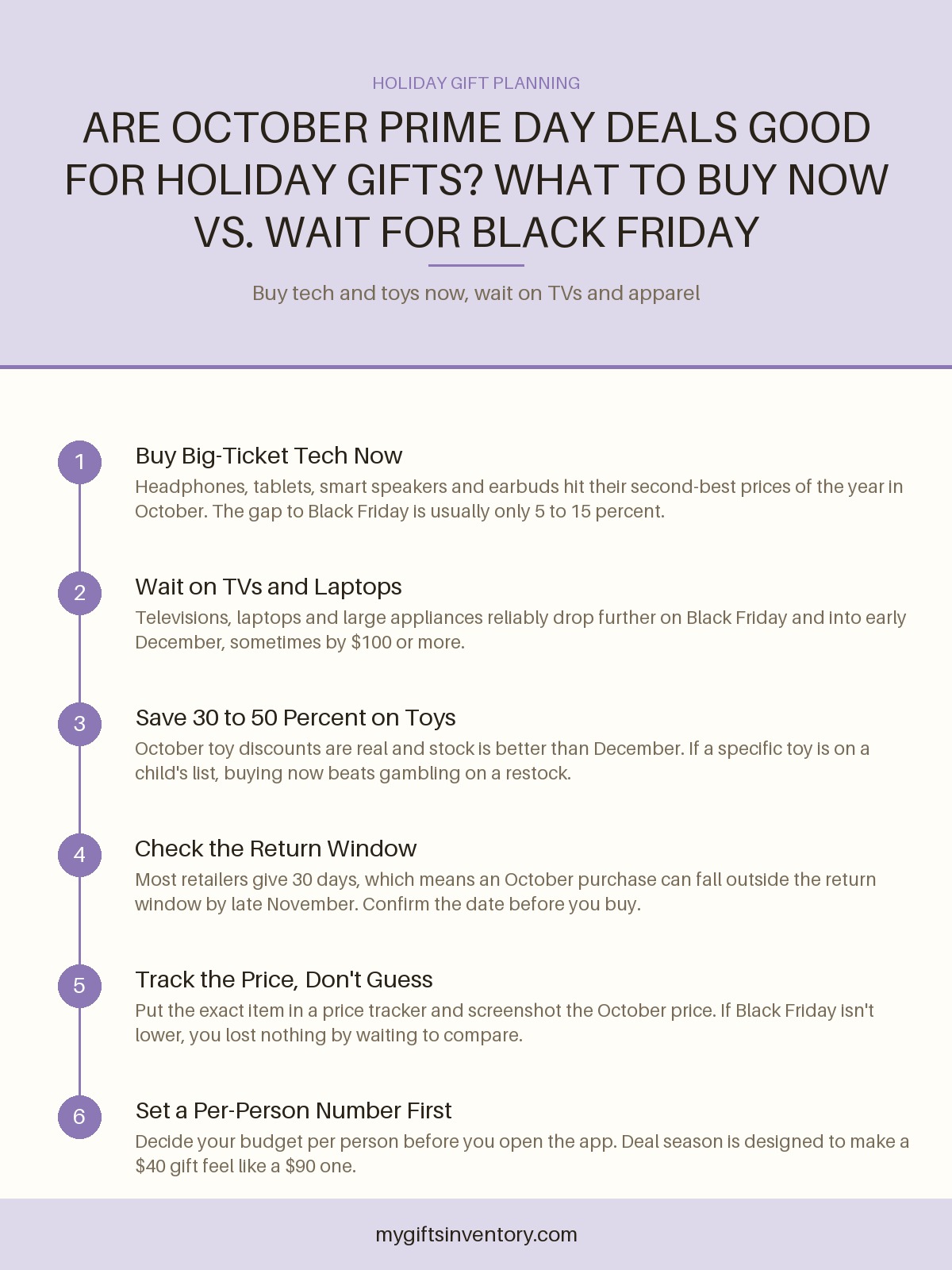
This is where October Prime Day earns its reputation. Headphones, earbuds, tablets, smart speakers, streaming sticks, fitness trackers, and charging accessories all see real discounts in October, and the gap between October pricing and Black Friday pricing on these items is usually small, often 5 to 15 percent. If you are buying a $60 pair of earbuds for a teenager, waiting five weeks to save maybe $6 is not a good trade for the risk that the exact color sells out.
If your list is heavy on tech, our home tech gadgets for him guide is worth skimming before you buy, mostly because it separates the genuinely useful desk toys from the ones that get used twice and then live in a drawer.
Toys, especially specific requests
Toy discounts in October commonly run 25 to 40 percent off, and occasionally 50 percent on overstocked items. The bigger advantage is not the price, though. It is availability. If a six-year-old has asked for one specific building set, October is when it is in stock in every color and every variant. By the second week of December, that same set is either sold out or marked up by third-party sellers.
We have watched this happen enough times to stop treating Black Friday as the automatic default for toys. If the child is specific about what they want, buy it when you see it. If they gave you a vague list and would be happy with anything in a category, you can afford to wait. For broader ideas in that lane, our gifts for 6 year old boys roundup is a decent starting point for spotting what is actually being asked for this year.
Small home goods and cozy items
Blankets, candles, mugs, kitchen gadgets, and throw pillows are classic October sale fodder. These are also the backbone of gift exchanges, teacher gifts, and the "something small for the neighbor" category. Discounts here run 20 to 35 percent, and the items are not going to get dramatically cheaper later because the margins were never that big to begin with. Buy them now and get them out of your head.
Our cozy winter comfort gifts under $75 guide is mostly useful for calibrating what a good blanket or throw actually costs, so you can tell a real October discount from a fake one.
Beauty, fragrance, and personal care sets
Fragrance and skincare gift sets show up in October sales more than people expect, usually as multi-piece sets rather than single bottles. The per-item value is genuinely better than buying the pieces separately, and these rarely go lower than about 30 percent off. If someone on your list has a signature scent they never deviate from, October is fine. If you are choosing a scent for someone else, buy from a retailer with a generous return policy and read our fragrance gift ideas piece first, because scent is the single hardest gift category to guess correctly.
What to Wait On Until Black Friday
Televisions and large electronics
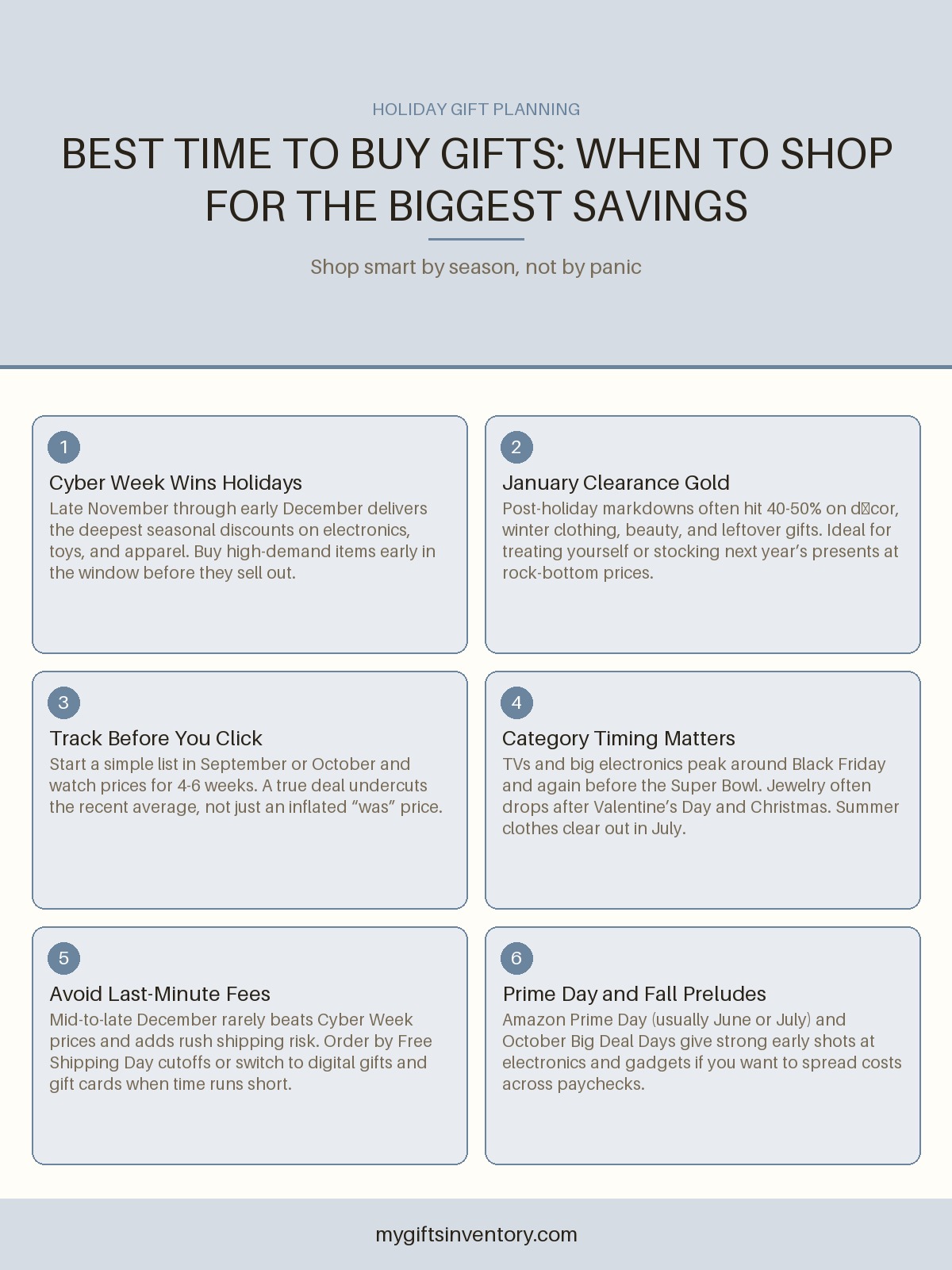
Televisions are the clearest wait. Black Friday television pricing is a loss leader for retailers, which means it is deliberately unprofitable and deliberately lower than anything they will offer in October. A 55-inch TV that is $80 off in October is routinely $150 to $250 off on Black Friday. Same logic applies to laptops, large monitors, and major appliances.
Brand-name apparel and footwear
October clothing discounts are usually 20 to 30 percent. Black Friday and Cyber Monday apparel discounts run 40 to 60 percent, and post-holiday clearance in January goes deeper still. Unless you need a specific size before it sells out, wait. The exception is anything that functions as a gift with a deadline, like a winter coat someone will wear in December.
Premium kitchen and home appliances
Stand mixers, espresso machines, air fryers, and robot vacuums all see their real annual lows in November, not October. The October discounts on these tend to be modest, and the Black Friday discounts tend to be the ones people screenshot and text to their siblings.
Subscription and membership gifts
Streaming bundles, membership deals, and software subscriptions often run their best promotions around Black Friday and into January. There is no advantage to buying these in October.
The Return Window Problem Nobody Warns You About
This is the single most overlooked issue with buying gifts in October, and it has nothing to do with price.
Most retailers offer a 30-day return window. If you buy a gift on October 10, that window closes around November 9. You will not have given the gift yet. You will not know whether it fits, whether they already own it, or whether it works. And many retailers suspend their normal return policy during the holidays anyway, replacing it with an extended window that starts in November, which means an October purchase can actually land in the worst possible spot: past the standard window and before the holiday extension kicks in.
Before you check out, do three things. Confirm the exact return deadline in writing. Ask whether the retailer offers a holiday extension and what the qualifying purchase dates are. And keep the gift receipt separate from the gift, because a $70 item that cannot be returned is a $70 loss, which erases any discount you got.
If you are buying something where fit, taste, or compatibility matters, this alone can be a reason to wait until mid-November.
How to Decide, Item by Item
We use a short set of questions on every gift during deal season. It takes about ten seconds per item and has saved us real money.
- Is it a specific request? Buy it now if you find a real discount. Availability beats price on specific requests.
- Is it a large electronics purchase over $300? Wait for Black Friday almost every time.
- Is it small, replaceable, and unlikely to be returned? Buy now. The mental space you free up is worth more than the extra $4.
- Does the person need it before mid-December? Buy now, and note the return deadline.
- Is the "discount" less than 15 percent? Ignore it and keep looking. That is not a deal, that is marketing.
Sticking to Your Budget When Deals Are Everywhere
Deal events are engineered to make you spend more, not less. The discount is real, but the number of things you buy goes up, and the total often exceeds what you would have spent at full price on fewer, better-chosen gifts.
Before you open any shopping app this month, write down a per-person number. Something like $50 for each coworker, $100 for each sibling, $200 for a partner. Then write the actual gift next to the number. If the item you are looking at is not on the list, it does not get bought, no matter how good the price is. Our holiday gifts under $50 guide is built around that exact constraint and is a good reality check on what $50 actually buys.
One more budgeting note: October is early enough that you can spread purchases across two or three pay cycles instead of putting everything on one November credit card statement. For a lot of people, that is the real benefit of shopping now, more than the discount itself.
Practical Logistics If You Buy Early
Buying in October creates a storage problem and a remembering problem. Both are solvable.
Keep a running list, in a notes app or on paper, with three columns: who, what, and where it is hidden. The third column matters more than people expect. Every year someone buys the perfect gift in October and finds it in a closet in January.
Keep gift receipts in a single envelope or a labeled zipper pouch, not loose in a drawer. If you buy from three retailers, keep three separate stacks so you are not sorting through them in December.
If you buy anything that needs batteries, buy the batteries in the same trip. A toy that requires four AA batteries and arrives without them on Christmas morning is a small tragedy you can prevent for $8.
And if you buy gift cards during the October sales, which can be a smart move because some retailers discount them or bundle them with bonus credit, photograph the card number and keep the receipt. Balances get lost, cards get misplaced, and having the number on your phone turns a crisis into a five-minute fix. If you ever need to look one up, our guides walk through the process for brands like Netflix and PlayStation Store, and the general steps apply to most major retailers.
The Short Version
October Prime Day is a good holiday gift window for tech accessories, toys with specific requests, small home goods, and beauty sets. It is a bad window for televisions, laptops, apparel, premium appliances, and subscriptions. Buy early when availability matters or when the item is small and unlikely to be returned. Wait when the price gap is large or when the recipient might need to exchange it. And whatever you buy, know your return deadline before you click.
Frequently Asked Questions
Are October Prime Day deals actually cheaper than Black Friday?
For some categories, yes, or close enough that the difference does not matter. Tech accessories, toys, and small home goods are often within 5 to 15 percent of their Black Friday price in October. Televisions, laptops, major appliances, and apparel are reliably cheaper on Black Friday, sometimes by 30 percent or more.
Should I buy all my holiday gifts in October to avoid the December rush?
Buy the categories that peak in October and let the rest wait. Buying everything early sounds efficient but creates two problems: you may overpay on items that drop further in November, and you push your purchase outside the return window well before you actually give the gift.
What if the price drops after I buy in October?
Check whether the retailer offers a price adjustment policy, which typically gives you 14 to 30 days to claim the difference if the price falls. Amazon and most major retailers have some version of this. Take a screenshot of the price you paid and watch the item for two to three weeks.
Is it rude to give a gift that was bought on sale?
No. Nobody receiving a gift cares what you paid for it, and the people who genuinely love you would be pleased that you got a good deal. What matters is that the gift suits them, not that it was purchased at full price.
How do I keep from overspending during October sales?
Set a per-person dollar amount before you look at any deals, and write the specific gift next to each name. Anything not on that list does not get bought regardless of the discount. Deal events are designed to increase how much you buy, not just how little you pay per item.
Should I buy gift cards during Prime Day sales?
Sometimes. Retailers occasionally discount gift cards or add bonus credit during major sale events, which is a real discount on money you were going to spend anyway. Buy them only for stores the recipient actually shops at, and photograph the card number and keep the receipt somewhere you will find it later.
Looking for an Actual Gift Instead?


More Gift Advice