Baby Shower Gift Etiquette: What to Give, How Much to Spend, and When
A clear guide to baby shower gift etiquette, from budget ranges by relationship to registry rules, card wording, and what to do if you can't attend.
As an Amazon Associate, My Gifts Inventory earns from qualifying purchases. We only recommend products we'd genuinely consider buying ourselves.
You got the invitation, or maybe you heard about the shower through a group text, and now you're staring at a registry with ninety items on it wondering how much you're actually supposed to spend. Or maybe you can't make the date and you're not sure if that means you're off the hook for a gift entirely. Baby shower etiquette has more gray area than most people admit, mostly because the "rules" vary so much by region, family, and generation. Here's what actually holds up across most situations.
Do You Have to Bring a Gift If You're Invited?
Yes, this one is close to non-negotiable. A baby shower invitation, unlike a lot of other party invites, comes with an understood gift expectation baked in. If you're invited and you attend, you bring something, even if it's modest. If you're invited and genuinely can't attend, the polite move is still to send a gift, either mailed ahead of time or dropped off with a mutual friend who's going.
Where the expectation loosens is if you weren't invited at all. Hearing about a shower secondhand, through social media or a group chat that wasn't meant for you, does not create an obligation. Some people send a small gift anyway once the baby arrives, but that's generosity, not etiquette.
What About Second (or Third) Baby Showers?
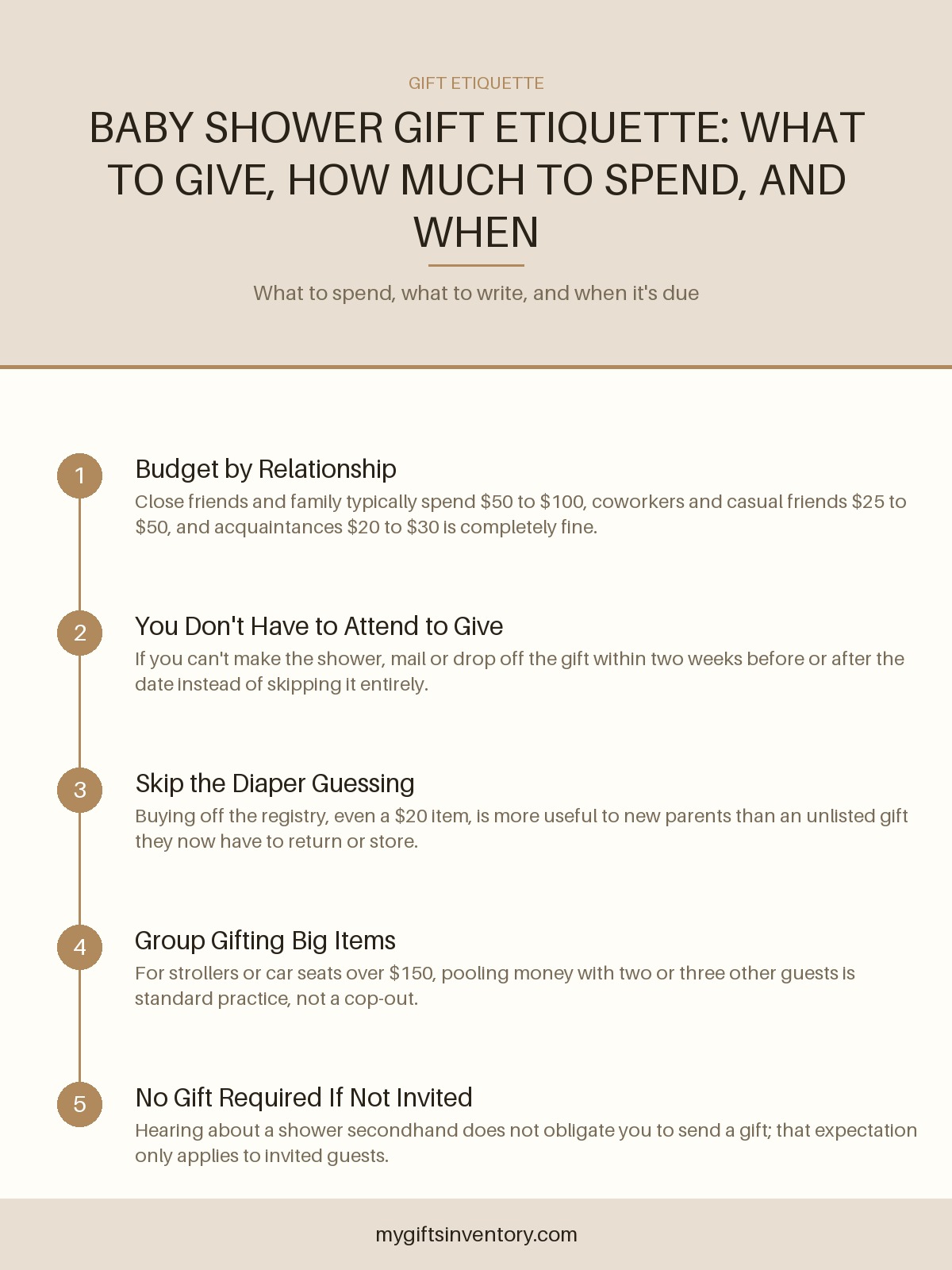
This is where things get genuinely touchy. Traditional etiquette says showers are for first babies, since that's when parents are building a nursery from zero. For a second child, a "sprinkle" is more appropriate: a smaller, lower-key gathering with modest gifts, often focused on items the family actually needs new, like diapers in a bigger size or clothes for a different season. If you're invited to a sprinkle, scaling your gift down to $15-$30 is completely appropriate and expected, not stingy.
How Much Should You Actually Spend?
This is the question everyone actually wants answered, so here are real numbers rather than vague ranges.
Close Friends and Family
For a sister, best friend, daughter, or daughter-in-law, most people land somewhere between $50 and $100. If you're the host or a grandparent-to-be, spending more on a bigger registry item is common and nobody blinks.
Coworkers and Casual Friends
For someone you like but aren't especially close to, $25 to $50 is the standard range. Office showers often solve this with a collective card and small pooled gift from the whole team, which spares everyone the awkward math.
Acquaintances and Plus-Ones
If you're attending because you're someone's partner or you got looped in through a broader friend group, $20 to $30 covers you. A gift card in this range, or a well-chosen item off the registry's lower-price section, both work fine.
Group Gifts for Big-Ticket Items
Strollers, car seats, and bassinets often sit at $150 to $400 on registries, and pooling money for these is standard practice, not a workaround. Someone usually organizes it through a shared link or simply collects Venmo contributions, then buys the item as one combined gift with everyone's names on the card. It's genuinely one of the more useful things a group of guests can do, since it solves a big expense in one move instead of the parents piecing it together from five smaller gifts.
Registry Etiquette: How Closely Do You Need to Follow It
Registries exist because new parents are tired of guessing games and duplicate onesies, so treating the registry as a strong suggestion rather than a rough theme is the respectful approach. That said, a few nuances come up constantly:
- Buying off-registry is fine in small doses. A handmade blanket, a book with a sentimental inscription, or something tied to your specific relationship with the parents adds warmth. Just don't make it your only gift if the parents clearly need bigger items.
- Don't assume something's already covered. Many registries update in real time and mark items as purchased, so check right before you buy rather than trusting a screenshot from two weeks ago.
- Gift cards are not a lesser gift. Since most registries live on sites like Target or Amazon, a gift card to Target or Amazon lets parents fill in whatever they still need after the shower, including things that sell out or that they realize they want more of after the baby arrives, like a second set of crib sheets.
If you want to step outside the registry entirely and give something for the parent instead of the baby, that's a whole category worth considering too. New parents rarely get gifts aimed at them once the shower turns into "everything is about the baby," so something like a thoughtful pick from a coffee lovers gift guide for the exhausted-but-caffeinated months ahead, or a small self-care item from a perfume gift guide, tends to land better than another burp cloth.
Timing: When to Actually Give the Gift
Most people bring the gift to the shower itself, but there are a few situations where a different timeline makes more sense.
- If you're attending: bring it wrapped, to the shower. Simple as that.
- If you can't attend but were invited: mail it so it arrives within a week or two of the shower date, or hand it to the host beforehand to bring on your behalf.
- If the baby arrives before the shower happens (it happens more than people expect, especially with later showers): the gift is still appropriate to give at the shower as planned, though some guests also send a small separate congratulations gift right after birth.
- If you missed the window entirely: a gift is still welcome up to about three months after the baby is born. After that, it starts to feel more like a random gesture than a shower gift, which is fine too, just reframe it as a "welcome to the world" gift rather than trying to retroactively cover the shower.
What to Write in the Card
Baby shower cards don't need to be poetic. They need to be warm and specific enough that they don't read like a form letter. A few real examples by tone:
Simple and warm: "Wishing you all the sleep you can get and a baby who agrees to nap on schedule. So excited to meet this little one."
For a close friend: "I've watched you get ready for this for months and it's going to be so good. Call me the second you need anything, day or night. Can't wait to spoil this kid."
For a coworker or acquaintance: "Congratulations to you both. Wishing you a smooth delivery and a happy, healthy baby."
For a second or third baby: "This one is lucky to have siblings already showing them the ropes. Congratulations on your growing family."
If you're stuck, naming one specific quality about the parents-to-be, patience, humor, how ready they seem, does more than any generic line about "bundles of joy."
Gift Opening, Diaper Raffles, and Other Shower Traditions
Whether gifts get opened at the shower depends heavily on the host and the region, so it's worth checking the invitation or asking a mutual friend rather than assuming. Some showers still do the classic gift-opening-in-front-of-everyone routine, where the mom-to-be unwraps each gift while a "helper" tracks who gave what for thank-you notes later. Others have moved away from this, especially at larger showers, since it can eat up an hour and put a lot of pressure on the guest of honor to react enthusiastically to forty gifts in a row.
Diaper raffles have become common too: guests bring a pack of diapers in exchange for a raffle ticket, and a small prize gets drawn at the end. If a diaper raffle is mentioned on the invite, bringing diapers is a nice add-on to your main gift, not a replacement for it.
If your shower does involve gift-opening, keep your wrapping reasonably easy to get into. A parent unwrapping their fifteenth gift does not want to fight tape for two minutes while everyone watches. A gift bag with tissue paper is often the most practical choice for exactly this reason.
Returns and Exchanges: How to Handle It Gracefully
New parents end up with duplicates and wrong sizes constantly, and this is completely normal, not a reflection on your gift choice. If you gave something off-registry, including a receipt or gift note with where it was purchased makes a return painless if it turns out they already have two of the same swaddle blanket. Registries themselves are built for this too, most track what's been purchased specifically so returns and exchanges go smoothly without anyone needing to explain themselves.
If you're the one who received a duplicate gift as a parent, you're not obligated to keep it or pretend to love it forever. A simple "thank you so much, we ended up with two so I'm going to exchange this one for a bigger size" is completely fine to say if it comes up, and most gift-givers would rather you use something than let it sit in a closet out of guilt.
Gift Ideas to Go With This


Want more ideas? Browse our full guide: 20 Best Gifts Under $100 (2026): Thoughtful Picks They'll Actually Use
Frequently Asked Questions
Is it rude to not bring a gift to a baby shower you're attending?
Yes, attending a baby shower without a gift is considered a genuine etiquette breach in most social circles, since the event's entire purpose is to help outfit the new baby. If money is genuinely tight, a small $15-$20 registry item or a handwritten card with a heartfelt note still counts and is far better received than showing up empty-handed.
How much should a coworker spend on a baby shower gift?
Most coworkers spend between $25 and $50 on an individual gift, though many offices solve this by pooling money as a team for one shared gift and card instead. If your office does a group gift, contributing whatever amount is comfortable, even $10 or $15, is perfectly acceptable.
Can you just give cash instead of a gift?
Cash is increasingly accepted, especially from close family, and many registries now include a cash fund for things like a college savings account or larger nursery purchases. For friends and coworkers, a gift card tends to feel slightly more personal than plain cash, though neither is considered impolite anymore.
What if you can't afford anything on the registry?
Registries almost always include a range of prices specifically so guests at every budget can participate, so look for the $15-$25 items rather than assuming everything is expensive. If nothing fits your budget, a handmade item, a book for the baby with a personal inscription, or simply a generous, specific card is a completely acceptable substitute.
Do you need to send a thank-you note if you give a gift at the shower in person?
Giving a gift in person does not exempt the parents from sending a thank-you note, and most etiquette guides still recommend one within two to three months of the shower given how overwhelming the newborn period gets. As the gift-giver, you're not owed anything and shouldn't feel slighted if it takes a while, new parents are working with very little sleep.
Looking for an Actual Gift Instead?


Gift Sets We Love Right Now
Every item picked, priced and linked, ready to buy.
More Gift Advice