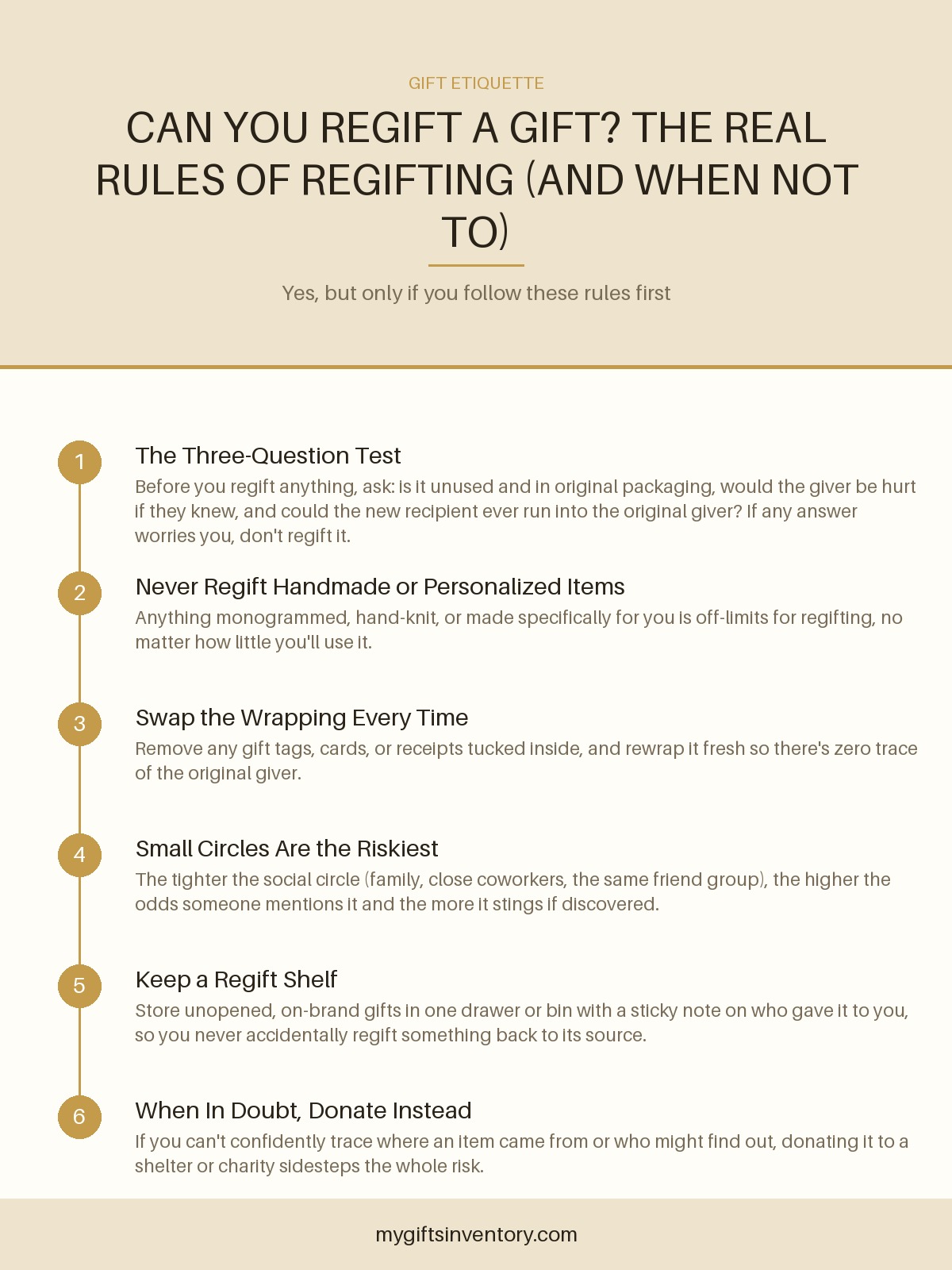
Host Gift Etiquette: What to Bring, How Much to Spend, and When to Give It
A practical guide to host gift etiquette, covering what to bring for a dinner party versus a weekend stay, realistic budgets, timing, and what to say when you hand it over.

As an Amazon Associate, My Gifts Inventory earns from qualifying purchases. We only recommend products we'd genuinely consider buying ourselves.
You're standing in a store aisle twenty minutes before you're supposed to be at someone's house, trying to figure out if showing up empty-handed makes you a bad guest, or if bringing something makes you look like you're overcompensating. Maybe it's a casual Tuesday dinner with friends, maybe it's a weekend stay at your in-laws' lake house, and the etiquette feels different every time because it actually is different every time. There's no single rule that covers "friend's apartment for takeout" and "cousin's beach house for four nights," so let's go through the real distinctions.
Do You Always Need to Bring a Host Gift?
Not every single time, but close to it. If someone is opening their home to you, cooking for you, or housing you overnight, showing up with something in hand is the safer default. The exceptions are the truly casual, no-fuss situations: a spontaneous "come over, we're ordering pizza" invite, a standing weekly dinner with the same close friends where nobody brings anything anymore, or a potluck where you're already contributing food or drink as your part of the deal. In those cases, a host gift on top of your dish can actually feel like overkill.
Where it stops being optional is overnight stays, holiday gatherings, dinner parties that clearly took planning and effort, and any situation where someone is hosting you at real personal cost, whether that's their time, their space, or their grocery bill. The general instinct to bring "a little something" is right. The question is usually how much and what.
Budget by Occasion
Host gifts don't need a formula, but having rough ranges in mind stops the aisle paralysis.
Casual Dinner or Weeknight Visit
For a low-key dinner at a friend's place, somewhere between $10 and $20 is the sweet spot. A decent bottle of wine, a small box of good chocolate, or a bunch of flowers all land in this range without feeling like you're trying too hard for a Tuesday.
Dinner Parties and Weekend Gatherings
When someone has clearly put effort into a multi-course meal, a table setting, or a themed gathering, $15 to $30 is appropriate. This is a good range for something a little more considered than a grocery store bottle, maybe a specialty item or something tied to their actual tastes. If your host is the type who has a coffee ritual every morning, a nice bag of beans or a specialty blend from our gift ideas for coffee lovers under $50 guide reads as thoughtful rather than generic.
Overnight and Weekend Stays
Staying under someone's roof for one or two nights calls for $25 to $50, and this is one of the few host gift situations where a gesture can matter more than an object. Treating your host to dinner out one night, handling the grocery run for a meal you're all sharing, or leaving a thoughtful item alongside a genuinely useful one all count. For longer stays, four or five nights or more, $50 to $100 or an equivalent contribution (stocking the fridge, covering a activity for everyone) is more fitting, since you're using real household resources the whole time.
Holiday Gatherings and Recurring Hosts
If the same person hosts Thanksgiving or a holiday party year after year, $20 to $40 is a comfortable range, and it's worth rotating what you bring so it doesn't become the exact same bottle every November. For hosts who genuinely seem to have everything already, and many longtime hosts do, our gift ideas for the person who has everything guide is a useful place to look for something a little less predictable than another candle.
What to Actually Bring
The safest host gifts fall into two categories: things the host consumes and enjoys without any obligation, or things that are useful without requiring display space. Wine, coffee, tea, specialty snacks, a small box of pastries, or a candle all fit the first category. A nice set of cocktail napkins, a small kitchen item, or something for their home falls into the second, and our home decor gifts under $50 guide has options in that lane if you know the host's style.
Flowers are a classic host gift, but they come with a small etiquette trap: if you hand over an unarranged bouquet during a dinner party, your host now has to stop what they're doing, find a vase, trim stems, and arrange them while also managing a meal. If you want to bring flowers, either have them pre-arranged in a jar or small vase, or send them the day before or after instead of at the door.
Food gifts are lovely as long as they don't imply your host is now responsible for serving them that night. A box of chocolates for later, a jar of good jam, or a bag of coffee for the next morning works. A pie you expect to be cut and served at dinner does not, unless you've asked ahead.
Gift cards are a fine option when you genuinely don't know a host well, say a coworker's holiday party or a new in-law's first dinner, though they read as slightly more transactional than a chosen item. If you go this route, something specific to something you know they enjoy lands better than a generic card. A Target gift card works for a host who's always redecorating something, and an Amazon gift card covers almost anyone when you're truly stuck.
When to Give It
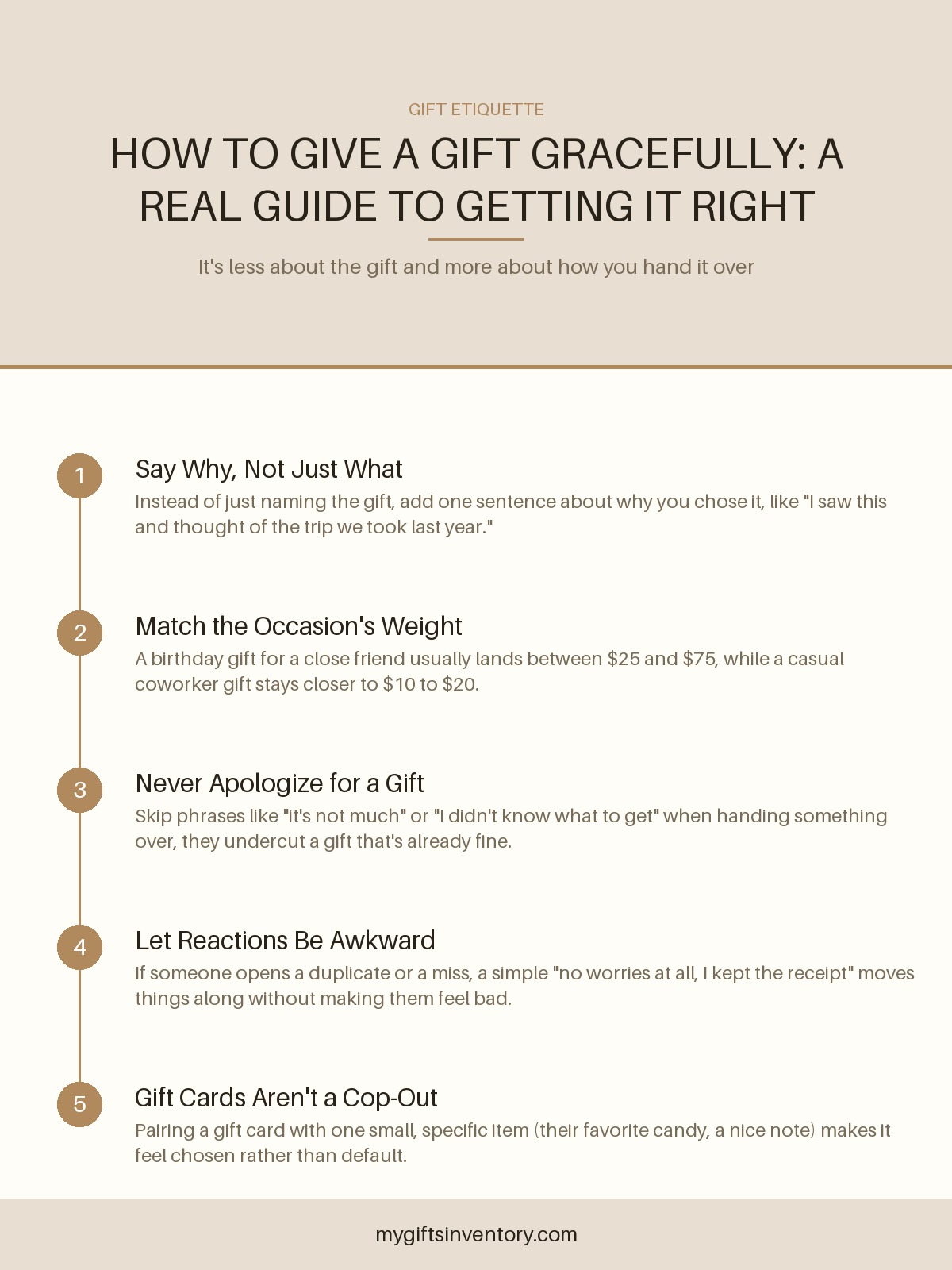
Hand the gift directly to your host, in person, early in the visit, not left on a table by the door where it might not even register as yours. A simple line does the job: "This is for you, thank you so much for having us." For a dinner party, this typically happens in the first few minutes, right after greetings and before you're pulled into conversation or seated. For an overnight stay, some people prefer to give something small at arrival and save a slightly bigger gesture, like treating everyone to dinner out, for partway through the stay once you've settled in.
If you're bringing something the host will need to actively deal with, like flowers needing water or a dessert needing refrigeration, it can actually help to drop it off earlier in the day or the day before, so it's one less thing competing for their attention during the event itself.
What to Say (or Write) When You Give It
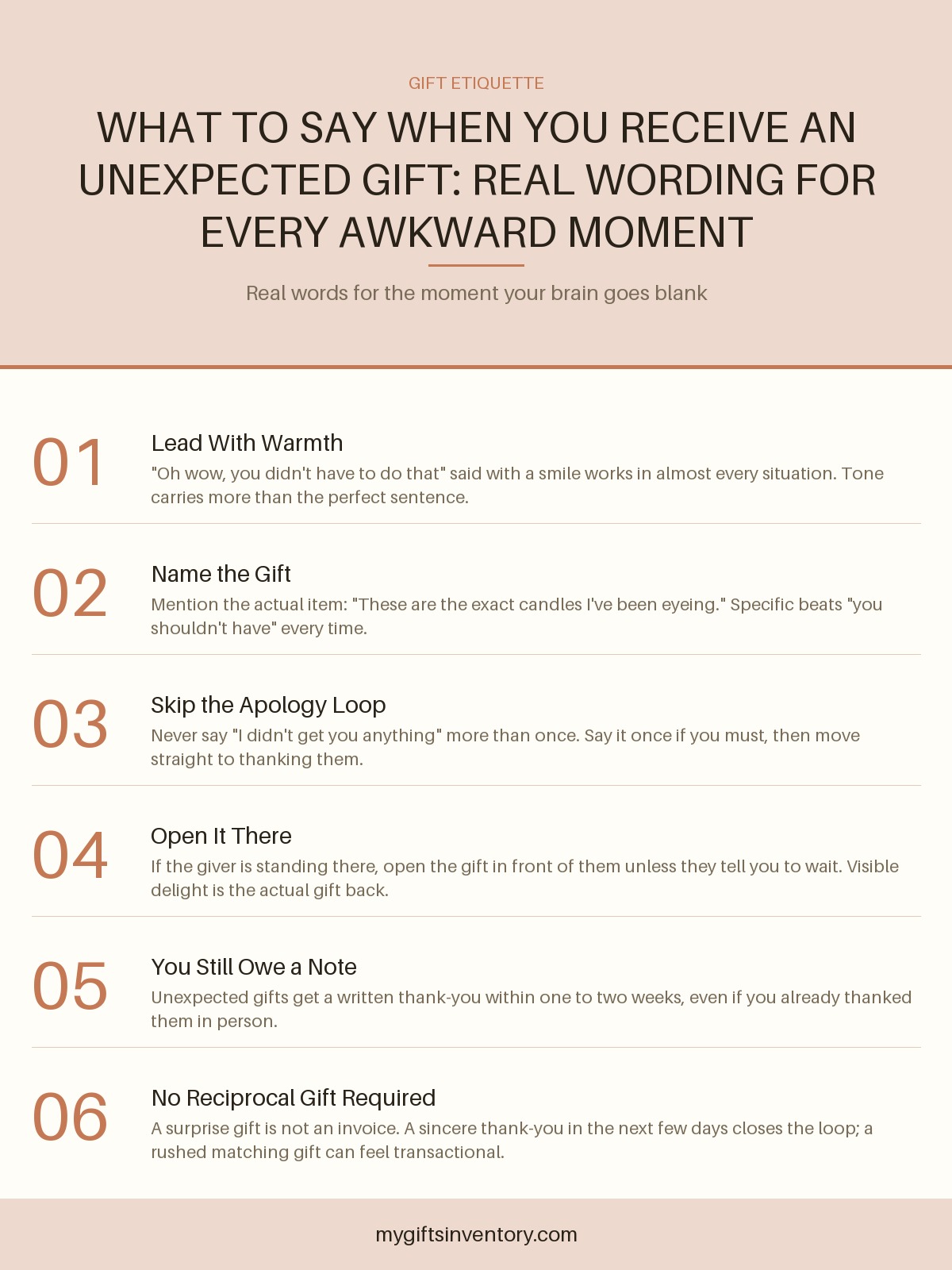
You don't need an elaborate speech. A card is a nice touch for overnight stays or bigger occasions, and a short handwritten note goes further than people expect. Some real examples that work:
- For a casual dinner: "Thanks for having us over, dinner was perfect and so was the company."
- For a weekend stay: "Thank you for opening up your home to us this weekend, it meant a lot and we had the best time."
- For a recurring holiday host: "You do this every year and we never say it enough, thank you for always making the holidays feel like home."
- For a host you don't know well: "Thank you so much for having me, I really enjoyed getting to know everyone."
If you're not a card person, saying a version of this out loud when you hand over the gift covers the same ground.
Common Host Gift Mistakes
A few patterns come up again and again. Bringing something that requires the host to do work in the moment, like unarranged flowers or a dish that needs to be cooked, adds to their load instead of easing it. Regifting something you clearly didn't choose for them, an obviously leftover fruit basket or a promotional item, tends to land worse than bringing nothing at all. And matching a lavish gift to a casual invite can make the host feel like they need to reciprocate at a level they weren't planning for, which isn't the point of a host gift in the first place.
On the other end, skipping a host gift entirely for a stay of several nights or a clearly effortful dinner party reads as an oversight most hosts will quietly notice, even if they'd never say anything.
Sending a Gift Instead of Bringing One
Sometimes you can't bring anything in person, maybe you're flying in for a wedding and arriving with limited luggage, or you're joining a dinner party straight from work with no time to shop. In these cases, having something sent ahead or dropped off after the fact is completely acceptable. A thank-you note sent a day or two later, paired with a small gift, covers the gap just fine. If the host has a specific interest, browsing something tied to it, whether that's a home item from our home decor gifts under $50 list or a coffee-focused pick, tends to feel more personal than whatever's fastest to grab on the way out the door.
Gift Ideas to Go With This


Want more ideas? Browse our full guide: 20 Best Gifts Under $100 (2026): Thoughtful Picks They'll Actually Use
Frequently Asked Questions
Is it rude to show up to a dinner party without a host gift?
It's not a firm rule breaker, but it can come across as an oversight for anything beyond a casual, no-fuss meal among close friends. If a host cooked, planned, and cleaned for the occasion, bringing even something small like wine or flowers acknowledges that effort. For truly casual hangouts with regular friends, it's often genuinely optional.
How much should I spend on a host gift for a weekend stay?
For a one or two night stay, $25 to $50 is a comfortable range, either as a physical gift or as a gesture like treating your host to a meal out. For longer stays of four or more nights, $50 to $100 or an equivalent contribution to groceries or an activity is more appropriate given the extended use of their home.
Should I bring wine as a host gift, or is that overdone?
Wine is a reliable, well-worn choice specifically because it works, and it's fine to bring unless you know your host doesn't drink. If you want to make it feel less generic, pick something tied to what they actually enjoy, or swap in specialty coffee, tea, or snacks if wine feels overused for this particular host.
Can I give a host a gift card instead of a physical gift?
Yes, a gift card is acceptable, especially when you don't know the host's specific tastes well, such as at a coworker's or new acquaintance's gathering. It reads best when it's tied to something you know they'd use, rather than a completely generic card grabbed at checkout.
What if I forgot to bring a host gift?
Send a thank-you note within a day or two, and consider having a small gift delivered or dropped off afterward. A sincere, prompt follow-up largely smooths over an in-the-moment miss, and most hosts care more about genuine appreciation than perfect timing.
Looking for an Actual Gift Instead?




Gift Sets We Love Right Now
Every item picked, priced and linked, ready to buy.


More Gift Advice