Average Gift Spending by Occasion: What People Actually Spend, and What You Should
Real dollar ranges for weddings, birthdays, Christmas, graduations, and more, plus how to set your own number without guilt or guesswork.
As an Amazon Associate, My Gifts Inventory earns from qualifying purchases. We only recommend products we'd genuinely consider buying ourselves.
You are staring at a wedding invitation, a birthday party evite, or a baby shower registry link, and the same question keeps surfacing: how much is normal here? Nobody hands you a price tag with the invitation, and asking the host is awkward. We pulled together the ranges people actually spend by occasion so you can stop guessing and start shopping with a number in mind.
Why There Is No Single "Right" Number
Gift spending varies wildly based on three things: the occasion, your relationship to the recipient, and your own financial reality. A $200 wedding gift from a close friend with a solid income is normal. That same $200 from a broke college student would be reckless. The averages below are starting points, not rules.
We also want to say this up front: nobody worth keeping in your life is tracking what you spent. The pressure is mostly internal, and a thoughtful $30 gift chosen with care consistently outperforms a $100 gift bought out of obligation.
Average Gift Spending by Occasion
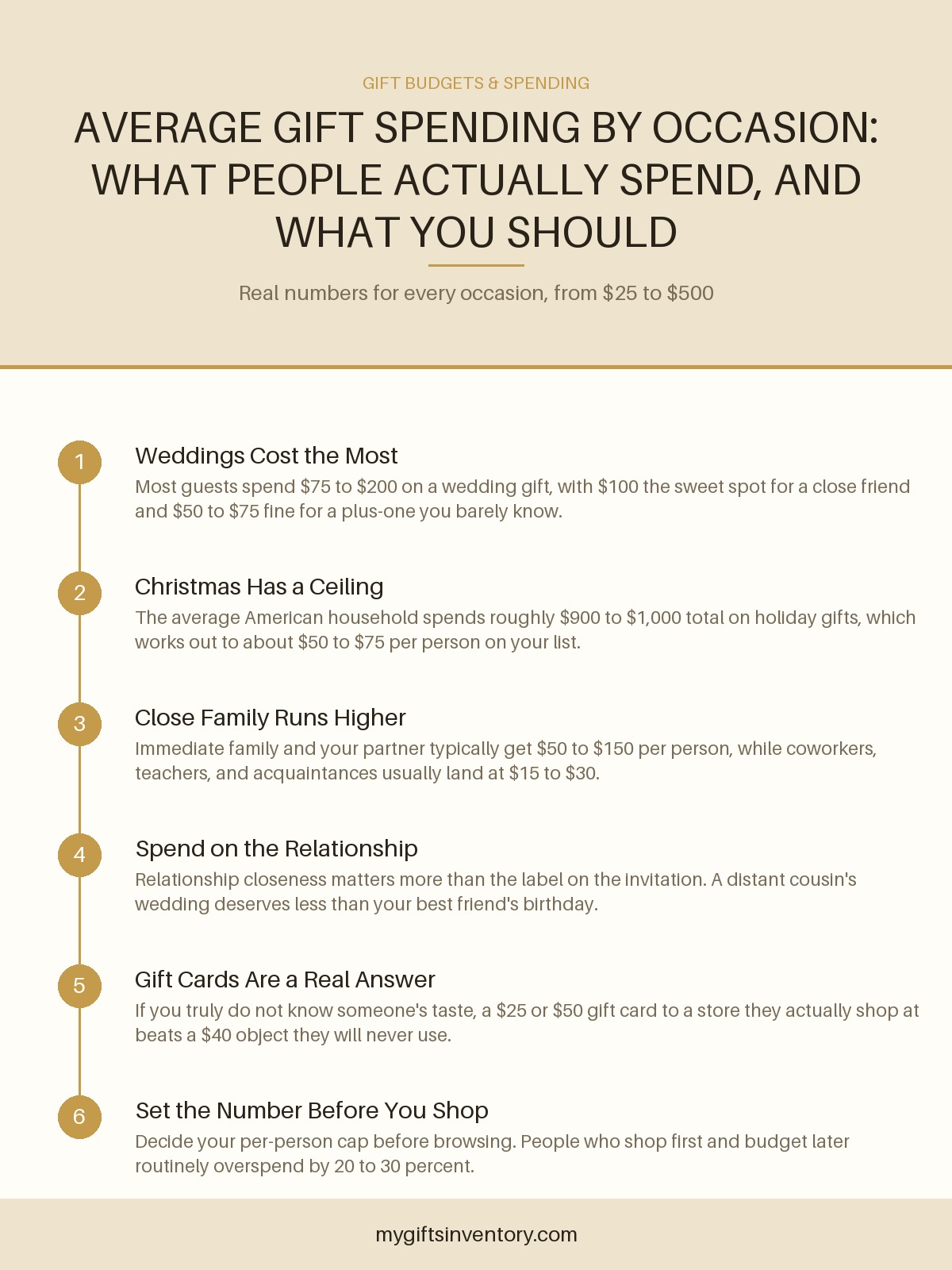
Weddings: $75 to $200
Wedding gifts carry the highest expectations of any occasion. The traditional guideline of "cover your plate" has largely fallen out of favor, mostly because plate costs vary so much by region, but it still shapes what people give.
Here is what we see as genuinely typical:
- Close friend or family member: $100 to $200
- Extended family or a friend you see regularly: $75 to $125
- Coworker or distant acquaintance: $50 to $75
- Destination wedding (you already paid for travel): $50 to $100, and skipping the gift entirely is defensible
If you are attending as part of a couple, you do not double the amount. A joint gift of $150 to $250 from two people is generous and appropriate.
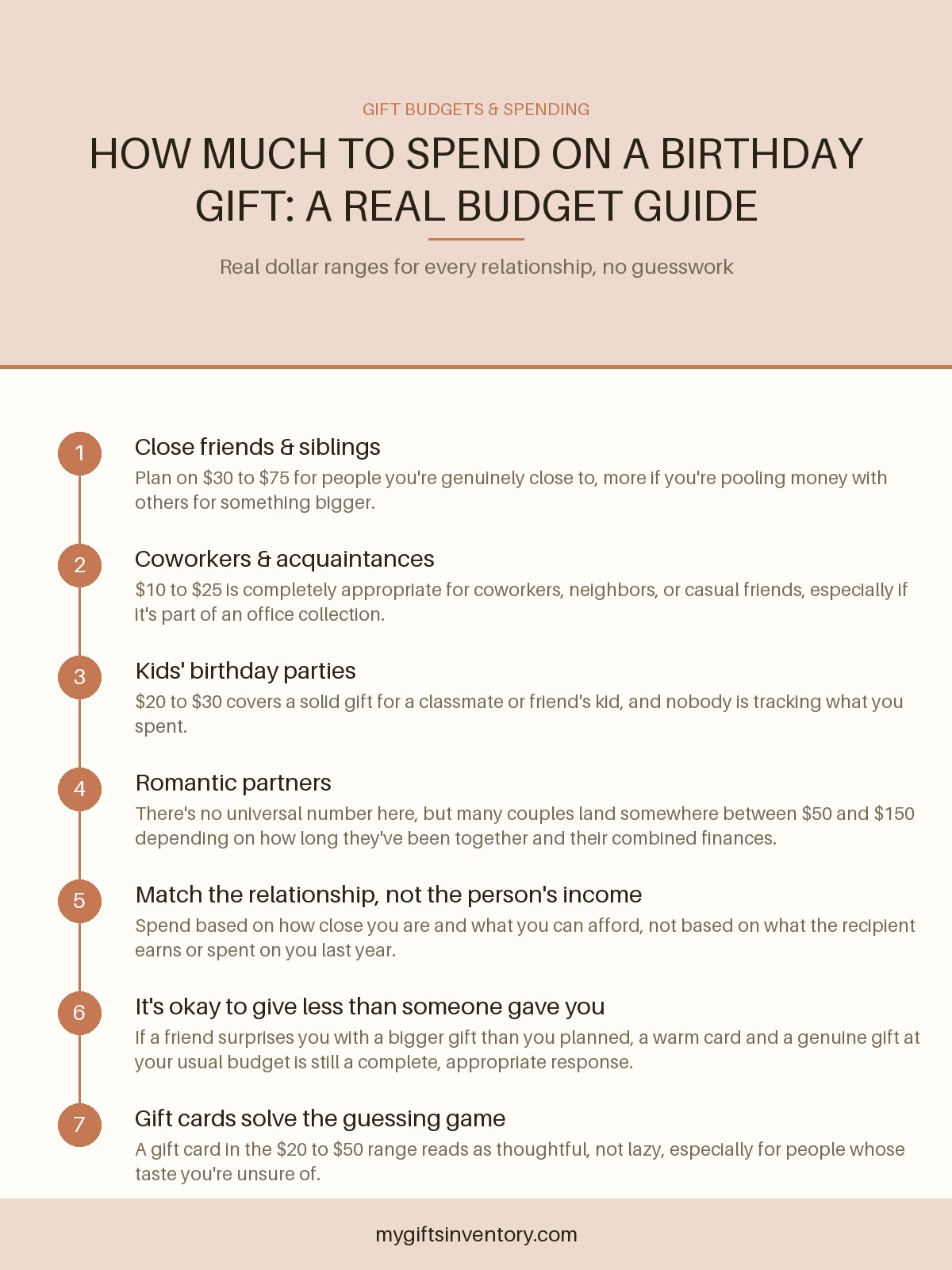
Birthdays: $25 to $100
Birthday spending depends almost entirely on age and closeness. Kids' parties are their own ecosystem, and there is a whole separate calculation for those.
- Partner or spouse: $100 to $300 or more, often the biggest single gift of the year
- Your own child: $50 to $200 depending on age and whether there is a party
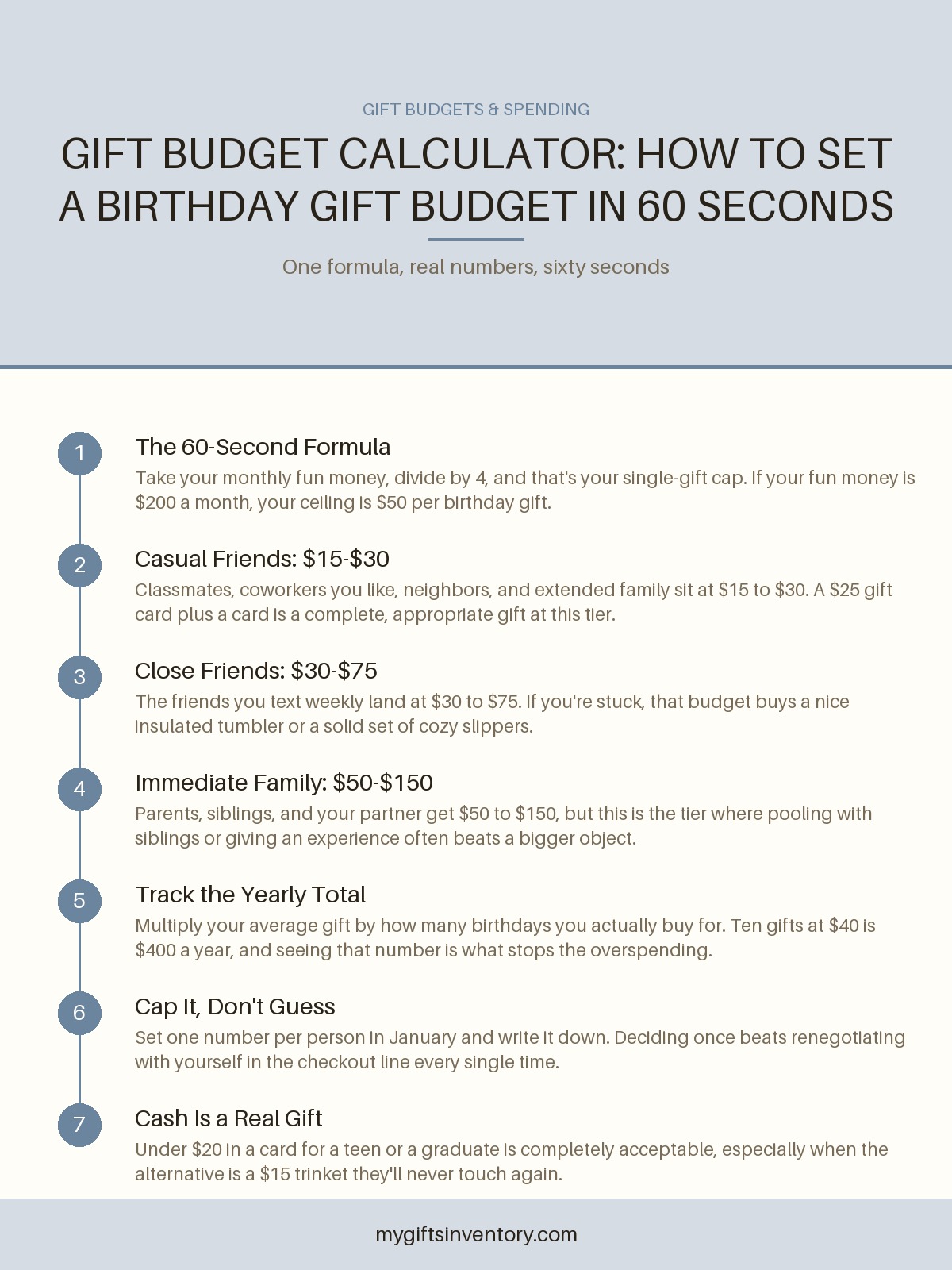
- Close friend: $40 to $75
- Coworker or casual friend: $20 to $30, or a group gift
- Child's classmate's party: $20 to $30
For kids' birthdays, a $25 gift plus a card is the standard and nobody will think twice. If your child is invited to six parties in one month, that is $150, and it is fine to set a household cap on how many you accept.
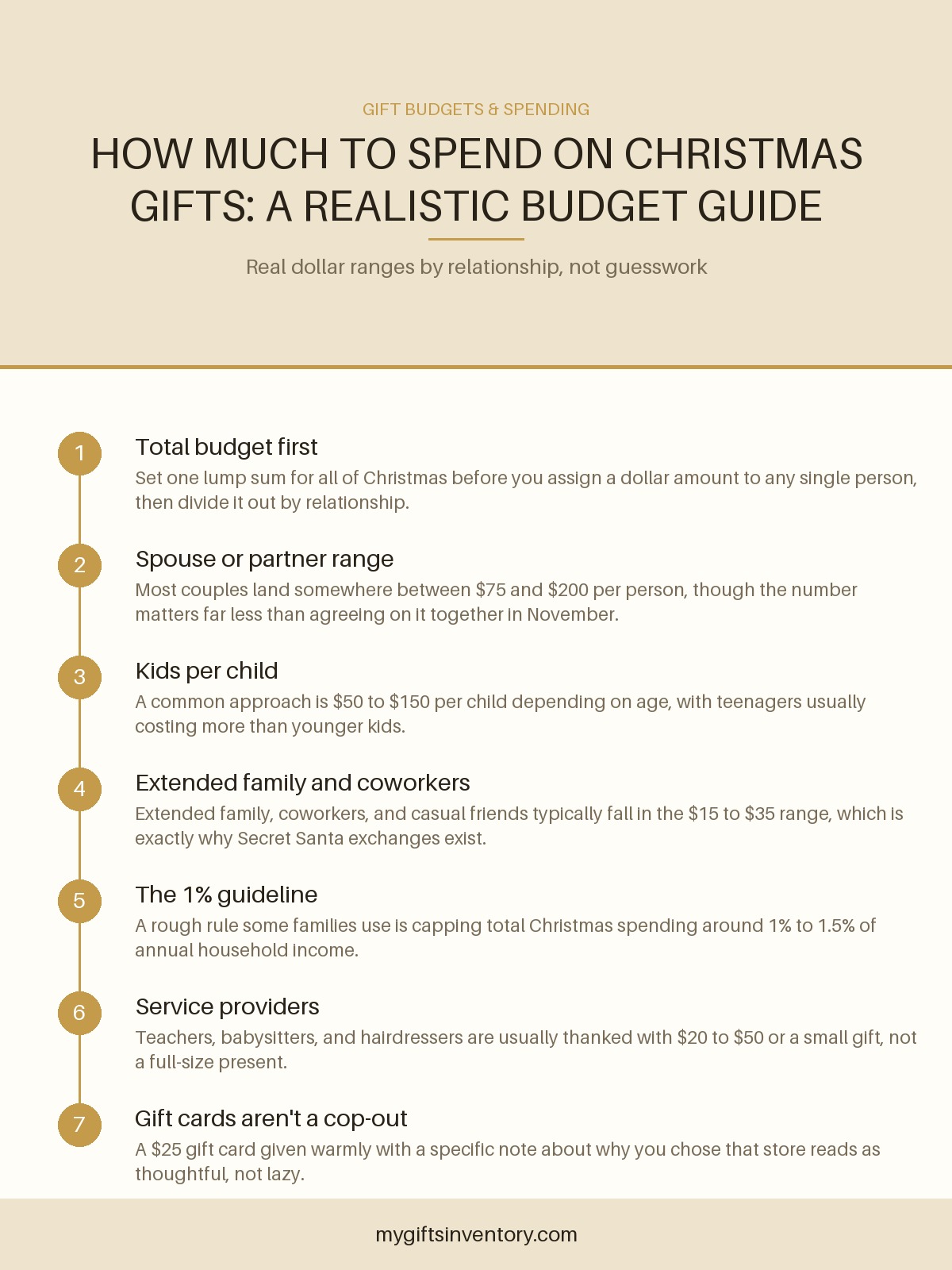
Christmas and Holidays: $50 to $75 Per Person
Holiday spending is the biggest aggregate category because it is not one gift, it is twenty. Households that track it typically spend somewhere between $900 and $1,000 total on gifts, food, and decor combined.
Per person, here is a reasonable breakdown:
- Partner: $150 to $500
- Each child: $100 to $300
- Parents or siblings: $50 to $100 each
- Extended family in a gift exchange: $25 to $50
- Coworkers, teachers, neighbors: $15 to $30
If your list runs long, a themed approach can help. Something like a cozy winter comfort gift in the $30 to $50 range works for a sister, a neighbor, and a teacher without anyone feeling shortchanged, and it keeps you from buying twelve unrelated things.
Baby Showers and New Baby Gifts: $25 to $75
Baby shower gifts typically run $25 to $50 for a casual friend or coworker and $50 to $100 for a close friend or family member. If you are buying off the registry, stick to it. Parents register for what they need, and a $30 item from the list beats a $60 item they did not ask for.
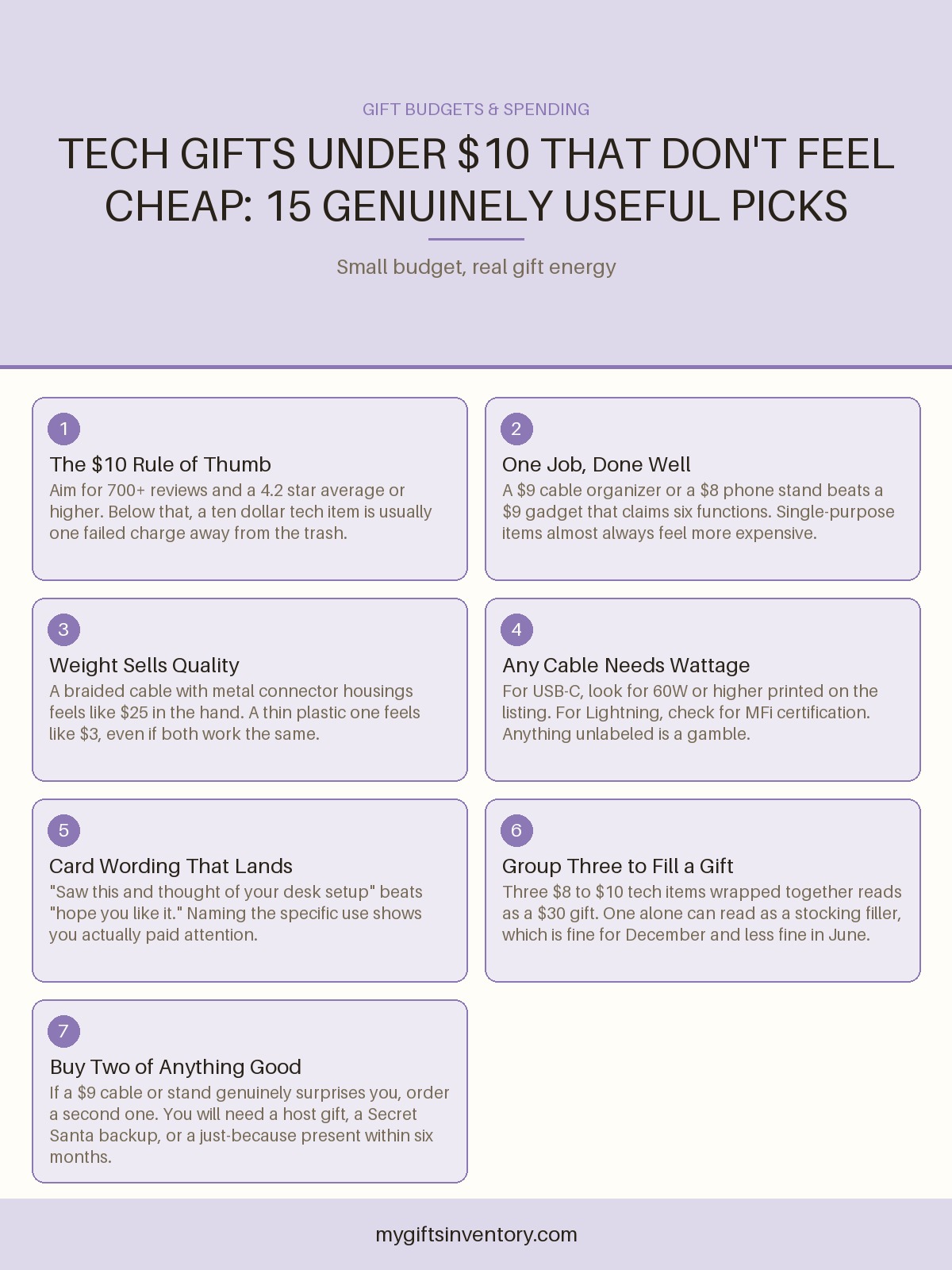
First birthday parties usually call for $20 to $40, since the child has no idea what is happening and the parents already have most of the gear. If you want something genuinely useful and inexpensive, third-party picks under $30 tend to land well.
Graduations: $50 to $150
High school graduation gifts from a family friend typically run $50 to $75. College graduation from a close family member runs $100 to $150. Cash is completely acceptable and usually preferred; a check for $100 in a card with a handwritten note is a genuinely great gift.
Engagements: $50 to $150
Engagement parties are usually lower-stakes than the wedding itself. If you will also be attending the wedding, keep the engagement gift modest (a $50 to $75 bottle of champagne and a card, or a small keepsake) and plan to spend more on the wedding gift. If the engagement party is the only event you will attend, $75 to $150 is appropriate.
Housewarmings: $25 to $75
A bottle of wine and a $25 to $50 gift is standard for a housewarming. Close friends might get $75 to $100, especially if the move was significant. This is an occasion where a practical gift beats a decorative one, so think useful rather than pretty.
Teacher, Coach, and Coworker Gifts: $15 to $30
Teacher appreciation gifts and end-of-year gifts from a single family typically run $20 to $30. Group gifts pooled from a class or team are the norm and let everyone contribute $10 to $15 while the teacher gets something substantial. Class-wide gifts for coworkers around the holidays should stay in the $15 to $25 range; anything higher gets awkward for everyone else in the office.
Retirement: $75 to $170
Retirement gifts from coworkers usually come from a pool, with individual contributions of $20 to $50. From close friends or family, $75 to $150 is typical, and personalized or experience-based gifts often carry more meaning than a spendier object here.
Anniversaries: $50 to $200
Anniversary gifts for a partner generally mirror birthday spending. For friends' anniversaries, a card and a modest gift (or none at all) is completely fine. The exception is milestone anniversaries like 25th or 50th, where $50 to $100 from close friends is common.
How to Set Your Own Number
Averages are only useful if you translate them into a number that fits your actual budget. Here is the method we recommend.
1. Start With a Total Annual Figure
Look at last year's spending and pick a number you can afford without touching savings or carrying a balance. Divide it into categories: holidays, birthdays, weddings, and miscellaneous (teachers, showers, housewarmings).
2. Assign a Per-Person Cap
Write down the names on your list and assign a cap to each. Partner, kids, parents, and siblings get the highest numbers. Everyone else falls into tiers. If you have ten weddings this year and $1,000 to spend, that is $100 each and you can stop agonizing over it.
3. Track It Somewhere Real
Most people overspend because they do not track what they have already spent. A simple note on your phone, a spreadsheet, or a dedicated gift-planning list works. The point is not to be rigid, it is to know whether you have $40 left in the coworker budget or $200.
4. Keep a Running Wish List All Year
The single biggest money-saver in gift giving is buying something you spotted in June because it reminded you of someone, rather than panic-buying in December. Keep a note of ideas as they come and check it before shopping.
When to Spend Less (and How to Say So)
There are legitimate reasons to spend below the averages: you are between jobs, you just had a baby, you are saving for a house, or you simply do not have it this year. None of these require an apology or an explanation, but if you want to get ahead of a group gift that assumes a $50 contribution from everyone, a short message works: "I'm tight this month, so I'm going to sit this group gift out. I'll do a card." That is a complete sentence and nobody reasonable will push back.
Likewise, if a friend group is planning an expensive Secret Santa, it is completely fine to suggest a $25 cap instead. More people will be relieved than you expect.
The Gift Card Question
Gift cards solve the "I have no idea what they want" problem, and the spending ranges are similar to physical gifts. A $25 card to a coffee shop for a teacher, a $50 card to a home improvement store for a housewarming, or a $100 card to a restaurant for a wedding are all normal and welcome.
One practical note: if you are the one receiving cards, keeping track of leftover balances gets confusing fast. Before you shop, it helps to know where you stand. If you have a Trader Joe's card lingering in your wallet, you can check the Trader Joe's gift card balance in a couple of minutes and use it up rather than letting it sit. Same goes for the Spotify, Netflix, or Google Play cards that tend to accumulate in a drawer.
If you are buying and want the safest option, pick a store the recipient actually shops at, not one you personally like. A $50 card to a store they visit weekly is worth far more in practice than a $75 card to somewhere they have never been.
What About Registry Gifts?
If someone has a registry, the registry answers the "how much" question for you. Buy an item in a price range you are comfortable with and skip the guessing. Etiquette experts broadly agree that buying off-registry is fine if you know the person very well, but for acquaintances and coworkers, stay on the list. The registry exists precisely to prevent the situation where someone receives four blenders and no sheets.
For group gifts, divide the cost of one larger registry item among several people. This lets everyone contribute $30 to $50 and gives the couple something they genuinely wanted.
A Note on Cultural and Regional Differences
The numbers above skew toward typical American spending patterns. Cash gifts for weddings are more standard in many cultures and communities, and gift amounts can run higher in urban areas with higher costs of living. If your family or friend group has its own norms, follow those. The averages are a backstop for when you have no other information, not a replacement for reading the room.
Gift Ideas to Go With This


Want more ideas? Browse our full guide: 20 Best Gifts Under $100 (2026): Thoughtful Picks They'll Actually Use
Frequently Asked Questions
How much should I spend on a wedding gift if I'm a plus-one?
Treat it as one gift from the two of you, not two. A joint gift of $100 to $200 is typical for a close friend, and $50 to $75 is fine if one of you barely knows the couple. You do not need to double the amount just because there are two people attending.
Is $50 enough for a Christmas gift for a parent?
Yes. $50 to $100 per parent is a very normal range, and many families set a cap well below that to keep things manageable. A thoughtful $50 gift with a handwritten note is genuinely appreciated; the number matters far less than the effort.
How much do people spend on a baby shower gift?
Typically $25 to $50 for a coworker or casual friend, and $50 to $100 for a close friend or family member. Buying directly off the registry at any of those price points is always the safest choice.
Should I give cash or a gift for graduation?
Cash or a check is completely acceptable and usually preferred, especially for high school and college graduates who are saving for a move, tuition, or a first apartment. $50 to $75 from a family friend, and $100 to $150 from close family, is a solid range.
What if I can't afford the typical amount?
Spend what you can afford and do not mention the number. A $20 gift chosen thoughtfully reads as thoughtful, not cheap. If a group gift assumes a contribution you cannot make, it is fine to opt out and give a card instead, with a short, no-apology explanation.
Looking for an Actual Gift Instead?


Gift Sets We Love Right Now
Every item picked, priced and linked, ready to buy.

More Gift Advice