Christmas Gift Planning: A Realistic Timeline, Budget and Game Plan
A practical, month-by-month approach to Christmas gift planning, covering budgets by relationship, a shopping timeline that beats the shipping cutoff, and how to handle the people who are impossible to shop for.
As an Amazon Associate, My Gifts Inventory earns from qualifying purchases. We only recommend products we'd genuinely consider buying ourselves.
Most people don't start thinking about Christmas gifts because they're excited. They start because something triggered it: a spouse asked what the plan is, a sibling group chat started tossing around ideas, or you realized the calendar flipped to November and you have bought exactly nothing. The good news is that Christmas gift planning isn't complicated, it's just a series of small decisions made early enough that December doesn't turn into a series of emergency purchases.
Here's how we actually approach it, from the first list to the last roll of wrapping paper.
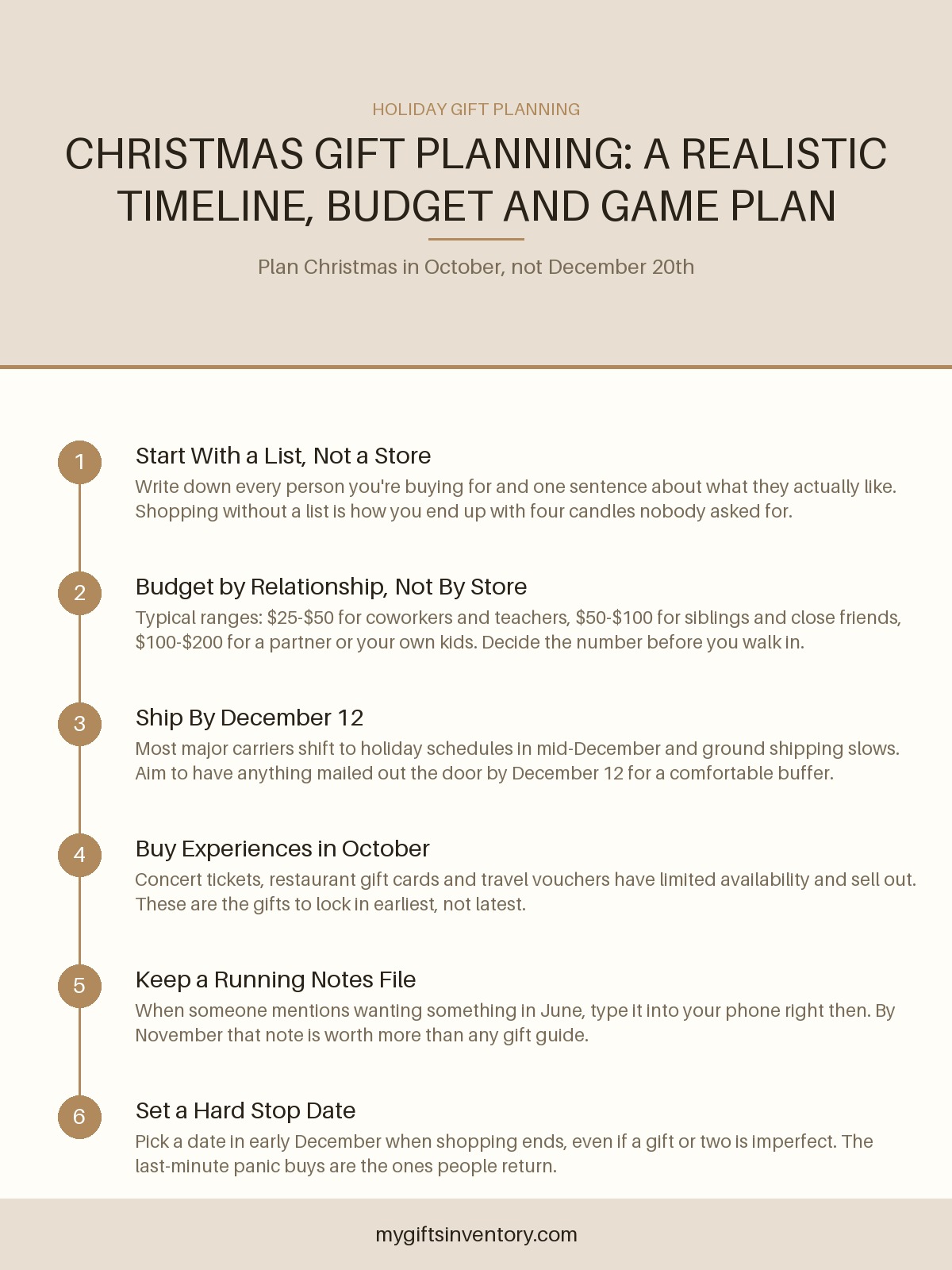
Start With a Written List, Not a Shopping Trip
The single biggest cause of overspending at Christmas is walking into a store or opening a browser tab without knowing who you're shopping for. You see something nice, you buy it for someone vaguely, and by the time you reach the people who really matter you've burned through your budget on strangers and acquaintances.
So before anything else, open a notes app and write down every single person you plan to give a gift to. Include the ones you feel obligated to but don't really want to think about: the neighbor who always drops something off, your kid's teacher, the office Secret Santa, your partner's parents. Getting the full roster on paper first is what keeps December from surprising you.
Next to each name, write one sentence. Not a gift idea, just a description of what that person actually likes. "Drinks coffee all day and complains it's too bitter." "Plays golf every weekend but never buys himself anything." "Obsessed with her Nintendo Switch." That sentence is worth more than any gift guide, because it tells you where to actually look.
And that's the moment a good gift guide becomes genuinely useful rather than overwhelming. If your sister's line says "always cold," a heated blanket or electric throw is worth considering. If your brother-in-law's line is "gaming on the couch every night," a gaming gift guide for him will do more for you than a general list of popular items. The trick is that the list comes first and the guide serves the list, not the other way around.
Set a Real Budget, Broken Down by Relationship
Nobody loves this part, but a Christmas budget only works if it's broken into actual numbers rather than one big vague pot. Here are ranges that reflect what most people we know actually spend, adjusted for how close the relationship is:
Extended Circle: $15-$35
Coworkers in a gift exchange, neighbors, your hairdresser, teachers, casual friends, the mail carrier. A nice consumable works beautifully here: a good coffee sampler, a quality candle, a small tin of something edible, a $25 gift card to somewhere they actually shop. The under-$30 gift exchange ideas we put together covers exactly this range.
Close Friends and Siblings: $40-$100
This is where a real gift beats a generic one. You know these people well enough that the "one sentence" from your list is specific. A pickleball paddle or bag set for the friend who plays three times a week, or a Bluetooth speaker for the one who brings music everywhere. In this range, personalization matters more than price.
Partner and Your Own Kids: $100-$300+
No fixed rule here, and honestly the range varies hugely by household income and family size. What matters is that you've decided the number before you start shopping, and that both partners are on the same page if you're splitting the budget.
Grandparents and Parents: $30-$75
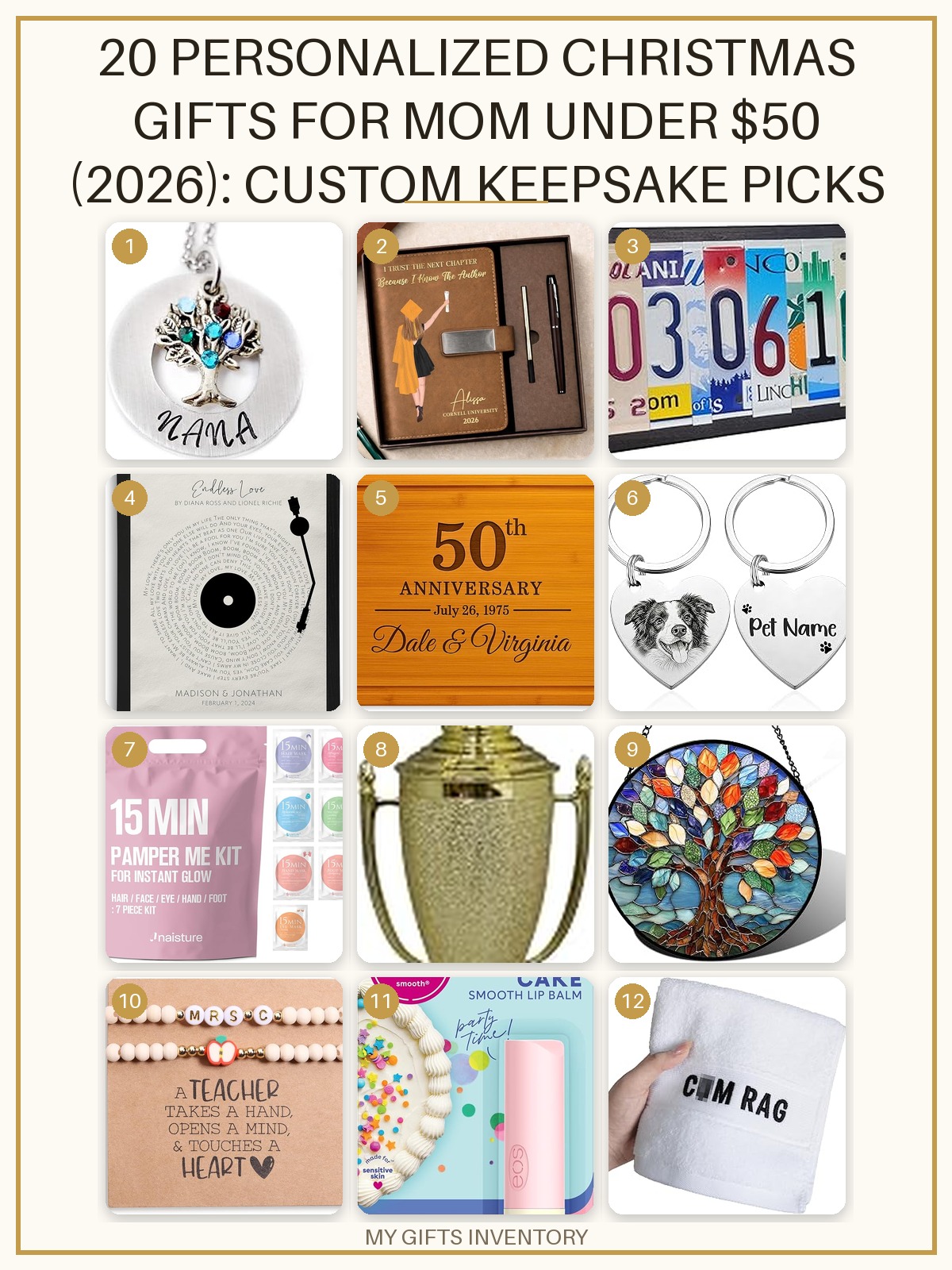
Sentimental usually wins over expensive. A framed photo, a keepsake, something related to a shared hobby. If you want ideas in this lane, the keepsake gifts for her collection has options that fit the "she has everything already" problem.
Add up every line item. If the total makes you wince, cut names from the list before you cut quality. Buying twelve $15 gifts nobody remembers costs more than buying six $40 gifts people actually use.
The Christmas Planning Timeline That Actually Works
This is the part most articles skip. Here's a realistic month-by-month plan.
Late September to Mid-October: Decisions Only
No shopping yet. Make your list, set your budget, and figure out who you're mailing to versus handing a gift to in person. Book any travel. If you're buying group gifts (a family membership, a shared experience), this is when to plant the seed with the other people splitting the cost.
October: Experience Gifts and Big-Ticket Items
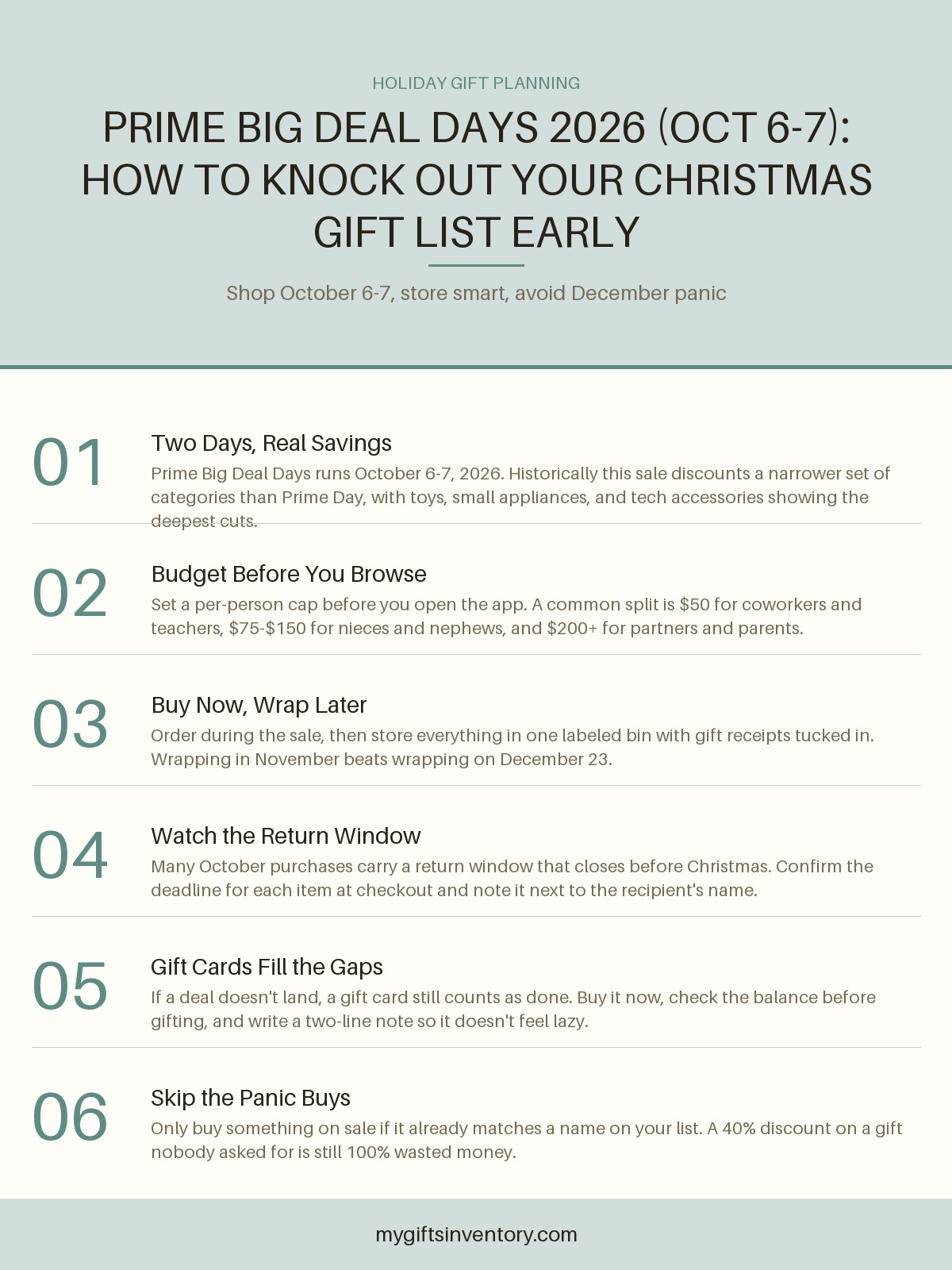
Concert tickets, restaurant gift cards, show tickets, anything with limited availability. These sell out in November, not December. If a big-ticket item is on your list, buy it now while stock is normal.
Early November: Start Buying the Easy People
Knock out the coworkers, neighbors, teachers and exchange gifts. These are low-stakes and quick, and clearing them early frees your attention for the harder gifts later. Also a good time to pick up wrapping paper, tape and gift tags before the good patterns are gone.
Mid to Late November: The Real Shopping
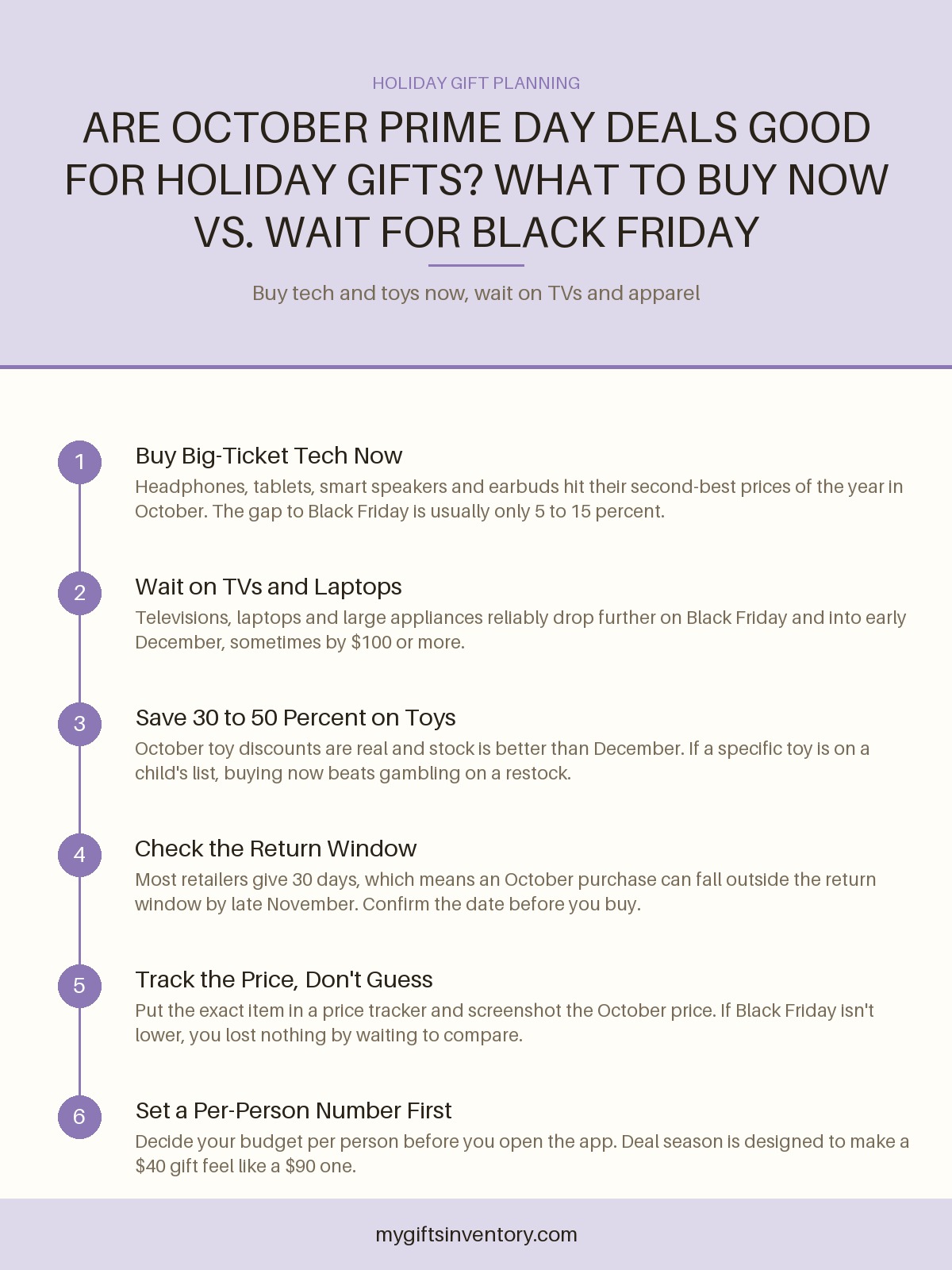
Family, close friends, partner. If you're shopping online, this is when shipping is still predictable. If you're shopping in stores, Black Friday weekend is genuinely a decent time for electronics, small appliances and toys, so long as you're buying from your list rather than from the sale sign.
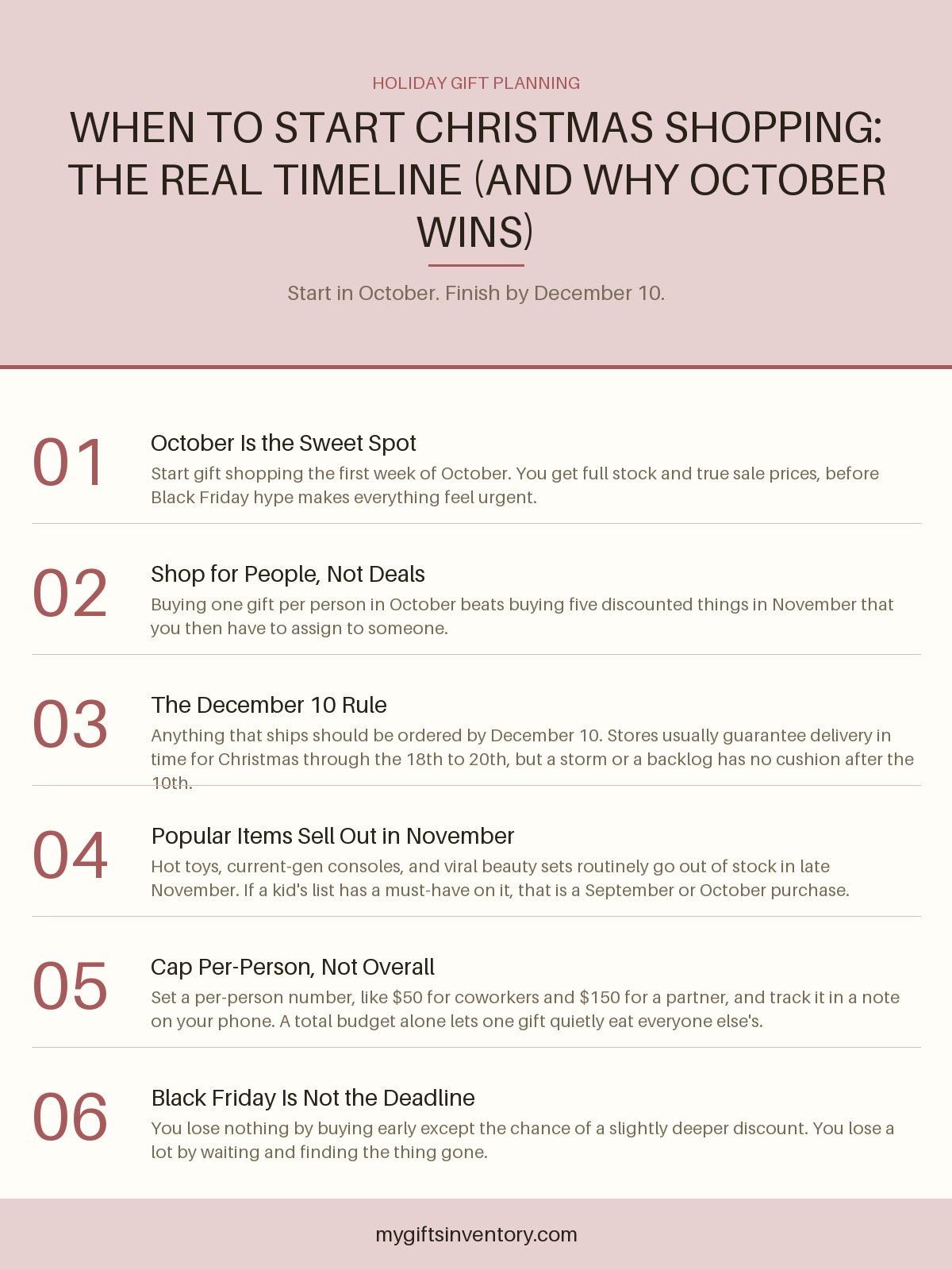
December 1-12: The Shipping Window
Anything that needs to go in the mail needs to go out by roughly December 12 to comfortably beat the holiday slowdown. Yes, major carriers offer later deadlines, but they come with higher costs and more risk of delay. Treat December 12 as your own personal deadline and you'll never be the person paying $40 to overnight a $25 gift on the 23rd.
December 13-Onward: Local and Last Minute Only
Anything you buy after this point should be something you can hand over in person or pick up from a store the same day. Gift cards, food, experiences with instant delivery, and items from local shops. For the genuinely last-minute situations, there's a reason a Netflix gift card or a restaurant card still works: it's always the right size and it never arrives late.
Handling the Hard-to-Shop-For People
Every family has at least one. The father-in-law who wants nothing. The teenager who already has everything. The coworker you barely know.
For the "wants nothing" types, stop trying to find the perfect object and go with a consumable: a great bottle of olive oil, a nice coffee subscription, a cut of good cheese, tickets to something. You're not cluttering their house, and the gift still lands. The smooth coffee gifts under $50 list is a decent starting point for the coffee angle, and coffee is nearly universal.
For teenagers, the answer is usually a gift card plus one small "you know them" item. The gift card covers what they actually want, and the small item shows you weren't phoning it in. Pair it with a stocking stuffer or two so it doesn't feel like a card-only gift. Our stocking stuffer ideas for teens has plenty of small items that work as that companion piece.
For the coworker you barely know, a $20-$25 gift card to a chain with a wide reach is genuinely the best answer. It's polite, it's useful, and it doesn't require you to pretend you know their taste.
Wrapping, Cards and the Small Details
Two things most planners forget until the last week: wrapping supplies and cards. Buy both in late November, not the week of.
On cards, keep the message short and specific. "Merry Christmas, thanks for being such a great neighbor this year" beats four lines of generic poetry. If you're writing to a partner or a parent, one specific memory does more than any printed verse: "Remember when we drove to the coast in the rain? Thinking about that today." That's a full card right there.
If you're giving cash or a gift card, a plain envelope is fine. Wrap it in a small box if you want it to feel less transactional, especially for kids and teenagers.
What to Do About Gifts You Receive but Didn't Plan For
Someone hands you a gift you weren't expecting. It happens every year. Two things help: keep a small stash of generic gifts (nice candles, good chocolate, a bottle of wine) for exactly this situation, and accept gracefully without apologizing for not having something in return. "Thank you so much, that's really thoughtful" is a complete sentence. You can drop off or send a return gift in January without making it awkward.
If you receive something that doesn't fit, remember that most retailers extend their return window through January for holiday purchases, and gift receipts exist for a reason. Pass them along when you can.
Gift Ideas to Go With This




Want more ideas? Browse our full guide: 18 Holiday Gifts & Christmas Present Ideas Under $50 (2026): Thoughtful Picks for Everyone on Your List
Frequently Asked Questions
When should I start Christmas gift shopping?
Start making your list in late September or early October, and start buying in early November. Experience-based gifts and big-ticket items should be bought in October because they sell out. The bulk of physical gifts can wait until mid-November without any risk.
How much should I spend on Christmas gifts per person?
Rough ranges that most people use: $15-$35 for coworkers, neighbors and teachers, $40-$100 for close friends and siblings, $30-$75 for parents and grandparents, and $100-$300 or more for a partner or your own children. The number matters less than deciding it before you shop.
What's the deadline for shipping Christmas gifts?
Aim to ship anything by December 12. Major carriers offer later deadlines through the third week of December, but those come with higher costs and increased risk of delay. December 12 gives you a buffer without paying rush rates.
How do I plan Christmas gifts for someone who wants nothing?
Go with a consumable or an experience instead of an object. Good coffee, olive oil, a nice bottle of wine, a restaurant gift card, or tickets to something they'd enjoy. You're not adding clutter, and the gift still feels considered rather than obligatory.
Is it rude to give a gift card for Christmas?
No. Gift cards are appropriate for coworkers, teenagers, teachers, and anyone whose taste you genuinely don't know well. Add a short handwritten note and, when possible, a small companion item so it reads as a thoughtful gift rather than a default one.
Looking for an Actual Gift Instead?
Shop Hand-Picked Gift Sets
Every item picked, priced and linked, ready to buy.
More Gift Advice