How Much to Spend on a Wedding Gift: A Real Budget Guide
The etiquette rules everyone quotes are mostly myths. Here's what to actually spend on a wedding gift based on your relationship, budget, and how you're attending.

As an Amazon Associate, My Gifts Inventory earns from qualifying purchases. We only recommend products we'd genuinely consider buying ourselves.
You got the invitation, you're happy for them, and then it hits you: how much is this actually supposed to cost? Somewhere along the way "wedding gift etiquette" turned into a stress spiral involving Venmo requests, group chats full of conflicting advice, and a vague fear that whatever you spend will be read as a judgment on the friendship. It doesn't need to be that complicated.
There's no single correct number, but there is a real range that most people land in once you factor in your relationship to the couple, your own financial situation, and how you're attending. We'll walk through all of it below, including the myths worth ignoring.
The Short Answer
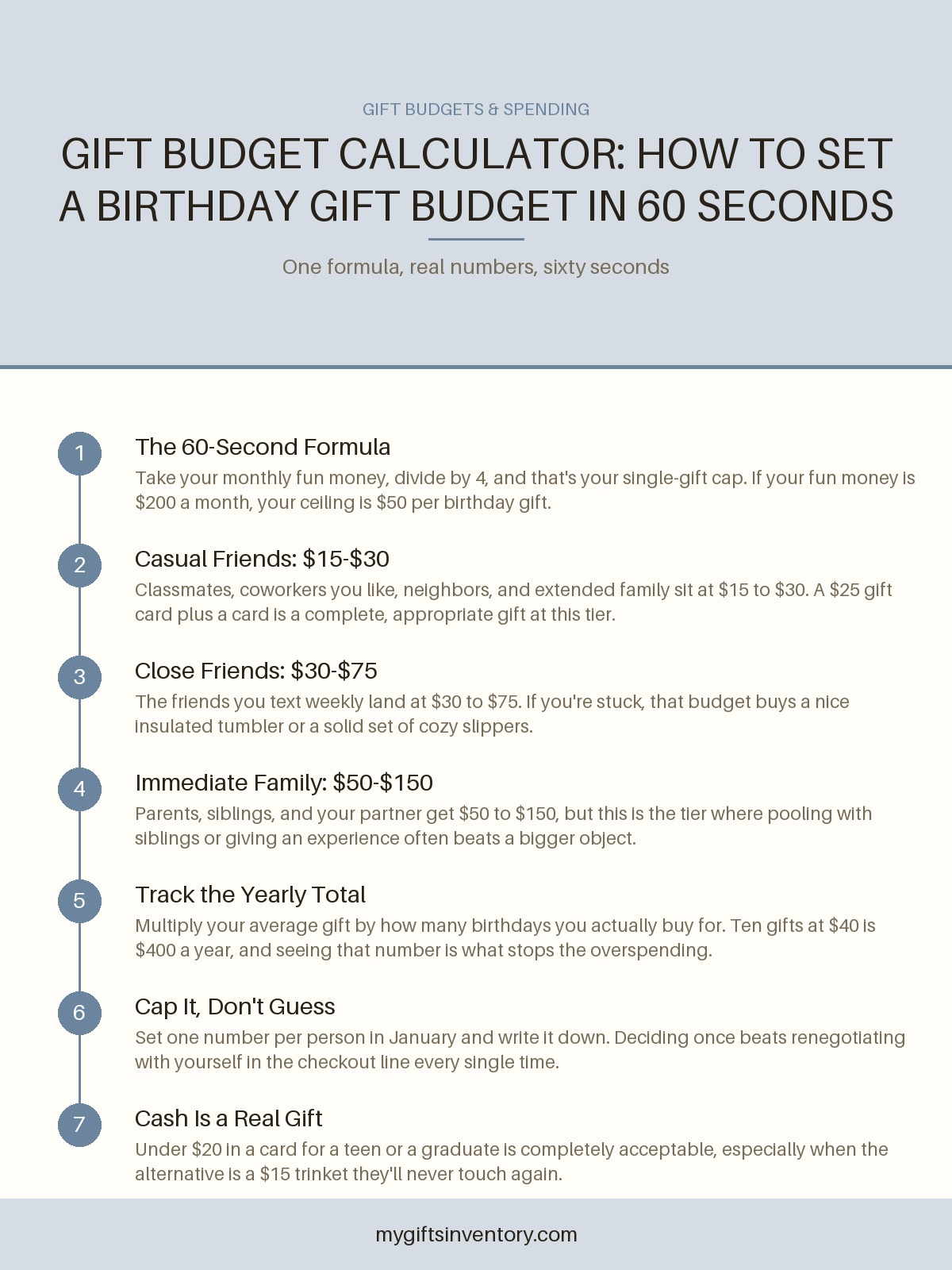
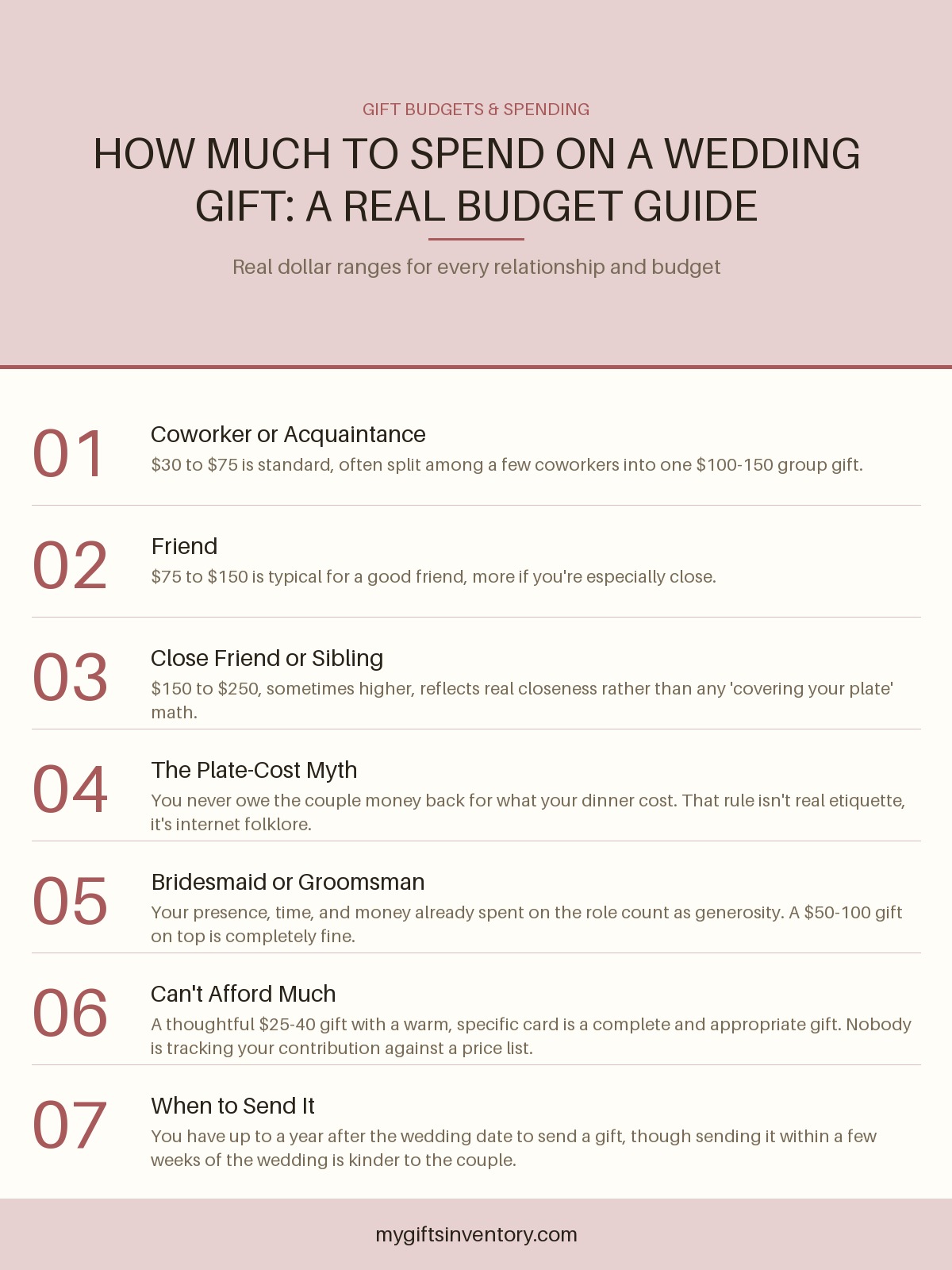
For most guests attending a wedding in the United States, a gift in the $75 to $150 range is considered generous and appropriate. Close friends and family members often go higher, somewhere between $150 and $250, while coworkers, distant relatives, and plus-ones tend to land closer to $50 to $100. None of these numbers are rules carved into etiquette stone. They're simply what most people, most of the time, feel comfortable spending without resentment or financial strain.
If you take away one thing, let it be this: your gift should reflect what you can genuinely afford and how close you actually are to the couple, not a formula based on the venue, the open bar, or what you assume everyone else is spending.
How Your Relationship to the Couple Changes the Number
The single biggest factor in what to spend isn't the wedding itself, it's who you are to the people getting married. Here's how that tends to break down in practice.
Coworker or Casual Acquaintance
If you're invited because you work together or run in the same social circle but aren't especially close, $30 to $75 is a comfortable range. This is also the situation where a group gift makes the most sense. A handful of coworkers each chipping in $20 to $30 turns into a $100-150 gift that feels substantial without anyone overspending on someone they see mostly at the printer. If you're brainstorming what a group of colleagues could go in on together, our corporate gift ideas under $50 roundup has plenty of options that read as thoughtful rather than obligatory, even outside the office context.
Friend
For a friend you see regularly, grab drinks with, or have a real history with, $75 to $150 is typical. This is the sweet spot where most wedding gifts actually land, and it's enough to buy something meaningful off a registry or a nicer cash gift without stretching your budget uncomfortably.
Close Friend, Sibling, or Family Member
When it's your sister, your best friend since college, or someone whose life is deeply intertwined with yours, $150 to $250 or more is common. At this level, people often skip the registry entirely and go for something personal and lasting instead, which is where personalized jewelry or a piece meant to mark the milestone tends to outperform a kitchen gadget. The gift becomes less about the price tag and more about the fact that you know them well enough to pick something specific.
Distant Relative or Plus-One
If you're attending as someone's date, or you're a second cousin invited mostly out of family obligation, $30 to $50 is genuinely fine. Nobody expects a plus-one to match the primary guest's spending, and distant relatives aren't held to the same standard as immediate family.
Does the Venue or "Covering Your Plate" Actually Matter?
You've probably heard some version of the rule that you're supposed to spend enough to "cover your plate," meaning whatever the couple paid per head for the reception. We want to be direct about this one: it's not real etiquette, and it's not how any wedding planner or etiquette authority actually advises people to think about gifts. Nobody is calculating your dinner's cost against your card. Weddings aren't a bill you're being handed, they're a celebration you're invited to share.
That said, it's fair that a lavish, black-tie wedding at a vineyard might nudge your instinct toward a slightly more generous gift than a backyard barbecue wedding, simply because the overall tone signals a bigger occasion. But that's a feeling, not a formula, and it should never override what you can actually afford.
What If You're in the Wedding Party?
Bridesmaids and groomsmen often feel like they owe extra on top of everything else they've already spent, the dress or suit, travel for the bachelorette or bachelor party, hair and makeup, hotel rooms. If that's you, take a breath. Being in the wedding party is already a substantial financial and time commitment, and the couple knows that. A gift in the $50 to $100 range is completely appropriate here, and many couples would tell you honestly that your presence throughout the whole process already counts as generosity.
If you want to give something personal rather than pulling from the registry, a keepsake tied to the friendship itself, something that will still mean something on their tenth anniversary, tends to land better than another kitchen appliance. Our guide to anniversary gifts by year is actually a good source of inspiration here too, since a lot of those ideas work just as well as a wedding gift with a longer shelf life than a toaster.
Group Gifts: How to Split Costs Without It Getting Awkward
Pooling money with siblings, coworkers, or college friends is one of the most practical ways to give a gift that feels significant without any one person overextending. A few things make group gifts go smoothly:
- Pick one person to organize collection through Venmo, PayPal, or cash, and set a deadline at least two weeks before you plan to buy or send anything.
- Suggest a per-person amount up front rather than leaving it open-ended, since an open "chip in what you can" often results in wildly uneven contributions and hurt feelings later.
- Decide together whether you're buying something off the registry, going in on cash, or picking something more personal, and put one name (or the whole group's names) on the card so the couple knows who to thank.
Cash or Registry: Which Should You Choose?
This is largely a matter of preference, both yours and the couple's. Cash and checks have become the default in a lot of circles, especially for couples who are older, already living together, or simply don't need another set of dishes. If the couple has a registry, though, sticking to it is almost always the safer choice, since it guarantees you're giving something they'll actually use rather than duplicating what they already own.
If you'd rather give something outside the registry entirely, home goods remain one of the most reliably appreciated categories for a new household. Something like a piece from our home decor gifts under $50 list can round out a cash gift nicely, giving the couple something to unwrap alongside the more practical contribution. For more general guidance on picking something that actually fits the two people you're buying for, our piece on choosing the perfect gift is worth a look before you commit to an idea.
What to Do If You Genuinely Can't Afford Much
Weddings are expensive to attend even before you factor in a gift, between travel, outfits, hotel rooms, and time off work. If your budget is tight, a $25 to $40 gift paired with a warm, specific, handwritten card is a complete gift. It is not a lesser gift, it's a gift that reflects your actual circumstances, which is exactly what a thoughtful couple wants from their guests. Nobody worth attending a wedding for is quietly ranking gifts by dollar amount.
If you want the gift to feel a little more considered without spending more, put the extra effort into the card itself rather than the price tag. A specific, personal message often means more to a couple than an extra $30 spent on something generic off the registry.
Destination Weddings and Multiple Pre-Wedding Events
If you're traveling for a destination wedding, it's widely accepted that your travel costs count as a significant contribution on their own, and you're not expected to also give a full-price gift on top. A smaller gift, in the $50 to $75 range, or even just a heartfelt card, is appropriate when you've already spent hundreds or thousands getting there.
The same logic applies if you're attending the bridal shower, the bachelorette or bachelor party, and the wedding itself. You don't need to buy three separate substantial gifts. A modest gift for the shower (often something small and registry-based, in the $20-40 range), covering your own share of the bachelorette weekend, and then a wedding gift in your normal range is plenty. Spreading your generosity across all three events rather than concentrating it all at the wedding is completely acceptable.
Timing: When to Actually Send the Gift
Traditional etiquette gives you up to a year after the wedding to send a gift, which is more breathing room than most people realize. In practice, though, sending it within two to three weeks of the wedding date is kinder to the couple, who are often eager to write thank-you notes and wrap up wedding-related logistics while it's still fresh. If you're shipping a gift rather than bringing it in person, send it directly to their home address rather than the wedding venue, since venues aren't equipped to store or forward gifts safely.
Gift Ideas to Go With This


Want more ideas? Browse our full guide: 20 Best Gifts Under $100 (2026): Thoughtful Picks They'll Actually Use
Frequently Asked Questions
Is $100 a good amount for a wedding gift?
Yes, $100 sits comfortably in the middle of what most guests spend and works well for a friend, cousin, or coworker you're reasonably close to. It's generous without tipping into the range reserved for immediate family or your closest friends.
Is it rude to give cash instead of a registry gift?
No, cash is widely accepted and often preferred, especially by couples who are older or already living together and don't need household items. If the couple has a registry, it's a thoughtful signal of what they actually want, but cash is never considered rude on its own.
Do I need to give a gift if I can't attend the wedding?
It's customary but not strictly required, and a smaller gift in the $25 to $50 range is perfectly appropriate when you're invited but unable to make it. A heartfelt card alone is also acceptable if the budget genuinely isn't there.
Should I spend more if I'm a plus-one?
No, plus-ones aren't expected to match or contribute equally to the primary guest's gift. If you're attending as someone's date, either let your host's gift represent both of you or add a modest $20-30 of your own if you'd like to contribute something personally.
What if the couple asks for no gifts at all?
Respect the request, though bringing a card with a heartfelt note is always appropriate even when gifts are declined. Some guests still choose to send a small token afterward, but it's genuinely optional when the couple has explicitly said not to.
Looking for an Actual Gift Instead?



Shop Hand-Picked Gift Sets
Every item picked, priced and linked, ready to buy.

More Gift Advice