Donations Instead of Christmas Gifts: What to Write on Your Holiday Cards
Skipping the mall and giving to a cause instead this year? Here is exactly how to word the card so it feels warm and generous, not like a polite rebuke of gift-giving.
As an Amazon Associate, My Gifts Inventory earns from qualifying purchases. We only recommend products we'd genuinely consider buying ourselves.
Somewhere in the middle of December, most of us hit the same wall: we have people on our list who genuinely do not need another thing, and we have causes that could use the $40 we were about to spend on a scented candle. So we decide to donate instead. That decision is the easy part. The hard part is the card, because "in lieu of gifts, I gave to charity" can land anywhere from genuinely lovely to faintly insulting depending on six or seven words. This is about getting those words right.
We have written and received our share of these cards, and the pattern is clear. The ones that work are personal, specific, and a little humble. The ones that flop read like a press release. Below is wording that works, broken out by relationship, plus the practical questions people ask after the message: how much to give, whether to name the charity, and what to do when someone was clearly expecting a real present.
Start with the person, not the philanthropy
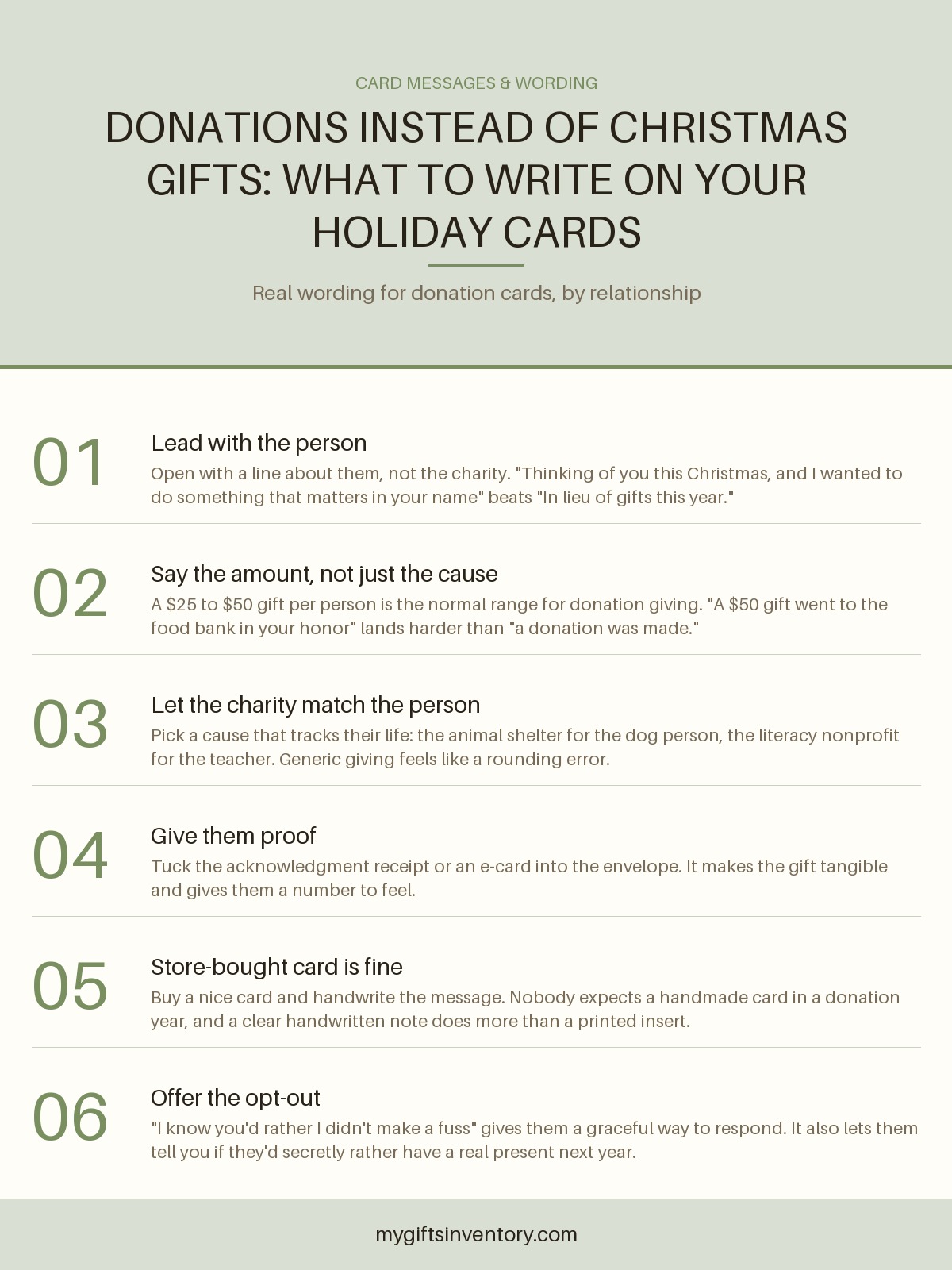
The single biggest mistake on donation cards is opening with the donation. "In lieu of gifts this year, we have made a contribution to..." The reader learns about your values before they learn you were thinking of them, and it feels like being told about a policy rather than being given a gift.
Flip the order. Open with a line that could only be written to that person, then explain what you did. Compare:
In lieu of gifts this year, a donation has been made to the Nature Conservancy.
You are the only person I know who can name every bird in the backyard. I made a gift to the Audubon Society in your name this year, because it felt more like you than anything I could wrap.
Same act, same charity, same amount. The second one is a gift. The first is a receipt.
If you are planning this for a whole group, an office, or a family gathering, the same rule holds at scale: lead with a sentence about the people, then explain the choice. Our full walkthrough on charity donation in lieu of gifts wording: what to write on the card or invitation covers invitation and group-card versions in more detail, including how to phrase it when you are coordinating for ten people at once.
Real wording, by relationship
You do not need to reinvent this. Steal whichever of these fits, then edit the personal line so it sounds like you.
For a partner or spouse
We already have more than we need, and I would rather spend the money on something we both believe in. This year I gave $100 to [charity] in our names, with a promise that we pick the cause together next December. Merry Christmas, and yes, there is still a small something under the tree.
That last sentence matters. With partners, a donation is rarely the whole gift, and saying so up front avoids a slightly deflated moment on Christmas morning.
For parents and grandparents
Mom, you have told me for years that you do not need anything else to dust. So this year I made a gift to [charity] in your name, and I am also taking you to lunch in January. Two gifts, one of them edible.
Older relatives are often the most receptive audience for this, but they also care about being honored rather than managed. Naming the charity and saying why you picked it for them does that work.
For siblings, cousins, and friends
We are doing donations instead of presents this year, and yours went to the animal shelter where you got your terrible, wonderful dog. Happy Christmas. Please still send me a photo of whatever you bought yourself with the money you saved on me.
The humor helps. Among peers, the donation card works best when it is a little self-aware about the swap.
For adult children
You are impossible to shop for, which you know. This year your gift is a donation to [charity] plus a check, because I am not going to pretend a goat is what you wanted.
This is the place to be plain. Adult children are usually the easiest people to be direct with, and a donation plus cash is a completely respectable combination when the donation is the sentimental half.
For aunts, uncles, and extended family you see once a year
Thinking of you this Christmas. I made a gift to [charity] in your honor this year instead of sending a parcel. Wishing you a warm and quiet holiday.
Short is correct here. You are not close enough to need a long explanation, and a long one would feel like an excuse.
For teachers, coworkers, and clients
Thank you for everything this year. In place of a gift, we have made a donation to [charity] in your name, and we hope the holiday gives you some genuine rest.
For professional relationships, always name the charity, keep it brief, and never make the recipient feel like they need to respond. Some workplaces have rules about gifts over a certain value, and a clearly stated donation avoids all of that.
How much should a donation gift be?
The honest answer: match what you would have spent on the present. If your normal gift for a sibling is $50, the donation is $50. People do not usually compare donation amounts the way they compare presents, but a $5 donation in place of a $60 gift reads as a cost-cutting move dressed up as generosity, and recipients can tell.
Common ranges, from what we have seen and done:
- Pals and casual coworkers: $15 to $30, or a group donation pooled across a team.
- Siblings and close friends: $40 to $75, in line with a normal present.
- Parents, partners, adult children: $100 to $250, often combined with a smaller physical gift or an experience.
- Whole-family gift (one donation covering a household): $75 to $150.
- Corporate or client gifting: $25 to $100 per person, and check your company's gift policy first.
If money is tight, a smaller donation plus a genuinely thoughtful note is still a perfectly good gift. What you should not do is donate $10 and write a card implying it cost you $80.
Should you name the charity, and should you say the amount?
Name the charity almost always. "A donation was made" is the least satisfying sentence in the English language to receive, because it gives the recipient nothing to picture. The specific cause is half the gift. If you are worried about the recipient disagreeing with your pick, choose something broadly uncontroversial (food security, animal shelters, disaster relief, local libraries) or ask them directly before you give.
Saying the amount is a judgment call, but we lean toward including it, especially in the $25 to $250 range, because it makes the gift concrete and lets the recipient thank you properly. "A $50 gift went to the food bank in your honor" is easier to receive than an unquantified "I donated on your behalf." For larger gifts, or for professional relationships, keep the amount out and let the organization send the acknowledgment.
When the recipient was clearly expecting a present
This is where most of the anxiety lives, and it deserves a straight answer. If you know the person will show up with a wrapped gift for you, a donation card alone can sting, no matter how beautifully it is worded. There are two ways out.
Option one: pair the donation with something small. A $15 box of good chocolate, a nice candle, or a decent bottle of wine alongside the card changes the entire experience. The donation is the gift, and the small object is the thing they get to unwrap. This is also the answer for anyone you suspect is a "I like to open something" person.
Option two: give the donation card instead of the whole exchange. If you are close enough, tell them in November that you are doing donation-only gifts this year. Nearly everyone says "oh thank goodness." If you can't tell them in advance and they hand you a present at the party, the right move is to be gracious, thank them warmly, and let them know what you did without apology. "I hope you don't mind, I did donations this year, and yours went to the shelter." No long justification.
For anyone on your list who is famously hard to shop for in the first place, a gift card is often the better route than a donation, and it is worth knowing how to handle one properly. Our guide to gift cards at Ross: brands, fees, and where to buy is a useful reality check on how much value actually reaches the recipient after fees and expiration rules, which applies just as much to a donation as to a card.
Pick a charity that matches the person, not the season
A donation gift gets its emotional weight from the pairing. The same $40 means much more when it is aimed well:
- The dog person: the local animal shelter, or a rescue that pays for surgeries.
- The teacher or librarian: a literacy nonprofit, a school book fund, or the public library foundation.
- The hiker or gardener: a land trust, a trail association, or a community garden.
- The cook or foodie: a food bank or a community kitchen. This one is also the most universally acceptable.
- The musician: a music education program or a youth orchestra.
- The brand-new parent: a children's hospital or a NICU family fund.
- The recently bereaved or a family touched by illness: the relevant disease research organization, given quietly and without commentary.
If nothing jumps out, ask. Most people are thrilled to be asked "which charity should I give to in your name?" and it turns a slightly detached gesture into a genuinely collaborative one. Even better: give the recipient the choice, and let them pick from a shortlist of two or three. That is a present in itself.
How to make the card itself feel like a gift
The card is doing all the work here, so treat it like the present it is.
Write by hand. This is non-negotiable for a donation card. A printed insert inside a store-bought card feels administrative. A handwritten paragraph, even sloppy, feels like effort, and effort is what the recipient is actually receiving.
Include proof. Print the acknowledgment email, or ask the charity to send an e-card to the recipient directly. Many nonprofits offer exactly this, and it turns a claim into a real thing. Slip it inside the card so the recipient can see the organization and the amount if they want to.
Add a small tangible token. A donation to a food bank plus a jar of good jam, a donation to a garden trust plus a packet of seeds, a donation to an animal shelter plus a framed photo of their dog. The object does not have to cost much. It just has to exist.
Do not preach. The card should not explain why consumerism is bad or how much stuff everyone already has. Nobody wants to be given a donation and a lecture. Keep the message about them and the cause, full stop.
If you are pairing the donation with a small physical something and want help choosing it, our pick of the best hot chocolate and cocoa gifts is a reliable source of $15 to $30 add-ons that pair beautifully with a cozy, quiet holiday message.
Practical details people forget
Taxes. A donation you make in someone else's name is your deduction, not theirs, and you generally need a written acknowledgment from the charity for gifts of $250 or more. The recipient cannot deduct it. If the recipient is the type to care about the tax treatment, mention it in passing so there is no confusion later.
Group giving. If a family, team, or friend group is pooling money, collect first and donate once. Ten $25 donations generate ten acknowledgment emails and ten thank-you tasks. One $250 donation generates one, and the card can say "from all of us."
Timing. Make the donation before you write the card, so the card tells the truth about something that has already happened. Some people write the card in November and donate in January, which occasionally goes sideways. Donate first, then write.
Keep a record. A simple note of who received a donation gift and which cause you chose saves you from accidentally donating to the same shelter for the same person three years running, and it makes next December much faster. The same planning habit that makes a toy and craft-kit shopping list manageable in December works for donations too.
The three-sentence rule. If you are stuck, write exactly three sentences: one about the person, one about the donation and the cause, one about the holiday. It is almost impossible to write a bad card in three sentences.
Frequently Asked Questions
What do I write in a Christmas card when I gave a donation instead of a gift?
Open with a personal line about the recipient, then state what you did and where it went. A version that works for most people: "Thinking of you this Christmas. This year I made a $50 gift to the local food bank in your name, because it felt more useful than another package. Wishing you a warm holiday." Name the charity, keep it short, and write it by hand.
Is it rude to give a donation instead of a gift?
It is not rude, but it can feel dismissive if the card is generic or if the person was clearly expecting a present. The etiquette fix is simple: a specific cause tied to the recipient, the amount stated or hinted at, and a small physical add-on for anyone who likes to unwrap something. A well-paired donation is usually received warmly; a vague one is not.
Should I tell the recipient how much I donated?
Usually yes, in the $25 to $250 range. Stating the amount makes the gift concrete and gives the recipient something to respond to. For larger gifts, corporate giving, or relationships where money is awkward, leave the amount off and let the charity's acknowledgment carry the detail.
How much should I donate in place of a Christmas gift?
Match what you would have spent on that person's present. In practice that means $15 to $30 for casual friends and coworkers, $40 to $75 for siblings and close friends, and $100 to $250 for parents, partners, and adult children. A donation smaller than your normal gift is fine if money is tight, as long as the card does not imply otherwise.
What if someone gives me a gift and I only have a donation card for them?
Thank them warmly and tell them plainly what you did, without apologizing at length. "I hope you don't mind, I did donations this year and yours went to the animal shelter." Then change the subject. If you want to smooth it over, a shared meal or a small favor in January goes further than a rushed replacement present.
Looking for an Actual Gift Instead?


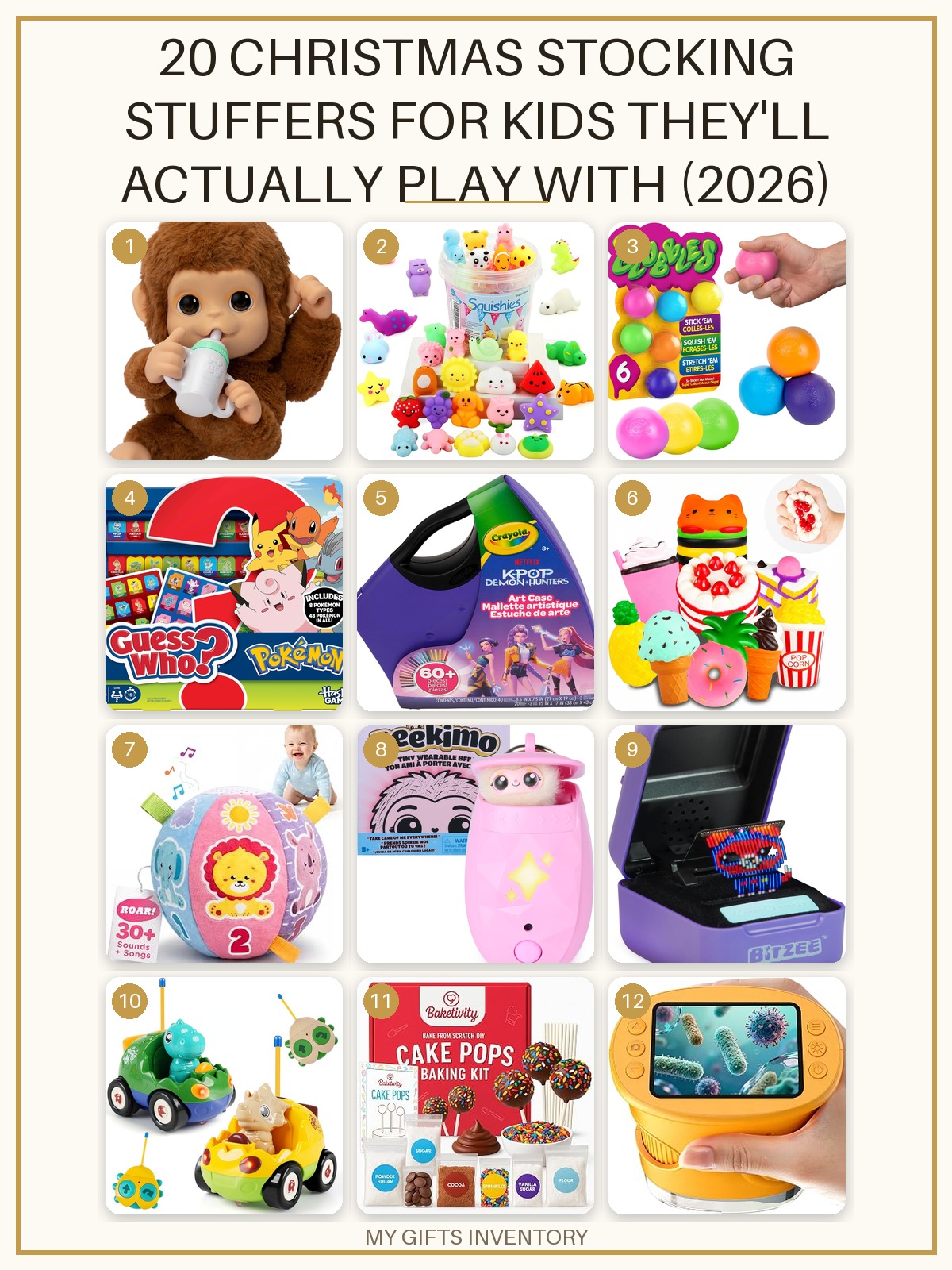

Shop Hand-Picked Gift Sets
Every item picked, priced and linked, ready to buy.

More Gift Advice