How Much to Spend on a Coworker Gift: A Real Budget Guide
From the $5 Secret Santa exchange to the boss who's leaving after ten years, here's how to figure out a coworker gift budget that feels right without overthinking it.

As an Amazon Associate, My Gifts Inventory earns from qualifying purchases. We only recommend products we'd genuinely consider buying ourselves.
You're standing in line at the store, or scrolling through options at your desk, trying to figure out a number that won't embarrass you either way. Too little and you look cheap in front of people you see five days a week. Too much and you've somehow made the whole office weird, or worse, started an unspoken arms race where everyone feels obligated to match you next year. The truth is there's a fairly narrow, well-established range most workplaces operate in, and once you know it, the anxiety mostly disappears.
The General Rule for Everyday Coworker Gifts
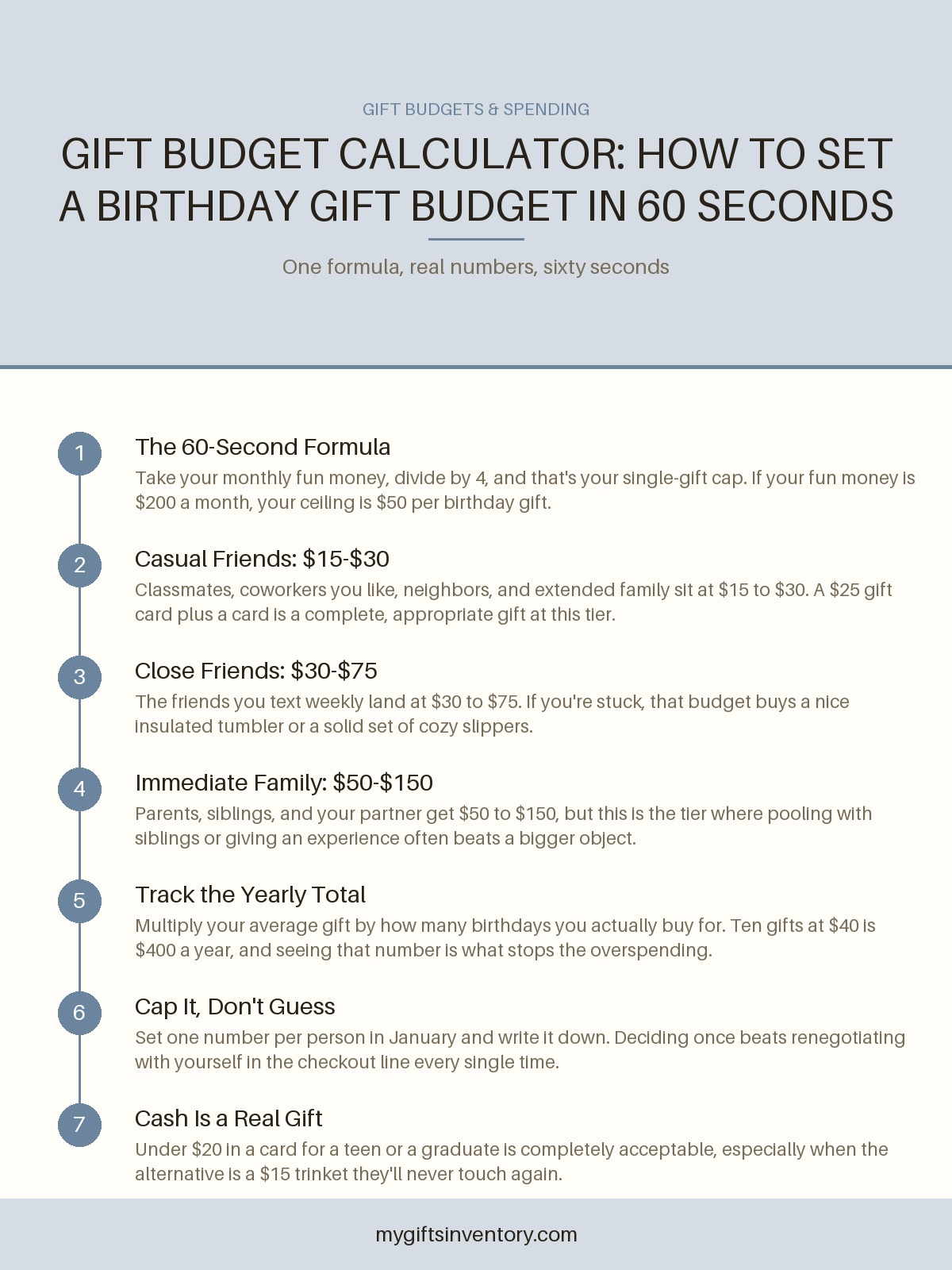
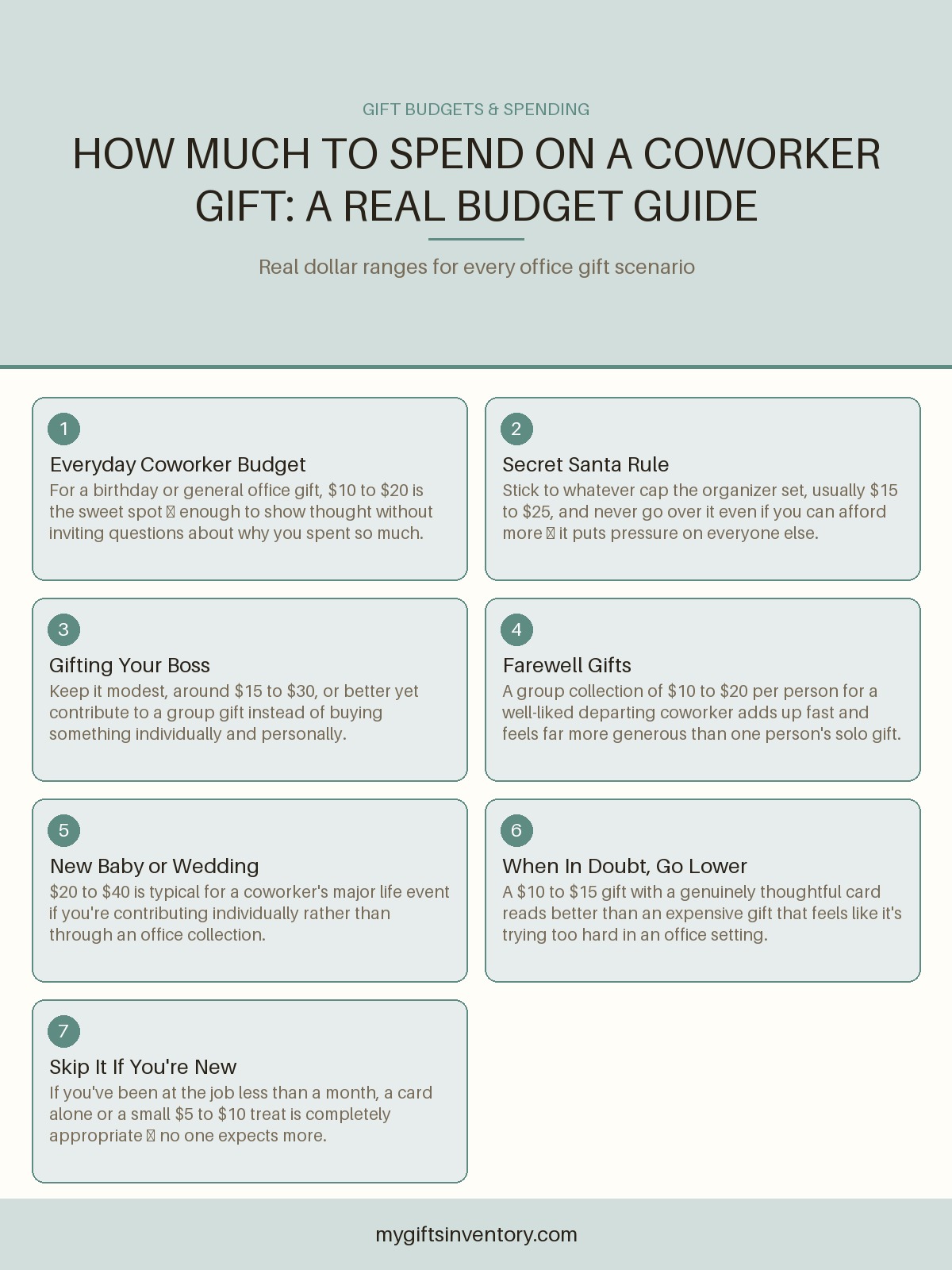
For a regular coworker birthday, a "just because" gift, or a small holiday token, $10 to $20 covers almost every situation. This range signals that you thought about the person without making anyone wonder if you're trying to buy favor or make a statement. Office relationships live in a specific gray zone: you're not close enough for a $75 gift the way you might be with a best friend, but you're friendly enough that a gift entirely without thought feels off too.
If you genuinely don't know the person well but everyone in the department is chipping in, $10 is a perfectly acceptable individual contribution. If it's someone you sit next to every day and actually know things about, like their coffee order or their kid's soccer schedule, you can lean toward the $20 end and pick something a little more specific to them.
Why $10 to $20 Works
This range exists for practical reasons beyond just tradition. It's low enough that nobody feels financially pressured to reciprocate at the same level, which matters in an office where salaries and personal budgets vary widely among people who technically hold the same job title. It's also high enough to clear the "did you just grab something from your desk drawer" test. A candle, a nice mug, a small box of good chocolate, or a $15 gift card all sit comfortably in this zone.
Office Gift Exchanges and Secret Santa
Secret Santa, White Elephant, and Yankee Swap exchanges almost always come with a stated spending cap, and the single most important rule here is simple: respect the cap exactly. If the organizer set a $20 limit, don't spend $35 because you found something you loved. Going over the limit doesn't read as generous in these exchanges, it reads as either showing off or making the person who drew your name feel bad about their own gift.
Typical caps we see in offices run:
- Casual or large-group exchanges: $10 to $15
- Standard department exchanges: $15 to $25
- Smaller, closer-knit teams: $25 to $40
If no cap was ever announced and you're not sure, ask whoever organized it rather than guessing. It's a completely normal question and organizers expect it. If you truly can't get an answer, default to $20, which is safely in the middle of what most offices set as their ceiling.
Gifting Your Boss or Manager
This is where budget questions get more loaded, because there's a real dynamic of a power imbalance at play. Spend too little and it can look like you didn't bother. Spend too much and it can come across as trying to curry favor, or worse, make your manager genuinely uncomfortable about accepting something expensive from someone they supervise.
The safest move is often a group gift. If several team members pool $5 to $10 each, you land on something in the $30 to $60 range collectively, which feels appropriately generous without any single person having spent an awkward amount. If you're giving individually, $15 to $30 is the ceiling we'd recommend. Many workplaces also have official policies against employees giving individual gifts to supervisors specifically to avoid the appearance of favoritism, so it's worth knowing your company's culture before you buy anything at all.
For ideas that read as professional rather than personal, our guide to corporate gift ideas under $50 that won't feel like an obligation is built exactly for this kind of gray-zone relationship, where you want something nice but not intimate.
Farewell and Retirement Gifts
When someone is leaving a job, whether they got a new opportunity or are retiring after twenty years, the group collection model is the norm. Someone in the office typically starts an email or a card circulating with an envelope, and $10 to $20 per person is standard for a coworker most people liked working with. For someone who was a manager, mentor, or particularly beloved figure in the office, contributions of $20 to $40 aren't unusual, especially if the group is smaller and everyone wants to go in on something more meaningful like a nice bag or a piece of jewelry.
If you're the one organizing the collection, set a suggested amount rather than a rigid number, something like "whatever feels right, most people are doing $10 to $15," so people at different income levels don't feel cornered into overspending.
Weddings, Babies, and Other Big Life Events
Coworker milestone gifts sit in a slightly higher bracket than everyday office gifts because they mark something genuinely significant in someone's life. If your office does a group card and collection, individual contributions of $10 to $20 are typical. If you're giving something separately and you're reasonably close with the person, $25 to $50 is a common range, similar to what you'd spend on a casual friend rather than a close one.
If the couple or new parents have a registry, it's worth checking before you buy anything specific, since a well-chosen registry item in the $25 to $40 range often means more than a generic gift at a higher price point. Our guide to choosing the perfect gift for any occasion walks through how to actually pick something meaningful rather than defaulting to the first thing you see.
Holiday Season Coworker Gifts
The winter holidays bring their own version of this question, usually multiplied by however many people are in your department. A reasonable approach is to separate people into two categories in your head: coworkers you're friendly with generally, and the two or three people you're actually close to at work. For the wider group, small $5 to $10 tokens like holiday cookies, a shared box of treats for the whole team, or a card are more than enough. For the smaller inner circle, $15 to $25 individual gifts are appropriate.
A low-effort, well-liked option across almost every office is something coffee-related, since it works for nearly everyone and doesn't require knowing someone's exact taste. Our roundup of gifts for coffee lovers under $50 has options across that whole holiday budget range, from small stocking-stuffer items to something nicer for a closer coworker.
Gift cards are also a completely acceptable holiday choice for coworkers, especially at the $15 to $25 mark, since they remove the guesswork entirely. If you go this route, a card to somewhere universally useful tends to land better than something too niche. It's worth double-checking the balance stays intact if it's ever a reloaded or shared office card, and pages like our Amazon gift card balance checker or Target gift card balance checker make that a thirty-second task rather than a guessing game.
What If You're New to the Job?
If you've been at a company less than a month or two, nobody expects you to participate at the same level as someone who's been there for years. A card alone, or a very small $5 to $10 gesture like bringing in donuts, is completely fine. Jumping in with an expensive individual gift right away can actually feel a little off to longtime coworkers, since it skips the normal progression of an office relationship. Ease in the first year and calibrate your spending to what you observe others doing.
When Less Is Actually More
One thing worth saying plainly: a lower-budget gift paired with a genuinely specific, well-written card almost always outperforms an expensive gift with no personal touch. If you're stuck between spending $10 with a thoughtful note or $30 on something generic, the $10 option wins every time in an office setting. Coworkers remember being seen and remembered far more than they remember the dollar amount.
Gift Ideas to Go With This



Want more ideas? Browse our full guide: 20 Best Gifts Under $100 (2026): Thoughtful Picks They'll Actually Use
Frequently Asked Questions
Is it rude to not give a coworker a gift at all?
No, it's not rude, especially if your office doesn't have an established gift-giving culture or you genuinely don't have the budget that season. A card, a verbal happy birthday, or simply signing a group card someone else organized is a completely normal and accepted level of participation.
How much should I spend on a Secret Santa gift?
Spend whatever the organizer set as the limit, which is typically $15 to $25 in most offices, and never exceed it. If no limit was set, ask the organizer directly rather than guessing, since going over an unspoken cap can make the person who drew your name uncomfortable.
Should I spend more on a coworker who's also a close friend?
Yes, if the friendship exists outside of work hours too, it's reasonable to treat that gift more like a friend gift than a coworker gift, often in the $25 to $50 range depending on your budget. Just keep in mind that other coworkers may see the gift, so something overly personal or expensive can occasionally spark office gossip.
Is a gift card too impersonal for a coworker?
No, a gift card in the $15 to $25 range is one of the most practical and appropriate coworker gifts, since it avoids guessing at personal taste. Choosing somewhere broadly useful, like a coffee shop or a general retailer, tends to land better than something too specific to your own preferences.
Do I need to give my boss a gift if the rest of the team is?
It's generally a good idea to participate at some level if a group gift is being organized, even a small $5 to $10 contribution, so you're not the one visibly opting out. Check whether your company has a policy against individual gifts to supervisors before buying something on your own.
Looking for an Actual Gift Instead?



Shop Hand-Picked Gift Sets
Every item picked, priced and linked, ready to buy.

More Gift Advice