How Much to Spend on a Teacher Gift: A Real Budget Guide
From a $10 holiday treat to a $150 pooled class gift, here's how much people actually spend on teacher gifts and why the right number depends more on school policy than your budget.
As an Amazon Associate, My Gifts Inventory earns from qualifying purchases. We only recommend products we'd genuinely consider buying ourselves.
You're standing in the card aisle with a gift card in one hand, wondering if $10 looks cheap and $50 looks like you're trying to buy your kid a better seat in the classroom. Or maybe the class parent just sent an email asking everyone to "chip in" and you have no idea if that means $5 or $25. The anxiety here isn't really about money. It's about not knowing the unwritten rules, and worrying that whatever you pick will read the wrong way.
The good news is that teacher gift spending has a pretty clear range once you know what occasion you're dealing with and what your school actually allows. Here's how to land on a number that feels right without overthinking it for three days.
The Short Answer
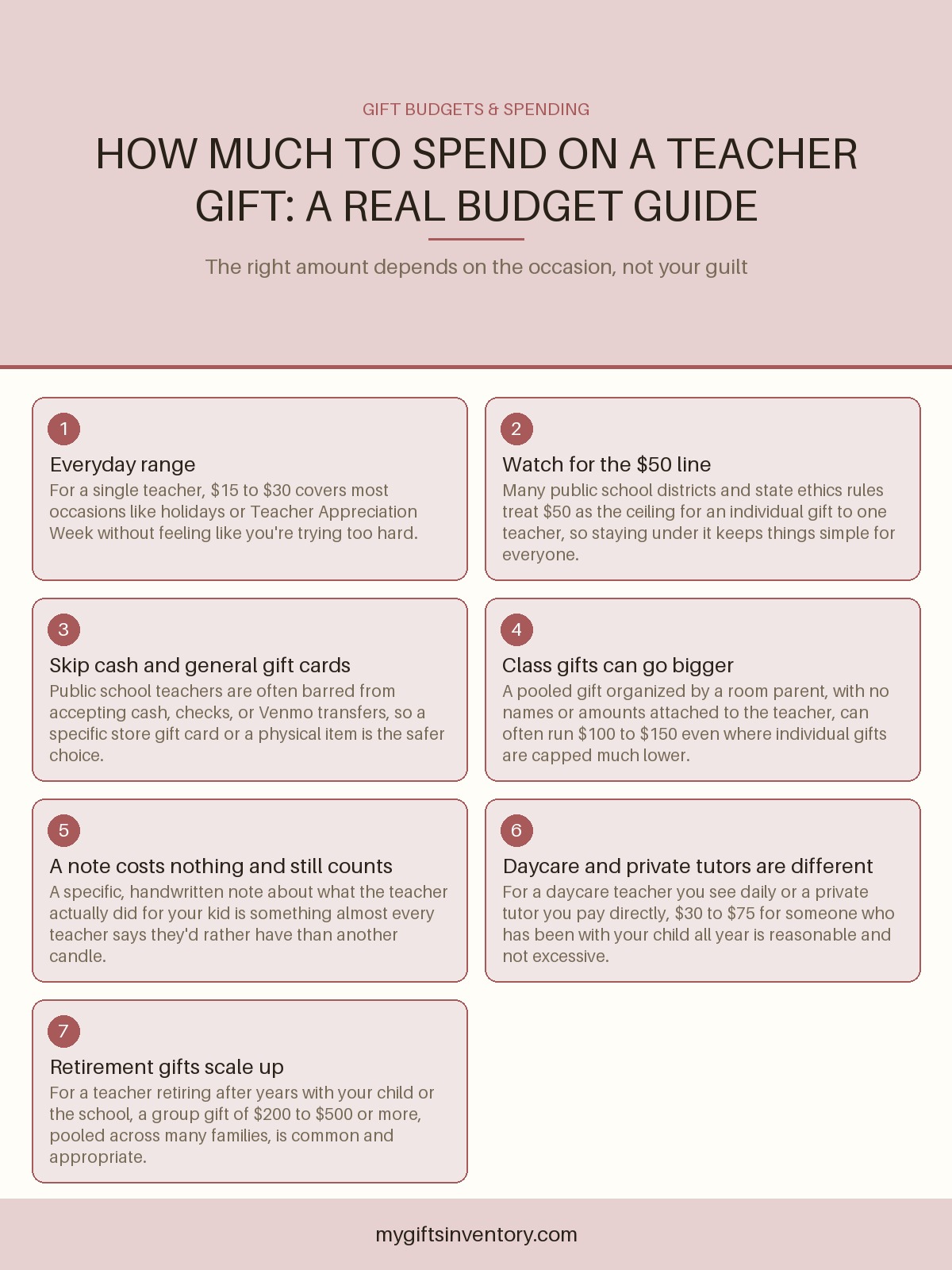
For most everyday teacher gifts, from a single family to a single teacher, $15 to $30 is the sweet spot. That covers a nice coffee mug set, a small gift card, or a thoughtful item without looking like you're trying to influence a grade or make a statement. Go lower, $5 to $15, for smaller gestures like a first-day-of-school treat or a quick thank-you at parent-teacher conferences. Go higher, $50 to $150, only for pooled class gifts, milestone moments like retirement, or private tutors and coaches you pay directly.
The one number worth remembering is $50. A lot of school districts and even some state ethics laws use that figure as an informal ceiling for what one family can give one teacher before it needs to be disclosed or starts to raise eyebrows. Staying comfortably under it, somewhere in the $20 to $40 range, is a safe zone for almost any occasion.
How Much to Spend, by Occasion
Holiday Gifts (Winter Break, Hanukkah, Christmas)
This is the big one every December, and it's also where people overspend the most because it feels like "the" teacher gift of the year. In reality, $20 to $35 per family is generous and appropriate for a single homeroom or subject teacher. If your child has six different teachers in middle or high school, you are not expected to spend that much six times over. A lot of families scale back to a $10 to $15 token, like a nice candle or a gift card to a coffee shop, when there are multiple teachers to cover.
Teacher Appreciation Week (Usually Early May)
This week is built around small, frequent gestures rather than one big spend. Think $10 to $20 total across the week, often split into a few smaller touches like a coffee gift card on Monday and a handwritten card on Friday, rather than one expensive item. Schools frequently organize this as a group effort anyway, with a sign-up sheet for snacks or a shared gift, so your individual outlay is often closer to $5 to $10.
End of the School Year
This is typically the largest individual teacher gift of the year because it's a thank-you for the whole year, not one event. $25 to $50 is the common range for a single family thanking one teacher, especially at the elementary level where your child has spent all day with the same person for nine months. If you're also pitching in on a group gift, it's fair to bring your individual spend down to $15 to $25 and let the pooled portion cover the rest.
First Day of School
Optional and small. $5 to $10 for something like a "welcome back" treat or classroom supply is plenty, and plenty of families skip this one entirely. Nobody keeps a scorecard on the first-day gesture the way they might for the year-end one.
Teacher Retirement or Leaving the School
This is the one occasion where spending more makes sense, especially if it's pooled. A group gift of $200 to $500 or more across an entire class or grade, put toward something like a nice piece of jewelry, a travel fund, or a framed collection of notes from students, feels appropriately celebratory for someone closing out a career. If you're contributing individually rather than through a pool, $20 to $40 is still a fair personal contribution.
Individual Gift vs. Class Gift: Why the Number Changes
One of the biggest sources of confusion is that "how much should I spend" has two different answers depending on whether you're giving alone or as part of a group.
An individual gift from one family, given directly and attributable to you, tends to top out around $25 to $50 for good reason: many public school ethics policies specifically limit how much value one family can give one teacher before it needs to be logged or disclosed. A single family showing up with a $200 gift to one teacher can genuinely put that teacher in an awkward position with their administration, even if your intentions were purely grateful.
A class gift works differently. When a room parent collects small contributions, often $5 to $15 per family, and pools them into a single unattributed gift, the total can legitimately reach $100 to $150 or more without anyone flagging it, because no single family's name or amount is tied to the total. This is exactly why "chip in $10" emails exist: it lets a class give a teacher something meaningful, like a nice gift card or a classroom fund, while keeping everyone's individual contribution well within a comfortable range. If you'd rather understand the general etiquette behind pooled and individual giving across other relationships too, our guide to choosing the perfect gift covers how to read a group's expectations before you commit to a number.
Why Schools Actually Have Rules About This
It can feel strange that there are rules at all around something as simple as saying thank you, but the reasoning is straightforward once you see it laid out. Public school teachers are considered public employees in most states, and conflict-of-interest laws exist to prevent the appearance that a gift might influence a grade, a recommendation letter, or classroom treatment. Massachusetts law, for example, prohibits gifts worth $50 or more given to public employees "because of the position they hold, or because of some action they could take or have taken in their position," while allowing gifts under that threshold with disclosure in certain cases. Many districts elsewhere set their own informal ceiling around $50 as well, and some go lower, with a few individual district policies capping personal gifts at $10 to $25. Cash is treated more strictly than physical items almost everywhere. Even a small cash gift or a general-use gift card can be off-limits for a public school teacher, since it reads less like a token of appreciation and more like a direct payment. A store-specific gift card to somewhere like a coffee shop or bookstore is usually fine, but a blank Visa or Mastercard gift card can land in a gray area depending on the district. If you'd like to give a gift card and want the teacher to be able to check what's left on it easily, cards from places like Target or Amazon tend to be the safest and most flexible bets since they cover almost anything a teacher might want to buy for themselves or the classroom.
Class gifts get more leeway than individual ones specifically because no single family can be identified as the source, which removes the appearance-of-influence problem entirely. This is also why donating supplies directly to a classroom, rather than giving a personal gift to the teacher, sidesteps most of these rules altogether. Many teachers keep an Amazon wish list or a supply list for exactly this reason, since it lets families give generously without anyone bumping into a personal gift cap.
Private School, Daycare, and Tutors Are a Different Calculation
Everything above is really about public school ethics rules, and private schools, daycares, and independent tutors don't operate under the same restrictions. That changes the math a bit.
Daycare and Preschool Teachers
These are often the people who spend more one-on-one time with your child than almost anyone outside your family, sometimes 40 hours a week. It's common and appropriate to spend a bit more here, in the $25 to $75 range for the year-end or holiday gift, especially if you're only giving to one or two lead teachers rather than a whole staff.
Private Tutors and Coaches You Pay Directly
Since these relationships are already a paid arrangement rather than a public employment one, gift rules mostly don't apply, and a nicer gift feels earned. $50 to $100, or the equivalent of one session's fee, is a reasonable holiday or end-of-year gesture for someone who has worked closely with your child over months.
Private School Teachers
Private schools set their own policies rather than following state ethics law, and many have no gift limit at all. Ask the front office if you're unsure, but in practice families at private schools often land in a similar $20 to $50 range purely out of good taste, even without a legal ceiling forcing the number down.
What to Do If You're on a Tight Budget
Spending less doesn't mean the gesture means less. A specific, handwritten note describing one real thing the teacher did, like staying late to help with a hard math unit or noticing your kid was having a rough week, is something teachers consistently say they value more than another mug or candle. It costs nothing and takes ten minutes.
If you want to give something small alongside the note, a $5 to $10 gift card to a coffee shop, or a homemade treat, covers the gesture without stretching your budget. Homemade and unwrapped items like a plate of cookies typically fall outside any gift-value rule entirely, since they carry no real resale value. And if a class-wide pool is happening, contributing your $5 or $10 share is a perfectly complete way to participate even if you can't manage anything on top of it.
For families juggling gifts across a lot of different relationships this time of year, not just teachers, it helps to think of this the same way you'd think about corporate gift budgets that don't feel like an obligation: a modest, well-chosen gift given warmly reads better than an expensive one given out of guilt.
Ideas That Fit the Common Ranges
If you're trying to land in the $15 to $30 zone that covers most occasions, something practical and consumable tends to land well since it doesn't add clutter to a desk that's probably already full of mugs. A good coffee gift under $50 is a reliable, well-liked choice for exactly this reason; teachers run on caffeine more than almost any profession, and a nice bag of beans or a coffee shop gift card gets used immediately instead of sitting on a shelf.
Gift Ideas to Go With This


Want more ideas? Browse our full guide: 20 Best Gifts Under $100 (2026): Thoughtful Picks They'll Actually Use
Frequently Asked Questions
Is $20 too little for a teacher gift?
No, $20 is right in the normal range for most teacher gift occasions, including holidays and end of year. Many families spend less than that, especially when a class has multiple teachers to cover or when a group gift is also happening alongside it.
Can teachers accept cash gifts from parents?
In most public schools, no. Cash, personal checks, and digital transfers through apps like Venmo are typically treated as off-limits for public school teachers even in small amounts, since they read more like direct payment than a token of appreciation, while a physical gift or gift card of the same value is usually fine.
How much should a class chip in for a group teacher gift?
A common ask is $5 to $15 per family, which pools into a total gift often in the $100 to $150 range depending on class size. This works because the gift is presented as coming from "the class" as a whole rather than any one family, which is exactly what keeps it within most school policies even though the total is higher than any individual gift cap would allow.
Do I need to give every teacher my child has a gift?
No, it's completely optional and most families don't give equally to every single teacher, especially in middle and high school where a student might have six or seven of them. It's common to give a modest gift to a homeroom teacher or one or two teachers your child felt especially connected to, and a card or verbal thank-you to the rest.
Is a gift card a good teacher gift or does it feel impersonal?
A gift card is a genuinely good choice as long as it's for a specific store rather than a blank prepaid card, since many districts treat store-specific cards more like a physical item than cash. Pairing it with a short handwritten note naming something specific the teacher did well removes any impersonal feeling almost entirely.
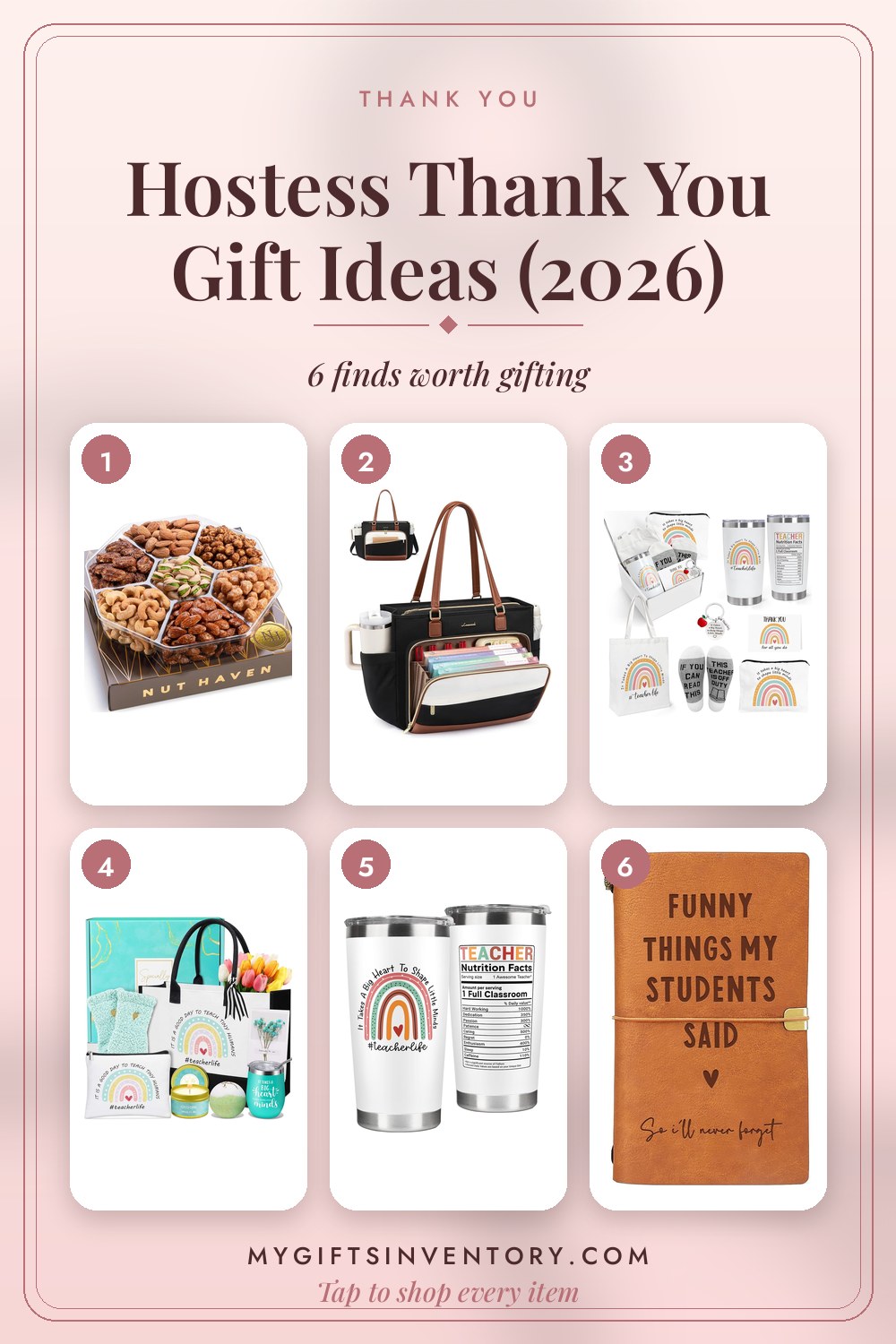
Looking for an Actual Gift Instead?




Shop Hand-Picked Gift Sets
Every item picked, priced and linked, ready to buy.


More Gift Advice