How to Choose the Best Corporate Gifts Under $50: A Practical Checklist
A real-world system for picking client and employee gifts under $50 that land well, stay on budget, and don't look like a procurement afterthought.
As an Amazon Associate, My Gifts Inventory earns from qualifying purchases. We only recommend products we'd genuinely consider buying ourselves.
You have a list of 40 clients, 12 employees, or one very important account, and a hard ceiling of $50 a head. Now the real question: what do you actually buy that won't end up in a drawer by February? We have watched enough corporate gifts get opened and forgotten to have opinions about this, and the short version is that the best ones are useful, modest, and arrive with a human note attached. Everything else is packaging.
Start With the Number, Not the Gift
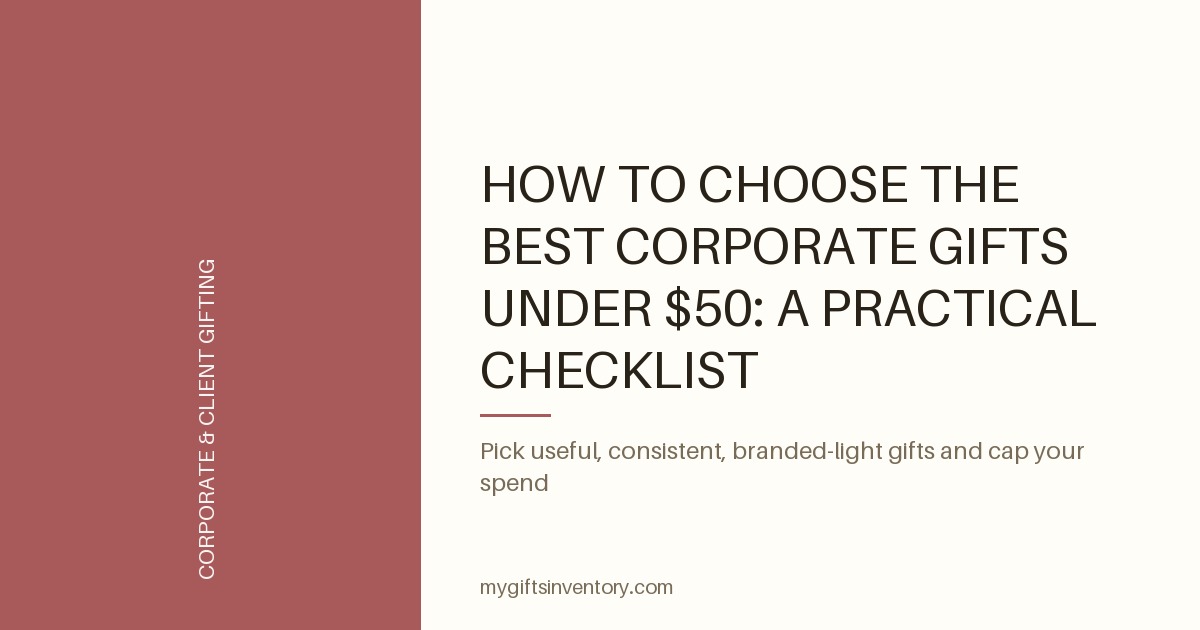
The $50 cap is a ceiling, not a target. If you spend $50 on the object, you have nothing left for the card, the box, or the $9 shipping label, and your real cost per recipient lands at $62 when finance asks. Most companies that do this well land somewhere between $25 and $40 per person on the item itself.
Here is a working allocation for a $50-per-person program:
- $25 to $38 for the gift itself
- $3 to $6 for packaging or a gift box, if the item doesn't come presentable
- $2 to $4 for a decent card and envelope (skip the folded printer paper)
- $4 to $8 for shipping or hand delivery, if applicable
That puts you at $34 to $56 all in, which is why $30 to $35 per item is the practical sweet spot. It gives you access to genuinely nice versions of everyday things rather than the cheap end of luxury categories, which is a much better trade. Nobody has ever resented a $32 water bottle. Plenty of people have quietly wondered why they got a $48 branded paperweight.
Client gifts and employee gifts are different budgets
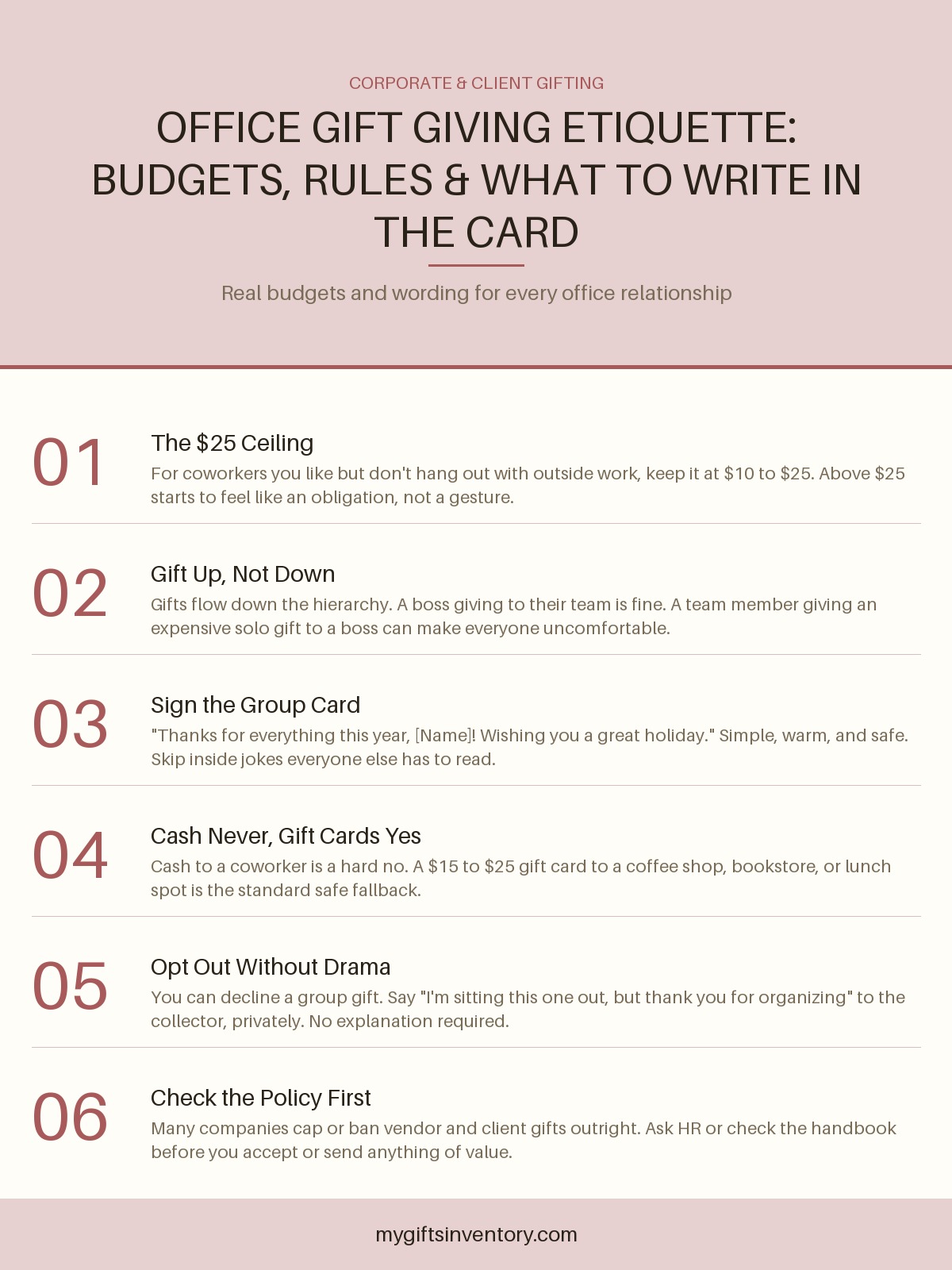
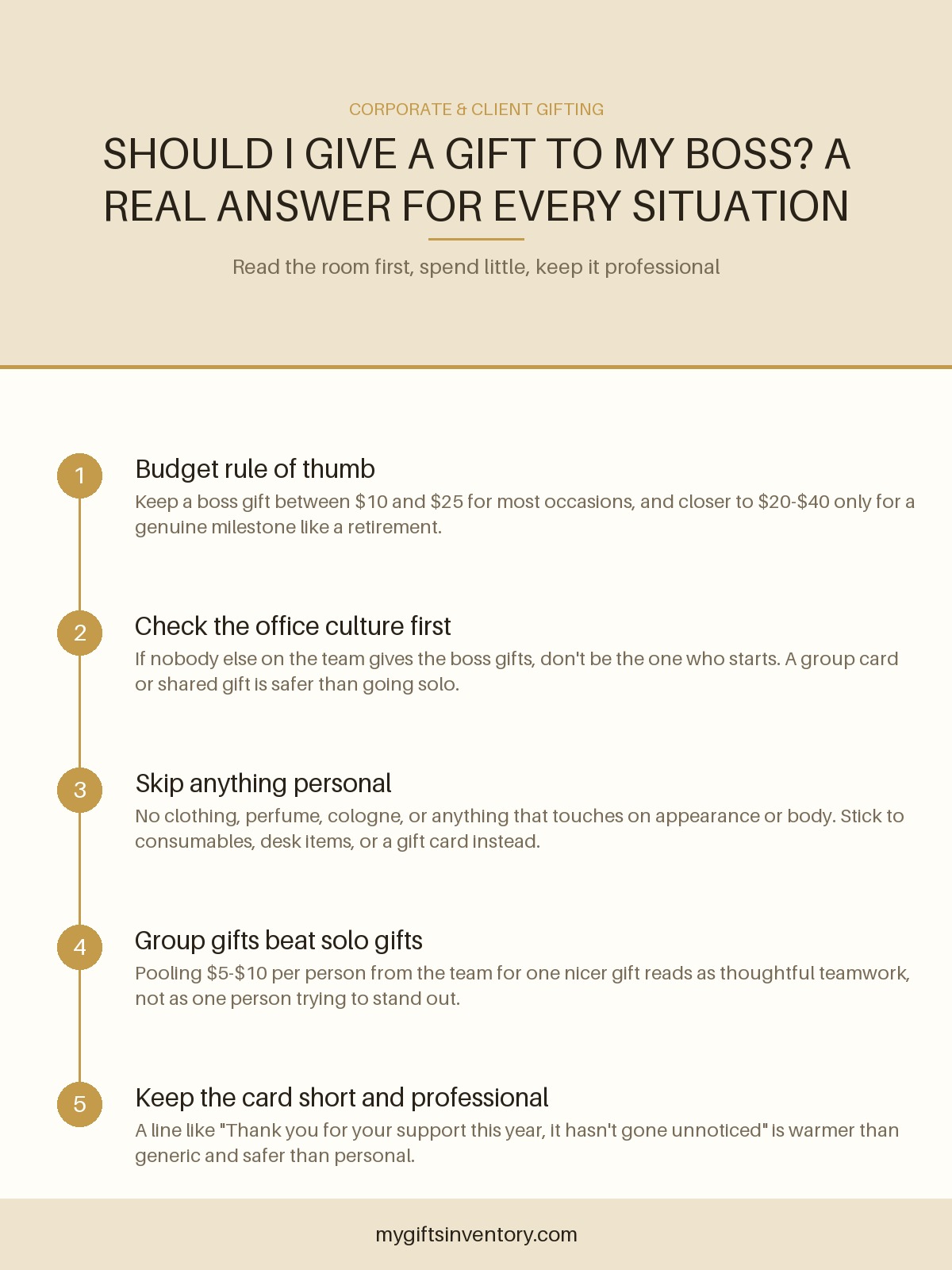
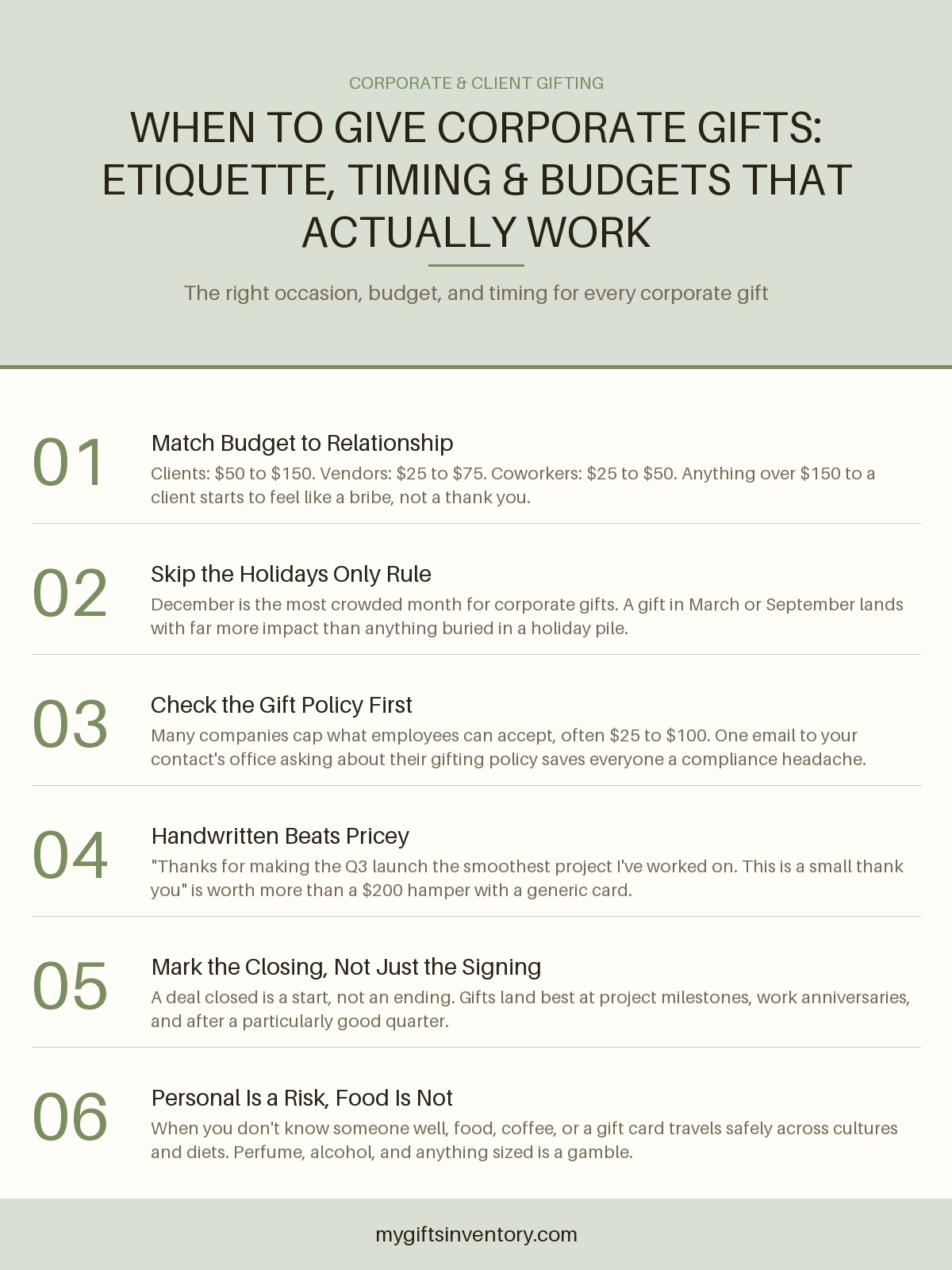
Client gifting usually has a compliance dimension: many organizations have internal rules about what employees can accept, and some industries cap it lower than $50. Public sector and healthcare clients often can't accept anything of meaningful value, so a food item shared with the whole office or a card is safer. Employee gifts are simpler on the rules side but harder on the fairness side, since everyone sees what everyone else got.
The Five-Point Checklist We Actually Use
Before anything goes on the approve list, it has to pass all five of these. If it fails one, it's out.
1. Would a person buy this for themselves?
Not "would they admire it," not "is it tasteful." Would they spend their own money on it within the next year. A rechargeable hand warmer, a good notebook, a set of nice pens, a compact umbrella that doesn't invert in wind: yes. A crystal paperweight, a leather coaster set, a mini desk Zen garden: no.
2. Is the logo small enough to ignore?
Branding on a gift should be a quiet signature, not a billboard. A small embossed mark on the base, inside the lid, or on the card is the right amount. If the recipient's first reaction is "this is a promotional item," the money is wasted regardless of what you spent. Discreet beats loud at every price point, and it matters more the higher you go.
3. Does it survive shipping?
Glass, ceramics, and anything with a liquid inside is a gamble if you're mailing 200 of them. Multiply your breakage risk by your headcount and you'll see why sturdy, unbreakable items dominate good corporate gift programs. It also means you can use standard shipping instead of paying for special handling.
4. Is it one-size-fits-everyone?
Food, drink, and desk items are safe across a whole roster. Clothing, fragrance, and anything size-dependent are not, unless you're collecting sizes in advance and are prepared for the two people who don't answer. If you want apparel, a hat is one of the few genuinely low-risk options since it adjusts: a simple men's baseball hat at $14.99 works for a casual team gift and leaves plenty of budget for a card and a bonus snack.
5. Can you explain the pick in one sentence?
"We got you a heated back massager because half the team mentioned their desks wreck their backs" is a sentence. "We got you this because it was in the catalog" is not. If you can't write the one-liner, the gift is generic, and generic is the thing you're trying to avoid.
Category Picks That Reliably Land Under $50
We've grouped these by the kind of recipient, which is how most people actually shop once the list is in front of them.
For clients you want to keep
Go consumable and shareable. Good coffee, a nice tea assortment, a box of real chocolates, a bottle of wine if the relationship and the recipient's organization allow it. Consumables have two advantages: they get used, and they don't create clutter, which is exactly what a client with a full office doesn't need. Our guide to smooth coffee gifts under $50 is a good starting point if you want something more interesting than a standard sampler.
For employees at their desks
This is where practical gear wins. A cordless heated pad for the chair, a decent portable charger, a compact measuring tool for anyone in operations or facilities, a solid insulated cup. A cordless heating pad with massager at $36.08 is the kind of thing people mention unprompted a month later, which is the real test. If your team skews toward field or trade work, a pocket-size laser measuring tool at $29.98 reads as genuinely thoughtful rather than corporate.
For the holiday season specifically
If your gifting happens in December, the constraints change: shipping deadlines, backorders, and the general chaos of every vendor at once. We keep a full list of Christmas gifts for coworkers between $25 and $50 that avoids the usual tin-of-cookies problem. And if you're still deciding between categories rather than specific items, our broader roundup of 21 corporate and employee gift ideas under $50 covers a wider range, from desk gear to food to experiences.
For the person who has everything
Give an experience or a gift card, and do it without apology. A $40 gift card to a local coffee roaster or a restaurant the person actually likes beats a $40 object they'll re-gift. The etiquette here is straightforward: a gift card is a fine corporate gift as long as it's specific enough to feel chosen, not generic. If you go that route, make sure you know how recipients can check the balance, since a card someone can't easily use is worse than nothing. Our Trader Joe's gift card balance guide is the kind of thing worth having on hand if you're sending grocery or food cards to a distributed team.
Set a Tier System So Nobody Feels Slighted
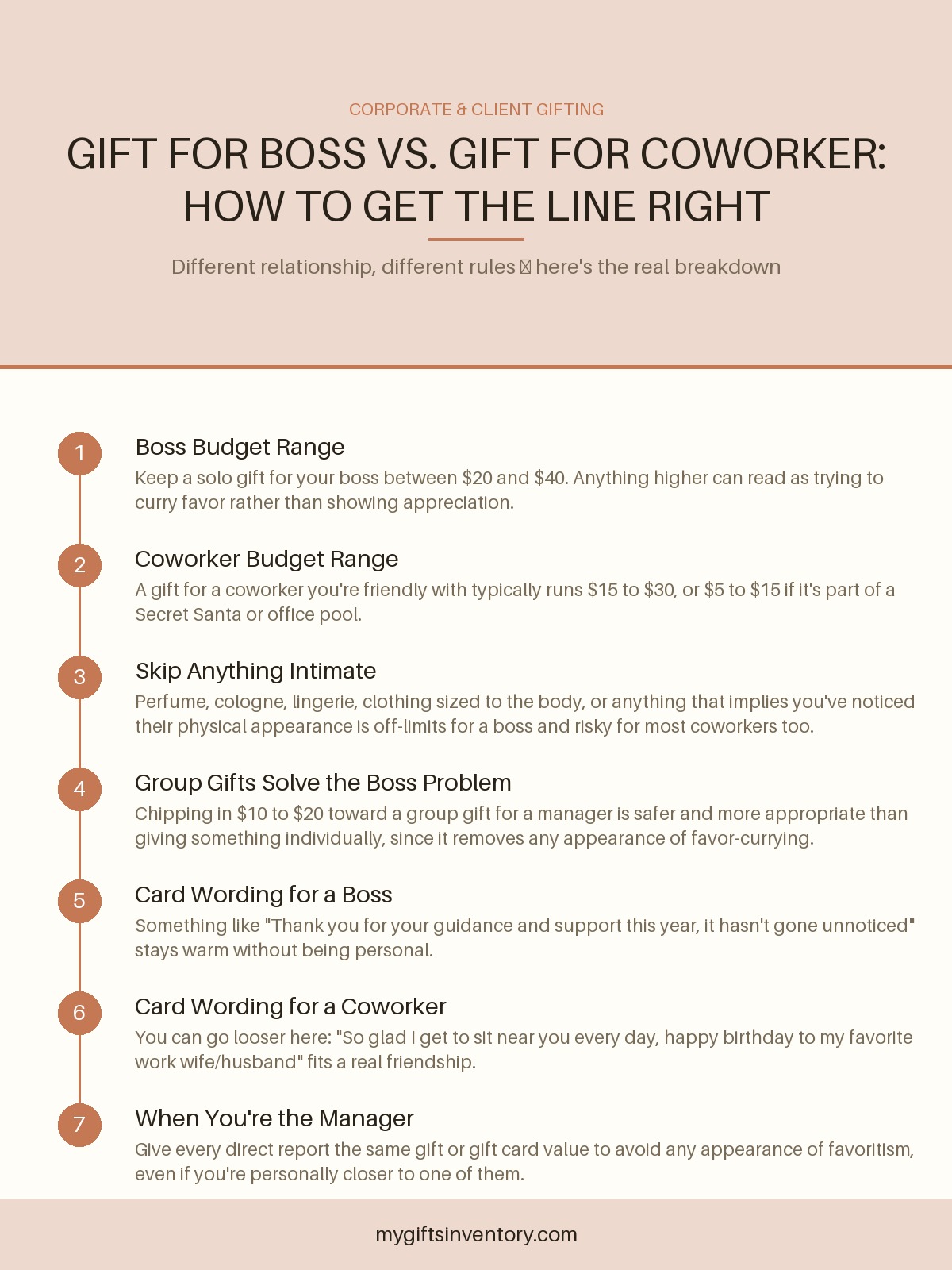
The fastest way to turn a nice gesture into an HR conversation is inconsistent spending. Two people at the same level, same tenure, getting gifts that cost $22 and $48 respectively, will notice. So build tiers before you shop, and write them down.
A simple, defensible structure:
- Tier 1, all employees: $20 to $30. Something everyone gets, no exceptions. Consistency matters more than the item.
- Tier 2, milestone or tenure: $30 to $45. Five-year anniversaries, project completions, above-and-beyond moments.
- Tier 3, key clients and partners: $40 to $50, with the compliance check done first.
Within a tier, let people choose between two or three options. Choice solves most of the "I don't drink coffee" and "I already have three water bottles" problems, and it costs you nothing to offer. It also removes the awkwardness of a gift that clearly wasn't thought about, because the recipient picked it.
What to Write in the Card (With Real Wording)
The card does more work than the gift. A $20 item with a specific, sincere note beats a $50 item with a printed "Thank you for your partnership." Here is wording that works, matched to the situation.
To a client
"Thank you for a genuinely good year of working together. The [specific project] launch went smoothly because your team was on top of it from day one. Enjoy the holidays." Two sentences, one specific detail, done.
To an employee
"Thanks for covering the [project] crunch in March. I know that wasn't fun and it made a real difference. Hope this makes your desk a little more comfortable." Naming the specific thing is the entire trick.
To a whole team
"Thanks for a strong year. This one's small, but it's the good kind of coffee. Enjoy it on us." Short, warm, no corporate throat-clearing.
Things to avoid: "valued stakeholder," "synergy," any sentence longer than the gift is worth, and anything that sounds like it was written by a committee. If you're writing 60 cards, write three or four templates with a blank for a specific detail, and fill in the detail by hand. That detail is the whole point.
Packaging, Timing, and the Stuff People Forget
A few operational details separate a smooth program from a scramble.
Timing
Place your main order by the third week of October for December gifting. Custom or branded items routinely take three to five weeks, and anything ordered after the second week of November risks rush fees that can add 15 to 30 percent, which eats directly into your per-person budget. If you're shipping to individual home addresses (common for remote teams), add a week and confirm addresses in early November, not December 15.
Packaging
You don't need elaborate. A simple kraft box with tissue and a card looks intentional and costs a few dollars. What you want to avoid is the item arriving in the manufacturer's retail box with a shipping label slapped on it, which reads as "we ordered this from a warehouse and forgot about you." A $3 box fixes a $30 problem.
Tax and compliance, briefly
In the U.S., business gifts to clients are generally deductible up to $25 per recipient per year, while employee gifts are treated differently and are often deductible as a business expense (and sometimes taxable to the employee depending on value and type). The rules shift, so check with your accountant rather than trusting a blog, including this one. The practical takeaway: keep receipts itemized per recipient, and loop in finance before you buy, not after.
A Short Pre-Purchase Checklist
Run every candidate gift through this before you click buy:
- Does it pass all five checks above?
- Is the all-in cost under $50, including packaging and shipping?
- Is it consistent with what everyone else at that tier is getting?
- Have I confirmed the recipient can accept it, if they're a client in a regulated industry?
- Do I have the card wording written, with a specific detail for each person?
- Is the order placed before the shipping cutoff?
If you can answer yes to all six, you're done. The gift will be fine, the budget will hold, and nobody will be quietly re-gifting it in March.
Gift Ideas to Go With This


Want more ideas? Browse our full guide: 21 Corporate & Employee Gift Ideas Under $50 (2026) That Won't Feel Like an Obligation
Frequently Asked Questions
What is a reasonable budget for corporate gifts under $50?
Aim to spend $25 to $40 per person on the item itself, which leaves room for packaging, a card, and shipping to keep your all-in cost near $50. Spending the full $50 on the object usually means the extras push you over budget.
Are gift cards acceptable as corporate gifts?
Yes, as long as they're specific enough to feel chosen rather than generic. A $40 card to a coffee roaster or a restaurant the recipient actually likes reads as thoughtful; a generic prepaid card reads as a cop-out. Make sure recipients can easily check the balance so the card doesn't become a hassle.
Should employee gifts all be identical?
Not necessarily. Spend roughly the same amount on everyone at a given tier, but offering two or three options within that budget solves the "I don't drink coffee" problem and makes the gift feel considered rather than mass-ordered.
How far in advance should I order corporate gifts?
Place your main order by the third week of October for December gifting. Custom and branded items typically take three to five weeks, and orders placed after the second week of November risk rush fees of 15 to 30 percent that eat into your per-person budget.
Is it okay to put a company logo on a gift?
Yes, if it's small and discreet, like an embossed mark on the base or a logo on the card. A large logo across the front turns the gift into advertising, and recipients immediately notice the difference between a gift and a promotional item.
Looking for an Actual Gift Instead?
Shop Hand-Picked Gift Sets
Every item picked, priced and linked, ready to buy.
More Gift Advice