Corporate gift giving etiquette: budgets, card wording, timing, and what to avoid
We cover how to choose the right level of effort, set a budget that won’t backfire, and write card messages people actually want to read.

As an Amazon Associate, My Gifts Inventory earns from qualifying purchases. We only recommend products we'd genuinely consider buying ourselves.
When we are asked to “do corporate gifts,” it usually comes with a second, quieter worry: What if we pick something that feels weird, too personal, or too small to be taken seriously? And what if we miss the timing so the gesture lands at the wrong moment? We built this guide for the exact anxiety behind the search: getting corporate gift giving right without turning it into a stressful project or an awkward exchange.
Corporate gift giving etiquette we actually use
Corporate gifting etiquette is less about following strict rules and more about protecting boundaries. We aim for three things: respect the relationship, match the level of formality, and make it easy for the recipient to receive the gift without interpretation. That means we think about workplace culture, company policies, and the “hidden message” a gift can send.
Start with your context: internal, external, or client-facing
Before we pick a gift type, we sort the relationship into one of three buckets, because etiquette changes fast once money, hiring power, or ongoing negotiations get involved.
- Internal (team members, managers, peers): Typically more flexible. The gift can recognize milestones, gratitude, or team culture.
- External (clients, partners, vendors): More careful. We avoid anything that could look like an attempt to influence decisions.
- High-sensitivity situations: If there is an active contract discussion, performance evaluation, or procurement involvement, we keep it simple, modest, and aligned with any written policy.
Check company policy first when it involves decisions
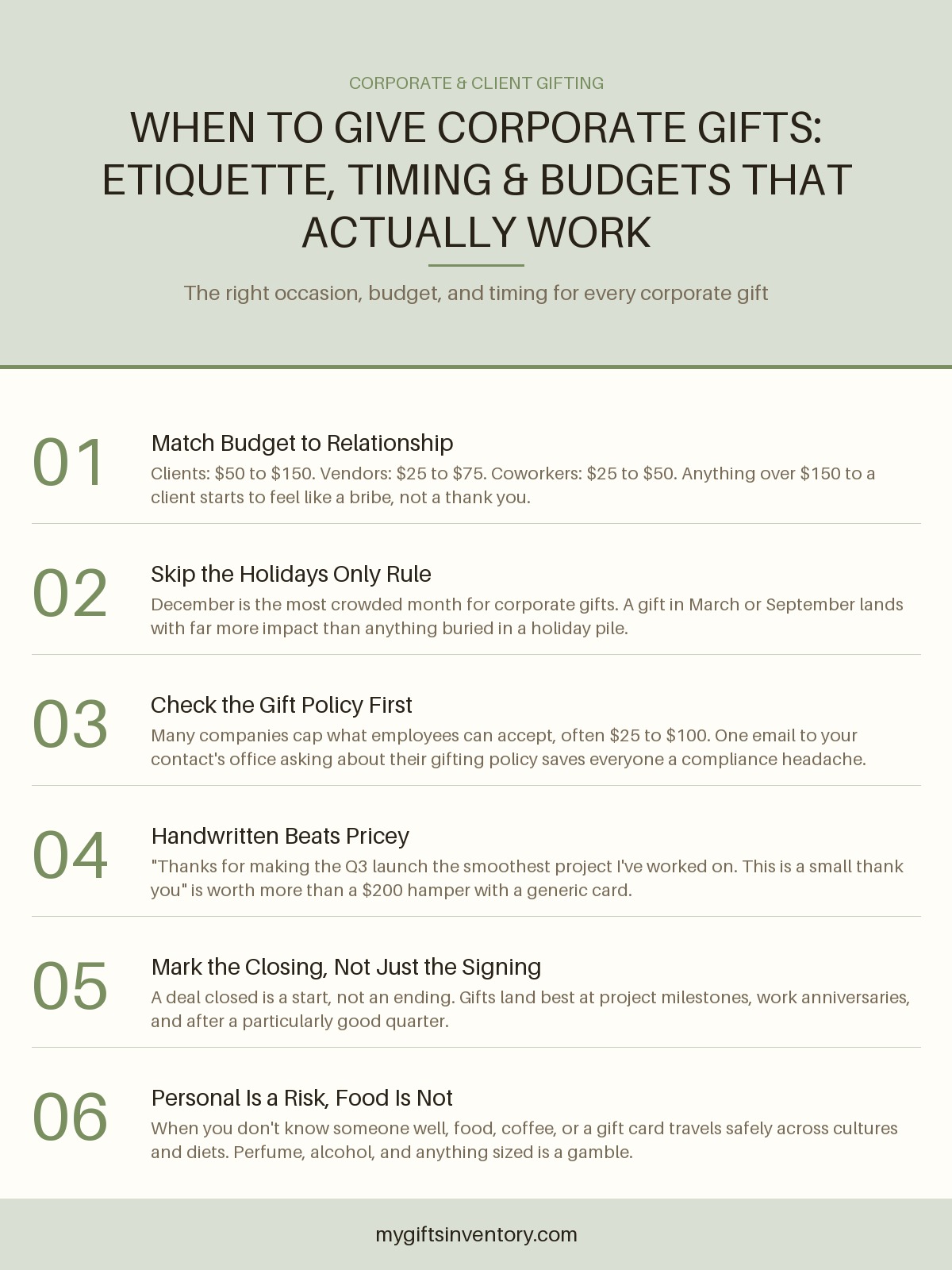
If we are in a role that touches procurement, sales negotiations, hiring, or renewals, we treat gifting as a compliance question before it becomes a lifestyle question. Many organizations have limits, approved categories, or timing rules. If there is no policy, we still operate with the same principle: keep the gift modest, consistent, and clearly framed as appreciation.
Budgets for corporate gifts: what feels appropriate
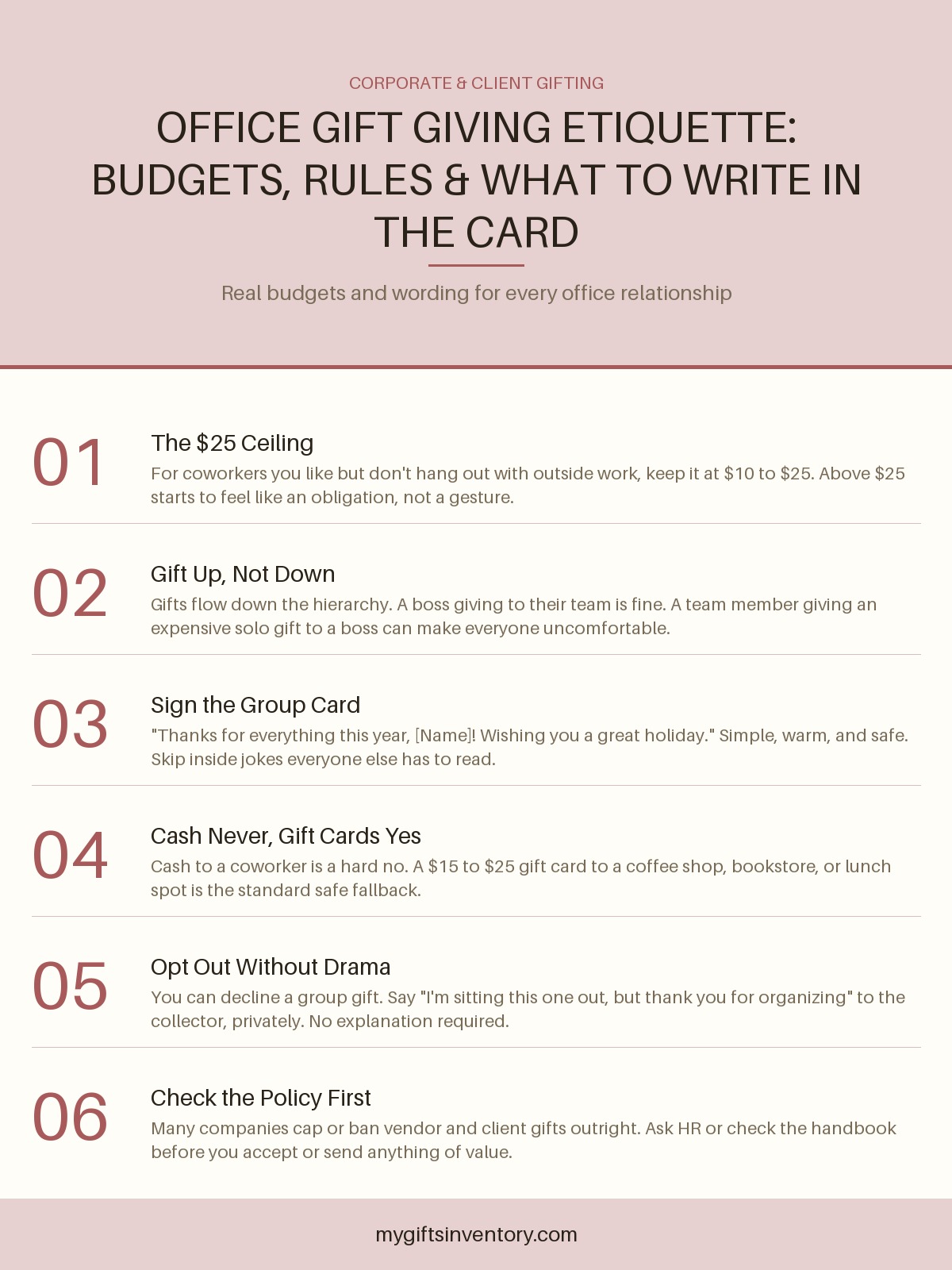
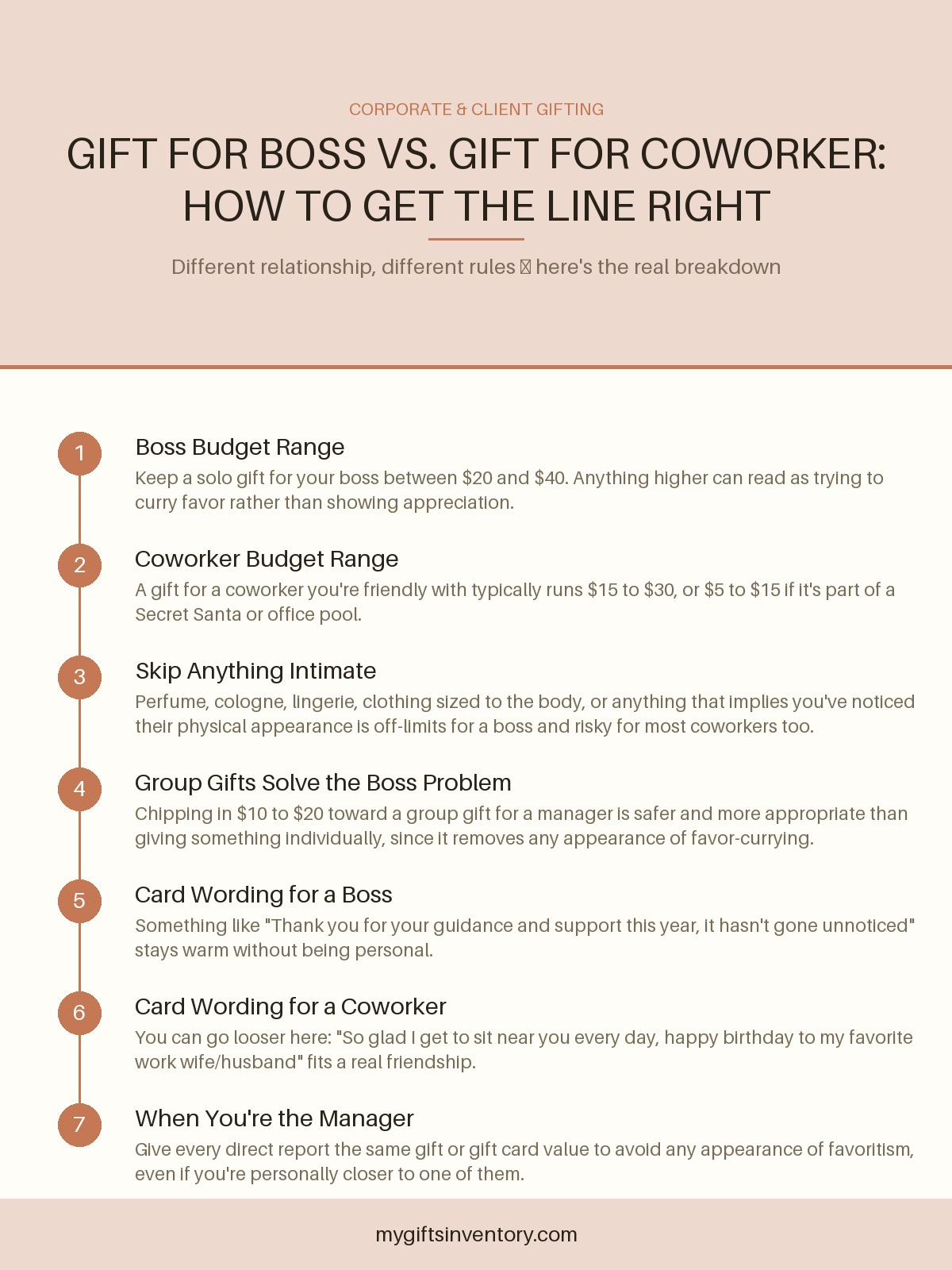
Budget is where most awkwardness starts. People read value as intent. If we are too low, it can feel dismissive. If we are too high, it can feel like we are trying to buy favor. The best budget is usually the one that matches the relationship and the norms of your workplace.
A practical budgeting guide by relationship
Here are ranges we commonly see work for U.S. corporate settings, assuming the recipient is an adult professional and the gift is non-cash unless you are using a gift card option.
- Peer-to-peer within the same team: $20 to $75
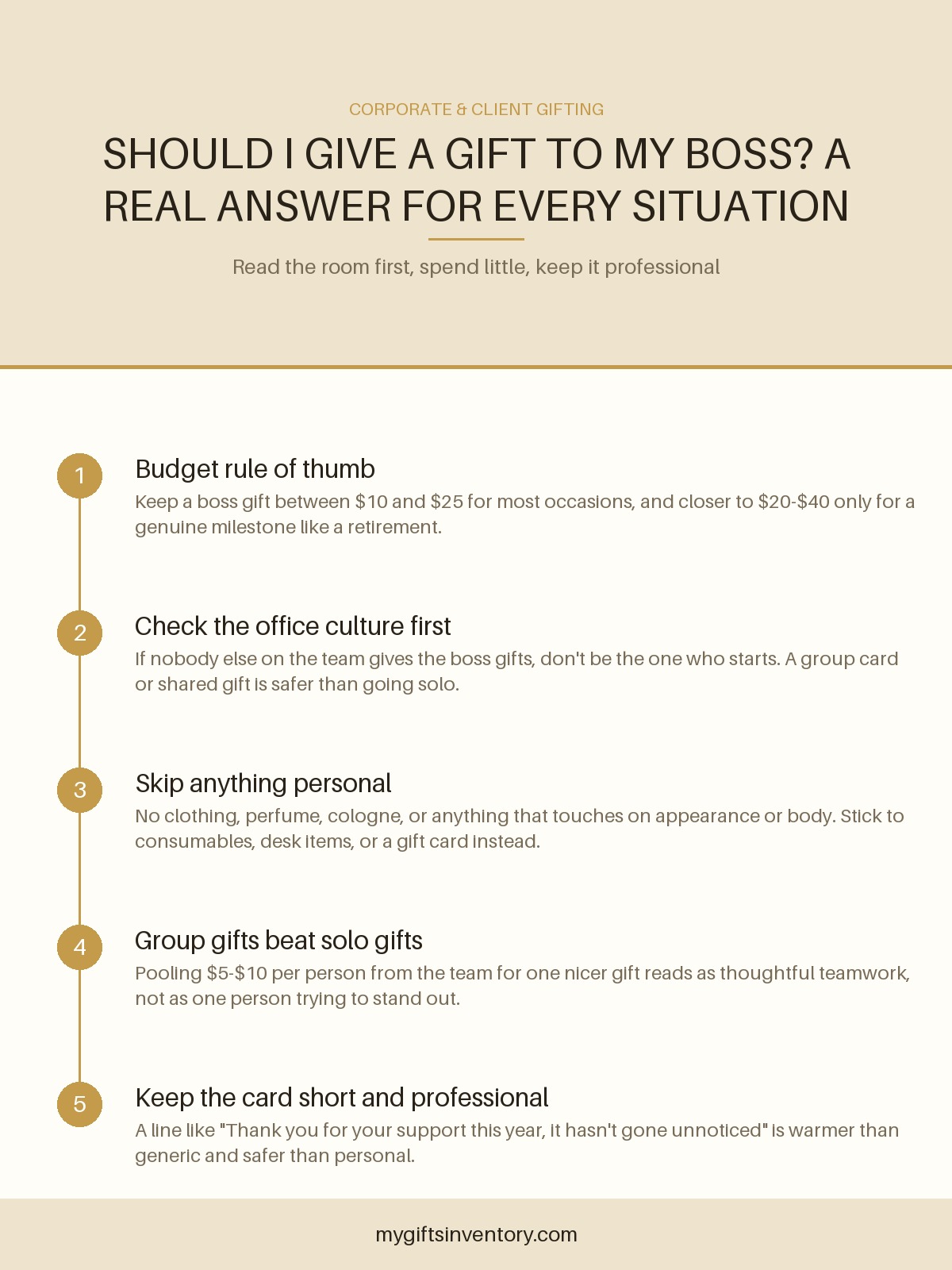
- Manager to team (recognition, not a “favor”): $25 to $100
- Director to team or milestone recognition: $50 to $150
- Client-facing appreciation: $50 to $150 total per recipient (often less if your company sets a limit)
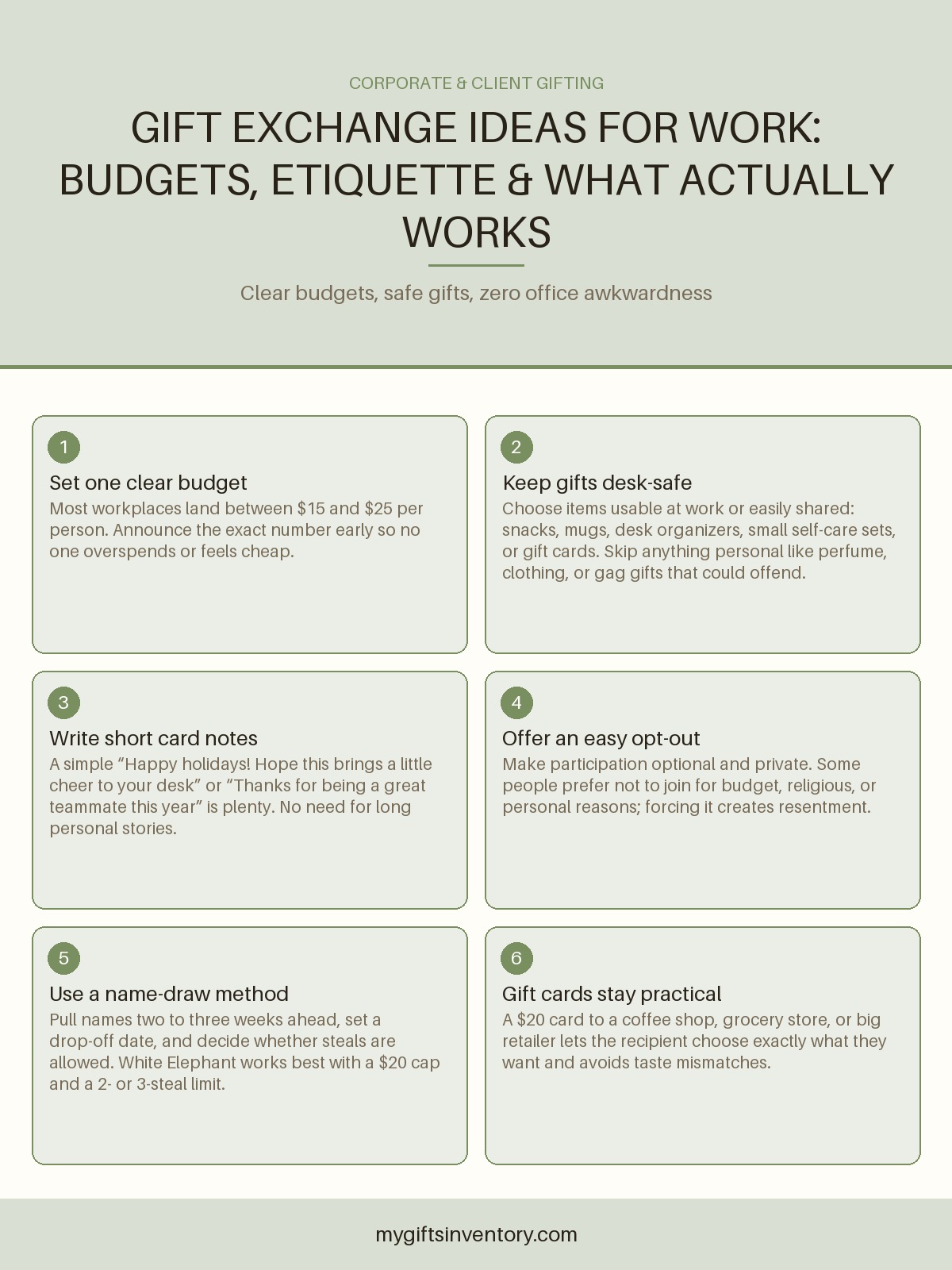
- Group gifts (office collections): $10 to $50 per person contributed toward a shared gift
When “less” is the safer choice
If you are unsure about norms, go conservative. A thoughtful, simple gift plus a good card message often lands better than a more expensive item with a vague note. If your workplace is gift-sensitive, a small token is usually more respectful than a borderline splurge.
Use a category that signals “appreciation,” not “relationship pressure”
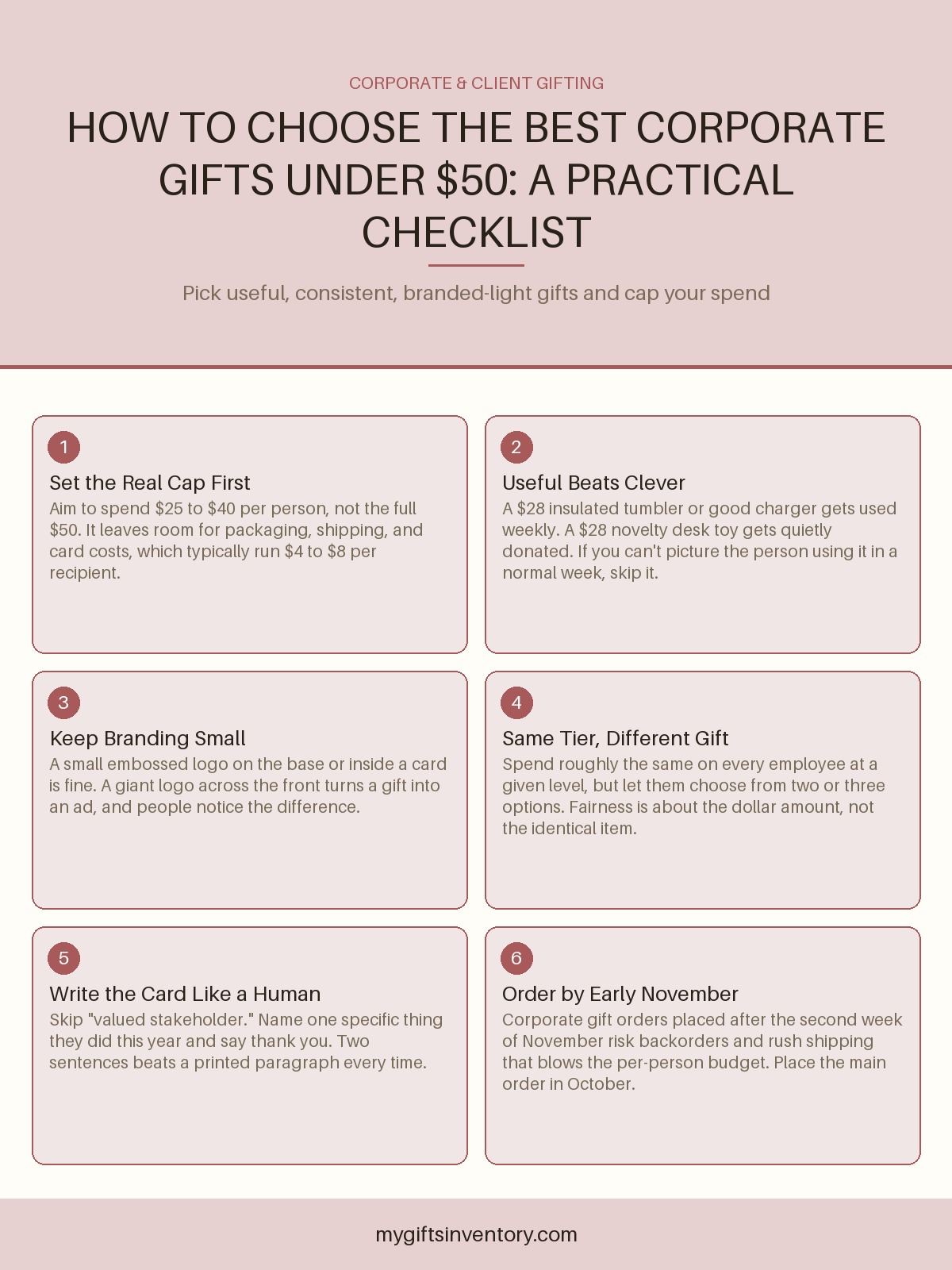
We prefer categories that feel universally acceptable: gourmet snacks, coffee or tea, desk-friendly items, or small self-care sets. If you want an easy starting point for gift ideas that tend to behave well at work, we like keeping them within common everyday-use boundaries, like this guide to 21 Corporate Gift Ideas Under $50 (2026) That Won’t Feel Like an Obligation.
What to write in a corporate gift card (with ready-to-use wording)
A card is not decorative in corporate gifting. It is the context. Without it, recipients can overthink the gift. With it, the message becomes clear: appreciation, respect, and good will.
Our formula for card wording
We stick to a simple three-part structure:
- Reason: one specific line about what we are thankful for
- Sentiment: sincere appreciation without flattery
- Closing: a respectful sign-off
Card message examples that fit common corporate situations
Internal appreciation (team member)
Example: “Thank you for everything you did to keep the project moving. We really appreciate your effort and calm leadership. With gratitude, [Name].”
Manager to team (recognition)
Example: “I appreciate the care you bring to your work and the way you support the team. This is a small thank-you for a great quarter. Warmly, [Name].”
Client or partner appreciation
Example: “Thank you for your partnership this year. We appreciate the trust and collaboration, and we look forward to continuing working together. Sincerely, [Name].”
Milestone or anniversary (work anniversary, not personal relationship)
Example: “Congratulations on your work anniversary. Your contributions make a real difference, and we’re grateful to have you on the team. Best, [Name].”
When you’re using a gift card
Example: “Thank you for your help and support. We hope you can enjoy this at your convenience. With appreciation, [Name].”
What to avoid in corporate card wording
- Any hint of obligation: “This is for all you did for us” can be fine when specific, but avoid anything that implies the gift requires reciprocity.
- Inside jokes: If it would require explanation, it might not belong on a card.
- Too much personal detail: Keep it workplace appropriate.
- Overly casual closings: “Love, XOXO” reads too intimate for many professional settings.
Gift wrapping, presentation, and small etiquette details
Wrapping is where people can tell whether you put effort in or just ran out the door. We keep the presentation neat and clean, not flashy. The goal is to make it feel like a deliberate gesture.
How we wrap for offices
- Choose simple, sturdy wrapping: Matte paper or classic colors look professional.
- Label if there are multiple recipients: If gifts are part of a group exchange, include a name card inside or on the bag.
- Skip unnecessary add-ons: If the add-ons distract or look like clutter, they can make the gift feel less thoughtful.
- Make sure the card is easy to find: Put the card on top, not hidden under tissue.
Timing etiquette: what “on time” means
In corporate settings, “on time” usually means before people are fully buried. If you wait until the final week, the gift can land when the recipient is already out of the office or when everyone is rushing.
- Standard planning: Order at least 2 to 4 weeks ahead.
- Holiday gifting: Aim for delivery before the last busy workweek. If you are sending to offices, build in extra time for receiving and internal distribution.
- Remote teams: Plan for shipping cutoffs by using earlier delivery dates and confirming addresses.
Gift vs. gift card: when each is appropriate
We know many workplaces have a “gift card debate.” Some teams dislike them because they feel impersonal. Others prefer them because they reduce guesswork. The etiquette answer is simple: gift cards are appropriate when you can keep the tone and denomination respectful, and when the recipient will likely appreciate the flexibility.
When a gift card is usually the best option
- You do not know preferences (size, tastes, dietary restrictions, lifestyle differences)
- You are gifting a group and want to avoid inconsistent picks
- You are constrained by time and need something reliable and easy to redeem
Gift card etiquette that prevents awkwardness
- Keep it modest and appropriate: A smaller, respectful amount reads better than a large “blank check.”
- Include a card: The note matters more than the funding source.
- Avoid too many gimmicks: No “prize” language or anything that reads like a raffle.
Where it can help to keep the logistics simple
Sometimes the best corporate gift card choice is the one that matches how your recipients already shop. If you want logistics and option clarity without turning it into a research rabbit hole, we provide store-specific guides like Gift Cards at Walmart: The Complete List of Brands, Fees & Where to Buy (2026) and Gift Cards at Target: The Complete List of Brands, Fees & Where to Buy (2026). These are especially useful when teams agree on a specific store for consistency.
Registries: do corporate gifts use them?
In corporate gifting, registries are uncommon, but the concept still matters. If you are using a registry-like system, it should be intentional and transparent, with clear boundaries that it is optional.
When “registry behavior” is appropriate
- Team-based milestone gifting where the recipient shares a preference sheet or wish list
- Smaller internal groups that agree on a practical item category
- Charitable or experience contributions where the “registry” is a selection list of options
When to avoid it
If the recipient did not ask for input and the registry approach feels like you are asking them to manage their own gift, it can feel strange. In that case, we keep it simpler and choose an universally safe category instead.
Returns and exchanges: what to do when the gift doesn’t work
Corporate gifting has a built-in risk: you cannot always confirm what the recipient already has. We manage that risk before it becomes a problem.
Choose items that are easy to return if needed
- Keep receipts and order confirmations in a shared folder
- Check return windows before buying
- Avoid final-sale items if you are gifting broadly
Exchange planning when you are the team coordinator
If you are coordinating multiple gifts, we often do a quick internal check first: ask for preferences or confirm what has already been given. If the gift is not working, we quietly swap and keep the card message consistent in tone and reason.
Corporate gift dos and don’ts
Do
- Match the gift to the relationship: peer-to-peer gifts can be simpler than client gifts.
- Keep messages clear: appreciation and respect, not jokes or pressure.
- Plan for the recipient’s reality: shipping, dietary restrictions, and workplace norms.
- Choose something people can actually use: items that fit desk life, daily routines, or shared office enjoyment.
Don’t
- Don’t pick something too personal: avoid perfume, clothing sizing, or anything that could feel like a private assumption.
- Don’t ignore cultural norms: if your team is diverse, keep gifts universally comfortable.
- Don’t give cash directly: it can be interpreted as compensation unless your organization explicitly allows it.
- Don’t overdo it: a large, lavish gift can create discomfort even if your intent is good.
Gift ideas that behave well for corporate settings
We do not do “random holiday shopping” for corporate gifts. We choose categories that are low-risk and easy to enjoy. If you want inspiration while staying within common office-safe boundaries, you might use a gift guide like 21 Corporate Gift Ideas Under $50 (2026) That Won’t Feel Like an Obligation to keep the variety thoughtful but still appropriate.
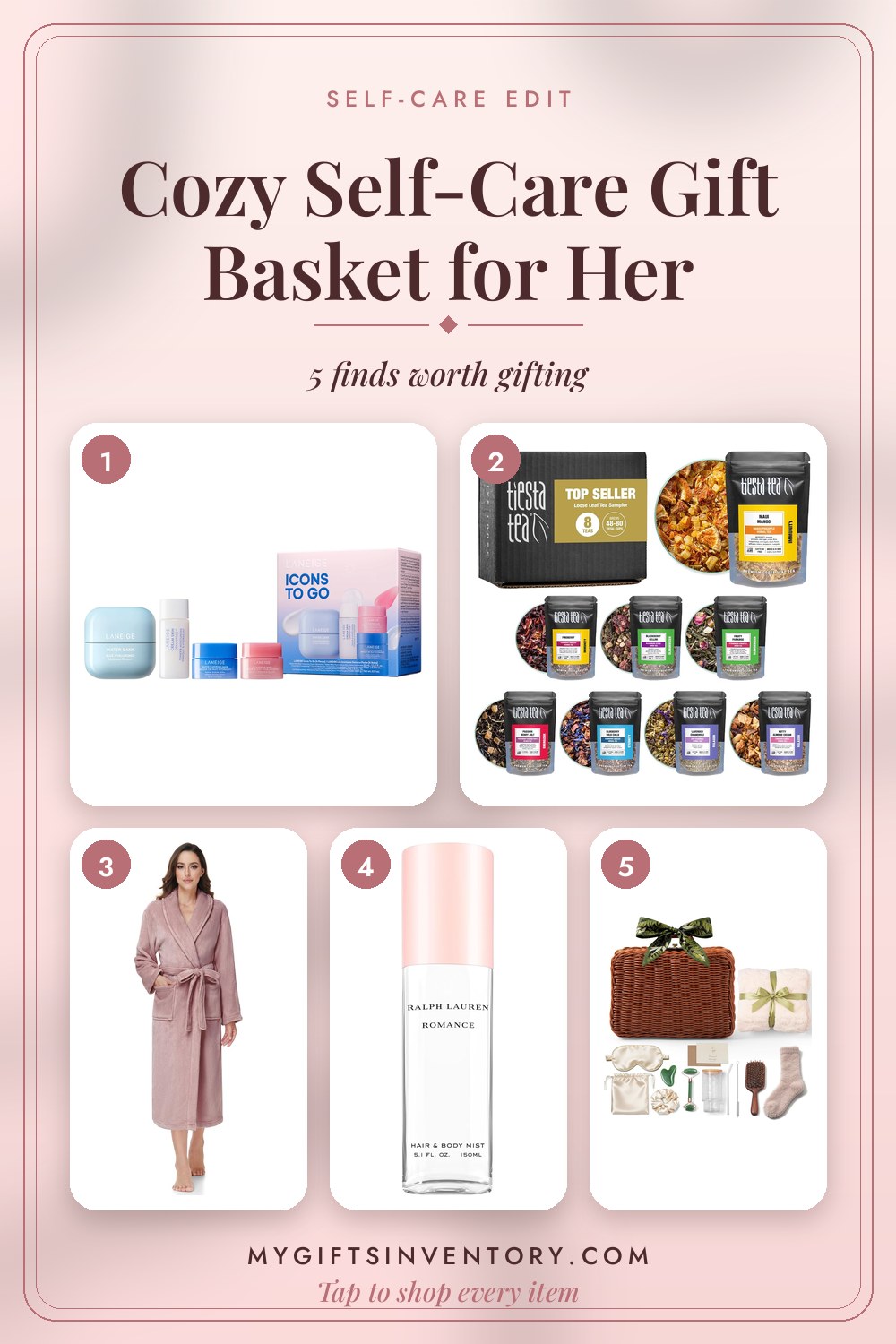
For teams who want to treat the gift as a small experience rather than an item, we lean toward gourmet treats, coffee, or self-care sets, especially when the budget is capped and time is limited. You can also use curated lists like 20 Gift Ideas for Self-Care & Spa Gift Sets Under $50 (2026) when you want something that feels personal without being intrusive.
And if you are matching a higher budget tier for a leadership milestone or major client appreciation, we suggest looking at options in a broader mid-range band rather than swinging wildly from basic to extravagant, such as 20 Gift Ideas for Splurge-Worthy Gifts Between $50 and $150 (2026).
Last-minute corporate gifting plan (so we don’t panic)
If you are within a week or two of gifting, we switch to a “reliable and respectful” strategy.
- Choose a gift card or a universally usable item that is easy to redeem and unlikely to duplicate.
- Send it with a short, specific card note: one reason, one appreciation line, one respectful closing.
- Confirm delivery details: office receiving hours, correct addresses, and any internal distribution steps.
- Skip elaborate wrapping if time is tight, but keep the packaging neat.

Gift Ideas to Go With This




Want more ideas? Browse our full guide: 21 Corporate & Employee Gift Ideas Under $50 (2026) That Won't Feel Like an Obligation
Frequently Asked Questions
How much should we spend on corporate gifts?
We generally aim for modest, relationship-appropriate budgets, often around $20 to $75 for peers and up to about $150 for client-facing appreciation when your workplace norms allow it. If you are unsure, staying consistent and keeping the gift simple usually reads as more respectful than stretching the budget.
What should we write in a corporate gift card if we are thanking someone for work?
We write one specific line about the work or impact, followed by a sincere appreciation statement and a respectful sign-off. For example: “Thank you for your help on [project]. We appreciate your effort and professionalism. Sincerely, [Name].”
Is it okay to give gift cards for corporate gifting?
Yes, gift cards can be perfectly appropriate when you keep the denomination reasonable and include a real card message that explains the reason for the gift. They are especially useful when you do not know preferences or when you are gifting a group.
When should we buy and deliver corporate gifts?
We try to plan at least 2 to 4 weeks ahead for standard gifting, because shipping and office receiving take time. For holiday gifting, we work backward to deliver before the last busy week when people are out of office or overwhelmed.
What if the recipient already has the gift or doesn’t like it?
We protect ourselves by choosing items with return options and keeping receipts, and we avoid highly personal categories. If you coordinate as a team, keep a simple swap plan so the resolution stays private and respectful.
Looking for an Actual Gift Instead?


Gift Sets We Love Right Now
Every item picked, priced and linked, ready to buy.

More Gift Advice