Gift Exchange Ideas for Work: Budgets, Etiquette & What Actually Works
How to run or join an office gift exchange without awkwardness, from setting fair budgets and clear rules to picking gifts everyone can use and writing a simple card note.

As an Amazon Associate, My Gifts Inventory earns from qualifying purchases. We only recommend products we'd genuinely consider buying ourselves.
Office gift exchanges sound fun until you are standing in a store aisle wondering what is appropriate, how much is too much, and whether your gag gift will land wrong. We have all been there: the last-minute scramble, the coworker who spent twice the limit, the awkwardly personal present that makes everyone shift in their seats. This guide walks through the real decisions that keep a work gift exchange light, fair, and actually enjoyable.
Why Work Gift Exchanges Feel Tricky
At home we know the people well. At work we share projects and coffee runs, not necessarily hobbies, humor style, or family details. A gift that feels thoughtful to one person can feel intrusive or tone-deaf to another. Add mixed budgets, different cultural or religious backgrounds, and the simple fact that some people would rather skip the whole thing, and it is easy to see why so many of us search for clear rules before we buy anything.
The good news is that a few simple agreements up front remove most of the stress. Clear budget, clear format, and a shared understanding that gifts should be usable and low-drama turn the event into something people look forward to instead of dread.
Common Types of Office Gift Exchanges
Most workplaces use one of a handful of formats. Matching the format to your group size and culture matters more than inventing something new.
Secret Santa
Everyone draws one name (or uses an app) and buys a gift only for that person. It keeps spending predictable and feels more personal than a free-for-all. Best for teams of 6 to 20 where people know each other at least a little. Draw names two to three weeks ahead so no one is stuck shopping the night before.
White Elephant or Yankee Swap
Everyone brings a wrapped gift within the budget. Players draw numbers and take turns either opening a new gift or stealing an already-opened one. Set a steal limit (usually two or three steals max per gift) so the same item does not bounce forever. This format works well for larger groups or when people do not know each other well, because the gift is for the group pool rather than one specific person. It also tends to be louder and more playful.
Grab Bag or Potluck Style
Everyone contributes one gift to a table and picks at random, sometimes with a quick thank-you round. Simple and fast. Good for very large departments or open-office parties where drawing individual names would be chaotic.
Themed Exchanges
Some teams add a light theme: “something for the desk,” “a favorite snack or drink,” “under $15 and useful,” or “homemade or handmade only.” Themes reduce decision fatigue and keep gifts coherent. Just make sure the theme itself is inclusive (avoid alcohol-only or highly gendered themes).
Setting the Budget and Rules Early
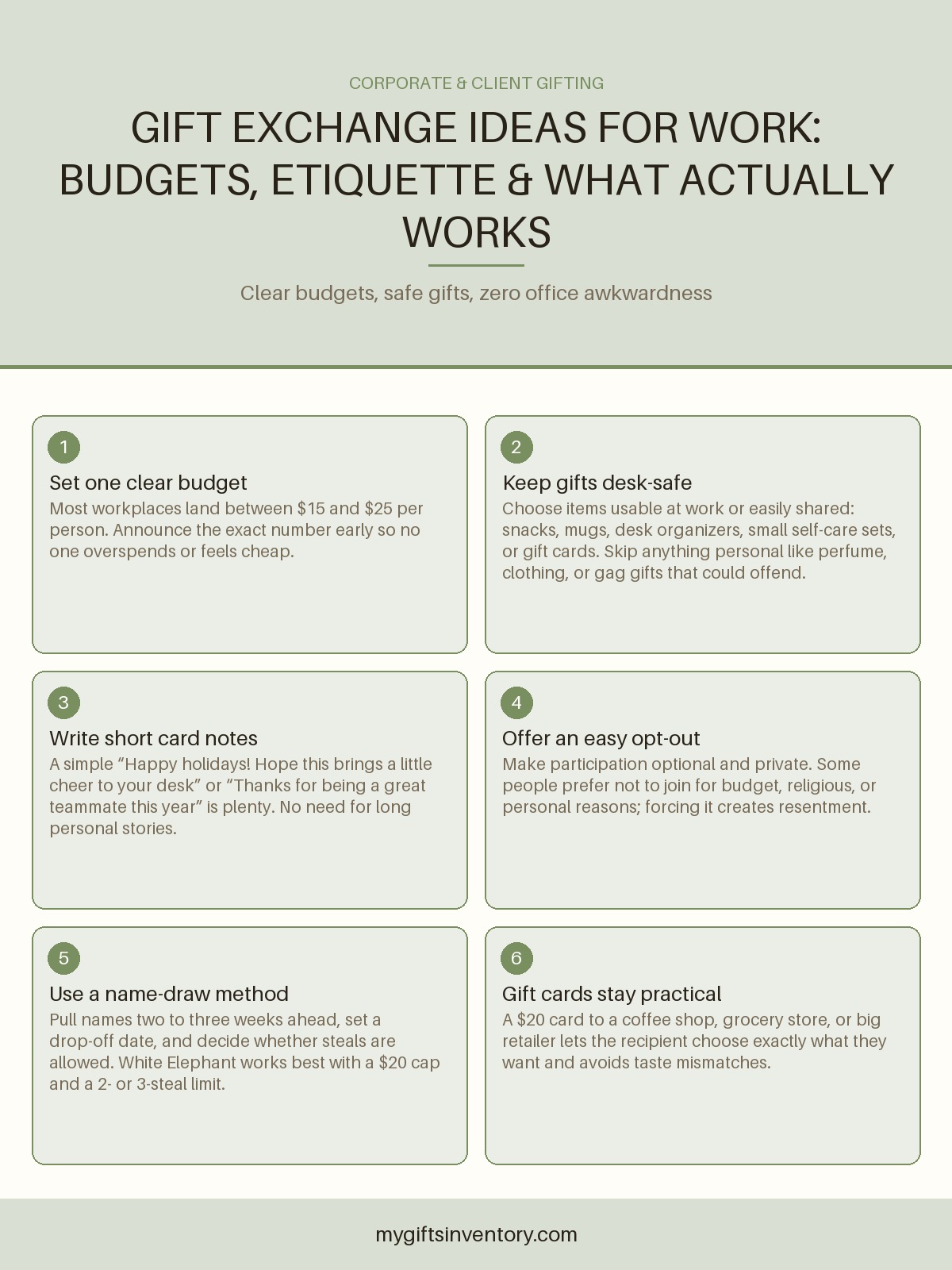
The single most useful thing an organizer can do is announce a firm dollar amount and stick to it. In most U.S. offices we see $15 to $25 as the sweet spot. Under $15 can feel too cheap for some; over $30 starts to pressure people who are already stretched in December. If your company or team has traditionally gone higher, reconfirm it rather than assuming.
Put the rules in writing (email or shared doc) so everyone sees the same version:
- Exact budget (and whether tax or gift wrap counts toward it)
- Deadline for buying and bringing the gift
- Whether names are drawn or it is a free-for-all
- Steal rules if it is White Elephant
- Any theme or “keep it work-appropriate” reminder
- How to opt out quietly
If the company is contributing a little extra (a gift card or matching funds), say so clearly so personal spending stays fair.
What Makes a Good Work Gift
The best office gifts are things the recipient can use at their desk, take home without explanation, or enjoy without special knowledge of their private life. Think useful, shared, or lightly indulgent rather than deeply personal.
Safe categories that rarely miss:
- Desk or workday helpers (nice pens, notepads, cable organizers, small plants that are hard to kill, quality mugs)
- Food and drink that most people like (good coffee, tea, chocolate, savory snacks, hot sauce sets). For more ideas in this range, see our guide to gourmet treats, wine, and coffee gifts under $50.
- Small self-care items that feel like a break (hand cream, lip balm sets, simple eye masks, mini lotions). Our roundup of self-care and spa gift sets under $50 has plenty of office-friendly options.
- Gift cards to widely used places (coffee chains, grocery stores, major retailers, streaming if the team knows the person uses it)
- Experiences that are low-commitment (lottery tickets, a movie gift card, a donation in the team’s name if that fits the culture)
When the budget is tighter, our list of highly rated gifts under $20 is full of items that still feel intentional. For teams that want a broader set of polished, non-cheesy options, the 21 corporate gift ideas under $50 collection is built exactly for this kind of professional-but-warm gifting.
What to Skip
Avoid anything that requires knowing someone’s size, scent preference, political or religious views, or relationship status. Skip heavy alcohol unless you are certain it is welcome and allowed on site. Steer clear of gag gifts that rely on embarrassment, inside jokes that exclude others, or anything that could be read as flirtatious. Used items and anything that needs assembly or batteries the recipient has to supply also tend to fall flat.
Gift Cards Done Right
Gift cards remove the taste-guessing problem and let people get exactly what they need. A $20 card to a place most coworkers already visit (coffee, grocery, big-box, or pharmacy) is almost always appreciated. If you want variety, many people like flexible cards from major retailers. For practical details on brands and fees at common stores, our guides to gift cards at places like Target or Walmart can help you choose without surprises.
Present the card in a small envelope or with a simple tag so it does not feel like an afterthought. A short handwritten note still makes it feel like a real gift.
Card Messages That Feel Natural
You do not need poetry. Two or three friendly lines are enough. Here are real examples that work across most office relationships:
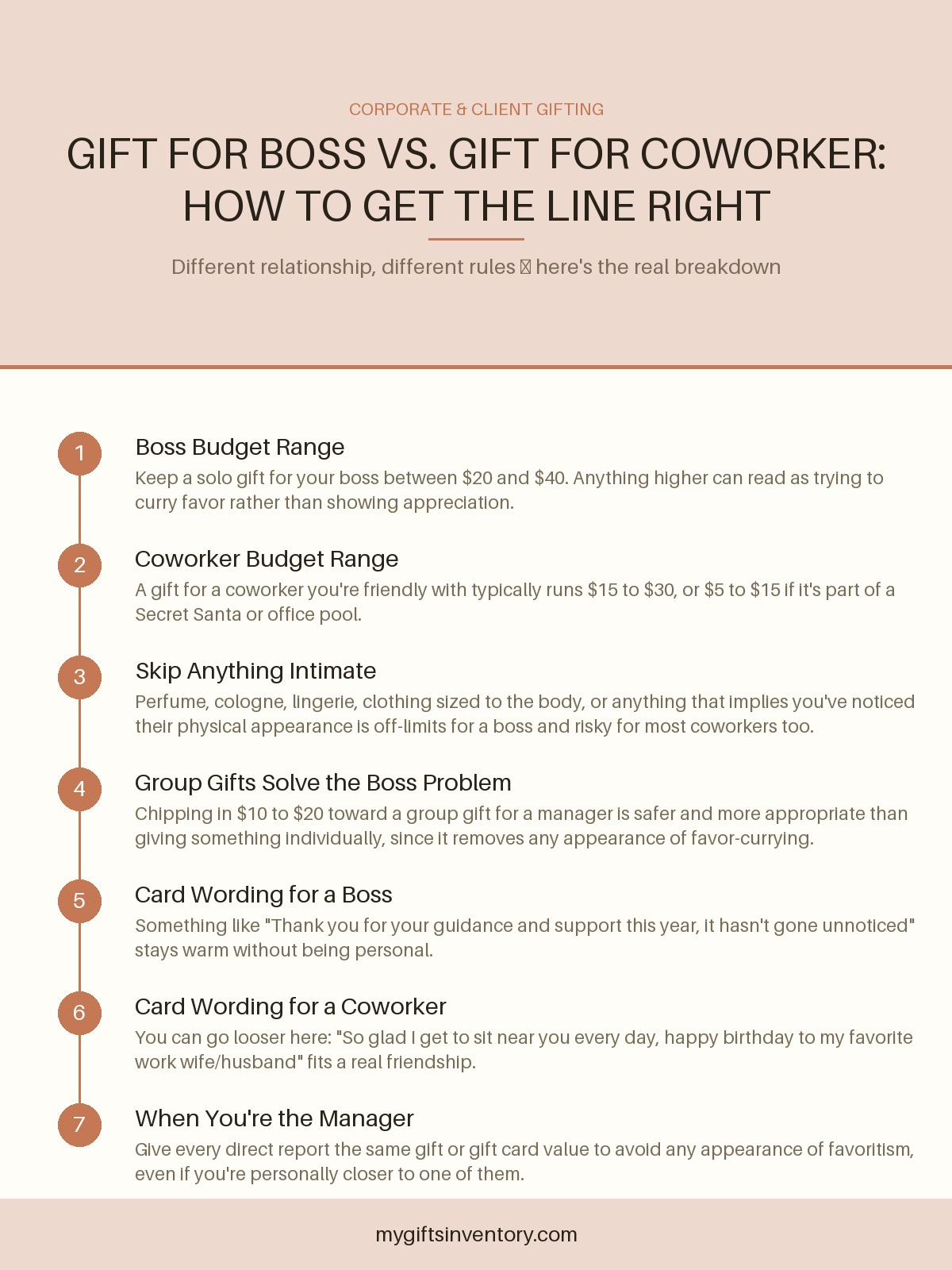
- “Happy holidays! Hope this adds a little ease to your week.”
- “Thanks for being a solid teammate this year. Enjoy!”
- “Secret Santa delivery. Wishing you a restful break and a good start to the new year.”
- “Merry Christmas / Happy Holidays from your Secret Santa. Hope you like it!”
- “White Elephant contribution. May the steals be ever in your favor.”
If you drew someone you work with closely, you can add one specific positive note (“Your calm in that last deadline saved us”) without turning it into a performance review. Keep religion-specific language only if you know it matches the recipient; “Happy holidays” or “Season’s greetings” travels more safely in mixed groups.
Wrapping, Presentation, and Logistics
Neat wrapping or a simple gift bag signals effort without requiring craft skills. Reusable bags or boxes are fine and often appreciated. Attach the name tag securely so gifts do not get mixed up during the scramble. If the exchange happens during a lunch or after-work gathering, arrive a few minutes early so your gift is in the pile before numbers are drawn.
For remote or hybrid teams, ship gifts to the office or to home addresses with enough lead time, or use an e-gift card delivered on the same day. Set a clear “gifts should arrive by” date so no one is left out of the virtual reveal.
Etiquette That Keeps the Peace
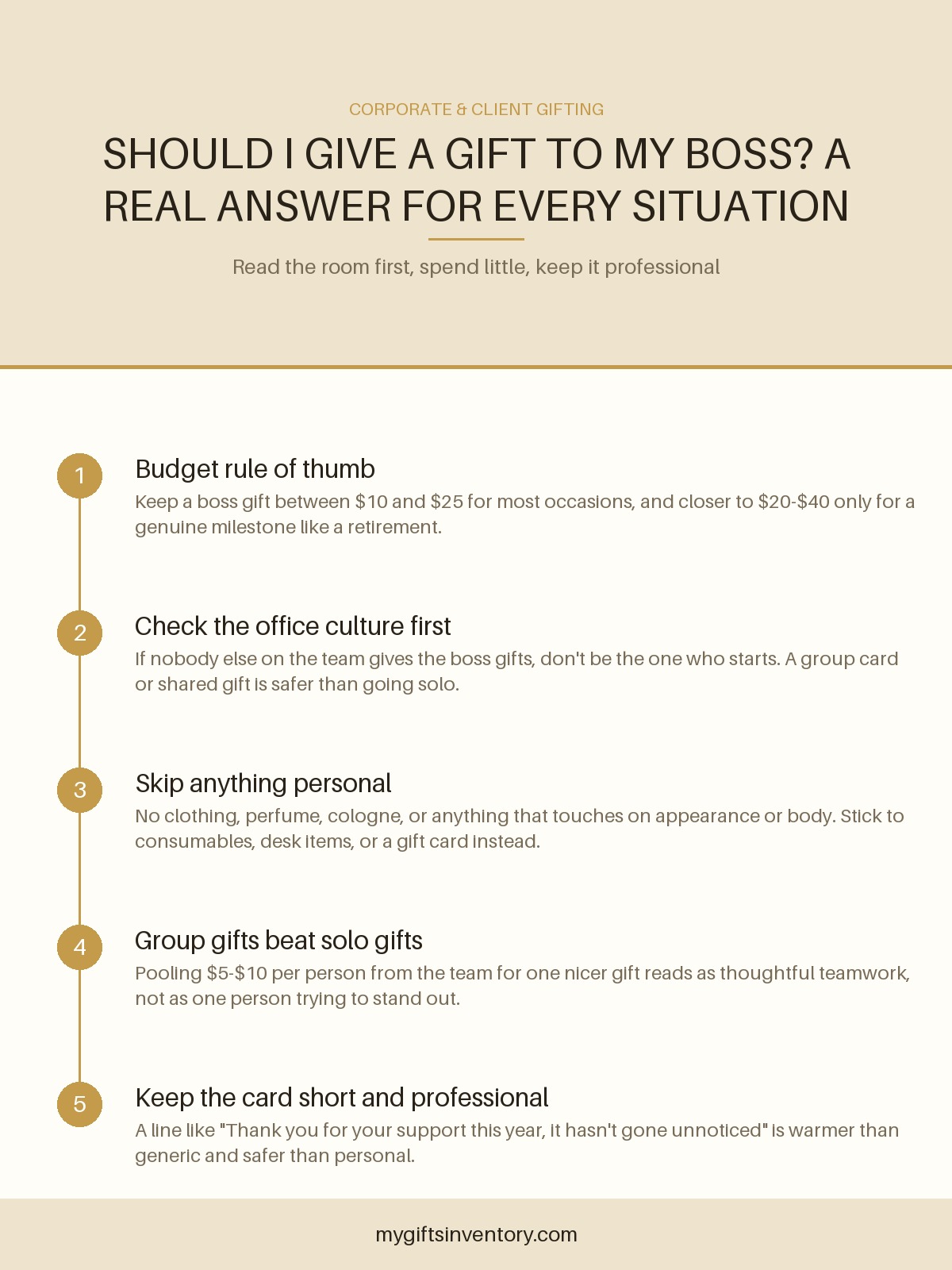
Make participation optional and the opt-out private. A simple “Reply only if you want in; no explanation needed” works. Never pressure the person who sits out.
If you receive something you cannot use, a polite thank-you is still required. “Thank you, this is really thoughtful” is enough in the moment. Later you can quietly regift, donate, or return if the store allows. Do not announce that you are returning it in front of the giver.
When you are the organizer, keep the tone light and the rules visible. Remind people once about the budget a few days before the event. Afterward, a quick group thank-you email closes the loop nicely.
Managers and team leads should generally match the same budget as everyone else unless the company is explicitly funding a larger gesture. Going significantly higher can make others uncomfortable.
Timeline for a Smooth Exchange
Three to four weeks ahead: decide format, set budget, announce, and open sign-ups or name draws.
Two weeks ahead: finalize participant list, send reminder of rules and deadline.
One week ahead: gentle nudge to anyone who has not confirmed their gift is ready.
Day of: collect gifts, run the draw or swap, keep it moving so it stays fun rather than dragging.
Day after: short thank-you note to the group if you organized it.
Last-minute is possible, but the earlier the rules are clear, the fewer stressed faces you will see in the break room.
Special Situations
Very large departments often do better with multiple smaller exchanges by team rather than one giant White Elephant. Cross-functional groups that barely know each other should lean toward grab-bag or themed “desk useful” gifts instead of highly personal Secret Santa. For global or remote teams, digital gift cards or small items that ship easily reduce friction. If your workplace has a strict no-alcohol or no-food policy for shared spaces, respect it completely.
When in doubt about any gift, ask yourself: Could this be opened in front of the whole team without anyone feeling weird? If the answer is yes, you are probably in good shape. For broader guidance on matching gifts to people and occasions, our overview on choosing the perfect gift has useful frameworks that apply beyond the office too.
After the Exchange
Use what you received if you can. A quick personal thank-you (message or verbal) to your Secret Santa, if identities are revealed, is gracious. If identities stay secret, the group thank-you covers it. Unwanted items can be quietly donated, swapped with a friend outside work, or returned according to the store’s policy. The goal is enjoyment, not forced clutter.
A well-run work gift exchange does not have to be elaborate. Clear budget, inclusive rules, desk-friendly gifts, and short sincere notes are enough to make it one of the brighter spots in a busy season. Keep it simple, keep it kind, and most people will leave smiling.
Frequently Asked Questions
What is a normal budget for an office gift exchange?
Most workplaces settle on $15 to $25 per person. That range feels substantial enough to buy something decent without creating financial stress. Announce the exact number early and treat it as a firm ceiling so everyone stays on the same page.
Is it okay to give a gift card for a work Secret Santa?
Yes. A gift card to a coffee shop, grocery store, or major retailer is one of the safest and most appreciated options because the recipient can choose exactly what they want. Pair it with a short handwritten note so it still feels personal.
What should I do if I get a gift I cannot use?
Thank the giver warmly in the moment. Later you can quietly return it, donate it, or regift it outside the office. Avoid saying anything negative about the gift in front of the group or the person who gave it.
How do I opt out of a work gift exchange without looking rude?
A brief private message to the organizer is enough: “I’m going to sit this one out this year, but thank you for putting it together.” Good organizers treat opt-outs as normal and do not require explanations.
Are funny or gag gifts a good idea at work?
Only if you know the entire group’s humor well and the joke cannot be misread as mean-spirited or exclusionary. When in doubt, choose something useful or pleasantly neutral instead. Office exchanges work best when no one feels like the punchline.