How to Give a Memory as a Gift: Planning, Presentation and What to Write in the Card
An experience gift only feels generous if the planning behind it does. Here is how to build a memory someone can keep, from budget and timeline to the exact wording for the card.
As an Amazon Associate, My Gifts Inventory earns from qualifying purchases. We only recommend products we'd genuinely consider buying ourselves.
You have decided a thing is better than a stuff, and now you are staring at a card wondering whether "I owe you a dinner" counts. It does not, not on its own. The reason memory gifts so often fall flat is not the idea. It is that the giver stopped at the idea and handed over an IOU. A memory is a gift only after someone has done the planning, picked a date, and made the thing actually happen. Here is how to do that part properly, so your gift lands as generous instead of as a to-do list.
First, the difference between an experience and an errand
A reservation is a gift. A promise to make a reservation is a chore you have outsourced to the person you supposedly love. That is the whole rule, and everything below follows from it.
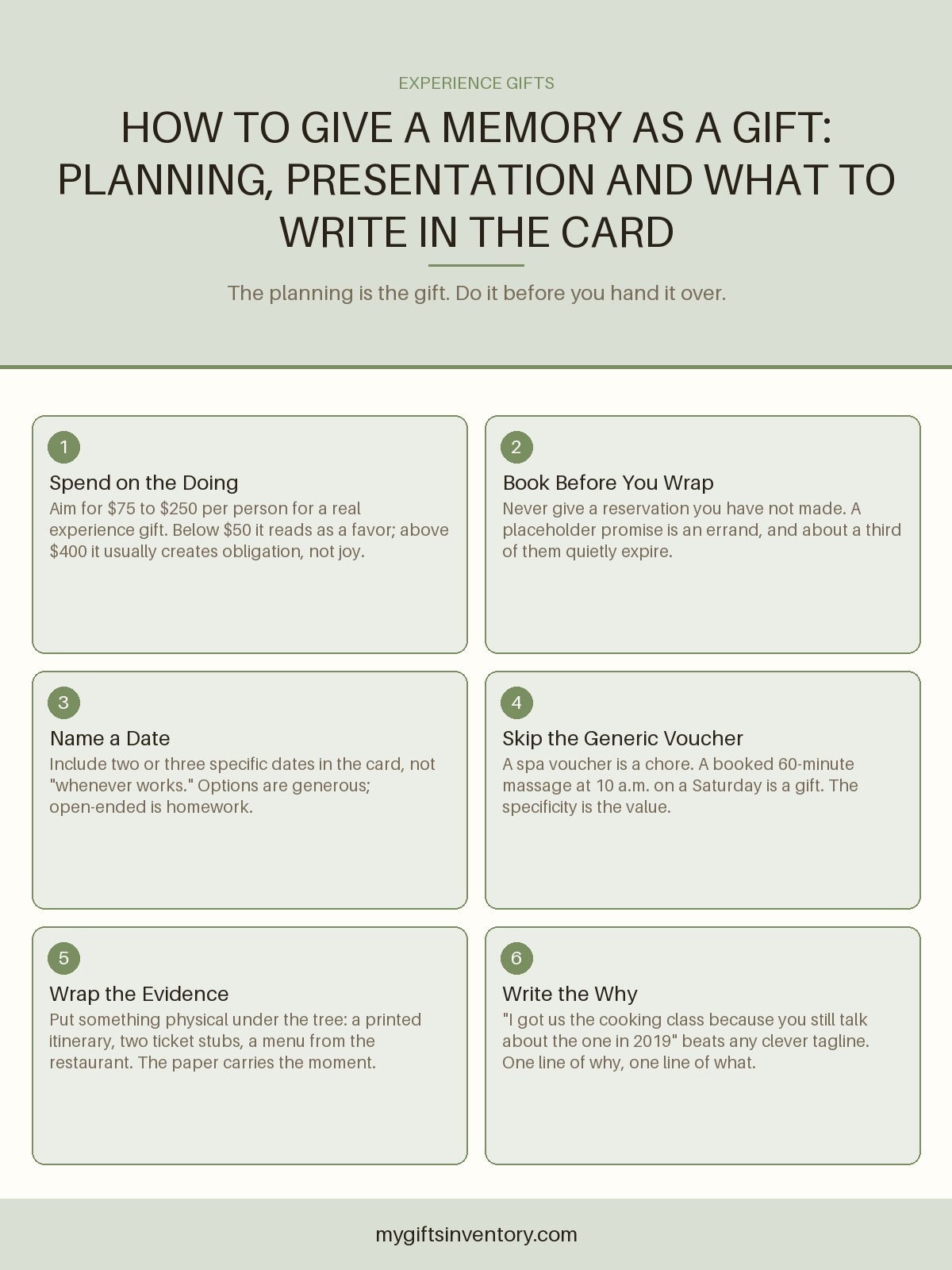
Consider the classic version: a gift certificate to a spa. On paper it says "relax." In practice it says "find a Saturday, call the spa, check the prices against the balance, book it, remember to bring the voucher." You have given the recipient a small project. Now compare it to a card that says: "You are booked for a 60-minute massage at the place on Main Street, Saturday the 14th at 10 a.m. I will have the kids." Same money, wildly different gift. The second one required ten minutes of your time and is worth perhaps three times as much to the person opening it.
So before you buy anything, ask yourself: after they open this, is their next step to enjoy it, or to organize it? If it is to organize it, go back and organize it yourself.
How much to spend on a memory gift
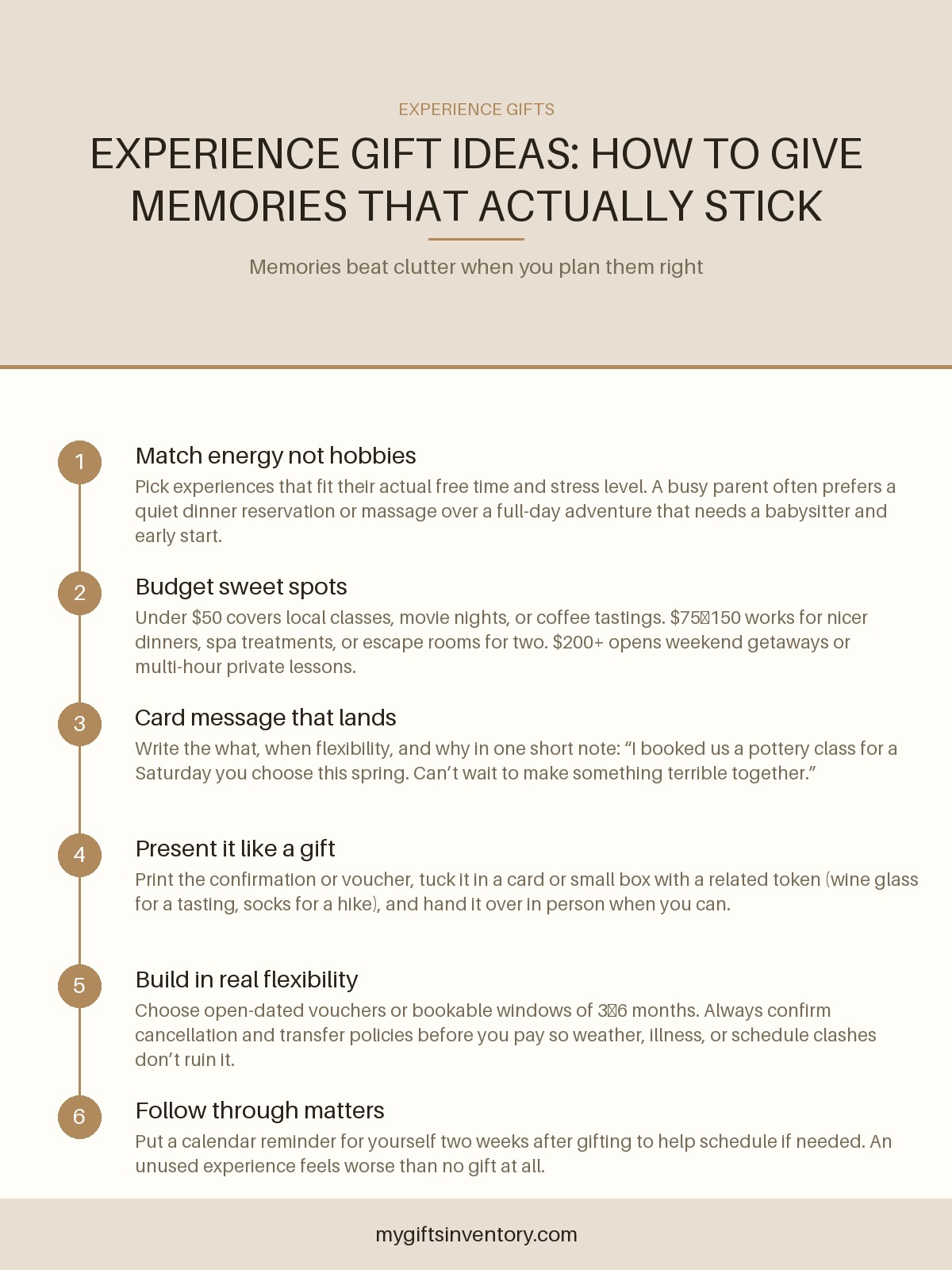
There is no registry to guide you here, so people tend to either overspend out of insecurity or under-spend and make it awkward. Some honest ranges, based on what actually reads as thoughtful rather than either cheap or overwhelming:
For a friend or coworker
Roughly $40 to $90 per person. A cooking class, a pottery session, a wine tasting, two tickets to something small. Above about $100 for a non-romantic friend starts to feel like a debt. If the experience is expensive but you want to do it together, split the cost with them explicitly and frame the gift as your share.
For a partner or spouse
$100 to $300 is the comfortable middle, and the ceiling is really about your own budget rather than etiquette. The failure mode here is not too little money. It is a big-ticket trip given as a surprise that the recipient now has to take time off work to use. If it involves flights or leave requests, it is not a surprise, it is a negotiation. Ask first.
For parents or grandparents
$75 to $250, and heavily weighted toward time together. A nice lunch you book and drive them to beats almost anything. If you are pooling money with siblings, a weekend away is lovely, but make sure one person owns the logistics and that person is not the person receiving the gift.
For kids and teens
$50 to $150, and pick the experience around the child rather than the adult's taste. A zoo membership, a ceramics studio afternoon, a day at an arcade with $20 in quarters. Teens are often more receptive to an experience than parents expect, particularly if it involves a friend and a ride they do not have to beg for. If you want to pair the experience with something small and physical to unwrap, our roundup of gifts for 13 year old teen girls has plenty of small items that photograph well and pair naturally with a day out.
Build the memory before you hand it over
Three things need to be true before the gift is wrapped.
It is booked. Actual date, actual time, actual confirmation number. If it requires a deposit, pay it. If it requires a minimum headcount, sort that out. The recipient should receive a plan, not permission.
It is feasible. Check their calendar, or at least their general life. A sunrise hike given to someone working nights is a trap. A weekend trip given to new parents with a six-month-old is a lovely thought that will not happen. Memory gifts fail for logistical reasons far more often than emotional ones.
It has a fallback. Prices and bookings change. If you are booking something weather-dependent or cancellable, confirm the refund policy and mention it in the card: "If it rains, we go the following Saturday, already sorted." That single sentence removes the recipient's main worry.
How to wrap something that is not an object
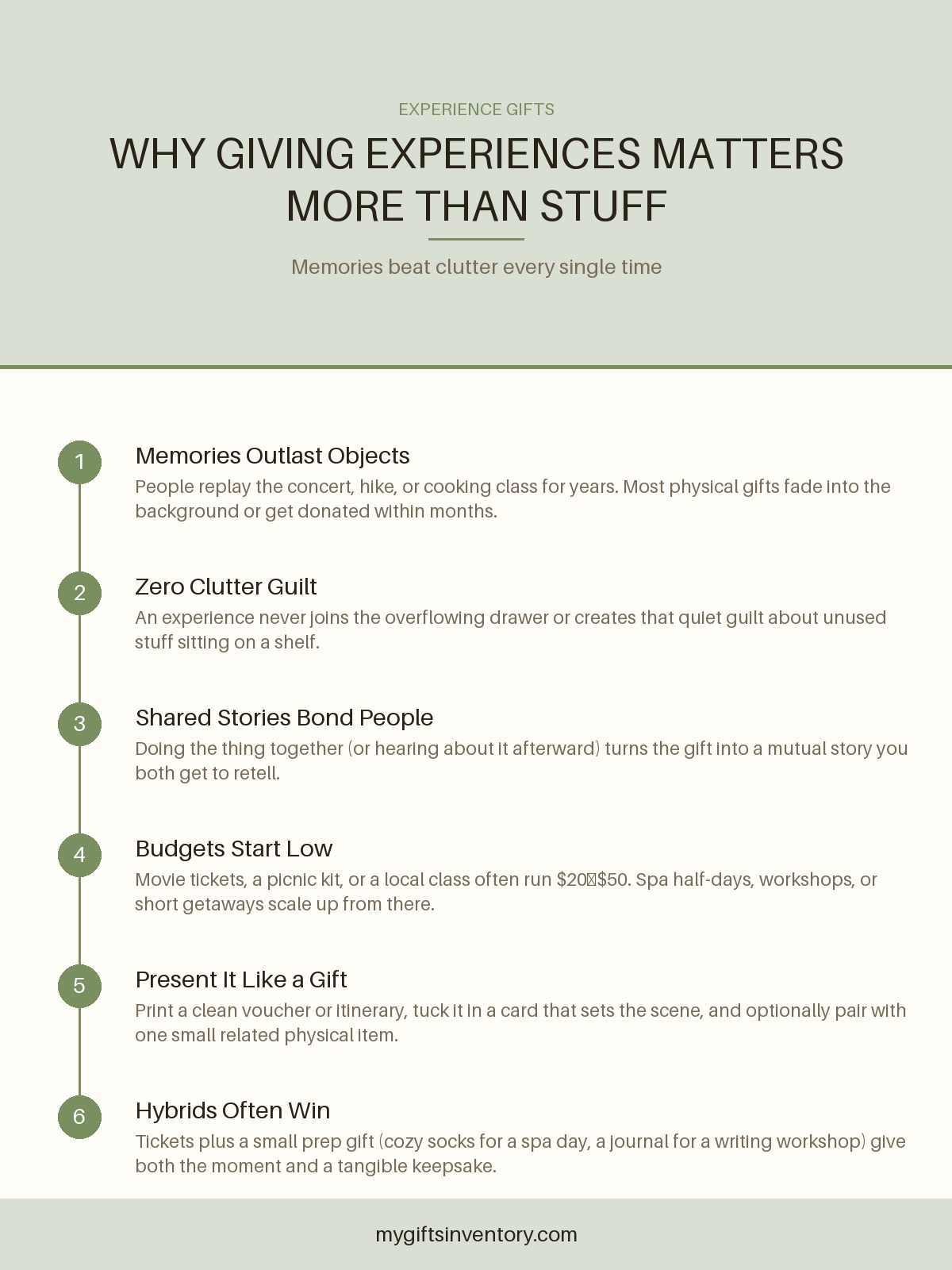
Half the pleasure of a gift is the unwrapping, and you lose that when the gift is invisible. So give the memory a physical body. It does not need to be expensive, and it should not pretend to be the gift itself.
Good options: a printed itinerary card, the actual tickets or booking confirmation in an envelope, a hand-drawn map of the route, a menu from the restaurant you booked, a photo of the two of you from the last time you did something similar, a small object tied to the activity. For a wine tasting, a nice bottle works. For a grilling class, a set of rubs. Our guide to gift ideas for wine lovers has good small accompaniments for a vineyard day, and the grilling and BBQ gift roundup has the equivalent for a smokehouse class or a backyard cookout gift.
Wrap it small. A memory gift should feel like a puzzle, not a paperweight. An envelope with a boarding pass inside, wrapped in a box with something rattling, is more fun than a large parcel of nothing.
What to write in the card
The card is where most memory gifts are won or lost. It has two jobs: say exactly what the gift is, and say why you chose it. Keep it to three or four sentences. The structure that works almost every time:
- Line 1: what it is and when it happens.
- Line 2: why you picked it for this person specifically.
- Line 3: what you have already taken care of, so they know it is real.
Real examples, not polished marketing copy:
For a partner: "We are doing the pasta-making class on Saturday the 8th at 6, the one you looked up in March and never booked. I booked it. I also booked the table after, because you will want to eat actual food if ours goes badly. Happy anniversary."
For a parent: "You and I are going to the botanical garden on the 22nd. I have the tickets and I am driving. You have been saying you wanted to see the spring beds for three years. I finally listened."
For a friend's birthday: "This is a voucher for a pottery afternoon, but not a generic one. We are going on the 14th at 2, I have paid, and I will be there."
For a child: "This envelope has the tickets for the aquarium on Sunday. We will leave at 9 so we are there before the crowds, and you can pick lunch."
What not to write: "I owe you," "whenever suits you," "just something small," or an elaborate joke that buries the actual plan. Do not make them ask what the gift is. That question is the sound of the gift deflating.
A short timeline that keeps it from becoming a fizzle
The most common failure is not the gift, it is the gap between the giving and the doing. A concert given in November for a March date needs one reminder or the excitement decays. Plan the follow-through along with the gift:
- Four to six weeks out: decide, book, confirm cancellation terms.
- One week out: put the date in both calendars, including the address and any travel time.
- Two days out: a short text, "Still on for Saturday, I have the tickets."
- The day itself: show up, phone away, no running commentary about how much it cost.
- After: send them a photo of the day. That photo is the actual memory, and it is what makes the gift stick long after whatever you might have bought instead.
When a memory gift is the wrong call
We love these gifts, but not for everyone. Avoid an experience gift for someone who is genuinely cash-strapped and would rather you bought them groceries. Avoid it for someone who dislikes surprises, who has a small child or a demanding job, or who has already told you they hate "gifts that make plans for me." Also avoid it when you cannot be there. A skydiving voucher to a nervous friend is not thoughtful, it is a dare. And if you only have a day's notice and no time to book anything, a small physical gift or a simple gift card is more honest than a hastily typed promise. If the person you are shopping for has a clear hobby, a tangible gift tied to it often lands better anyway. Readers tell us the same thing about gardening gifts and yoga gifts: the object they use every week becomes a memory of you, and sometimes that is the softer version of the same idea.
Gift Ideas to Go With This


Want more ideas? Browse our full guide: 20 Experience Gift Ideas Under $50 (2026)
Frequently Asked Questions
Can I give an experience gift without booking it first?
You can, but it reads as an errand. At minimum set a date, confirm the venue's availability and pay any deposit, then put the details in the card. If you truly cannot book yet, say what you are proposing and nominate two dates so the other person only has to pick, not plan.
What is a reasonable budget for an experience gift?
About $40 to $90 per person for friends and coworkers, $100 to $300 for a partner or spouse, and $75 to $250 for parents, always depending on your own budget. The real risk is over-giving: a gift worth more than the recipient can comfortably reciprocate creates awkwardness, not gratitude.
How do I present an experience gift so it feels like a gift?
Give it a physical form: a printed itinerary, the actual tickets, a small token tied to the activity, all in a small wrapped box or envelope. Then say the plan out loud, including the date and what you have already handled. The object is the bow, but the booked plan is the present.
What if the recipient cannot or does not use the experience?
Say in the card that you can rearrange it, and confirm the cancellation policy before you book anything non-refundable. If they decline entirely, offer to exchange it for something they would use and do not make them feel bad about it. The gift was supposed to be for them, not for your ego.
Is a gift card the same as a memory gift?
No, and that is fine. A gift card is a polite solution when you genuinely do not know someone's taste. A memory gift is what you give when you know them well enough to pick the thing. If you are short on time but want the memory angle, buy the card in an amount that covers the exact plan and write it out explicitly: "This is for the two of us at the cooking class on the 8th."
Looking for an Actual Gift Instead?
Gift Sets We Love Right Now
Every item picked, priced and linked, ready to buy.
More Gift Advice