Experience Gifts Instead of Things: Etiquette, Budgets, and Card Wording
We help you give memorable experience gifts with confidence, including budget ranges, planning timelines, and card-message wording that feels thoughtful, not awkward.

As an Amazon Associate, My Gifts Inventory earns from qualifying purchases. We only recommend products we'd genuinely consider buying ourselves.
“Experience gifts instead of things” is one of those searches that usually pops up right before a birthday, holiday, or anniversary when you can feel your cart filling up with stuff that will end up in a drawer. We get it. You want it to feel thoughtful, but you also want to avoid the awkwardness of guessing, scheduling, and logistics.
Below, we’ll walk through how to choose an experience gift that lands, how to set a realistic budget, what to write in the card, and how to plan without turning the recipient into the project manager. We also include wrapping ideas and the small etiquette moves that make this style of gift feel warm instead of vague.
Why experience gifts feel better than “more stuff”
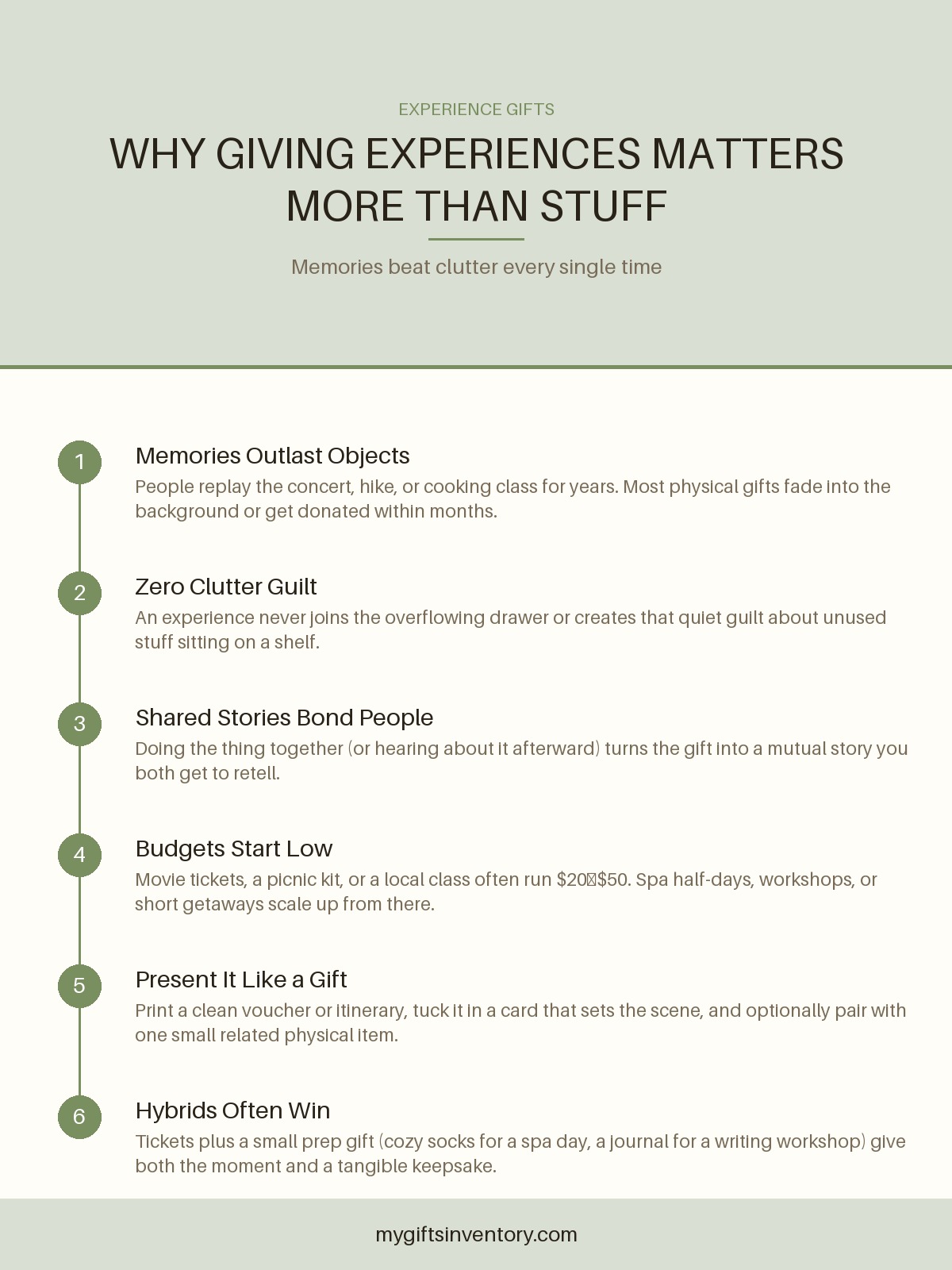
Experience gifts do two things that packaged items often do not: they create a shared memory and they encourage use in a way that does not require storage. Even when an experience is simple, like a dinner reservation or a museum visit, the gift is the moment. And when you build in a little intention, it feels personal, not generic.
The hidden anxiety: “What if they do not want it?”
That worry is valid, and it is the first design problem to solve. The easiest fix is to choose experiences that match how the person already lives. We look for signals like:
- Things they already follow, subscribe to, or talk about
- The kind of outings they say yes to, even when they complain about time
- Whether they prefer planning ahead or spontaneity
- Accessibility needs, like mobility, noise sensitivity, or sensory-friendly environments
If you are unsure, we use a “choose from two” approach. Instead of asking, “Do you like this?” we ask, “Would you rather do the cooking class or the food tour?” The gift still feels like yours, but the recipient does not have to gamble their enjoyment.
Experience gifts work for almost every relationship
They can be sweet for partners, easy for family members, and surprisingly appropriate for friends because they are social by nature. For work-adjacent gifts, we lean into experiences that are low-pressure and not too intimate, like a meal credit or a team-friendly activity.
If you are choosing a gift for someone who appreciates everyday practicality, you can also combine an experience with something small they will use immediately. If that “small thing” should stay budget-friendly, browsing ideas like gift baskets under $50 can help you round out the experience without making it feel like you just doubled your shopping list.
How to choose the right type of experience gift
“Experience” is a big umbrella. The trick is to match the experience style to the recipient’s personality and energy level.
1) Shared experiences (best for couples and close friends)
These are activities you can do together, which makes them feel complete even if they are not perfect. Examples that usually go over well:
- Show or event tickets with a plan for dinner nearby
- A guided day trip or a small group workshop
- A cooking class where you can laugh at your attempts and still eat the results
We like these because the “gift” is the pairing of time and context. A ticket alone can feel impersonal. A ticket plus a plan feels like care.
2) “Solo but supported” experiences (great when they need independence)
Some people do not want to feel scheduled. For them, we go with a self-paced experience that still feels like you did the work. Examples:
- Gym, yoga, or fitness class packages
- Massage, spa day, or salon appointments
- A learning experience like a writing workshop or hobby class
If you want a wellness-leaning option, you might pair the appointment with a small self-care add-on. For under-the-wire budgets, ideas like self-care and spa gift sets under $50 can make the whole gift feel cohesive without making it a lot of extras.
3) Gift cards, but with a plan
We are not anti-gift-card. We are anti gift-card with no structure. If you are giving a card, add a suggested next step. For example:
- “Use this for tickets you pick within the next month.”
- “Choose a time for dinner within 30 days, then I’ll cover parking or dessert.”
- “Pick your appointment date, and I’ll go with you.”
This is also where store-specific guidance can help. If you are going the practical route and you are shopping through a particular retailer, our pages for Walmart gift cards or Target gift cards can help you think through what is realistic to cover with the amount you plan to spend.
Experience gift budgets that feel right (and do not surprise you)
We see the same budget mistake again and again: people choose the price of the “thing equivalent” without factoring in the costs that come with experiences. Even a simple outing has add-ons like parking, tipping, snacks, a small accessory, or a reservation fee.
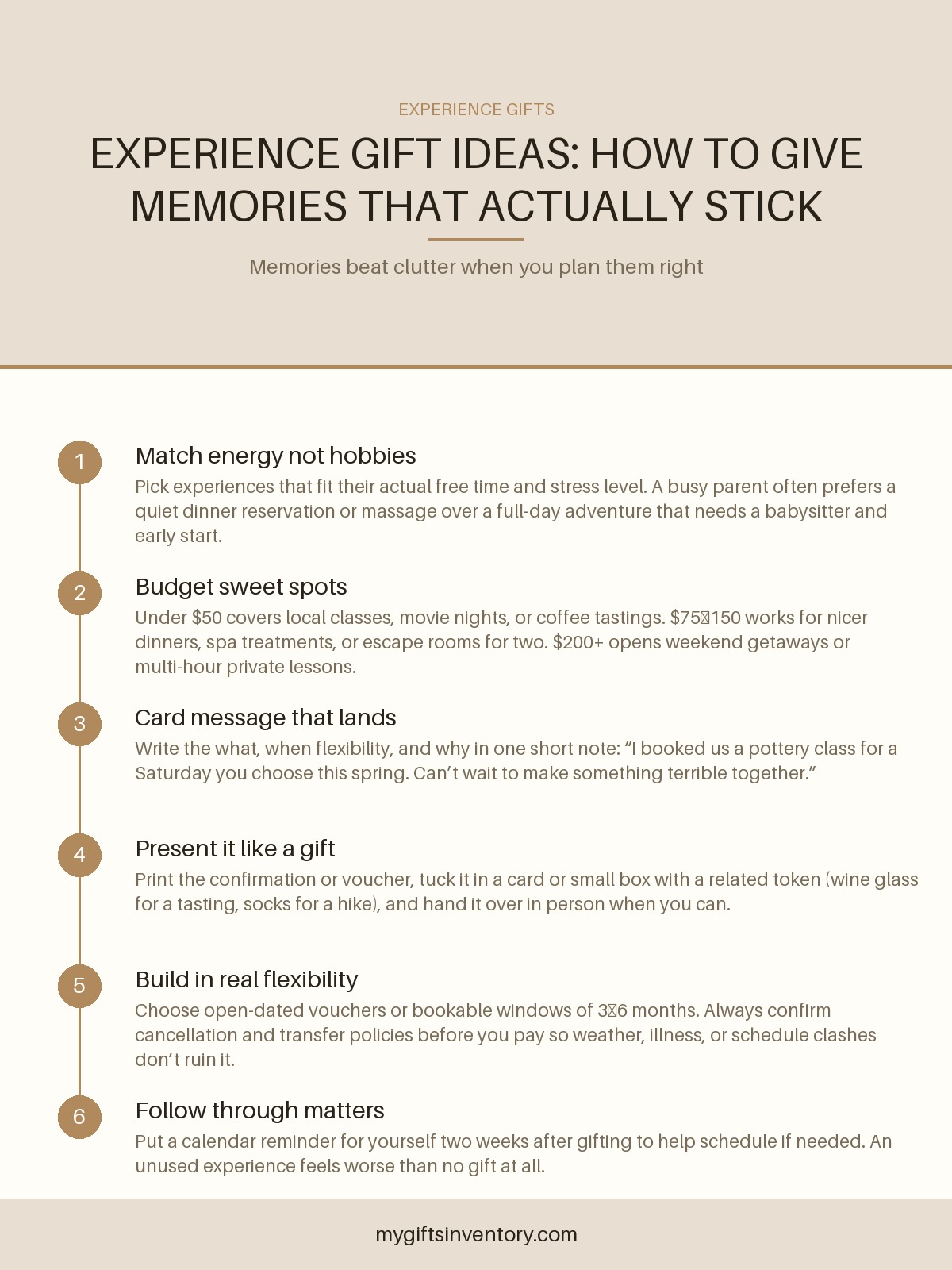
Use these budget ranges as starting points
These are not hard rules, but they do reflect what tends to feel meaningful without becoming a financial stretch:
- $25 to $50: Smaller experiences or add-ons, like a class add-on, a movie bundle, or a “part of a plan” with a note that you will cover the rest.
- $60 to $150: A full small outing, like two tickets plus a light dinner plan, or a salon or wellness appointment with a treat.
- $150 to $300: Two to three activity options, a guided experience, or a date-night level package that includes transportation and food planning.
- $300+: Multi-part weekends, larger concerts, cooking journeys, or travel-adjacent experiences with time built in.
If you are working with a splurge budget and you want it to feel intentional, you may also be thinking about a “special occasion” tier. For guidance on higher-end gifting styles (even if you are staying in experiences), our curated ideas for luxury gifts worth the splurge over $150 can help you calibrate what reads as genuinely meaningful.
How to budget without over-planning
Plan like this:
- Choose the anchor: the ticket, the reservation, or the appointment.
- Estimate the “support costs”: transportation, tipping, one meal or snacks, and any booking fees.
- Decide the level of involvement: Are you coordinating, or are you handing off to the recipient?
If the experience requires reservations and you are worried about timing, we recommend you pick something with multiple session times or a clear window for scheduling. That reduces the chance of a good gift becoming a calendar argument.
Card etiquette for experience gifts: what to write and what to avoid
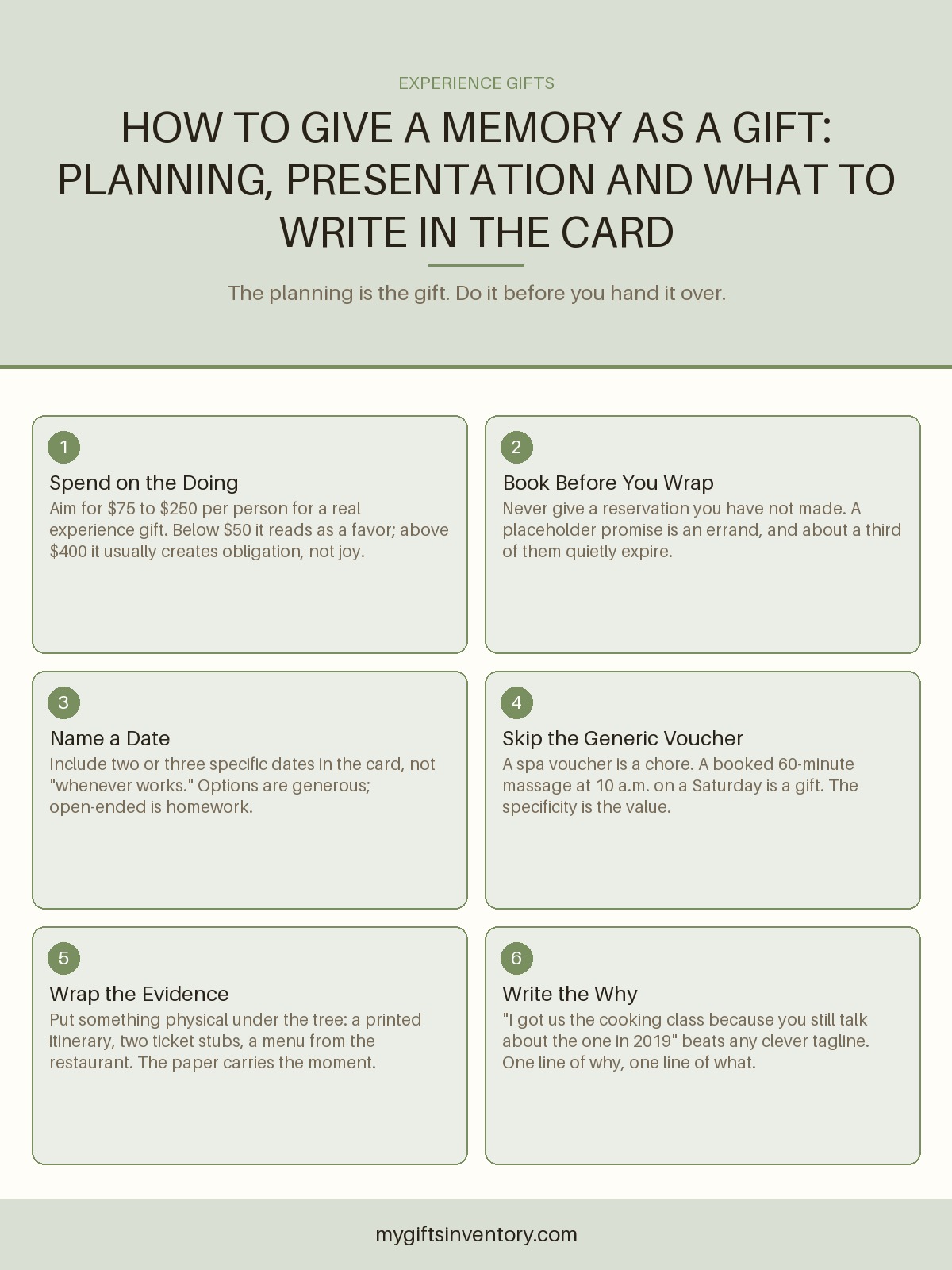
Experience gifts win or lose on the card. A printed ticket with no message can read like a transaction. A card that names the plan and includes one easy next step reads like love.
What to include (keep it short)
- One line of warmth: why you chose this
- One concrete detail: date, time, or “we will pick a date”
- One next step: how you will schedule or what they should decide
Copy-and-paste card wording that actually works
Here are options you can adapt. We like giving you lines that do not sound rehearsed.
Option A: You already scheduled it (best for couples, close friends)
“I booked us for the 6:30 show on Saturday. I cannot wait to hang out and make an evening of it. Can you let me know what you would like to eat before we go?”
Option B: It is flexible and you will pick a date together
“This is your plan ticket. Let’s pick a day that works for you in the next few weeks and turn it into a proper outing.”
Option C: It is a solo appointment (spa, class, etc.)
“I wanted you to have a little pause that is just for you. Use this for your appointment, then text me when you book the time, and we’ll plan something relaxing after.”
Option D: Gift card, but structured (so it does not feel lazy)
“Here is your experience credit. Pick what you want to do within the next 30 days, and we’ll lock in a time together.”
What to avoid
- “Thought it would be fun” with no detail. Fun is not a plan.
- Long paragraphs about your shopping search. Keep it about them.
- Making the recipient do all the work without asking. If they need to schedule, say so and offer one suggestion.
If you want a broader tone reference for different relationships, the general approach from our choosing the perfect gift: tips and ideas page can help you translate “experience” into the right voice for the person you are shopping for.
Wrapping experience gifts: how to make it feel special before the event
Experience gifts often get stuck in a weird middle: there is no physical item to wrap, and you do not want to hand over a ticket in a plain envelope. The goal is to make the gift moment feel complete.
Our favorite wrap approach: a “ticket packet”
We call it a packet because it feels intentional. Include:
- The confirmation or printed tickets
- A short itinerary card (even if it is only two bullet points)
- A small themed add-on, like snacks, a movie-style treat, or a small drink voucher
- The card with the wording you picked above
For example, for a museum or show evening, the itinerary could be:
- “Meet at 5:45”
- “Dessert near the venue after”
Creative wrapping ideas that do not get complicated
- Wrap the “how-to”: print a mini schedule and wrap that like the main event.
- Use a small container: put tickets in an envelope inside a cute tin, basket, or gift bag.
- Give a themed item: a book for a reading workshop, a playlist card for a night out, or a small tea sample for a tasting.
We avoid anything that requires explaining a complicated setup. The best wrapping should make the recipient smile immediately, then naturally lead into the event plan.
Planning timeline: when to buy and how to avoid last-minute chaos
Experience gifts have a calendar problem. The answer is not “start earlier,” because sometimes you are already shopping with a real deadline. Instead, plan with a timeline that matches the type of experience.
What we recommend by lead time
- Live events with popular seating: aim for 3 to 6 weeks ahead when possible.
- Workshops and classes: 2 to 4 weeks is usually plenty, depending on the schedule.
- Appointments (spa, salon, massage): about 1 to 2 weeks is often reasonable.
- Flexible experiences: a week or even a few days ahead can work if the vendor has multiple session times.
If you are truly last-minute, choose a gift that does not hinge on one exact date. A reservation that requires a precise time can become an anxiety-inducing handoff. A flexible class pass or a venue credit tends to be smoother.
Timing etiquette: who should coordinate?
We like to split responsibilities like this:
- If we bought fixed tickets, we offer two time options in the card and confirm how you want to meet.
- If we are giving a flexible pass, we suggest a booking window and offer to help find times.
- If the recipient is the scheduler, we make it easy with a short list: “Here are the top two days that work for me. Which do you prefer?”
That way, it feels like a gift, not a chore.
Returns and changes: how to handle the “what if plans change?” part
Experience gifts can be harder to reverse than physical items. That is why we always think about change policies before we commit.
Before you buy: check the change policy
- Can the booking be rescheduled?
- Is there a deadline for changes?
- Do refunds require specific timelines?
- Are name changes allowed for tickets?
If you are purchasing through a store or a gift-card credit, the policy may vary by issuer. For example, if you are choosing a practical card route, our pages for specific retailers like Kroger gift cards can help you think through how people typically use those funds, which is useful when you are building your “experience plan” rather than handing over a random amount.
When you cannot change plans
If rescheduling is not an option and you have to pass the experience to them, do it with care. Include a note that makes it easy to accept the transfer, like: “If you want, you can use this on your own schedule. If you need help picking a time, tell me what days are best for you.”
Experience gifts vs gift cards: when each is the better move
Not every experience gift needs to be fully booked. The best choice depends on how scheduling-friendly the recipient is and how much time you have.
Choose a fully planned experience if…
- You know their schedule preferences (early vs late, weekdays vs weekends)
- You can offer a meeting time and a simple plan
- You are close enough to share the moment
Choose a gift card or credit with structure if…
- The recipient is busy and needs control
- You do not know their availability
- You are gifting from a distance
The key is structure. If the card is your gift, your card message should create the experience plan. Otherwise it will feel like “Here is money” instead of “Here is a moment.”

Frequently Asked Questions
Are experience gifts more thoughtful than regular gifts?
They can be, because an experience usually connects to the person’s interests and creates a shared memory or a meaningful moment. The thought shows up in your planning, like naming the plan in the card and making scheduling easy.
How much should we spend on an experience gift?
A good starting range is $60 to $150 for most meaningful outings, with smaller “experience add-on” gifts around $25 to $50. If it is a bigger weekend-level gift, $150 to $300 is a common tier, especially when you include food or transportation costs.
What should we write in a card for a scheduled experience?
Tell them what is happening and give a simple next step. Example: “I booked us for the 6:30 show on Saturday. Can you let me know what you would like to eat before we go?”
What if the recipient needs to choose the date?
Make it specific and kind, not vague. Try wording like, “Pick a time within the next 30 days, and send me your top two options so we can lock it in.”
Can we wrap experience gifts if there is no physical item?
Yes, we recommend a ticket packet. Put the confirmation or tickets in an envelope with a short itinerary card and the message, then add a small themed item so it feels like a complete gift in your hands.
Looking for an Actual Gift Instead?
Gift Sets We Love Right Now
Every item picked, priced and linked, ready to buy.
More Gift Advice