How to Give Meaningful Gifts That People Actually Remember
Meaningful gifts come from attention, not price tags. Here’s how we choose, personalize, present, and write the note so the gift feels like it could only have come from you.
As an Amazon Associate, My Gifts Inventory earns from qualifying purchases. We only recommend products we'd genuinely consider buying ourselves.
We’ve all stood in a store or stared at a browser tab wondering if the thing in our cart will land as thoughtful or just… fine. The pressure to give a meaningful gift usually shows up right before a birthday, anniversary, holiday, or “just because” moment when we want the person to feel seen, not simply supplied. The good news is that meaning rarely requires a huge budget or perfect taste. It requires attention, a bit of planning, and the willingness to skip the safe generic option.
Here’s how we approach giving gifts that people actually remember and keep using, wearing, or talking about months later.
Start With Attention, Not the Store
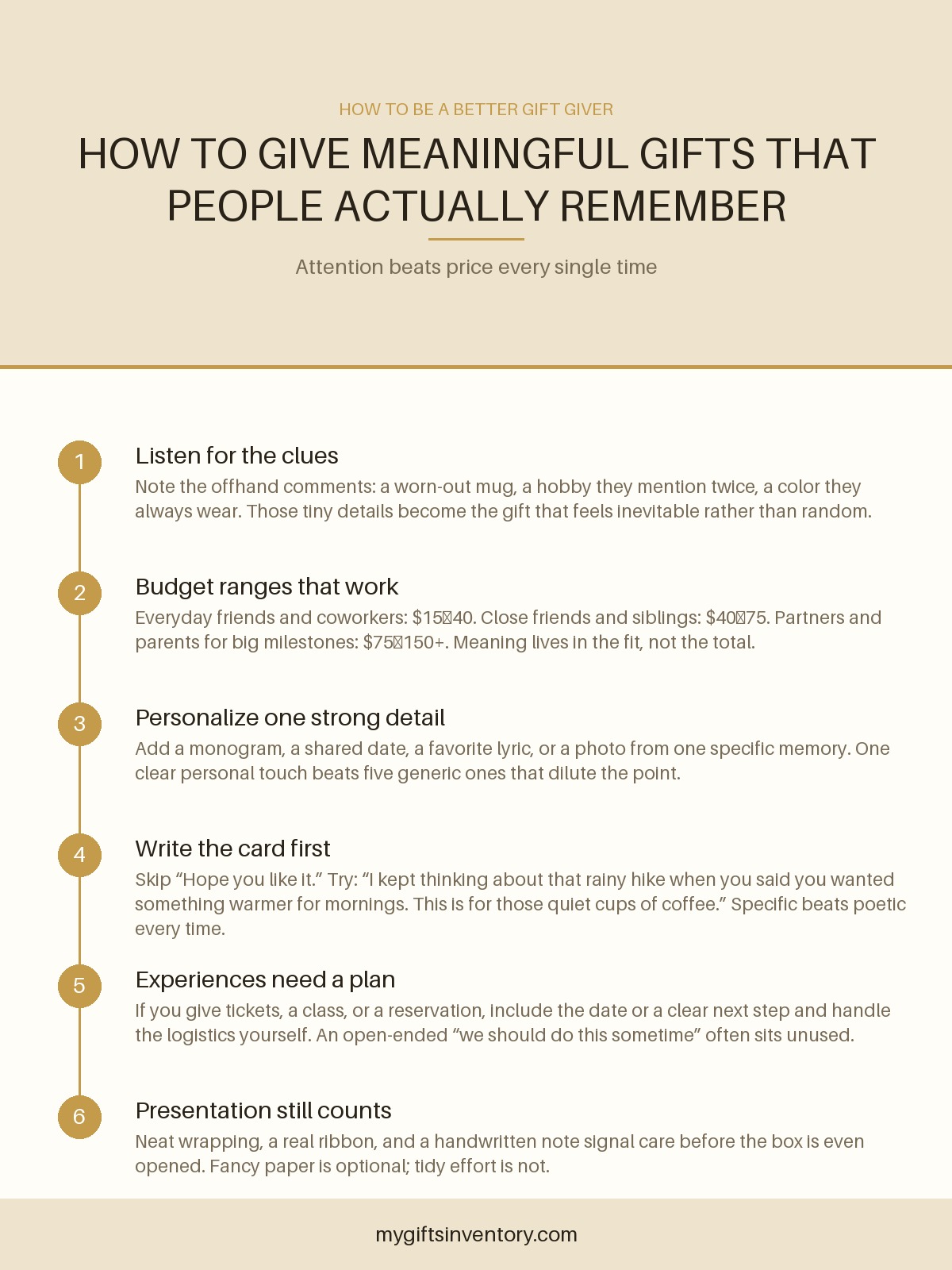
The most reliable path to a meaningful gift begins weeks or months before you buy anything. We listen for the small, repeated signals people drop without realizing it. The mug with the cracked handle they refuse to throw away. The hobby they mention every time you talk. The color they always reach for. The thing they said they “should get around to” buying for themselves.
Keep a simple note on your phone labeled with their name. When they complain that their headphones keep dying, or rave about a bakery two towns over, or sigh about how cold their hands get on the commute, jot it down. Those notes turn shopping from guesswork into recognition. The gift then feels like proof that you were paying attention on ordinary Tuesdays, not just scrambling the week of the occasion.
If you live far apart or don’t talk constantly, a short, casual check-in helps: “What’s one little thing that would make your week easier right now?” Most people will answer honestly if the question feels low-pressure.
Match the Gift to the Relationship and the Moment
A meaningful gift for a new coworker looks different from one for a partner of ten years. We calibrate three things: how well we know them, how public or private the giving will be, and what the occasion actually celebrates.
Everyday and lighter relationships
For teachers, neighbors, newer friends, or coworkers, keep it useful, pleasant, and low-commitment. Think small comforts, good consumables, or something that solves a tiny daily friction. A range of $15–40 usually feels right and generous without creating obligation. If you want ideas that still feel considered at that level, our roundup of thoughtful gifts under $30 is full of options that punch above their price.
Close friends, siblings, and chosen family
Here we can lean into shared history, inside jokes, or long-running interests. $40–75 covers most situations comfortably. This is where a well-chosen keepsake or something tied to a mutual memory starts to shine.
Partners, parents, and major milestones
Anniversaries, big birthdays, and holidays with the people closest to us can support $75–150 or more when the gift truly fits. The number matters less than whether it reflects real knowledge of their life right now. For couples or romantic occasions, small shared experiences or dual-use items often land better than another solo object. We’ve collected ideas in our guide to romantic gifts for couples under $50 that still feel intentional.
When money is tight, say so gently to yourself and choose meaning over markup. A handwritten letter bundled with a $20 item they will use every day almost always beats an expensive generic that gathers dust.
Personalization That Actually Helps
Personalization is powerful when it is specific and restrained. A monogram, a significant date, coordinates of a meaningful place, a short phrase only the two of you understand, or one clear photo from a shared memory can turn an ordinary object into something they will not re-gift.
The trap is overdoing it. Five different custom elements on one item start to feel like a craft project instead of a gift. Choose one strong detail and let the rest of the piece stay clean and usable. Engraved jewelry, custom star maps, embroidered textiles, or photo books work well when the personal piece is the hero rather than an afterthought sticker.
If you want lasting options that people tend to keep, look at keepsake gifts worth holding onto and personalized home and keepsake gifts under $50. Both lean into pieces that stay in the house or on the person rather than disappearing into a drawer.
Things Versus Experiences
Some people light up over a beautiful object they can touch every day. Others remember the concert, the cooking class, the overnight trip, or the reservation you handled for them far longer than any physical item. We try to notice which camp someone falls into (many of us are a mix) and lean that direction.
When you give an experience, do the logistics. Book the tickets or the table, include the date if possible, and write clear instructions or a simple “I already made the reservation for the 14th at 7.” An open-ended gift certificate that requires them to plan everything often sits unused out of decision fatigue. Pair the experience with a small physical token if you like (a related book, a piece of gear, a bottle of something for afterward) so there is still something to unwrap in the moment.
What to Write in the Card
The note is half the gift. We write it before we wrap so the words set the tone. Avoid empty lines like “Hope you like it!” or “To a wonderful person.” Instead, name the reason you chose this particular thing and, if it fits, one concrete memory or observation.
Examples we actually use:
- “You mentioned your hands freeze on the morning walk. These are for the next cold stretch. Proud of how consistent you’ve been with getting outside.”
- “I still laugh about that terrible karaoke night. This felt like the right soundtrack for the next round of adventures.”
- “For the new apartment kitchen. May every meal in it feel a little more like home.”
- “Ten years. I keep the ticket stubs and the photos, but this is for the ordinary Tuesdays that matter just as much.”
Keep it to three to six sentences for most occasions. Longer letters are wonderful for major milestones; everyday birthdays do not require an essay. Handwrite it if your penmanship is readable. A typed note is fine if you sign it by hand. The point is that it could only have been written by you to them.
Presentation Without the Stress
You do not need professional wrapping skills. You do need evidence of care. Neat folds, enough tape, a ribbon or sprig of something simple, and a properly sealed envelope for the card already signal that this was not an afterthought. Reusable fabric wraps, a nice box they can keep, or even brown paper with good twine can look intentional.
If the gift is an experience or digital, still give them something physical to open: a printed confirmation in a card, a small related item, or a nicely designed envelope with the details. The ritual of receiving matters.
For holidays or multiple gifts, we sometimes leave one small item unwrapped or in a simple bag so the evening does not become an endless paper-tearing session. Mix it up.
Planning Timeline That Actually Works
Meaningful rarely happens at 11 p.m. the night before. Our rough calendar:
- 4–6 weeks out for major holidays or big anniversaries: start the notes, check sizes or preferences, order anything personalized (those often need extra production and shipping time).
- 2–3 weeks out: buy or finalize the main gift, write the card draft, sort wrapping supplies.
- 1 week out: wrap, confirm any reservations or delivery windows, double-check that personalized items actually arrived correctly.
- Last-minute is still possible: a beautifully written letter plus one excellent small item, or a well-chosen experience you can book same-day, beats a panicked generic purchase.
Registries exist for a reason at weddings and baby showers. Using them is not unimaginative; it is respectful of what the couple or parents actually need. Add a small personal touch or upgrade one registry item if you want to put your own stamp on it. For more modest celebrations, our budget-friendly wedding gifts under $50 collection shows how to stay useful and warm without overspending.
When a Gift Card Is (and Isn’t) Meaningful
Gift cards get a bad reputation because they are often the lazy default. They become thoughtful when they remove a real friction or enable something the person already wants. A card to their favorite coffee place, the bookstore they live in, the art supply shop they visit every month, or a specific experience provider can feel generous and freeing.
Make it specific rather than generic multi-store plastic when you can. Include a note that says why you chose that particular place (“For the next three rainy-day novels” or “Go get the good paint set you’ve been eyeing”). If you go the gift-card route for practicality, pair it with one small physical item so there is still an unwrapping moment.
Common Traps We Try to Avoid
Regifting without cleaning it up or checking that the new recipient will actually want it. Giving something that creates work (high-maintenance plants to someone who travels constantly, complicated gadgets to someone who likes simple tools). Choosing shock value or inside jokes that only you find funny. Over-focusing on what we would want instead of what they would use. Waiting for the “perfect” idea until the only options left are mediocre.
Also watch for gifts that quietly criticize: fitness gear when they have not asked for support around movement, organizational products when their system works for them, or size-related items unless you are 100 percent certain and the relationship can hold it. When in doubt, ask a mutual close friend or simply choose something affirming.
Returns, Exchanges, and Grace
Even careful gifts sometimes miss. Include a gift receipt when the store allows it, especially for clothing, tech, or home goods. A short line in the card such as “If the size or color is off, swap it for whatever feels right. I just wanted you to have something you love” removes awkwardness. Most people would rather you know they exchanged it than feel stuck with something unused.
If you receive something that is not quite right, a warm thank-you still comes first. The relationship matters more than the object.
Putting It All Together
Meaningful gift giving is a practice, not a talent some people are born with. We get better by taking better notes, asking better low-stakes questions, writing more specific cards, and giving ourselves enough runway so we are not forced into the generic aisle. Price can amplify a good idea; it cannot rescue a vague one.
The gifts people remember are the ones that say, without needing a long speech, “I see you. I remember what you told me. I took the time.” That feeling is available at almost every budget. Start with one person and one upcoming occasion. Pay a little more attention than usual. The rest tends to follow.
Frequently Asked Questions
How much should I spend on a meaningful gift?
Spend what your budget and the relationship can comfortably support. For most friends and coworkers $15–40 feels considerate. Close friends and family often land in the $40–75 range. Partners and major milestones can go $75–150+ when the gift truly fits. The right $25 item regularly outperforms a mismatched $200 one.
Is it better to give an experience or a physical gift?
It depends on the person. Notice whether they light up more over objects they use daily or over stories and memories. When you give an experience, handle the booking and timing yourself so it does not become another task on their list. Many of our best gifts combine a small physical token with a planned experience.
What if I’m not creative or “good at gifts”?
You do not need to be. Keep a running note of things they mention, choose one clear need or delight, add a specific handwritten sentence about why you picked it, and present it neatly. Consistency of attention beats originality almost every time.
How early should I start shopping for a meaningful gift?
Four to six weeks out for anything personalized or for major holidays gives you time for production, shipping, and a second idea if the first falls through. Two weeks is workable for most standard gifts. Even three days can work if you pair a strong small item with a genuinely thoughtful note.
Are homemade gifts more meaningful?
They can be, when the homemade element matches your actual skills and their tastes. A well-made loaf of their favorite bread, a playlist with a short explanation for each song, or a simple photo book you assembled carefully often lands beautifully. A rushed craft that looks unfinished can feel like more obligation than gift. Match the effort to what you can execute well.


