How to Report a Gift on Taxes: What You Actually Owe (and What You Don't)
Most gifts never need to be reported. Here's exactly when the IRS cares, what the 2026 exclusion limit is, and which form to file if you cross it.

As an Amazon Associate, My Gifts Inventory earns from qualifying purchases. We only recommend products we'd genuinely consider buying ourselves.
Somebody hands you a check for $25,000, or you write one to help a kid with a down payment, and the first thing you feel is grateful. The second thing you feel, usually around 2 a.m., is a low-grade panic about the IRS. Here's the part almost nobody tells you upfront: the vast majority of gifts in America are never reported, never taxed, and never even mentioned to a tax preparer. The rules only start to matter at fairly high dollar amounts, and even then, the outcome is usually less scary than people imagine.
What follows is a plain walkthrough of when a gift becomes a tax event, who is actually on the hook, and how the paperwork works if you do cross the line.
First, the Honest Answer: Most Gifts Are Not Reportable
The U.S. gift tax exists mainly to stop wealthy people from transferring fortunes to heirs tax-free while they're alive. It is not designed to catch you handing your nephew $500 for graduation. If you gave a normal-sized gift this year, there is nothing to report and nothing to file. You don't list it on your 1040, you don't send a form, and the person who received it doesn't declare it as income.
That last point trips people up constantly. Gifts are not income to the recipient. If your parents give you $10,000, you do not add $10,000 to your taxable income line. You don't owe income tax on it, and in the normal case you don't owe gift tax on it either. The only person who ever has a filing obligation is the giver, and only past a specific threshold.
So before you go any further down this road: if the gift in question is under five figures, you are almost certainly done. You can skip to the FAQ and go about your day. If it's larger, or you gave several large gifts to the same person, keep reading.
The Annual Exclusion: The One Number You Need
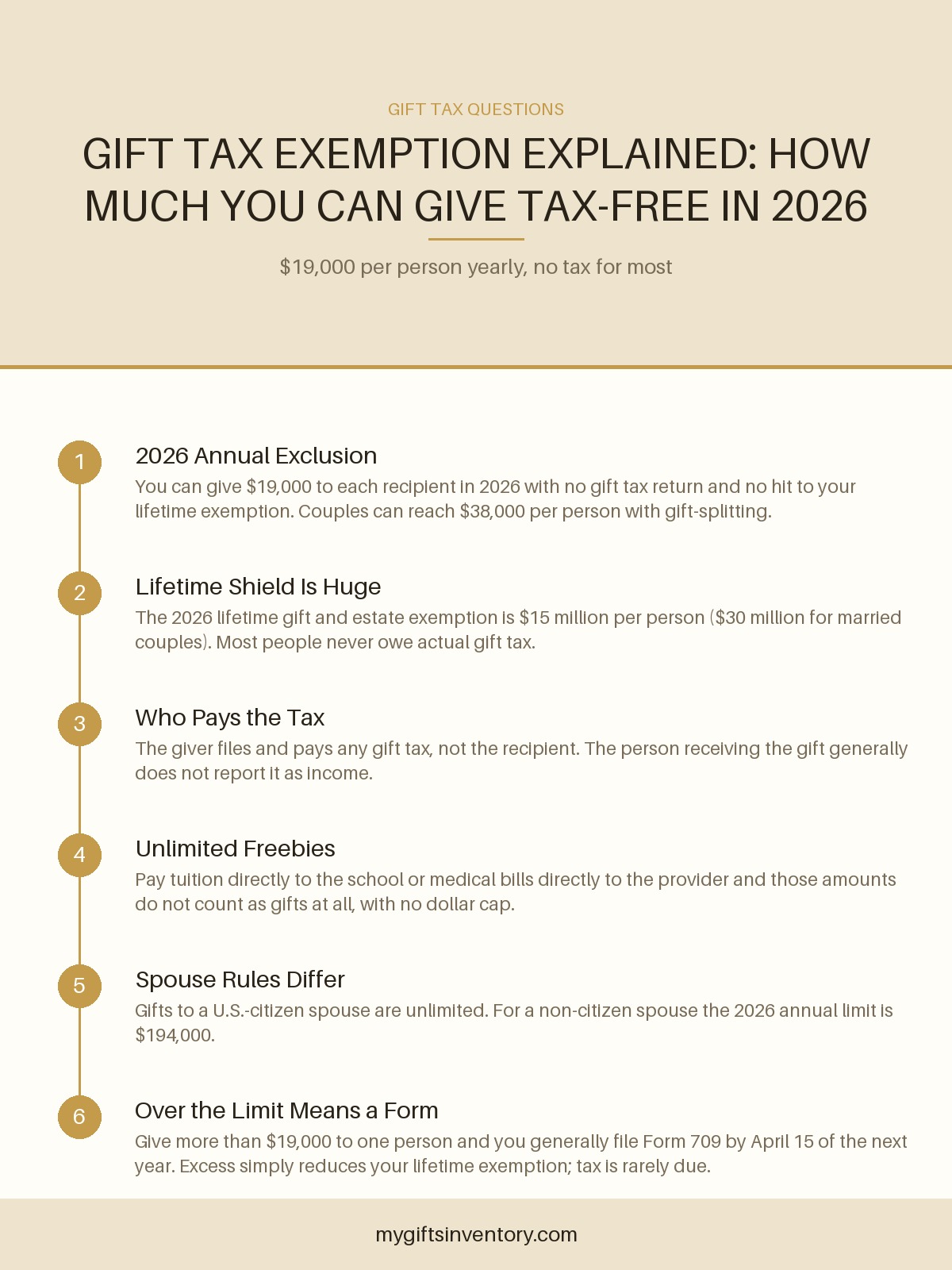
For 2026, the annual gift tax exclusion is $19,000 per recipient. This is the single most important figure in this entire article. It means you can give up to $19,000 to each individual person during the calendar year, to as many different people as you like, and you do not file anything, report anything, or owe anything. Give $19,000 to your daughter, $19,000 to your son, $19,000 to your neighbor, and $19,000 to your favorite barista. None of it is reportable.
The exclusion is per recipient, not a global cap, which is the detail people most often get wrong. There's no total limit on how much you can give away across everyone combined before you have to file. There's only a per-person yearly limit.
If you're married, the two of you each get your own $19,000 exclusion, and you can combine them on the same recipient. That's called gift splitting, and it means a married couple can give one person up to $38,000 in 2026 without filing a thing. If you and your spouse hand your daughter $37,000 for a house down payment, no form is required.
A quick example
Say you gave your son $15,000 in March and another $12,000 in October. That's $27,000 to one person in one year, which is $8,000 over the $19,000 exclusion. Did you break a rule? No. But you've now used $8,000 of your lifetime exclusion, and you're required to file Form 709 to report it and track that usage. You very likely still owe nothing.
When You Have to File Form 709
Form 709 is the U.S. Gift (and Generation-Skipping Transfer) Tax Return. You file it for the calendar year in which you made the gift, and it's due April 15 of the following year, the same deadline as your regular return. You can request an extension, but the form itself is separate from your 1040 even though it goes to the same place.
You need to file it if any single recipient received more than $19,000 in gifts from you during 2026, counting all the gifts you gave that person that year, not just one big one. Splitting a large gift into several smaller checks to the same person doesn't help. The IRS totals them.
You also file if you and your spouse agreed to split gifts, if you gave a gift of a future interest like certain trust contributions, or if you're reporting a gift your spouse made and you're electing to split it on a joint return.
Here's the reassuring part: filing Form 709 usually does not create a tax bill. What it does is subtract the reportable amount from your lifetime exclusion, which is the running allowance you get before federal gift or estate tax applies at all. For 2026, that lifetime exclusion sits at $15 million per person (adjusted annually for inflation). For a married couple, it's effectively $30 million. The overwhelming majority of people who file Form 709 are simply doing the bookkeeping and paying nothing.
Because the lifetime figure is indexed to inflation and has changed substantially over the past several years, it's worth checking the current number on the IRS site or with your preparer before you rely on it for planning. It is not a fixed number. If your gifting is anywhere near that scale, you're in estate-planning territory and should be working with a professional, not a web article.
What Actually Counts as a Gift (and What Doesn't)
A lot of things people assume are gifts legally are not, and a few things people assume are personal aren't. Getting this category right saves you from filing paperwork you never needed.
Usually not gifts for tax purposes
Paying someone's tuition directly to the school. This is the big one. Tuition paid straight to an eligible educational institution is excluded from the gift tax entirely, no matter the amount and it doesn't use your $19,000 annual exclusion. You could pay $60,000 of a grandchild's tuition directly and file nothing.
Paying someone's medical expenses directly to the provider. Same deal. Money paid directly to a hospital, doctor, or insurer for someone else's care is excluded. The key word is directly. If you write the check to your grandchild and they pay the hospital, that's a reportable gift of cash.
Money you spend on a dependent you're legally supporting. Support of your own minor children is a normal parental obligation, not a gift.
Political contributions and charitable donations. These have their own rules and are not treated as gifts to individuals.
Loans. A genuine loan with real repayment terms and a reasonable interest rate is not a gift. A "loan" that everyone privately understands will never be repaid usually is one, and the IRS can treat it that way. If you're putting a large amount of money into a family real estate purchase with no repayment date, that's a gift, not a loan.
Usually is a gift
Cash or check to an individual. This is the classic case and the easiest to track. Bank records make it visible.
Adding someone's name to your home or brokerage account. This can be a gift of half the value instantly, and it's one of the most commonly overlooked reportable events.
Forgiving a debt someone owes you. Cancelling a $50,000 loan you made to your brother is functionally a $50,000 gift.
Selling something valuable to a family member far below market value. If you sell your car worth $40,000 to your nephew for $5,000, the IRS generally views the $35,000 gap as a gift.
Large tangible items. A car, a boat, jewelry, art. These are gifts at their fair market value on the date you hand them over, which means you'll want a real valuation if the number is anywhere near the threshold. This is also the category where people most often need to inventory what they've already given, since several mid-sized gifts to the same person in one year can quietly add up past $19,000. A running log of what you've given and to whom makes filing season a ten-minute job instead of an archaeology project.
What the Recipient Owes (Spoiler: Nothing)
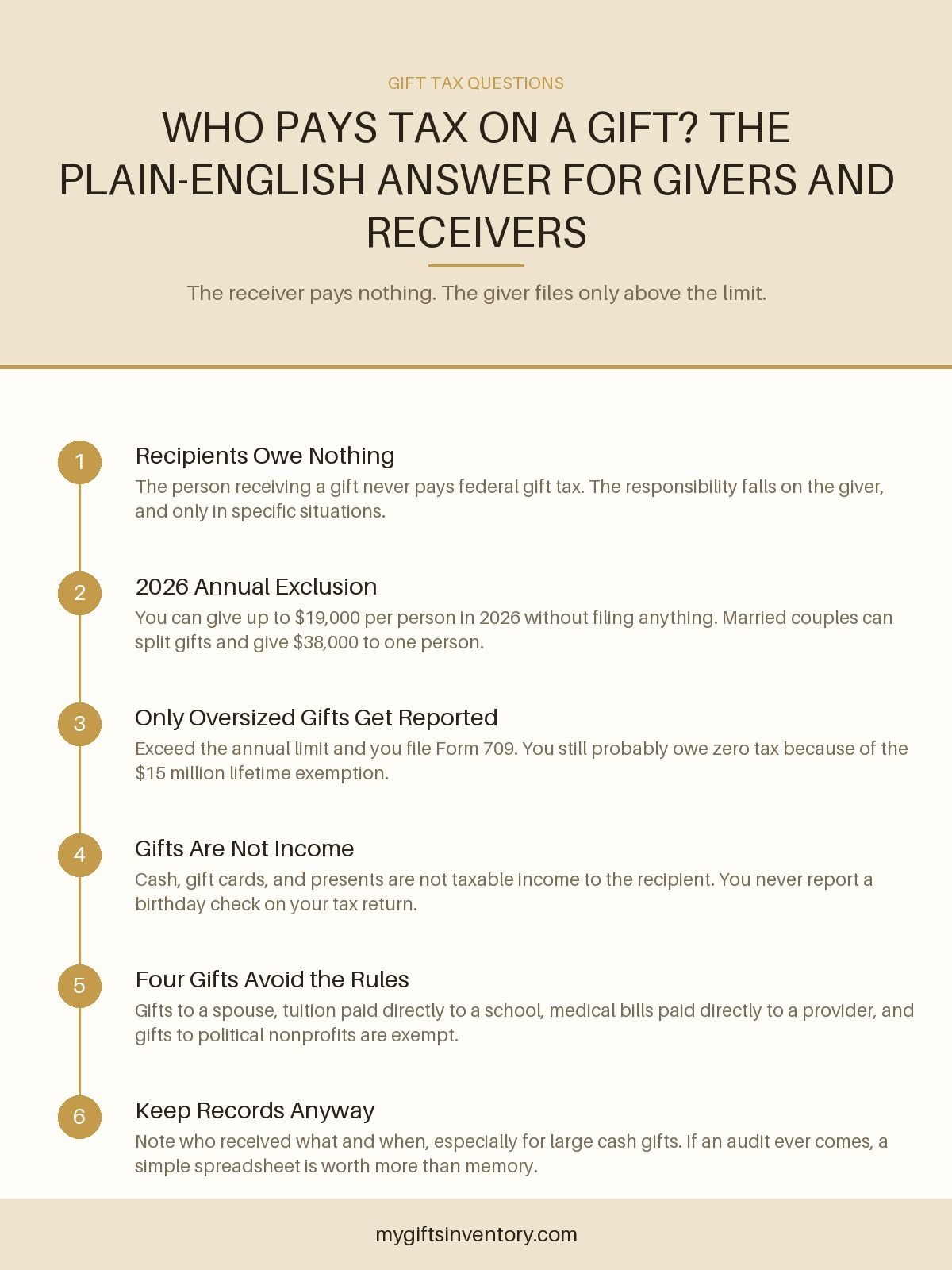
The single most common source of confusion here is the assumption that the person receiving a large gift has a tax problem. They don't. Gift tax, when it applies at all, is owed by the giver. The giver files. The giver pays. The recipient has no filing obligation and no tax liability on the gift itself.
There's one narrow wrinkle worth knowing: if you receive a gift from someone in another country and it exceeds a certain threshold (it's currently in the six figures and adjusted annually, so look it up for the year in question), you may need to file an informational form to report the receipt. That's a reporting requirement, not a tax, and it applies specifically to foreign gifts, not gifts from your American relatives. Also note that the giver in a foreign-gift scenario may be subject to their own country's rules, which may be entirely different from U.S. rules.
Separately, a gift can carry a hidden benefit for the recipient down the road: when you give someone an asset rather than cash, they generally inherit your original cost basis. If you bought stock for $5,000 and give it away when it's worth $50,000, the recipient's basis is still $5,000, and they'll owe capital gains on the whole $45,000 gain if they sell. Cash has no such problem. This is a good reason to talk to a tax professional before gifting appreciated assets, especially shares you've held for decades.
Practical Recordkeeping (Do This Even If Nothing Is Reportable)
We know the paperwork part of this is the least fun part. But keeping decent records is what makes an unlikely future question easy to answer rather than a nightmare, and it costs you almost nothing in time if you do it as you go.
Keep the following for at least three years, and longer for anything that touched your lifetime exclusion:
- The date of each gift and the amount
- The recipient's full name and your relationship to them
- The form the gift took (cash, check, wire, stock, property)
- For property or assets, a copy of the valuation and any appraisal
- Copies of prior Forms 709 you've filed, which track your lifetime exclusion usage
If you're gifting something like a piece of jewelry or a collectible, a written appraisal from a qualified appraiser is worth the fee. If you're gifting a car, the fair market value on the transfer date is what matters, not what you originally paid. A simple spreadsheet with a row per gift handles all of this. If gifting is a regular habit in your family, a shared note or folder keeps everyone on the same page and prevents the "wait, did we already give her the exclusion this year?" conversation in December.
When you're the one receiving gifts and unsure what you're dealing with, general consumer guidance and gift-tax basics can help you sort out what's taxable income versus what's just a gift. And if you're the one giving, the focus should stay on the amounts above, not on the gift itself.
Special Situations Worth Knowing About
Gifts to a spouse
There's an unlimited marital deduction for gifts between U.S. citizen spouses. You can give your husband or wife any amount, and there's no gift tax and no filing. This changes if your spouse is not a U.S. citizen, in which case an annual limit applies (currently in the low six figures).
Gifts to a 529 college savings plan
Contributions to a 529 count as gifts to the beneficiary, but there's a special option that lets you front-load five years of annual exclusions in one go. For 2026 that means up to $95,000 per beneficiary in a single year (five times $19,000), with no additional gifts to that person for the next five years. Married couples can double that by splitting the gift. It requires an election on Form 709, which is one of the few times a 529 contribution triggers a filing even though nothing is owed.
Giving a house or a large asset
Transferring real estate usually means a gift of the full fair market value unless the recipient pays you something close to it. There are title, mortgage, and capital gains implications that go well beyond the gift tax, and a real estate attorney plus a tax professional should be involved before the deed is signed.
Gifts to employees or clients
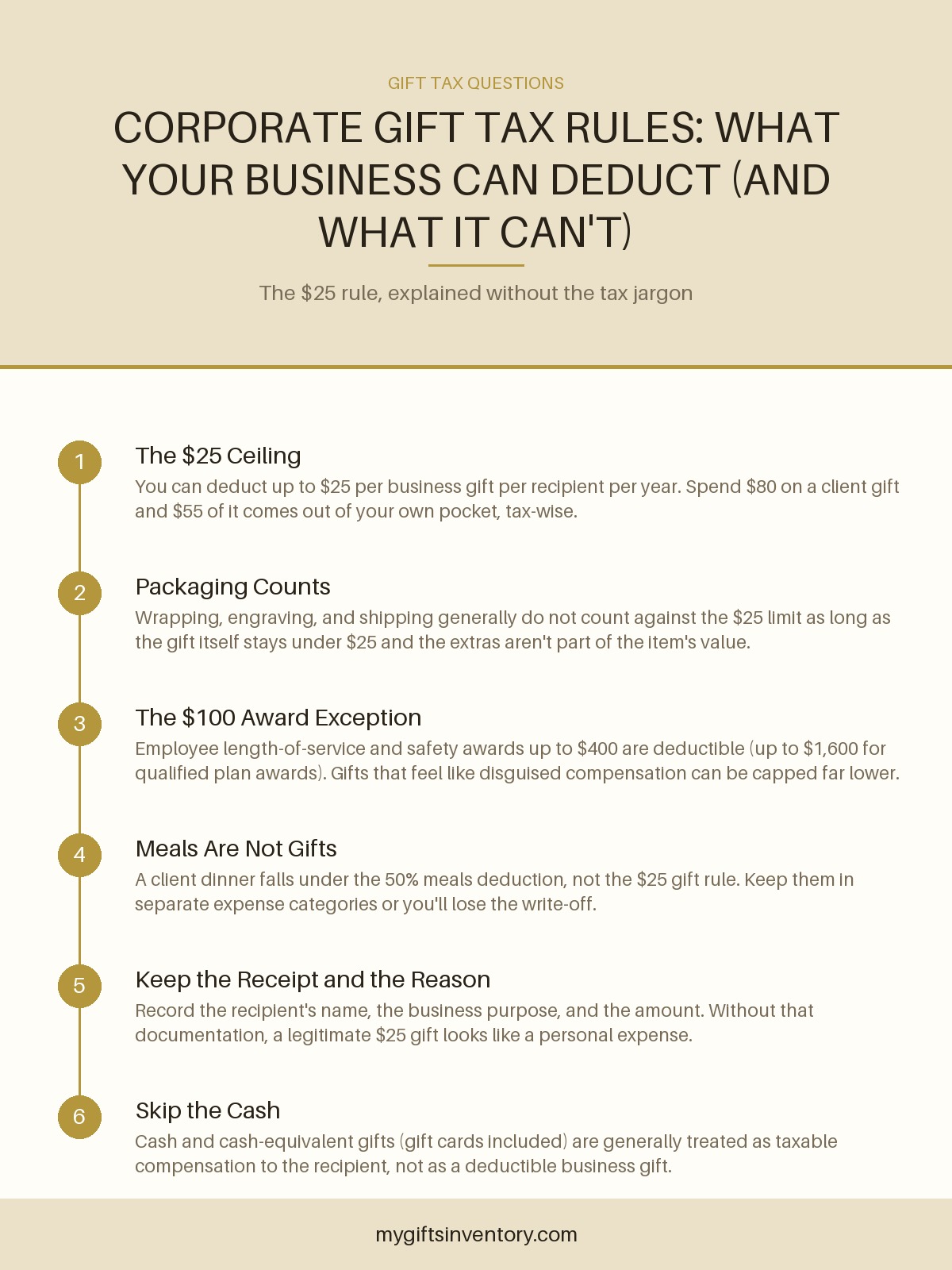
These follow different rules entirely. Business gifts to clients are generally deductible up to $25 per recipient per year, and gifts to employees are usually treated as taxable compensation to the employee and reported on their W-2. The rules that apply to your family don't apply here, and it's a good idea to check before promising a large year-end gift to a client or staff member.
Grandparents helping with a wedding, down payment, or grandchild's expenses
This is where the annual exclusion does a lot of quiet work. A married couple of grandparents giving to a married grandchild couple can direct gifts to all four people in the equation, multiplying the exclusion substantially. And if the money goes straight to a school or a medical provider, it's outside the exclusion altogether. This is the kind of thing where ten minutes with an accountant up front can save real money later.

Gift Ideas to Go With This


Want more ideas? Browse our full guide: 21 Corporate & Employee Gift Ideas Under $50 (2026) That Won't Feel Like an Obligation
Frequently Asked Questions
Do I have to report a gift under $19,000?
No. If you gave any one person $19,000 or less during 2026, you have nothing to report and no form to file. This is true no matter how many different people you gave gifts to. Only gifts to a single recipient that exceed the annual exclusion in one calendar year trigger a filing requirement.
Who pays the gift tax, the giver or the receiver?
The giver. Gift tax liability sits with the person who made the gift, and they're the one who files Form 709 if a filing is required. The recipient generally has no tax obligation on the gift and doesn't have to report it as income on their tax return.
Is a large cash gift from a parent taxable income to me?
No. Gifts are not taxable income to the recipient, regardless of size. Your parent may have a filing requirement on their end if the gift exceeds the annual exclusion, but that doesn't create any tax liability for you. The only exception worth checking is gifts received from someone living outside the United States, which may have a separate informational reporting requirement.
Can a married couple give more than $19,000 to one person?
Yes. Each spouse has their own $19,000 annual exclusion for 2026, so together they can give up to $38,000 to a single recipient without filing. This is called gift splitting, and with combined exclusions plus the lifetime exclusion being as high as it is, most married couples can make very substantial gifts before any tax applies.
When is Form 709 due?
Form 709 is due April 15 of the year following the calendar year the gift was made, the same deadline as your individual return. You can request an extension of time to file, but any tax owed would still be due at the original deadline, and extensions for the gift tax return are requested separately from any extension you file for your 1040.
Does filing Form 709 mean I'll owe money?
Almost never. Filing typically just means you're subtracting the reportable amount from your lifetime exclusion. The federal lifetime exclusion in 2026 is $15 million per person, so the overwhelming majority of people who file a gift tax return pay $0 and are simply doing required bookkeeping.
Looking for an Actual Gift Instead?




Gift Sets We Love Right Now
Every item picked, priced and linked, ready to buy.



More Gift Advice