How Much Can You Gift Tax-Free? 2026 Gift Tax Limits Explained Simply
The annual gift tax exclusion, who has to file a form, and how couples and families can combine limits. Here's what you can actually give without owing tax.
As an Amazon Associate, My Gifts Inventory earns from qualifying purchases. We only recommend products we'd genuinely consider buying ourselves.
Most people searching this are not trying to dodge the IRS. They are trying to do something generous without accidentally creating a paperwork problem, usually after a wedding, a house down payment, or a check to a grandkid that felt a little larger than usual. The good news is that the rules are friendlier than the internet makes them sound, and most gifts people actually give never touch a tax form at all.
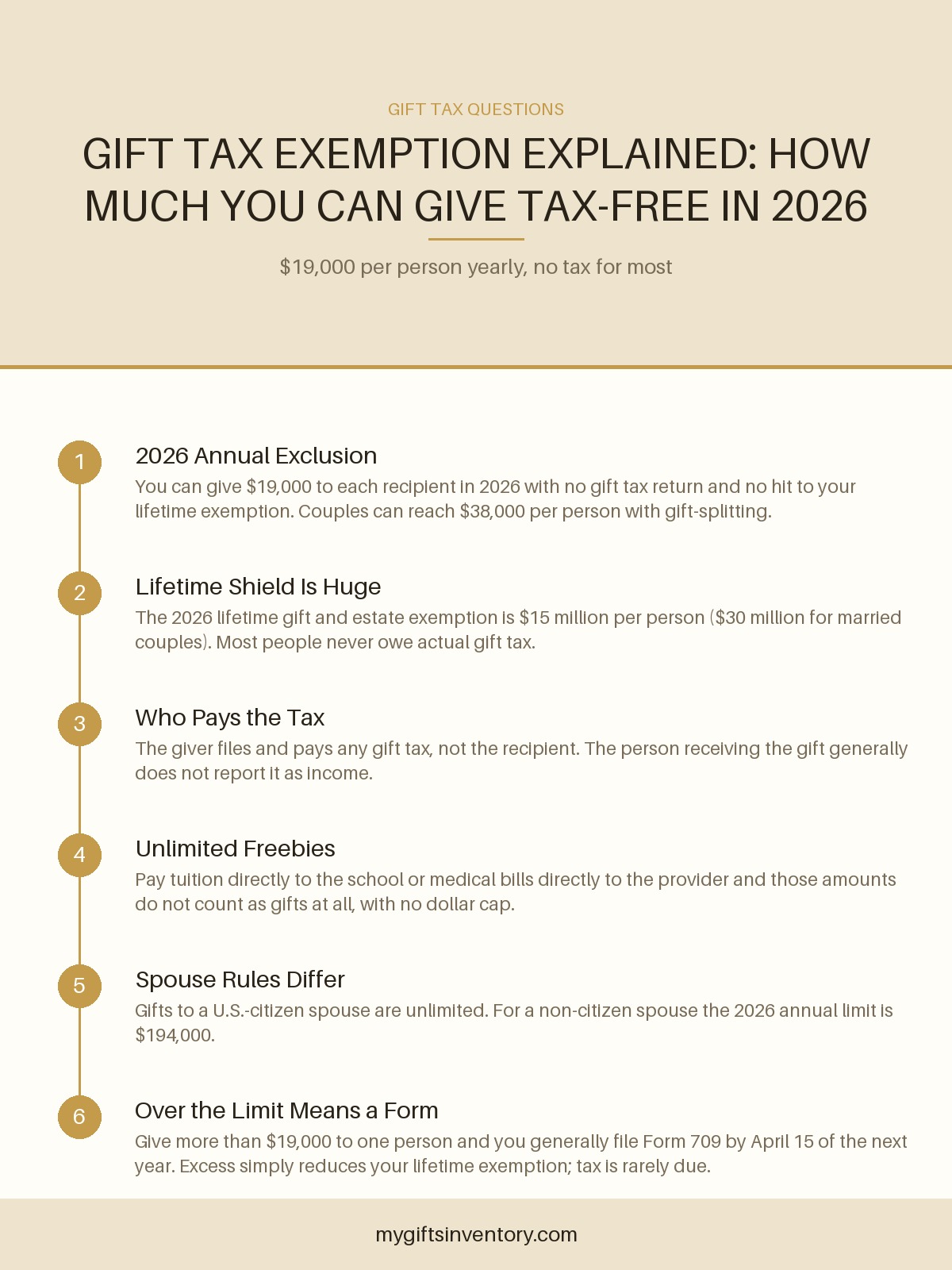
Here is the short version, then the details. For 2026, you can give any one person up to $19,000 in a calendar year with no gift tax return, no tax, and nothing to report. That is the annual gift tax exclusion, and it applies per giver, per recipient. A married couple can give $38,000 to the same person in the same year. Give more than that, and you generally just file a form. You almost never owe tax.
What the $19,000 Actually Means
The annual exclusion is not a cap on your generosity. It is a reporting threshold. Give $19,000 or less to a single person in one calendar year and the IRS does not want to hear about it. Give $19,500, and the $500 excess gets reported on Form 709 and applied against your lifetime exemption.
A few things people routinely get wrong:
- It resets every January 1. Give $19,000 in December and another $19,000 the following January and both are fully covered.
- It is per person. Two grandchildren means $19,000 to each, not $19,000 split between them.
- It is per giver. A married couple each get their own exclusion, so $38,000 to one child.
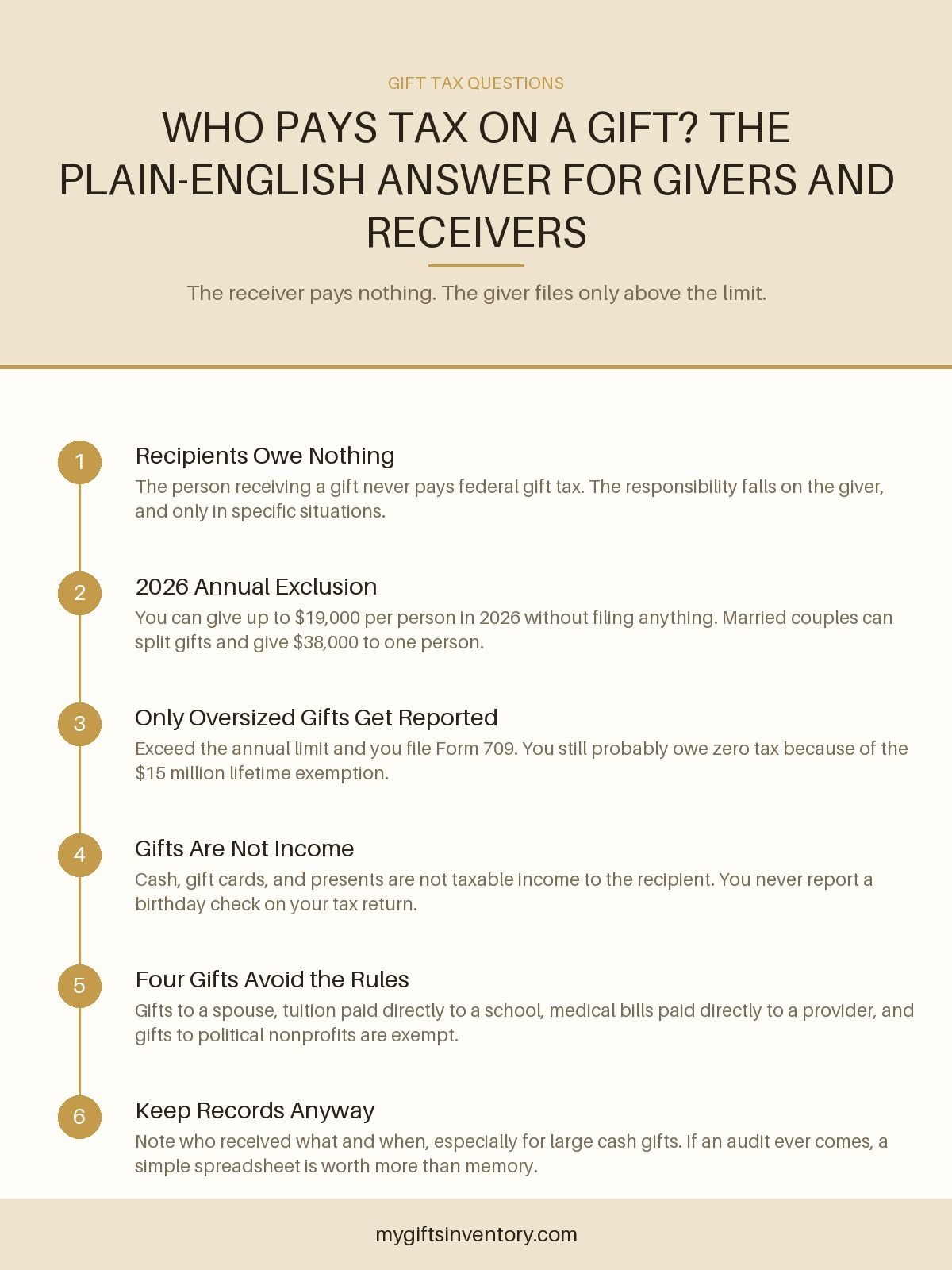
- Gift tax is paid by the giver. The person receiving the gift never owes anything and never reports it.
Gifts between spouses who are U.S. citizens have no limit at all. You can transfer any amount to your husband or wife with no tax and no form, thanks to the unlimited marital deduction.
What Happens If You Go Over the Limit
This is where the panic usually sets in unnecessarily. Exceeding $19,000 does not trigger a tax bill for most people. It triggers a form.
You file Form 709 with your federal return for that year, report the gift, and the amount over $19,000 is subtracted from your lifetime gift and estate tax exemption. For 2026 that exemption is roughly $15 million per person. Between the annual exclusions that never touch it and a lifetime number that large, the overwhelming majority of Americans will never owe a dollar of gift tax. The form exists mostly to track large transfers for estate purposes.
A realistic example
Say you give your daughter $50,000 toward a house down payment in 2026. Subtract the $19,000 exclusion and $31,000 gets reported on Form 709 and counted against your lifetime exemption. You owe no tax. Your daughter owes no tax. If you are married and your spouse joins the gift, that becomes $38,000 excluded and only $12,000 reported.
When the annual limit really matters
The stakes go up for people with estates near or above the exemption, and for anyone giving consistently large amounts year after year. If you are in that territory, this is a conversation for an accountant rather than a website. For everyone else, the takeaway is simple: stay under $19,000 per person per year and there is no paperwork at all.
The Gifts the IRS Does Not Count
Some of the most generous gifts you can make are excluded entirely and do not touch the $19,000 limit or your lifetime exemption. It is worth knowing these before you start splitting checks into $19,000 chunks.
- Tuition paid directly to a school. Pay your grandchild's college tuition straight to the bursar's office and there is no limit. Pay it to the grandchild instead and it counts against the exclusion. The direct payment is the whole trick.
- Medical expenses paid directly to a provider. Same logic. Pay the hospital, not the patient.
- Gifts to a U.S. citizen spouse. Unlimited.
- Gifts to a political organization. Excluded.
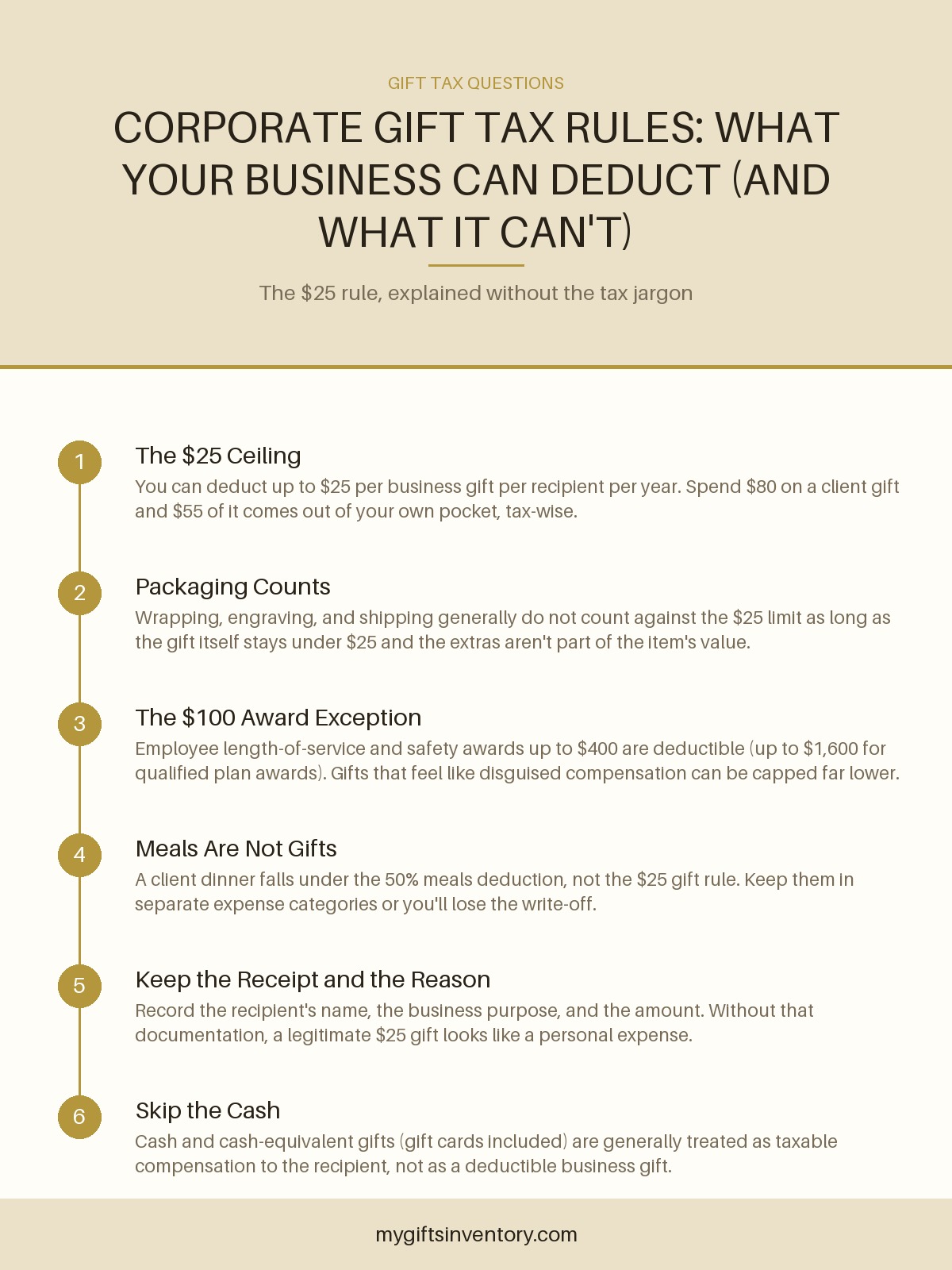
- Gifts to a qualifying charity. Deductible rather than taxable, with its own rules.
The tuition and medical exceptions are the ones most families should know about. If you are helping a relative with school or a medical bill, paying the institution directly is both simpler and more powerful than writing a personal check.
How Big Is a "Normal" Gift, Really?
Tax rules and social norms are two separate questions, and the tax threshold is far higher than most people assume. The $19,000 limit is not a suggestion that you should give $19,000. It is just the point at which paperwork starts.
In practice, the amounts people give are shaped by relationship and occasion, not by the IRS. A coworker gift usually lands in the $25 to $50 range. A wedding gift from a close friend commonly runs $100 to $200, more if you are in the wedding party. A grandparent helping with a first home might give anywhere from a few thousand to the full $19,000. None of those involve a form.
If you are working out what to spend on a specific person, our guide to coworker gifts between $25 and $50 is a good calibration point for the low end, and the $40 to $75 brother gift guide covers the middle. The tax question only becomes relevant above four figures.
Giving Cash, Gift Cards, and Big-Ticket Items
Cash is a gift like any other. Writing a check for $10,000 to a niece counts against your $19,000 exclusion exactly the same as buying her a $10,000 used car would. The IRS does not care whether the gift is cash, stock, property, or a very expensive piece of jewelry. It cares about the fair market value on the date you give it.
Gift cards are treated the same way, though in practice nobody is tracking the $50 restaurant card you gave your sister. Where cash and gift cards get genuinely useful is when you want to give generously without guessing wrong about what someone wants. If you are leaning that direction, our breakdown of gift cards available at Whole Foods Market covers which brands you can actually buy there and what the fees look like, which matters more than most people expect when you are picking up cards for a group.
Gifts of stock and property
Appreciated stock is a common way to give a large amount without a cash outlay. It comes with its own basis and valuation rules, and it is one of those cases where a few hundred dollars of tax advice usually pays for itself. If the gift is worth more than a few thousand dollars in securities or property, get it reviewed before you transfer anything.
Combining Limits Across a Family
The per-person rule is where families can be surprisingly generous. If four grandparents each give $19,000 to the same new grandchild in a year, that is $76,000 with no forms filed. Add two parents and the number climbs further. This is how families fund a first home or a college fund without triggering paperwork.
The only real rule is that the money has to actually come from each giver. You cannot write a check from a joint account and claim it was four separate gifts unless the funds genuinely belong to each person. Keep it clean and the math works in your favor.
Gifts That Come With Strings
Two situations catch people out. The first is giving with conditions attached, like a down payment on a house that the recipient must repay if they sell within five years. That is closer to a loan than a gift, and loans have their own rules, including an applicable federal rate for interest. If money is expected to come back, treat it as a loan in writing from the start.
The second is giving a share of something rather than all of it, such as a portion of a house or a business. Those are gifts of an interest in property, get valued accordingly, and are squarely in accountant territory. For most people giving cash or a normal present, neither of these applies.
Keeping It Simple
None of this requires a spreadsheet unless you are giving five figures to multiple people. A note on your calendar of who received what and when is enough, and it makes the following January easy if you plan to give again. If you find yourself near the limit, the simplest fix is to spread a large gift across two calendar years, which a married couple can turn into $76,000 to one person with a December gift and a January one.
And if you are giving a physical present rather than cash, the value question usually matters less than getting it right. The tax rules are there for the big transfers. The rest is just thoughtfulness, which is the part we spend most of our time on around here, from host gifts that actually get used to keepsake gifts for mom.

Gift Ideas to Go With This


Want more ideas? Browse our full guide: 21 Corporate & Employee Gift Ideas Under $50 (2026) That Won't Feel Like an Obligation
Frequently Asked Questions
How much can I gift tax-free in 2026?
You can give up to $19,000 per person in 2026 without filing a gift tax return or owing any tax. A married couple can give $38,000 to the same person by combining both spouses' exclusions. Amounts above that are reported on Form 709 but usually result in no tax at all.
Do I have to report a gift of $5,000?
No. Gifts under the $19,000 annual exclusion per person are not reported and require no form. The person receiving the gift also never reports it, since gift tax is the responsibility of the giver.
Does the person receiving the gift owe tax?
No. The recipient of a gift never owes gift tax in the U.S. The tax, when it applies at all, is paid by the person making the gift, and only after the lifetime exemption is exhausted.
Can I give $19,000 to each of my children?
Yes. The exclusion is per giver, per recipient, so you can give $19,000 to each child in the same year with no forms. If you are married, each spouse can do the same, bringing the total to $38,000 per child.
Does paying my grandchild's tuition count against the limit?
Not if you pay the school directly. Tuition paid straight to an educational institution is excluded from gift tax entirely, with no dollar limit and no effect on the annual exclusion. Paying the money to your grandchild instead makes it a regular gift that does count.
Looking for an Actual Gift Instead?




Gift Sets We Love Right Now
Every item picked, priced and linked, ready to buy.




More Gift Advice