What Is a Gift Registry? How They Work, Etiquette, and Why They Help
A gift registry is a shared list of wanted items that takes the guesswork out of giving. Here’s how they work, when to create one, and the etiquette for both hosts and guests.
As an Amazon Associate, My Gifts Inventory earns from qualifying purchases. We only recommend products we'd genuinely consider buying ourselves.
You’ve just opened a wedding invitation or baby shower card and spotted the words “registry at…” or a link, and suddenly you’re not sure what you’re supposed to do. Or maybe you’re the one planning the event and friends keep asking for your registry while you feel a little weird about telling people what to buy. We hear both sides all the time. A gift registry is simply a practical tool that removes the guesswork so the people who care about you can give something useful instead of something that ends up in a closet.
Once you understand how registries actually work, the etiquette gets a lot clearer for everyone involved. Here’s the full picture: what they are, how to set one up, what belongs on it, and how guests can shop from them without stress.
What a Gift Registry Really Is
A gift registry is a curated, shareable list of specific products or funds you would like to receive for a particular occasion. Retailers and online platforms host these lists. You add items (or cash funds), guests view the list, purchase what they want, and the system usually marks those items as bought so nobody duplicates the same blender or crib sheet set.
Registries started as a wedding tradition so couples could equip a new home without ending up with six toasters. They’ve expanded to baby showers, housewarmings, birthdays, graduations, and even “just because” wish lists. The core idea stays the same: you signal real needs and preferences, and gift-givers get confidence that their money and effort will land well.
Unlike a private wish list you keep for yourself, a registry is meant to be shared. Most platforms let you control visibility (password-protected link, public page, or invite-only) and often handle shipping directly to you or offer in-store pickup.
How Gift Registries Work Step by Step
The process is straightforward once you’ve done it once.
For the person creating the registry
You choose a store or multi-retailer platform, create an account or event page, and start adding items by scanning barcodes in-store, searching online, or pasting product links. You set a quantity for each item (one stand mixer is usually enough; six bath towels make sense). Many services let you add notes like preferred color or size. You then share the unique link or registry number on invitations, your wedding website, or a simple group text.
As people buy, the available quantity drops. Some platforms send you notifications. After the event you can often complete remaining purchases at a discount, convert leftovers to store credit, or keep the list active for returns and exchanges.
For guests
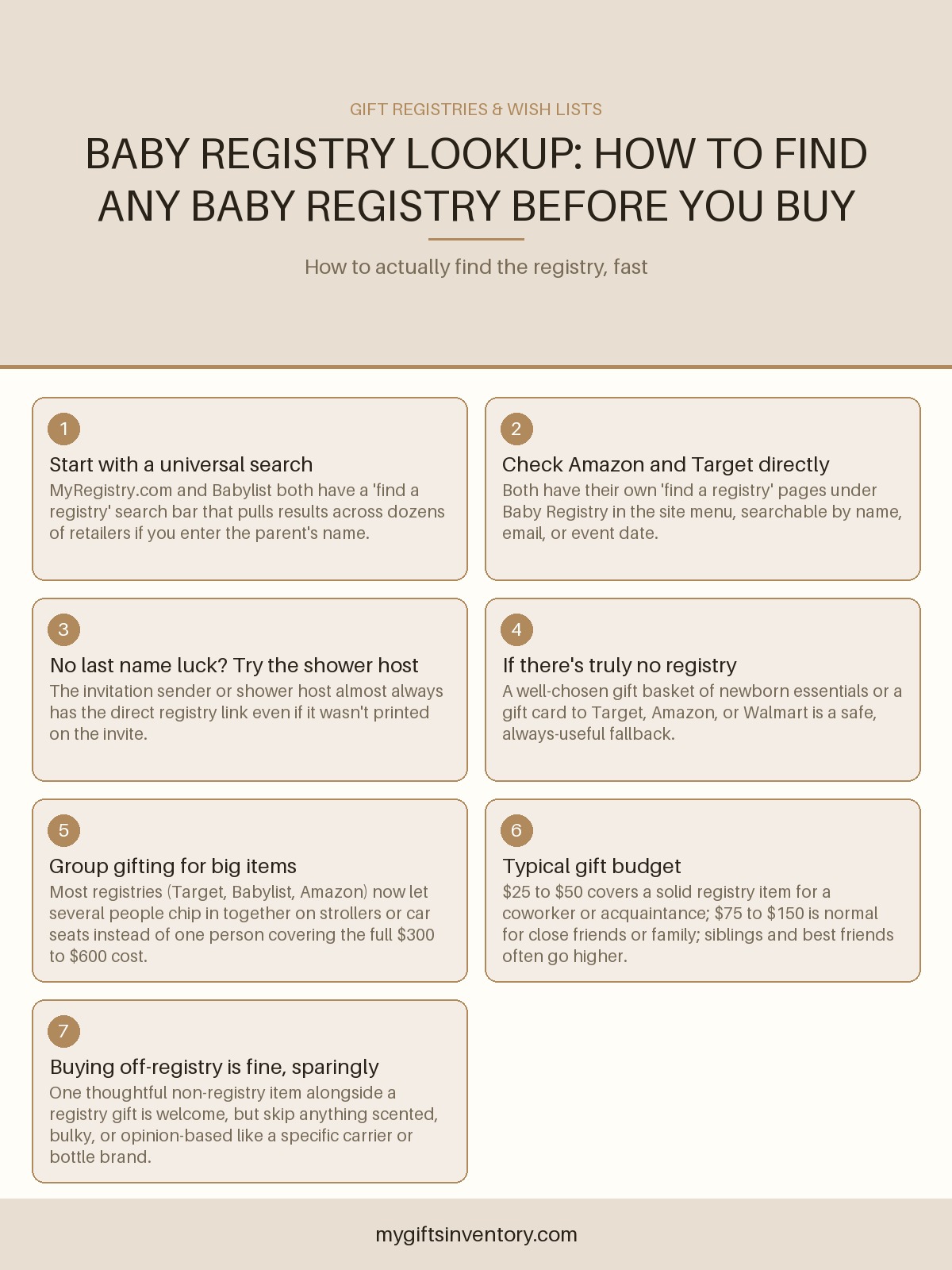
You open the link, browse available items, choose something in your budget, and check out. Shipping usually goes straight to the registrant. You can often add a gift message. If the perfect item is already purchased, the list updates in real time so you pick something else. That’s the biggest practical win: fewer awkward doubles and fewer returns.
Common Types of Gift Registries
Wedding registries remain the most familiar. Couples typically include kitchen tools, bed and bath linens, home essentials, and sometimes experiences or honeymoon funds. Baby registries focus on gear, clothing in multiple sizes, feeding supplies, and nursery items. Housewarming registries lean toward practical home goods and décor. Birthday or graduation registries are less formal but growing, especially for teens and young adults setting up first apartments.
Group-gift options appear on many platforms now. A higher-priced item can be split so several people contribute toward one big piece. Cash or honeymoon funds sit alongside traditional products on a lot of modern registries, which helps when the couple already has the basics or prefers travel memories over more stuff.
How to Create a Registry That Actually Helps Everyone
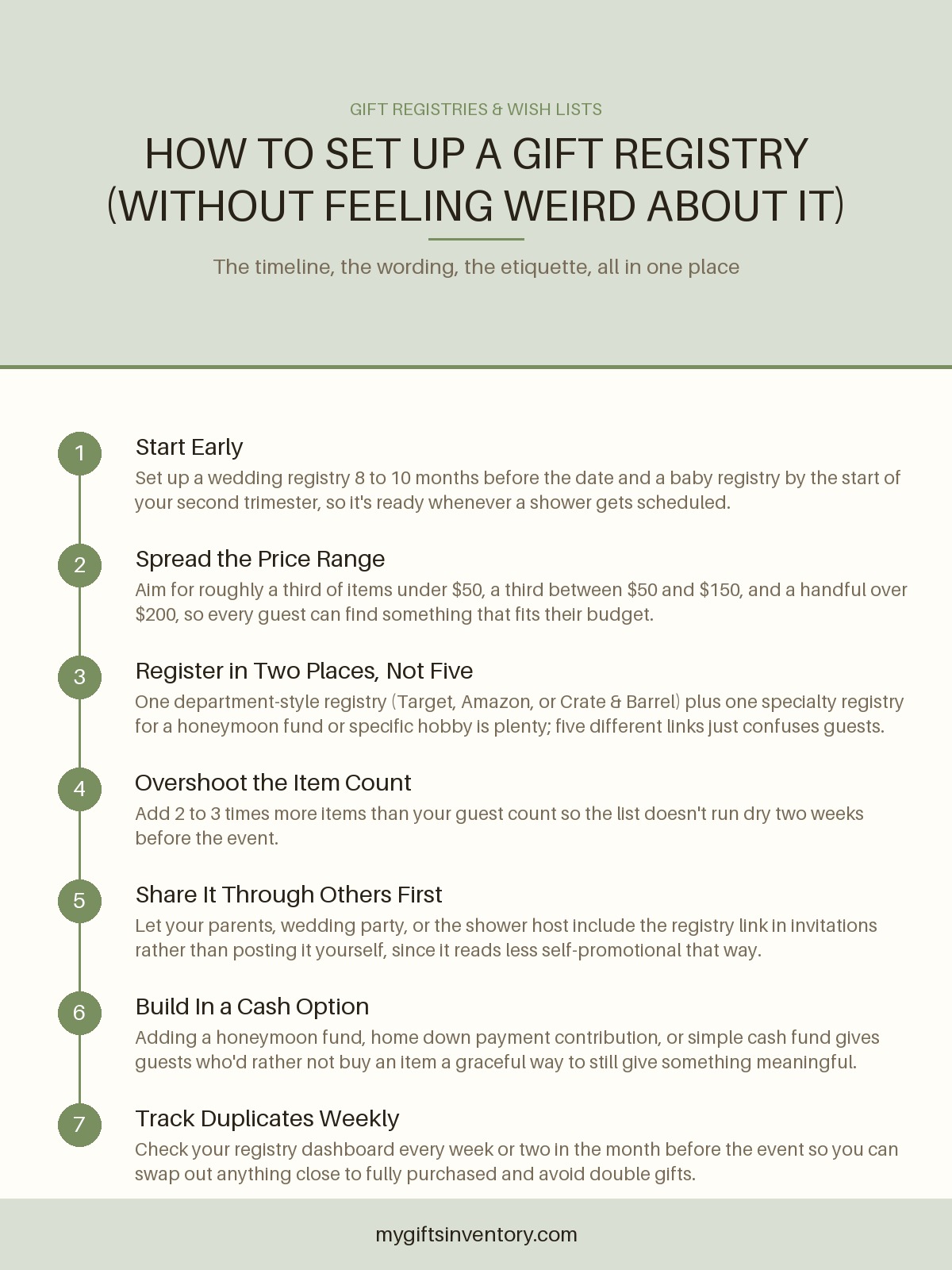
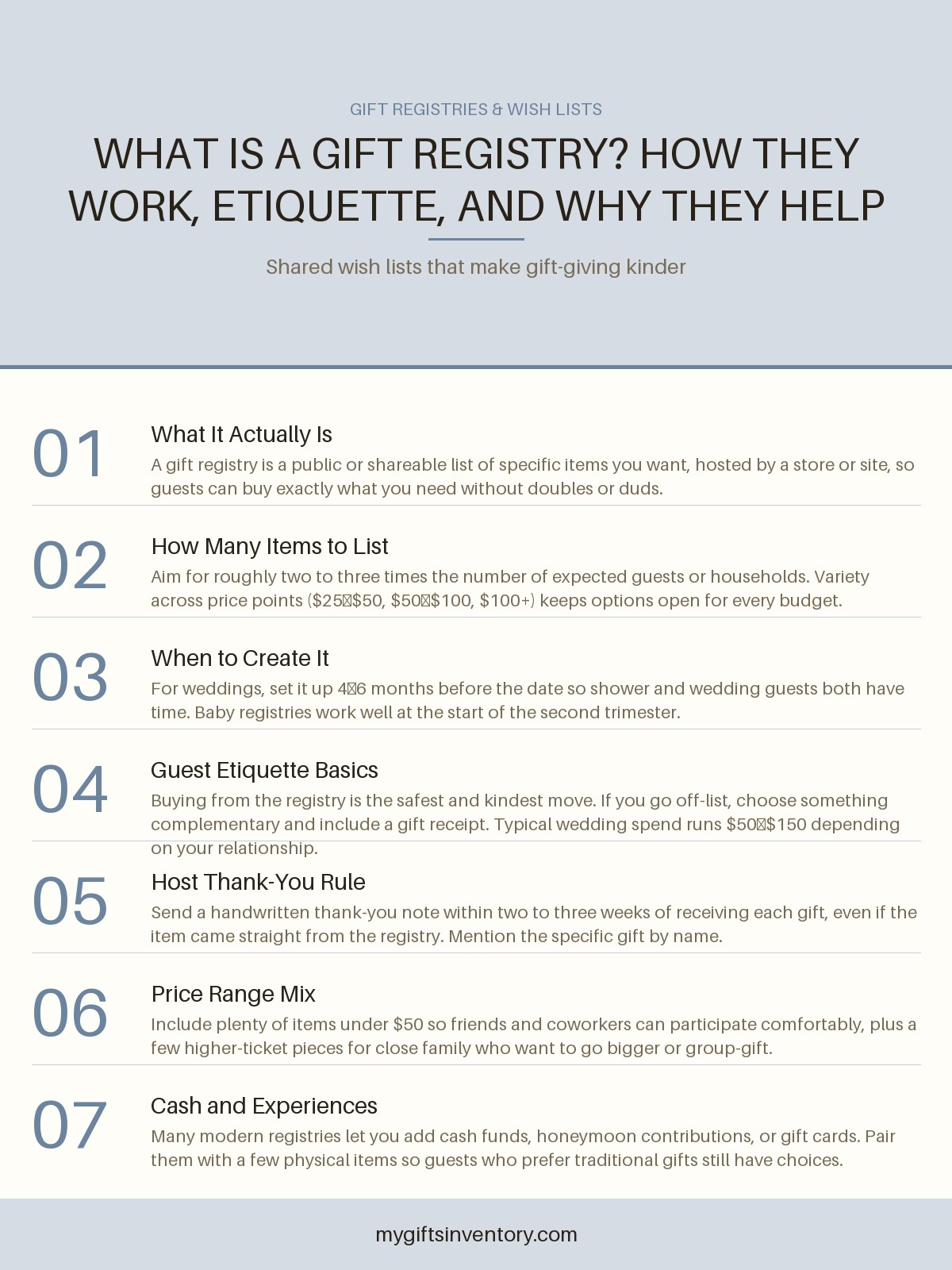
Timing matters. For a wedding, aim to have the registry live 4 to 6 months before the date. That covers both shower guests and wedding guests. Baby registries work well once you know the sex (if you want to find out) or at the start of the second trimester. Housewarming registries can go up as soon as you have a move-in date.
Quantity and range are the two biggest practical decisions. A solid rule of thumb is listing roughly two to three times as many items (or item slots) as the number of expected gift-giving households. If 80 people might bring gifts, having 160–240 options or slots gives breathing room as popular items sell out. Spread prices deliberately: plenty of choices under $50, a strong middle tier of $50–$100, and a handful of higher-ticket pieces for parents, siblings, or groups who want to go bigger.
Include both must-haves and nice-to-haves. Everyday towels and a good knife set sit next to the fancy Dutch oven. Variety keeps the list useful for coworkers who want to spend $30 and for grandparents who prefer something substantial. If kitchen tools are a big part of your list, practical picks that newlyweds or new parents will actually reach for every week make the biggest difference. We keep a roundup of kitchen gadgets under $50 that people genuinely use for exactly that reason.
Home décor and comfort items also belong on many registries. Soft throws, frames, or small organizational pieces help a new space feel finished without forcing guests into ultra-expensive territory. For inspiration that stays realistic, look at thoughtful home décor ideas under $50.
Add a few non-physical options if the platform allows it: a honeymoon activity fund, a date-night cash fund, or store gift cards. Guests who prefer not to choose a physical object still have a clear way to contribute. Just keep some tangible items so traditional gift-givers feel comfortable.
Write short notes on items when helpful (“we love this color,” “this size fits our space,” “we already have the matching pieces”). It guides people without micromanaging.
Etiquette for the People Creating the Registry
Having a registry is not greedy. Most guests actually prefer it because it reduces decision fatigue and the chance of giving something unwanted. Still, tone matters. Share the link on the invitation website, shower invite, or a brief note rather than leading with “here’s what you should buy us.” A simple “We’ve registered at X if you’d like ideas” is enough.
Do not put the registry information on the main wedding invitation itself in many traditional circles; the wedding website or a separate shower invite is cleaner. For baby showers and more casual events the rules are looser.
After gifts arrive, send thank-you notes promptly. Two to three weeks is a good target for most situations; within a month is still acceptable after a large wedding. Mention the specific gift by name and, if you can, how you plan to use it. A generic “thanks for the gift” feels thinner than “the Dutch oven is already making Sunday dinners easier.” Even registry gifts deserve that personal touch.
If someone goes off-registry with something thoughtful, treat it with the same gratitude. If the gift truly doesn’t work, most retailers make registry returns straightforward, often with extended windows.
Etiquette for Guests Shopping a Registry
Buying from the registry is almost always the kindest and lowest-stress choice. The couple or parents have already done the thinking about what they need, what fits their space, and what style they like. You get to skip the second-guessing.
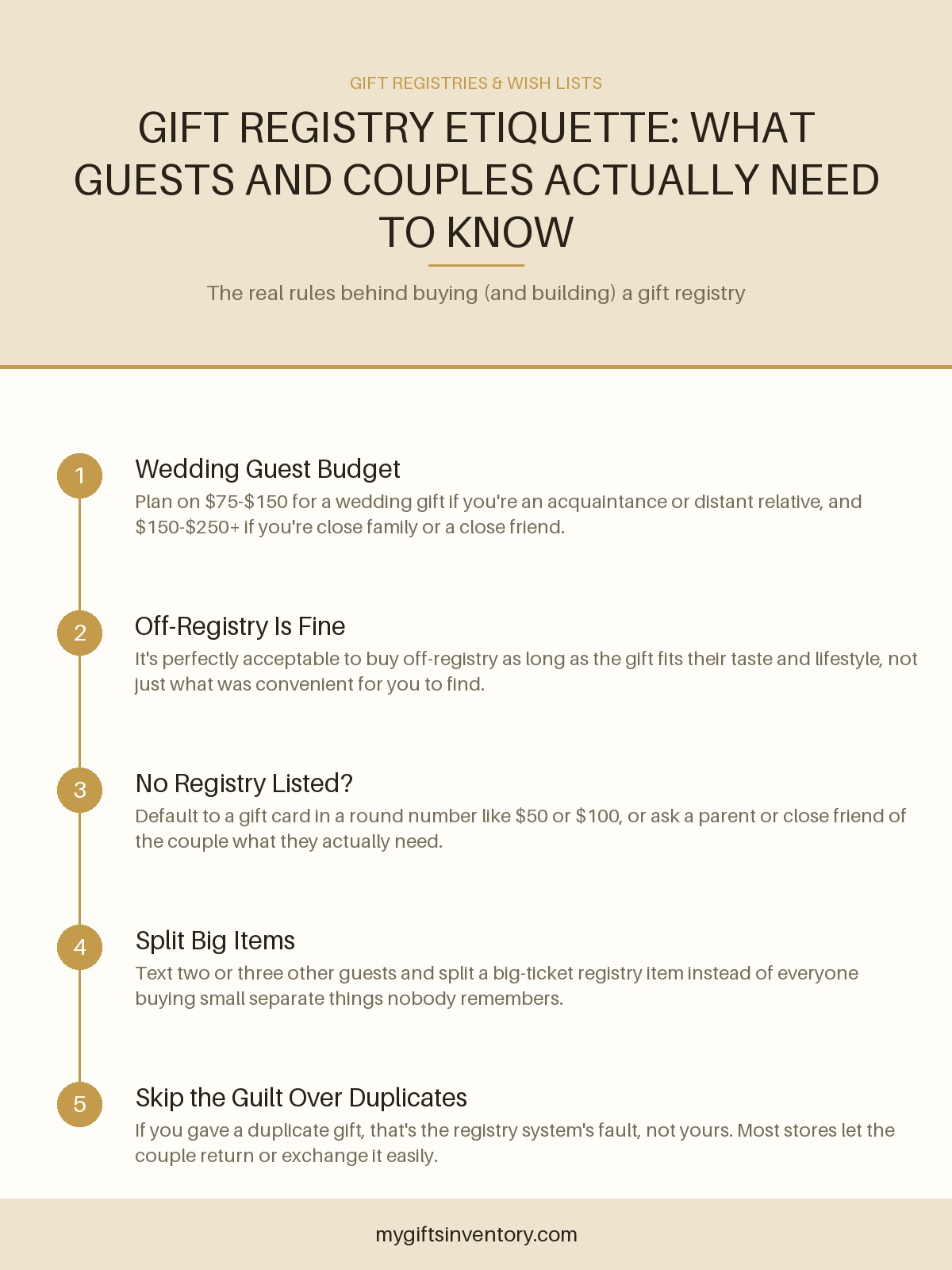
Budget according to your relationship and local norms. For a wedding, many people land between $50 and $150. Close friends and family often go higher; coworkers and distant relatives may stay closer to $50 or join a group gift. Baby showers often run a bit lower on average. There is no universal rule, only what feels right for your situation and wallet.
If every item in your price range is already purchased, look for something complementary or contribute to a group gift or cash fund if available. Going completely off-list is fine when you know the person well and have a specific idea, but include a gift receipt and choose something that fits the same practical spirit. A beautiful but fragile item that doesn’t match their style can create more work than joy.
Ship to the registry address when the option exists. It saves the hosts from coordinating multiple deliveries and keeps everything organized. Add a short personal note at checkout or in a card so the gift still feels like it came from you.
If you prefer to give a gift card instead of a listed item, that’s usually welcome, especially when the couple has already covered basics. Many people appreciate the flexibility. Just pair it with a warm card. For smaller budgets, thoughtful options under $30 still land well when chosen with care. We collected a set of gifts under $30 that actually feel considered for exactly those moments.
What Belongs on a Strong Registry (and What to Skip)
Focus on items you will use in the next one to three years. Trendy pieces that may feel dated quickly or ultra-specialized gadgets that require a learning curve often sit unused. Everyday workhorses (good sheets, reliable cookware, practical baby gear in multiple sizes) deliver more lasting value.
Mix price points deliberately so every guest can participate. Include multiples of consumables or basics (towels, onesies, coffee mugs) so several people can buy the same useful thing. Leave a few higher-priced anchors for those who want them.
Skip anything you already own in sufficient quantity unless you specifically want an upgrade. Duplicate specialty appliances create clutter. Also avoid listing only expensive items; it can make guests with tighter budgets feel excluded.
When you’re unsure what feels “right” for different people in your life, stepping back to broader gift principles helps. Our guide to choosing the perfect gift for every person and occasion walks through the same questions of usefulness, personal taste, and relationship that apply when you’re building a registry or shopping from one.
Common Mistakes and How to Avoid Them
Creating the registry too late leaves shower guests scrambling and wedding guests with fewer choices. Putting it up too early with no updates can leave the list looking stale. Check it every few weeks and add or adjust as needed.
Listing only high-ticket items is another frequent misstep. So is forgetting shipping preferences or address details, which leads to packages arriving at the wrong place. Incomplete profiles (missing sizes, colors, or quantities) force guests to guess.
On the guest side, waiting until the last minute often means the best mid-range items are gone. Buying something fragile or highly personal off-list without a receipt can create quiet stress for the recipient. And never publicly complain about someone’s registry choices; taste is personal.
After the event, ignoring leftover items is a missed opportunity. Many stores offer completion discounts for a limited window. Use them or convert what you can.
When There Is No Registry (or You Want to Go Beyond It)
Some people deliberately skip registries. In that case, ask a close family member or wedding-party friend for guidance on colors, styles, or real needs. Experiences, consumables, or a well-chosen gift card often work better than a random decorative object. Group gifts organized quietly among friends can still feel special.
If you are the host and prefer no traditional registry, a simple cash fund, charity donation option, or “your presence is present enough” note is clear and kind. Just be prepared that some guests will still want to bring something tangible.
Registries exist to make generosity easier, not to police it. The best ones feel like a helpful menu rather than a demand list. When both sides treat them that way, everyone ends up happier: the recipients get what they can actually use, and the givers leave knowing their gift landed well.
Frequently Asked Questions
Is it rude to have a gift registry?
No. Most guests appreciate the guidance because it removes guesswork and the risk of giving something unwanted. Share the link politely on a wedding website, shower invite, or brief note rather than making it the focus of the main invitation, and the tone stays gracious.
Do I have to buy something from the registry?
You do not have to, but it is usually the most helpful choice. If you go off-list, pick something complementary, include a gift receipt, and keep the person’s real needs and style in mind so the gift still feels thoughtful rather than random.
How many items should be on a wedding or baby registry?
A practical target is roughly two to three times the number of expected gift-giving households. Spread those items across low, mid, and higher price points so guests at every budget level can find something comfortable.
What is a normal amount to spend on a registry gift?
For weddings many people spend $50 to $150 depending on closeness and local custom. Baby showers and more casual events often land a bit lower. Choose an amount that feels right for your relationship and finances rather than stretching uncomfortably.
Can we add cash funds or gift cards to a registry?
Yes. Most modern platforms allow honeymoon funds, cash contributions, or specific store gift cards alongside physical items. Keeping a mix gives traditional gift-givers options while letting others contribute in the way they prefer.