Cultural Gift Taboos: What Not to Give (and Why) Around the World
A practical, region-by-region guide to the gifts, colors, numbers, and gestures that read as unlucky or offensive in other cultures, plus what to give instead when you're not sure.
As an Amazon Associate, My Gifts Inventory earns from qualifying purchases. We only recommend products we'd genuinely consider buying ourselves.
You've been invited to a colleague's home, or your partner's family is hosting a holiday you didn't grow up with, or you're sending a client gift overseas and suddenly you're standing in a store aisle wondering if the thing in your hand is going to read as thoughtful or as a quiet insult. That worry is fair. Gift-giving is loaded with meaning everywhere, but the specific things that carry that meaning shift completely depending on where you are and who you're giving to.
This isn't about memorizing a rulebook for every country on earth. It's about knowing the handful of categories that trip people up again and again, so you can spot a potential problem before you're standing in someone's foyer holding it.
Why the same gift can mean two opposite things
Most cultural gift taboos come from one of three sources: wordplay, color symbolism, or association with death and endings. A gift that seems perfectly neutral in one language can be a homophone for something grim in another. A color that means celebration in one country means mourning in the next. Once you know which of these three buckets a taboo falls into, the logic behind it usually makes sense, and you stop having to memorize isolated rules.
Numbers that carry more weight than you'd expect
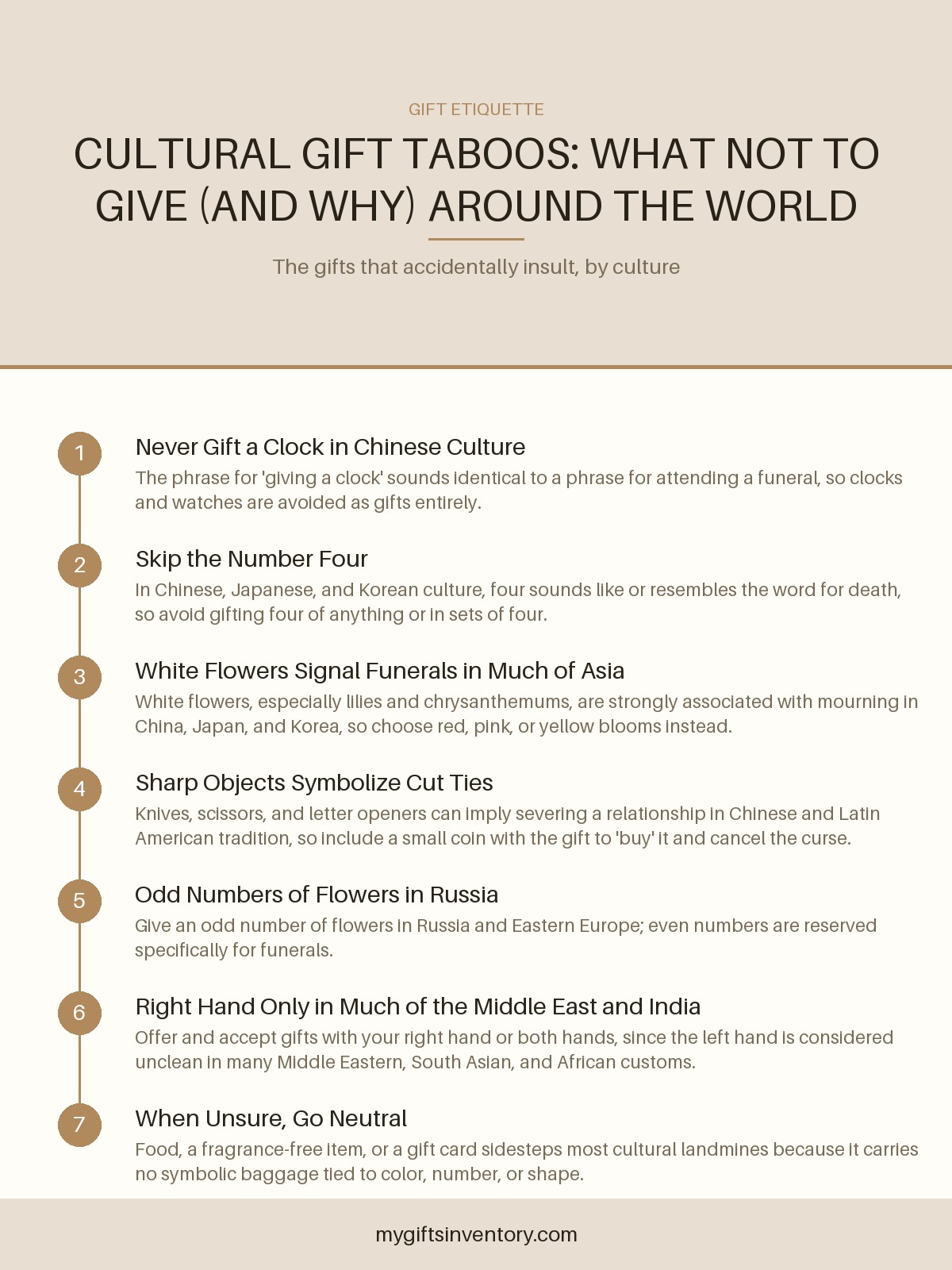
In Chinese, Japanese, and Korean culture, the number four is avoided in gift-giving because the word for "four" sounds like or closely resembles the word for "death" in each language. Many buildings in these countries skip a fourth floor entirely, and the same logic extends to gifts: avoid giving four of anything, and avoid sets of four items, whether that's four teacups, four pieces of fruit, or four of anything wrapped together. Japan carries a second number taboo around nine, which can sound like the word for suffering or pain.
Russia and much of Eastern Europe run this in reverse. Odd numbers of flowers are for the living and for happy occasions; even numbers are reserved specifically for funerals. If you're bringing a bouquet to a Russian host's home, count the stems before you leave the shop.
The clock problem
This one deserves its own callout because it trips up so many well-meaning gift-givers. In Mandarin, the phrase for "giving a clock" (song zhong) is a near-perfect homophone for a phrase describing attending someone's funeral. It doesn't matter how beautiful the clock is or how much it cost. Clocks and watches are on the short list of gifts to never bring to a Chinese household, especially for elders, and the same caution generally extends across other Chinese-influenced cultures including Taiwan and Chinese diaspora communities elsewhere.
Colors that flip meaning depending on where you are
White is the color that causes the most confusion for Western gift-givers traveling or gifting across cultures. In the US and much of Europe, white suggests purity and is fine for wedding gifts or wrapping paper. In China, Japan, Korea, and India, white is the color of mourning and funerals, so white flowers, white wrapping paper, and white ribbon are all worth avoiding for anything other than a somber occasion. Chrysanthemums and lilies in particular carry funeral associations in East Asia, so steer toward red, pink, or yellow blooms instead.
Yellow flowers carry their own baggage in Russia and parts of Latin America, where they can be read as a symbol of infidelity or a breakup rather than a cheerful color choice. Purple is similarly loaded in Brazil and Mexico, where it's associated with Lent and mourning. Red and gold, meanwhile, are the safest, most auspicious colors across most of East Asia, which is why you'll see them everywhere during Lunar New Year.
Objects that carry symbolic baggage
A handful of specific items show up on "avoid" lists across multiple, unrelated cultures, usually because of what they represent rather than what they cost.
Sharp objects
Knives, scissors, and letter openers symbolize cutting or severing a relationship in Chinese tradition, and a very similar belief exists in parts of Latin America and Italy. The workaround, if you really want to give a nice set of kitchen knives, is to include a small coin taped to the box. The recipient "buys" the knife from you for a token amount, which symbolically cancels out the bad luck.
Shoes
In Chinese tradition, giving someone shoes can be read as a wish for them to walk away from you, since the word for shoes sounds like a word associated with an evil connotation. Some families soften this by having the recipient hand over a coin in exchange, same as with knives.
Umbrellas and pears
Both are quiet landmines in Chinese-speaking cultures because of wordplay. The word for umbrella sounds like a word for separation or break-up, and the word for pear sounds like the word for leaving or parting. Neither is a gift you'd think twice about in most of the world, which is exactly why it catches people off guard.
Handkerchiefs
In French and some Latin American traditions, handkerchiefs are associated with tears and are considered a bad-luck gift, especially at weddings, because they're thought to invite future sadness for the recipient.
Green hats
This one is specific but worth knowing if you're gifting a man in Chinese culture. A green hat is a strong symbol implying his wife has been unfaithful, so a green baseball cap that seems like a totally casual gift can land as a genuine insult.
Region by region: what to know before you go
China
Beyond clocks, sharp objects, and the number four, avoid wrapping gifts in white or black paper, and be cautious with anything strap-shaped that might resemble a shoe. Red and gold wrapping is always a safe, celebratory choice, and gifts are traditionally given and received with both hands.
Japan and Korea
Sets of four or nine items are avoided for the same wordplay reasons as in China. Potted plants aren't ideal gifts for someone who is sick, since the roots can symbolize the illness "taking root" and prolonging recovery. Elaborate wrapping matters a great deal in Japan, and gifts are often deliberately modest in value so as not to burden the recipient with an obligation to reciprocate at an equal or higher price.
India
Leather goods can be a sensitive gift for Hindu recipients, since cows are considered sacred. White flowers and white wrapping lean funeral in association, so bright colors are the safer choice. As with much of the Middle East, gifts should be given and received with the right hand or both hands rather than the left.
The Middle East and Islamic culture
Alcohol is the big one to avoid for observant Muslim recipients, and that extends to gifts you might not immediately think of as containing alcohol, including some fragrances and skincare products. If you're set on giving a fragrance as a gift, it's worth checking whether an alcohol-free option exists or choosing something else entirely if you're not certain of the recipient's practices. Left-hand giving is also considered impolite here, and gifts featuring dog imagery are best avoided since dogs are viewed as unclean in some interpretations of Islamic tradition.
Jewish traditions
For recipients who keep kosher, skip food gifts containing pork or shellfish, and check labels for kosher certification if you're giving something edible. Timing matters too: avoid gifts that require immediate use or reciprocation if you're visiting during Shabbat, when observant recipients won't be handling money or engaging in commerce-related activity.
Latin America
Knives and scissors carry the same "cutting the relationship" symbolism here as in parts of Asia, so include a coin if you're giving either. In Mexico, marigolds are tightly associated with Día de los Muertos and read as a somber, specific-occasion flower rather than a casual bouquet.
Russia and Eastern Europe
Odd numbers of flowers only, never even. Yellow flowers are best avoided since they can suggest deception or an ending. If you're gifting an empty wallet or purse, tuck a coin or small bill inside first, since giving one truly empty is considered an invitation to financial bad luck.
Western Europe
Rules here are generally looser, but a few holdovers persist. In Germany, red roses imply romantic interest, so they're not the gift for a coworker. Chrysanthemums are funeral flowers in France and several other European countries, same as in Asia, so they're worth avoiding for a cheerful occasion.
Gifting across cultures at work
Corporate gifting adds a second layer of risk on top of everything above, because you're also navigating company policy and the power dynamic between giver and recipient. Keep client and colleague gifts modest, avoid anything overtly religious or political, and lean toward universally readable choices like good coffee, a nice notebook, or a well-made everyday item rather than something that requires cultural context to land well. Our corporate gift ideas under $50 guide leans into exactly that kind of safe, professional territory if you're shopping for a client or team member whose customs you're not fully familiar with.
Gifts that read as too personal in the wrong context
Some gifts aren't taboo exactly, but they carry an intimacy that doesn't translate well across a business or acquaintance relationship in many cultures. Jewelry is the clearest example. A piece from a guide like personalized jewelry gifts for her is a lovely choice for a partner, close friend, or family member, but giving jewelry to a coworker or new acquaintance can be read as romantic overreach in plenty of cultural contexts, even when that's not the intent at all. When you're not sure how a gift will be read, it's worth erring toward something less personal rather than more.
When you genuinely don't know: safe categories
If you're gifting across a culture you're not deeply familiar with and none of the guidance above feels specific enough, lean toward categories with almost no symbolic baggage attached. Good coffee or tea is close to universally welcome and carries none of the wordplay or color issues that flowers and objects do; our gift ideas for coffee lovers guide is a solid starting point if you want something warm without the risk. Gift cards are another dependable option, since the recipient chooses exactly what they want and you sidestep every taboo above entirely. A Visa gift card works almost anywhere and reads as generous without any cultural guesswork attached.
If you've already given the "wrong" gift
Most people, in most cultures, understand that an outsider isn't going to know every rule, and the intent behind a gift matters far more than getting every detail perfect. If you realize after the fact that you gave someone a clock, a set of four, or a bouquet of white lilies, a brief acknowledgment goes a long way: something like "I want to make sure this doesn't come across the wrong way, I didn't realize until after I gave it that this might have a different meaning in your culture." Most recipients will appreciate that you cared enough to check, and that gesture usually repairs any awkwardness faster than silence would.
Gift Ideas to Go With This


Want more ideas? Browse our full guide: 20 Best Gifts Under $100 (2026): Thoughtful Picks They'll Actually Use
Frequently Asked Questions
What is the most common cultural gift taboo?
Clocks in Chinese culture are probably the single most well-known taboo, since the phrase for giving a clock sounds identical to a phrase describing attending a funeral. Sharp objects like knives and scissors, which symbolize severing a relationship, are a close second and show up as a taboo across several unrelated cultures.
Is it rude to give an even number of flowers?
In Russia and much of Eastern Europe, yes. Even numbers of flowers are reserved for funerals, while odd numbers are given for celebrations and happy occasions, so it's worth counting the stems before handing over a bouquet.
Why is white considered a bad color for gifts in some cultures?
White is strongly associated with mourning and funerals in China, Japan, Korea, and India, which makes white flowers or white wrapping paper feel somber rather than celebratory in those contexts. This is the opposite of Western tradition, where white often signals purity or elegance, which is exactly why it trips up so many gift-givers.
Is it okay to give alcohol as a gift internationally?
Not always. Alcohol is best avoided for observant Muslim recipients and for anyone whose religious or personal practice excludes it, so it's worth confirming before you bring wine or spirits to someone's home if you're not certain of their customs.
What should I do if I'm not sure about a culture's gift customs?
Ask a mutual friend or colleague familiar with the culture, or default to a low-risk category like food, a gift card, or something practical without strong color or numerical symbolism attached. When in doubt, modest and neutral beats elaborate and risky every time.
Looking for an Actual Gift Instead?
Gift Sets We Love Right Now
Every item picked, priced and linked, ready to buy.
More Gift Advice