Gift Receipt Etiquette: When to Include One and How to Do It Right
Including a gift receipt can feel awkward, but leaving one out can leave the recipient stuck. Here’s the practical etiquette for givers and receivers so everyone stays comfortable.
As an Amazon Associate, My Gifts Inventory earns from qualifying purchases. We only recommend products we'd genuinely consider buying ourselves.
We’ve stood at the register wondering whether asking for a gift receipt somehow ruins the magic, and we’ve opened presents secretly hoping one was tucked inside. That little slip of paper sits right at the intersection of thoughtfulness and practicality, and getting the etiquette wrong can leave both giver and receiver feeling slightly off. Here’s how we handle gift receipts so the gesture stays warm and the option to exchange stays open.
Why Gift Receipts Feel Awkward (and Why They Still Matter)
A gift is supposed to say “I thought of you.” A receipt can feel like it adds “but I might have gotten it wrong.” That tension is real. At the same time, sizes run differently, colors look different in person, someone already owns the exact candle or gadget, and allergies or living situations change. Leaving someone with no way to exchange a well-meant gift often creates more discomfort than a discreet receipt ever could.
Modern stores make this easier than it used to be. Most major retailers will print a gift receipt that lists the item and the return window without showing the price. Online orders give you digital records you can edit or forward carefully. The goal is simple: protect the recipient’s ability to make the gift work for their life without turning the present into a transaction.
When we choose gifts with care in the first place, the receipt becomes insurance rather than a confession of doubt. If you’re still narrowing down ideas that feel personal and useful, our guide to choosing the perfect gift walks through the questions that reduce the chance anyone will need that receipt at all.
When You Should Almost Always Include a Gift Receipt
Some categories are high-risk for fit, preference, or duplication. In these cases we treat the gift receipt as standard, not optional.
- Clothing, shoes, and accessories: sizes, cuts, and personal style vary wildly. Even if you know their size, brands fit differently.
- Electronics and tech accessories: compatibility, color, storage size, or “I already have this exact one” come up constantly.
- Home goods, kitchen tools, and small appliances: counter space, existing sets, and aesthetic preferences matter.
- Beauty, skincare, and fragrance: skin type, scent preference, and product sensitivities are personal. If you’re considering something in this lane, thoughtful options like those in our spa gift ideas for her still benefit from a receipt when the formula or scent might not land.
- Toys and kids’ items: safety age ranges, existing collections, and parental rules change quickly.
- Anything bought on sale or final sale adjacent: if the return window is short or the policy is strict, the receipt (and a quick note about the deadline) becomes especially helpful.
Group gifts and registry gifts also deserve the paperwork. When multiple people contribute or when the couple/parents have already curated a list, the receipt keeps exchanges clean and avoids awkward money conversations later.
When Skipping the Receipt Is Perfectly Fine
Not every gift needs an exit ramp. We usually leave the receipt out in these situations:
- Handmade or homemade items you created yourself. There’s nothing to return to a store, and the personal effort is the gift.
- Family heirlooms, vintage pieces, or something with sentimental history attached.
- Custom or personalized goods that can’t be restocked or resold easily (engraved jewelry, monogrammed pieces, commissioned art). For keepsake territory, many of the ideas in our personalized home and keepsake gifts under $50 fall into this no-receipt category because the customization is the point.
- Experiences you planned together (concert tickets you already bought for a specific night, a reservation, a class you both intend to take).
- Very low-cost tokens or stocking-stuffer scale surprises where the administrative hassle outweighs the value. Still, if it’s clothing or a scented item, a receipt takes ten seconds and can spare mild frustration.
- Gifts where you are 100% certain of preference and the person has explicitly said they want that exact thing. Even then, many of us still slip the receipt in quietly just in case.
If the store policy is “no returns on gifts” or the item is clearly final sale, there is little point in including a useless slip. A quick verbal heads-up only if it feels natural is kinder than a fake safety net.
How to Include the Gift Receipt Without Killing the Mood
Presentation is everything. The receipt should be easy to find later and invisible during the opening moment.
In-store purchases
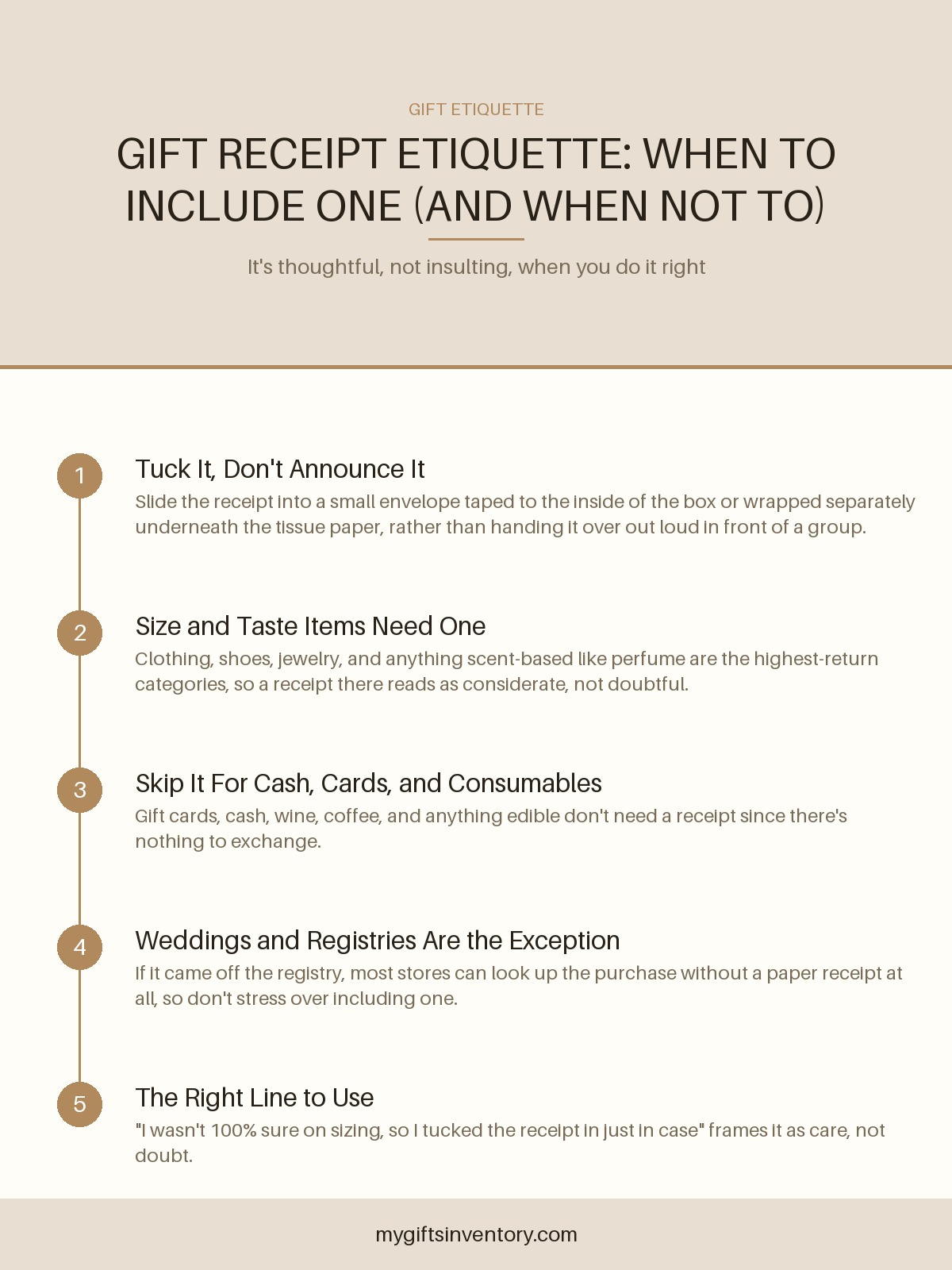
Ask for a gift receipt at checkout. Most places know exactly what you mean. If they only offer a regular receipt, fold it so the price is hidden and only the item description, store name, and return-by date show. Place it at the bottom of the box, inside a card envelope, or taped lightly to the inside lid. Never tape it to the outside of the wrapping or leave it sitting on top of the tissue paper where it becomes the first thing they see.
Online orders
Print the packing slip or order confirmation and black out or crop the price if it appears. Include the order number and return deadline. Some retailers email a dedicated gift receipt link; forward that or print it. If the gift ships directly to the recipient, many sites let you include a gift message and suppress pricing on the packing slip. Use that option. Keep your own copy of the order details in case they need help with the return later.
The “I included the receipt” announcement
Skip it. Saying “I put the receipt in there in case you want to return it” lands like “I already assume you won’t like this.” Let them discover it on their own time. If they later mention wanting to exchange something, then you can cheerfully say you’re glad the receipt was there and offer any order number they might need.
Cards and notes
Keep the card message about the person and the occasion. Do not reference the receipt or possible returns in writing. A warm line plus the gift is enough. If you want extra insurance, a separate small folded note inside the box that simply says “Return window is 30 days” (or whatever applies) is clearer and less emotionally loaded than weaving it into the main card.
Etiquette for the Person Receiving the Gift
Receiving a gift with a receipt is not a judgment on your taste or the giver’s effort. It is practical kindness. Here’s how we handle it on the receiving side.
Thank the giver for the gift itself, sincerely and promptly, before any exchange happens. A text the same day or a call within a day or two is ideal. Focus on the thought: “I love that you picked this for me” or “This was so thoughtful.” You do not need to announce that you plan to return or exchange it unless the relationship is very close and you know they would want to help or would feel hurt by silence.
If you do exchange it, you generally do not owe a report on what you got instead. Close family and partners sometimes enjoy the update; coworkers and distant relatives usually do not need the details. Never post about returning a gift on social media in a way that tags or identifies the giver.
If no receipt was included and you need to return the item, it is acceptable to ask gently: “Do you happen to still have the receipt or order number? I want to make sure I can exchange for the right size.” Most people are relieved to help rather than offended. Offer to handle the trip to the store yourself.
One soft boundary: if the gift was clearly expensive or highly personal and you return it for cash you intend to spend elsewhere, be extra discreet. The spirit of the gift was for you to have something nice, not for you to re-budget their money.
Special Occasions and Tricky Situations
Weddings and baby showers
Registry gifts almost always come with easy return paths, and couples/parents expect some exchanges for duplicates or changed needs. Include whatever paperwork the retailer provides. For off-registry gifts, a gift receipt is still smart unless the item is custom.
Corporate and office gifts
Keep these especially clean. A gift receipt protects both the company culture and the employee’s preferences. Avoid anything too personal or sized, and when you do give a physical item, the receipt should be easy to find. For inspiration that stays professional and useful, see our roundup of corporate gift ideas under $50. Many teams also lean on gift cards precisely because they remove fit and preference issues.
Kids’ gifts from relatives
Parents appreciate receipts more than almost any other group. Sizes, safety standards, existing toy inventories, and household rules make exchanges common. Tuck the receipt in and, if the child opens it in front of you, let the parents secure the paperwork before wrapping paper goes everywhere.
White elephant, Secret Santa, and Yankee Swap
These are already game-like. A gift receipt can actually increase the fun because the final owner can still exchange if needed. Just keep the price tier appropriate for the group so no one feels the receipt reveals an awkward spending gap.
When the gift is a gift card
Gift cards generally do not need a purchase receipt for the recipient to use them, but you should keep your own proof of purchase in case of balance issues, loss, or fraud. If you are the recipient and something goes wrong with a card, checking the balance early is smart. Policies and fees vary by brand and where the card was bought, so knowing the details ahead of time helps.
Return Windows, Policies, and Realistic Timelines
Always glance at the return window when you buy. Common ranges are 30 days for many big-box and apparel stores, 15 to 30 for some electronics, and longer holiday return periods (often into January) for gifts bought in November and December. Outlet, final-sale, and personalized items frequently have zero return options.
If you are giving a gift close to the deadline, either choose a store with a generous policy or include a small note with the actual end date so the recipient is not caught out. For online orders, the clock usually starts from delivery or from the order date; check which one applies.
We also keep our own photo or screenshot of the receipt and order confirmation. Phones get lost, paper gets thrown away in the excitement of unwrapping, and having a backup lets you help without stress.
Putting It All Together: A Simple Decision Path
Ask yourself three quick questions while the cashier is still there or before you hit “place order”:
- Could size, color, scent, compatibility, or duplication reasonably be an issue? If yes, get the gift receipt.
- Is this item returnable at all? If no, skip the theater of a useless slip.
- Can I include the paperwork so it is discoverable later but invisible during the first emotional reaction? If yes, do that every time.
That short mental checklist removes most of the second-guessing. The receipt is not a lack of confidence in your taste. It is respect for the other person’s real life.
Thoughtful giving still starts with knowing the person. Practical tools like receipts simply make sure the thought can land cleanly. When you want fresh ideas that people actually use, whether you are shopping small or planning something more special, keep browsing options that match their real habits and then decide on the receipt based on the category, not on anxiety.
Frequently Asked Questions
Is it rude to include a gift receipt?
No. Including a gift receipt is widely considered considerate, not rude. Most people prefer having the option to exchange for size, color, or duplicate reasons. Present it discreetly so it does not become the focus of the moment.
Should I tell the person I included the receipt?
Generally no. Let them find it on their own. Announcing it can make the gift feel tentative. If they later ask about exchanging, you can mention it then and offer any order details they might need.
What if the store will not give a price-hidden gift receipt?
Fold or cut the regular receipt so the price does not show, or cover the amount with a small sticker. Place it inside the box or card envelope. The item description and return date are the useful parts.
Is it okay to return a gift and not tell the giver?
Yes in most cases. Thank them sincerely for the original gift. You are not obligated to report an exchange unless you are very close and know they would genuinely want to know or help. Avoid public posts about returning their present.
Do I need a receipt for a gift card?
The recipient usually does not need your purchase receipt to spend the card. You should keep proof of purchase yourself in case of activation problems, missing balance, or theft. Encourage the recipient to check the balance early if the card was sent through the mail or left unattended.