Gift Tax Limit 2026: What You Can Give Without Filing a Gift Tax Return
The 2026 gift tax limit is $19,000 per person, and most people who worry about it never come close to owing anything. Here is how the rules actually work and how to plan a big gift without a tax headache.

As an Amazon Associate, My Gifts Inventory earns from qualifying purchases. We only recommend products we'd genuinely consider buying ourselves.
Every December, someone writes a big check to a grandchild for a house down payment and then goes to bed wondering whether the IRS is going to come knocking. Usually the answer is no. But the worry is real, and it comes up for people who are giving a genuinely meaningful amount of money, not just the average holiday gift. So let's walk through what the 2026 gift tax limit actually is, what it applies to, and where the line really sits between "nothing to think about" and "call your accountant."
One quick note before we start: this is a plain-English explainer, not tax advice. Numbers like these change with inflation adjustments, so if you are planning a large transfer, run the specifics past a tax professional who knows your situation.
The 2026 annual exclusion is $19,000 per person
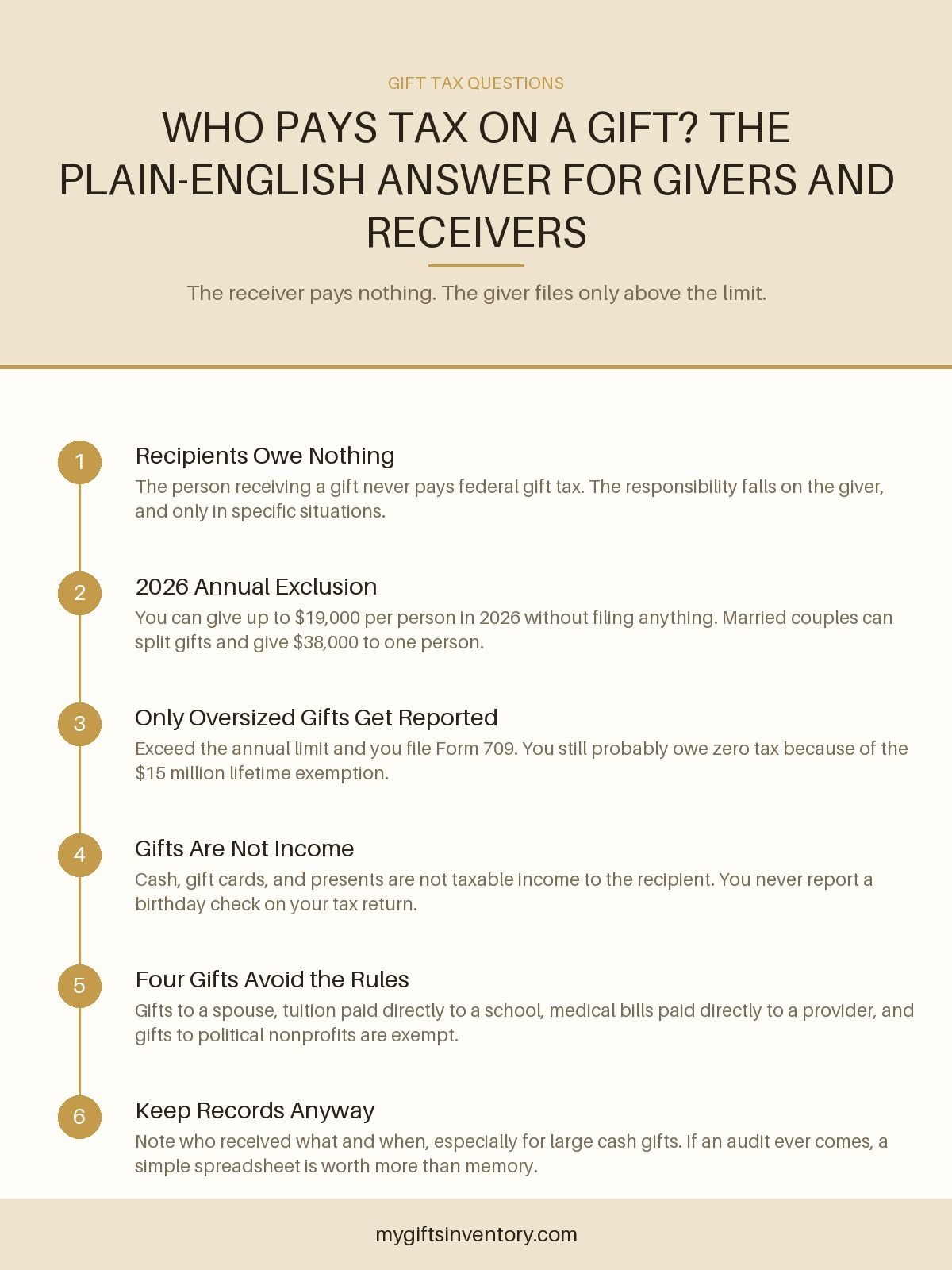
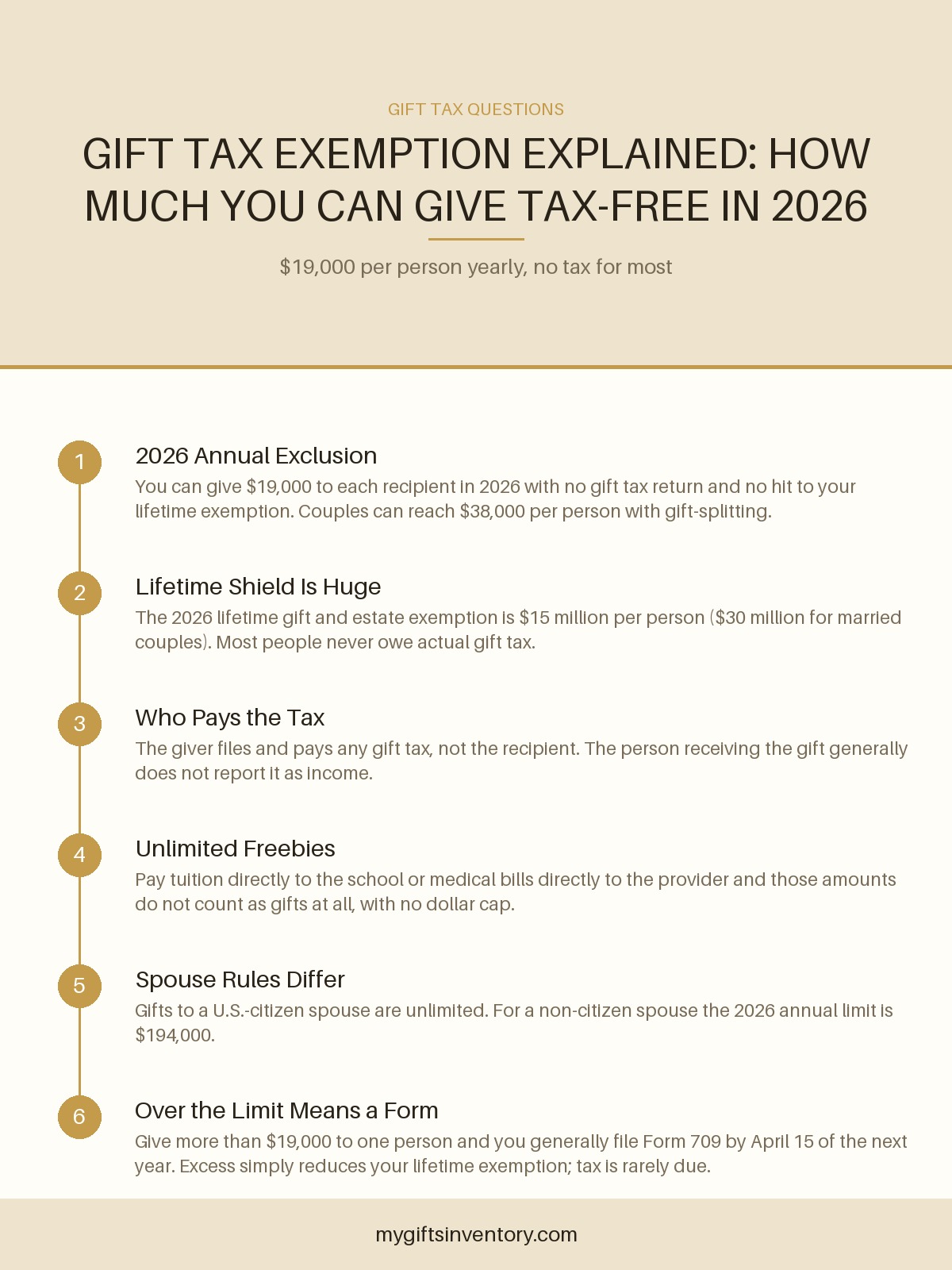
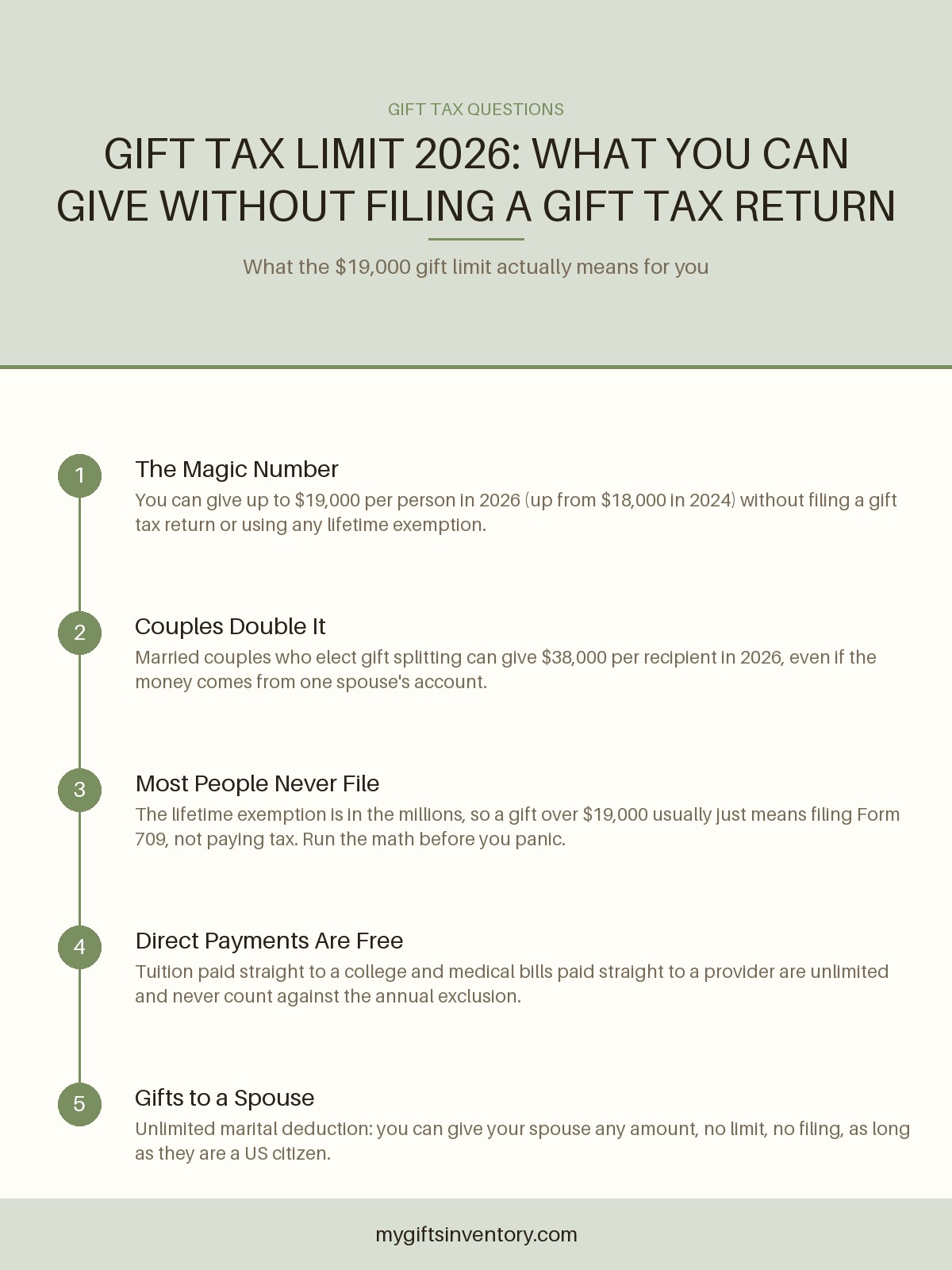
The number most people are searching for is the annual gift tax exclusion, which is the amount you can give any one person in a calendar year without having to file a gift tax return or tap into your lifetime exemption. For 2026, that figure is $19,000 per recipient. It held at $18,000 for 2024 and 2025, and the bump to $19,000 for 2026 reflects the inflation adjustments baked into the tax code.
Here is the part that trips people up: the limit is per recipient, per year, not a grand total. If you have three grandchildren, you can give each of them $19,000 in 2026, which is $57,000 given away with zero paperwork and no tax consequence. If you are married and file jointly, you and your spouse each get your own $19,000 per recipient, so together you can hand a single person $38,000. That "gift splitting" election is available even if all the money comes out of one spouse's account, but you do have to elect it on the gift tax return if you are reporting a gift.
What counts as a gift
The exclusion covers cash, obviously, but also the fair market value of anything you transfer for less than full price. That includes stocks and other securities, real estate, a car, an interest in a business, and even the forgiveness of a loan you made to someone. If you sell a house to your adult child for $200,000 when it is worth $250,000, the $50,000 difference is generally treated as a gift. This is where people get surprised, because they think of "gifts" only as envelopes of cash at the holidays.
In practice, the vast majority of holiday and birthday giving never comes close to the threshold. Most of the budget work we talk about elsewhere on this site is about finding the right $40 to $150 gift, not structuring a five-figure transfer. If that is your situation, the gift tax limit is a non-issue and you can file it next to the savings bond rules. Still, if you are buying something substantial and want to stay under the limit, a look at our roundup of holiday gifts for her across every budget or our gadget gifts for him will keep you well inside it while still feeling generous.
What happens if you go over $19,000
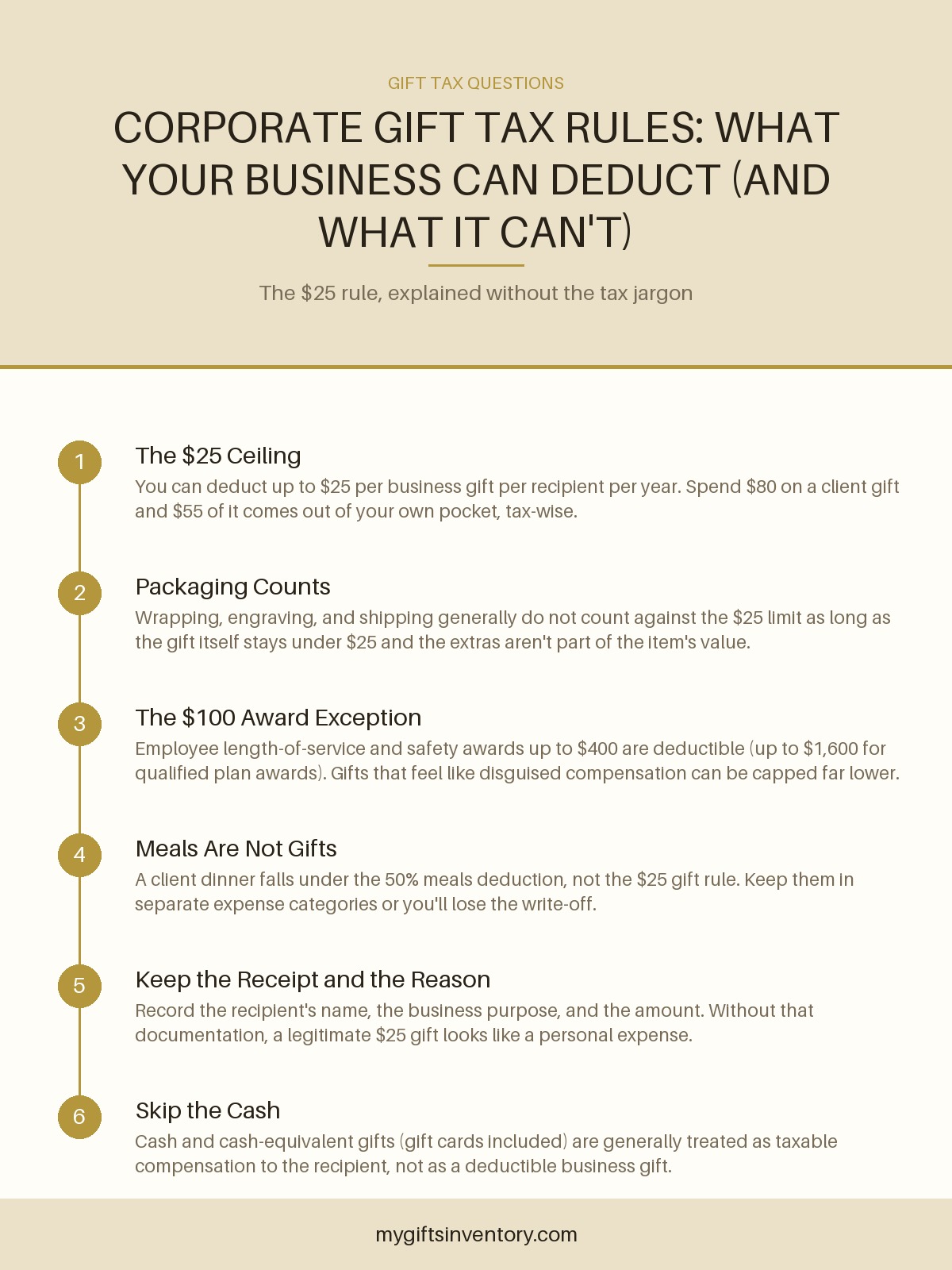
Here is the reassuring part, and it is the thing almost nobody understands until someone explains it: going over $19,000 does not mean you owe tax. It means you have to file a gift tax return, IRS Form 709, which reports the gift and applies it against your lifetime gift and estate tax exemption. For 2026, that lifetime exemption is in the millions of dollars per person (it is indexed to inflation and the exact figure moves, so check the current IRS number before you plan a major transfer). Almost every gift giver in the country will never come close to exhausting it.
Think of it this way. The annual exclusion is a shortcut for small gifts: under $19,000 and nobody needs to know. Above that, the excess amount gets added to a running tally of lifetime gifts. You only start actually owing gift tax once that tally plus your estate exceeds the lifetime exemption, which is a concern for very wealthy families and rarely anyone else. If you give one child $30,000 in 2026, $19,000 is excluded and $11,000 is reported against your lifetime exemption. No check to the IRS. Just a form.
Why filing the form still matters
The 709 is not just busywork. Filing it establishes the value of the gift on record, which protects you later if you are audited or if there is a question about what an asset was worth when you transferred it. Skipping the return because "it doesn't matter, there's no tax due" can create problems down the road. For gifts that touch real estate or business interests, have a professional handle it.
Gifts that never touch the limit
Some transfers are completely outside the gift tax rules, and knowing these can save you a lot of needless worry and paperwork.
Paying tuition and medical bills directly
If you pay a college directly for someone's tuition, or pay a hospital or doctor directly for someone's medical care, those payments are unlimited. You can pay a grandchild's full $60,000 tuition bill and none of it counts against the $19,000 exclusion or your lifetime exemption, as long as the money goes straight to the institution and not to the student. This is one of the most useful tools for grandparents who want to help with education, and it pairs beautifully with a smaller wrapped gift for the graduation party.
Gifts to your spouse
The marital deduction means you can give your spouse an unlimited amount, free of gift tax, as long as they are a US citizen. Buying a car together, funding a joint account, or paying off your partner's loan does not trigger the annual exclusion math.
Paying someone's expenses for them
Paying a bill directly, like a utility or a credit card, is generally still a gift to that person for tax purposes if there is no repayment expectation, so it does count. The tuition and medical carve-outs above are the narrow exceptions. If you are covering a family member's rent, that is a reportable gift above $19,000, not an expense payment.
Giving a large gift without the headache
If you know you want to move a significant amount of money or property to someone this year, a small amount of planning makes it painless.
Spread it across recipients and years
Because the exclusion is per person per year, the simplest structure is to divide a big gift across several recipients and, if needed, across two calendar years. Gifting $19,000 to a child in December 2026 and another $19,000 in January 2027 gets you $38,000 to that one person without touching lifetime exemption, and you can repeat it every year.
Use gift splitting if you are married
Married couples can double every number, so a combined $38,000 per recipient per year. If you want to help a child with a down payment, splitting a $60,000 gift between two spouses gets you there without reporting against the lifetime exemption at all.
Choose the right asset
Cash is easy but sometimes gifting appreciated stock or other property is smarter because of how basis carries over. That is a conversation for an accountant, but the gift tax exclusion treats the fair market value at the time of the transfer as the gift amount, regardless of what you originally paid for it.
How this fits into real gift giving
Most of us are not writing five-figure checks. The gift tax question usually surfaces for grandparents helping with a wedding or a first home, parents helping with a business, or anyone who has had a windfall and wants to share it. In those cases, the $19,000 annual exclusion is generous and the lifetime exemption is enormous, so the odds you owe any gift tax are low. The main thing that changes when a gift gets large is that you should keep good records and expect to file a return if you cross the line.
For everyday giving, the more useful question is how to choose something thoughtful inside a sensible budget, which is where our guides earn their keep. If you are shopping for a wine-loving in-law, our wine lover gifts and Thanksgiving host and hostess gifts stay comfortably under the annual exclusion, so the tax question never enters the picture. And if you decide to hand someone a gift card instead of cash for a large-ish present, our guide to checking a Whole Foods gift card balance is the kind of practical follow-through that keeps a generous gesture from becoming a nuisance.
A quick checklist before you give big
Add up how much each recipient is getting across the whole year, not just at the holidays. Remember that employers, relatives, and friends all count separately, but gifts from you to one person all add up. Write down what you gave and when. And if a single gift is heading north of $19,000, put a note on your calendar to file Form 709 with your return. That is the whole system, and it is far less scary than the phrase "gift tax" suggests.
Gift Ideas to Go With This


Want more ideas? Browse our full guide: 21 Corporate & Employee Gift Ideas Under $50 (2026) That Won't Feel Like an Obligation
Frequently Asked Questions
What is the gift tax limit for 2026?
The annual gift tax exclusion for 2026 is $19,000 per recipient. You can give that amount to as many people as you like without filing a gift tax return or using any of your lifetime gift and estate tax exemption.
Do I have to pay tax if I give more than $19,000?
Usually not. Amounts above the annual exclusion simply need to be reported on IRS Form 709 and count against your lifetime exemption, which is in the millions of dollars. You would only owe gift tax once your total lifetime giving plus your estate exceeds that exemption.
Can my spouse and I both give $19,000 to the same person?
Yes. Each spouse has their own $19,000 annual exclusion, so a married couple can give $38,000 to a single recipient in 2026. If the money comes from one spouse's account, you elect gift splitting on the gift tax return to have it treated as coming from both of you.
Is paying a grandchild's college tuition subject to the gift tax?
No, as long as you pay the school directly. Tuition paid straight to an educational institution and medical bills paid straight to a provider are unlimited and do not count against the annual exclusion or your lifetime exemption.
Do Christmas and birthday gifts count toward the $19,000 limit?
In principle any gift counts, but in practice small holiday and birthday presents are nowhere near the threshold, so there is nothing to track or file. The limit becomes relevant mainly when a single recipient gets a large cash gift, a down payment, or a valuable asset.
Looking for an Actual Gift Instead?




Gift Sets We Love Right Now
Every item picked, priced and linked, ready to buy.




More Gift Advice