How to Write a Thank-You Note for a Gift Card: Examples That Don't Feel Generic
Gift cards are a little awkward to thank someone for, and most people write the same three sentences. Here's how to write a note that sounds like you actually mean it, with real examples for every relationship.
As an Amazon Associate, My Gifts Inventory earns from qualifying purchases. We only recommend products we'd genuinely consider buying ourselves.
Somebody handed you a gift card, you said thank you in the moment, and now you're staring at a blank card trying to figure out how to thank someone for what is essentially money to a store. We get it. Gift cards are genuinely lovely to receive and genuinely awkward to write about, which is how half the thank-you notes in the world end up as "Thanks so much for the gift card! I can't wait to use it!" That sentence is not wrong, but it is forgettable.
The good news: a thank-you note for a gift card is one of the easiest notes to get right, because you have something most gift notes don't have, which is a plan. You know where the money is going, or you can decide right now. That detail is the whole trick.
Why graft card thank-yous go generic (and the one fix)
Generic notes happen for one reason: the writer is trying to express gratitude without saying anything specific, because they haven't actually spent the card yet and don't know what to say about it. So they reach for filler. "So generous." "So thoughtful." "Means so much." All true, none memorable.
The fix is to answer an unspoken question the giver is wondering about. When someone gives a gift card, a small part of them wants to know it was the right call and not a lazy one. They want to hear that you're going to use it on something you actually want. So tell them. You don't need to have spent it. You need a plan.
Compare:
Generic: "Thank you so much for the gift card! It was so thoughtful and generous of you."
Specific: "Thank you for the bookstore card. I've been eyeing a big hardcover cookbook for months and kept talking myself out of it, so this is going straight toward that. I'll send you a photo when it arrives."
Same length. One you forget, one you feel. The only difference is a real plan and a little specificity.
The four-part structure that works every time
We've found almost every strong gift card thank-you fits the same loose shape. It's not a formula to follow robotically, but it's a useful checklist when you're stuck:
1. Say thank you, plainly
Open with a clean thank you and name the card. "Thank you for the Amazon card" lands better than "Thank you for the generous gift," because it shows you remembered what they actually gave.
2. Name what it's going toward
One sentence about your plan. It can be specific ("putting it toward a new pair of running shoes") or honest about the uncertainty ("still deciding between two things, which is half the fun"). Both work. What doesn't work is leaving it blank.
3. Add one human detail
This is where the note stops sounding like a template. Who you'll go with, when you'll use it, what the card lets you do that you wouldn't normally do, or a callback to a conversation you had with the giver. One detail is plenty.
4. Close warmly, briefly
"Thank you again" or "So glad you thought of me" and sign off. Resist the urge to keep going. A short note that means something beats a long one that circles.
Real examples by relationship
Warmth level should match the relationship. A note to your boss's boss and a note to your best friend can both be sincere without sounding alike. Here's how that plays out.
For a friend
"Thank you for the coffee shop card. This is genuinely dangerous, because there is now nothing stopping me from becoming a daily latte person. I'm going to test every seasonal drink and report back. Thank you for thinking of me."
"You know me too well. Thank you for the bookstore card. I'm using it on the exact kind of novel I never let myself buy. Saturday morning, one card, no guilt. Thank you."
For a parent or grandparent
"Thank you for the gift card, and for the note that came with it. I'm putting it toward the new winter coat I've been putting off buying, so you've officially kept me warm this year. Thank you for always taking care of me."
"Thank you for the restaurant card. We're going to use it on a date night we would have skipped otherwise, so you've given us two gifts really. Thank you for being so thoughtful."
For a sibling or close family member
"Thank you for the card. Rude of you to give me exactly what I wanted, honestly. I'm spending it on something practical and then I'm spending the rest on something dumb. I'll tell you which is which. Thank you."
For a coworker or team gift
"Thank you for the gift card. It's going straight into the ridiculously good sandwich place near the office, which is exactly the kind of small luxury I love. Really appreciate the thought."
"Thank you so much for the card, and for organizing the collection. It's a lovely gesture and I'm putting it toward a nice dinner out. Thank you all for thinking of me."
For a teacher or coach
"Thank you for the gift card. I'm going to spend it on books for my classroom library and one very overdue cup of coffee. Thank you for a wonderful year and for the kind thought."
For a boss or a workplace gift from above
"Thank you for the gift card. I'm using it on a proper day out with my family, which is exactly what I wanted. I appreciate the generosity and the thought."
What to say when you genuinely don't know what you'll buy
Plenty of people write generic notes not out of laziness but because they really haven't decided yet, and they don't want to commit to a purchase that might not happen. That's fine. You can be honest and still be specific:
"Thank you for the card. I'm taking my time deciding, because I want to spend it on something I'll actually still love in six months. Right now I'm between a new pair of boots and finally upgrading my kitchen knife. Either way, it's going to be something I use constantly. Thank you."
Notice what that does. It tells the giver you're taking the gift seriously, which is flattering and true. It also gives them something to ask you about later. That last part matters more than you'd think.
The one thing not to write
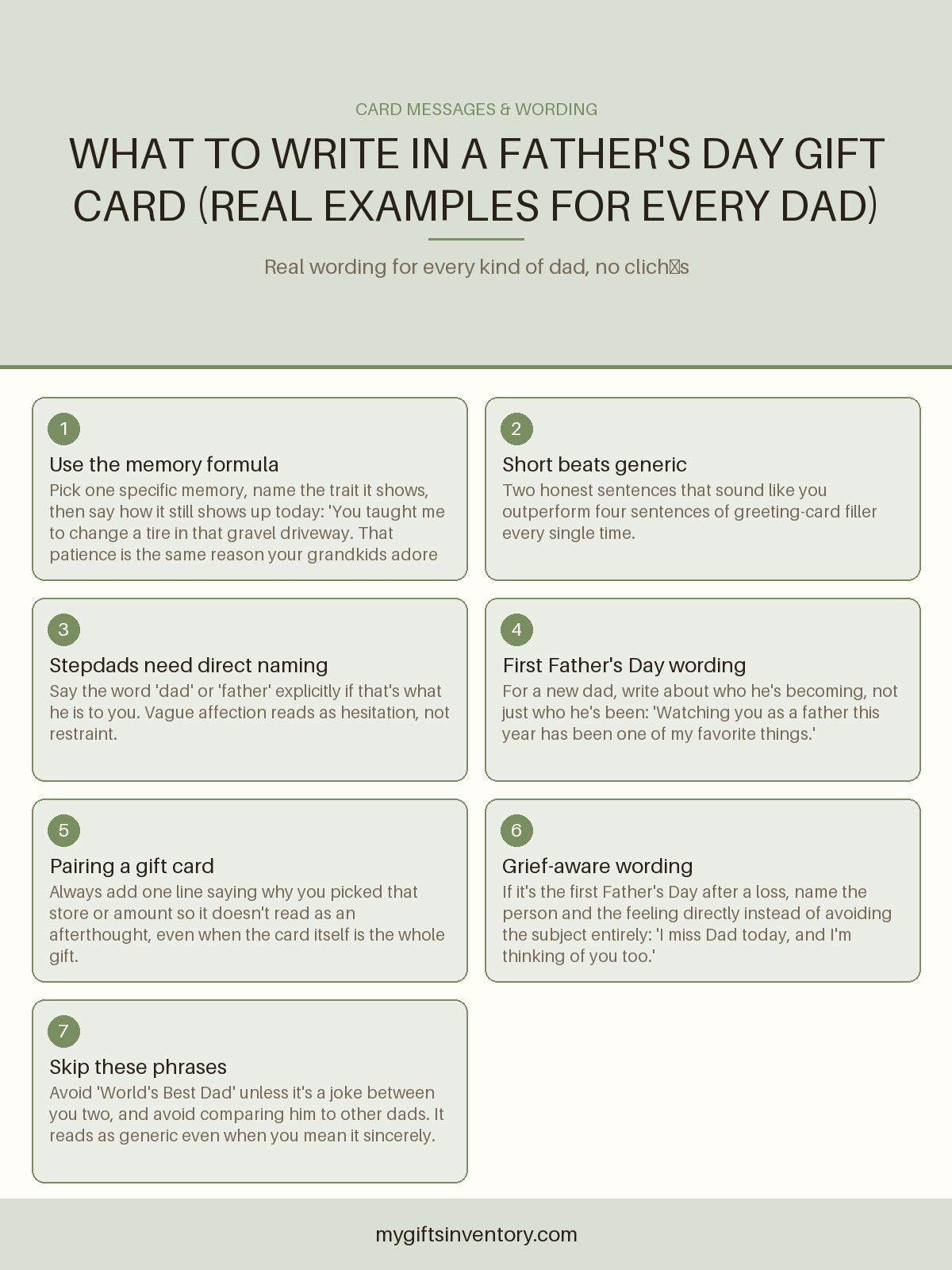
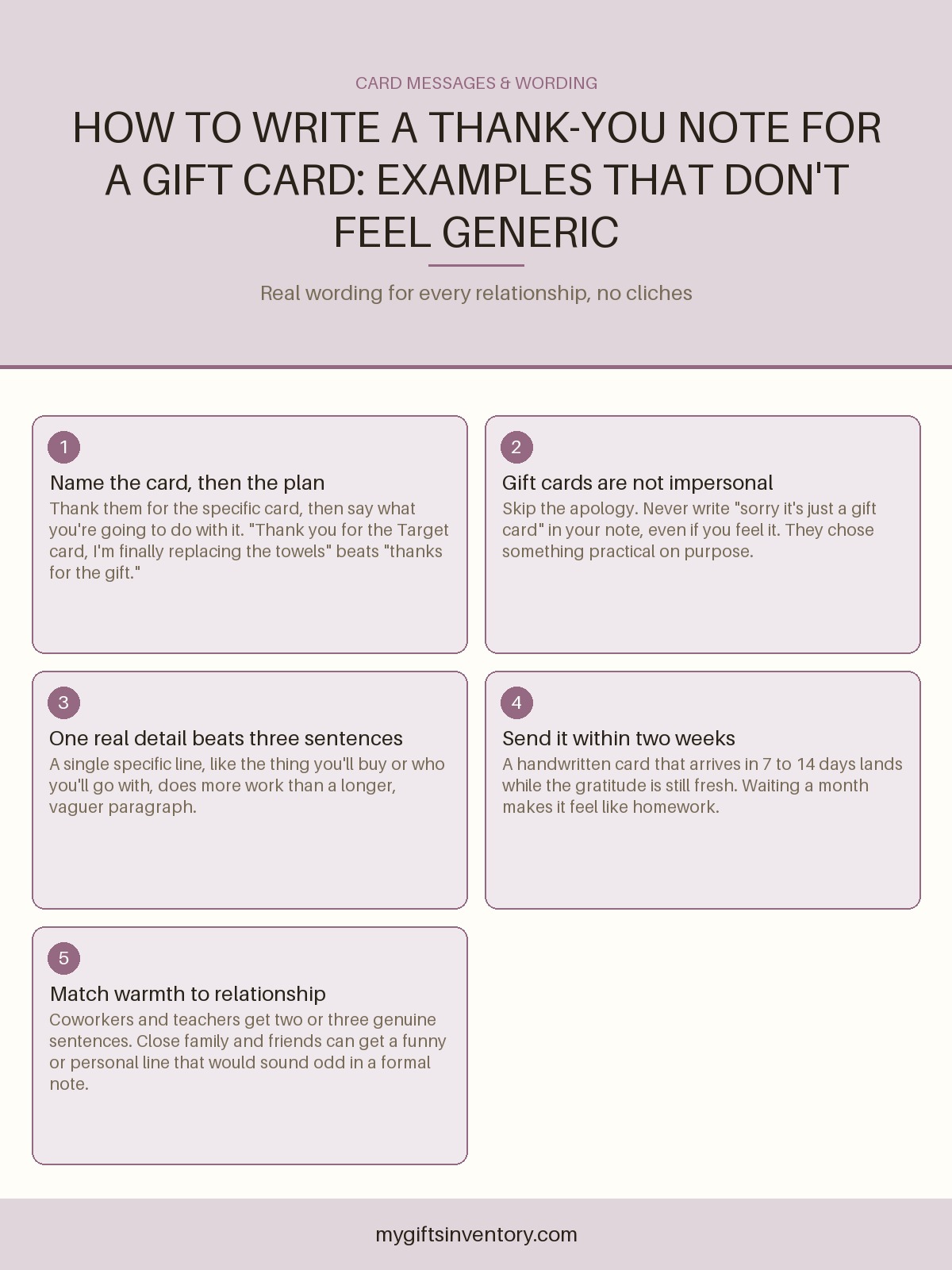
Never apologize for the card in your thank-you note. We see this constantly: "Sorry I couldn't get you something more personal, but thank you for the gift card!" Two problems. First, it's not your apology to make, because you're the receiver. Second, the giver already made peace with giving a gift card, and apologizing on their behalf makes it weird.
Gift cards are often the more considerate choice. They don't expire, they don't collect dust, and a lot of people prefer them. If you're on the giving end and want to make the card feel less transactional, our guide on what to write in a gift thank-you note (examples for every situation) covers the flip side of this, including wording for the note that goes with the card itself.
Format, timing, and the little things people skip
Handwrite it if you can
A note on a real card, even a cheap one, signals effort in a way a text never will. If handwriting isn't realistic, a text is far better than nothing, but keep it to a sentence or two and make it specific.
Timing
Within two weeks is the comfortable window. Within a week is better, especially for weddings, showers, and graduation gifts where the giver may be wondering if the card arrived at all. If two weeks slip by, send it anyway. A late note is always better than none.
Name the gift explicitly
"Thank you for the gift card" is fine, but "Thank you for the Amazon gift card" is better, and "Thank you for the $50 Amazon card" is best when the amount is generous enough to mention. It shows the giver you registered what they did.
Follow up when you actually spend it
This is the move that turns a good note into a memorable one. Send a photo or a one-line text when you buy the thing. "Remember that card you gave me? This is what it became." People love this more than you'd expect, because it closes the loop they never get to see.
If the gift card came with a wrapped gift
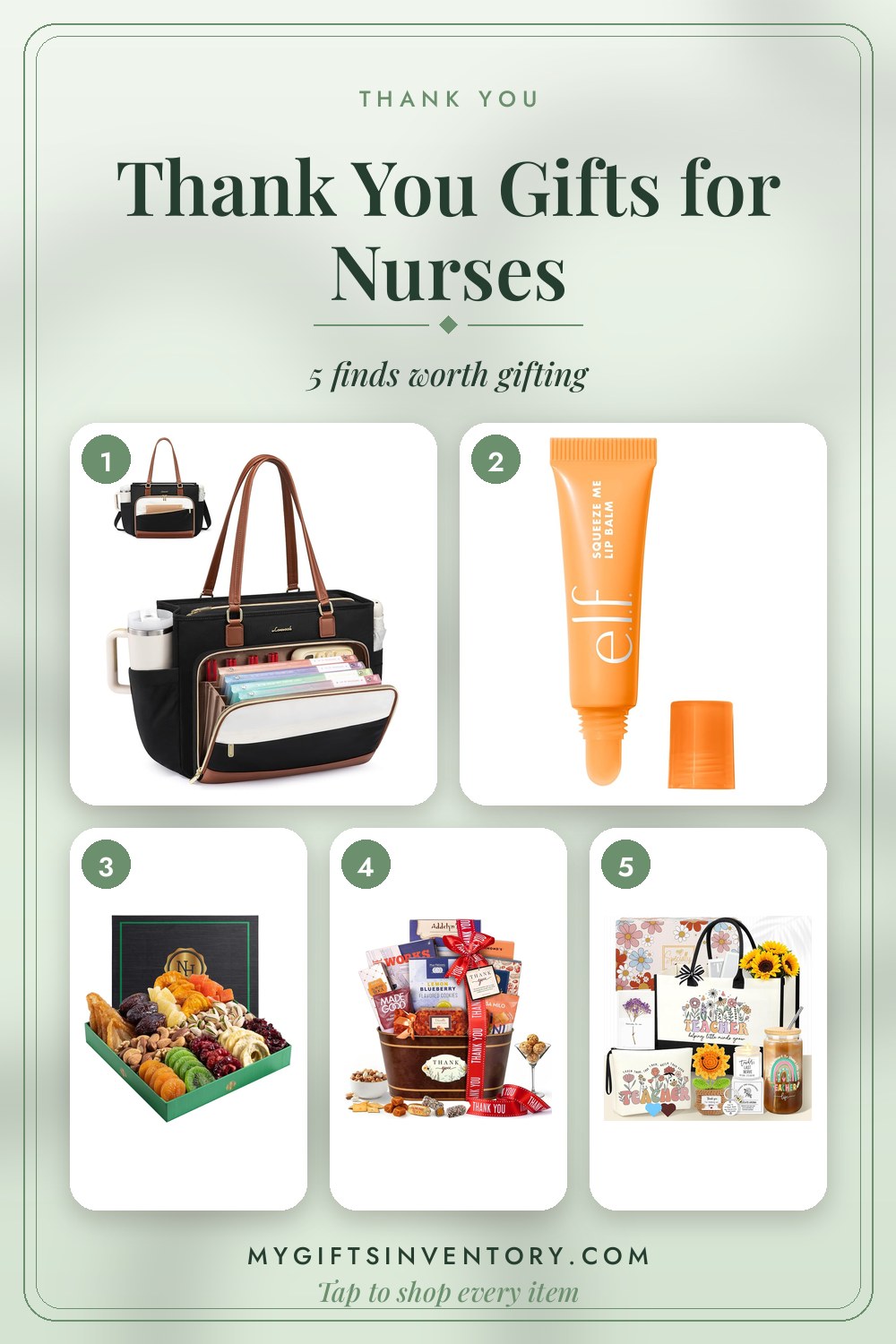
A lot of people pair a gift card with something smaller, like a candle, a bottle of wine, or a small item the person will use. In that case, thank them for both, and lead with the physical gift since it takes more thought, then mention the card. "Thank you for the candle and the card. The candle is already on my nightstand, and the card is going toward a new pair of jeans I've been putting off buying."
If you're the one doing the giving and want to pair a card with a small gift, our guides are a good place to start. We like the hot chocolate and cocoa gift sets because they pair well with a coffee shop card, and the book lover gifts line up naturally with a bookstore card. The trick is to make the physical gift feel like a companion to the card rather than an afterthought.
If the card is from a brand you don't know
Sometimes you get a card to a store you've never set foot in, and you have no idea what to say beyond a polite thank you. Two options. First, do a quick search for what the store actually sells, pick one plausible thing, and use it in the note. Second, thank them for the card and explicitly say you're excited to discover the store, which is a genuinely charming thing to hear.
"Thank you for the card. I'd never been to one of these stores and now I have an excuse to explore, which is honestly my favorite kind of gift. I'll let you know what I find." That works, and it's true.
If you're wondering what a card to a particular retailer is worth, our balance-check pages can also help you understand how to check the balance before you spend it, so you're not caught off guard at the register. For clothing and personal care cards, the Victoria's Secret and PINK balance page walks through it. If someone gave you a card to a discount or closeout retailer and you're not sure what's on it, the Ross gift card list is a useful reference.
Short versions for text messages
If the card came with a text rather than a card, match the medium. Keep it warm and specific in one or two lines.
"Thank you for the card! Going straight toward the concert tickets I've been saving for. You're the best."
"Thank you for the gift card, that was so kind. Spent part of it already, no regrets. Thank you."
"Got the card today, thank you! This is going toward a very good dinner. Appreciate you."
Gift Ideas to Go With This


Want more ideas? Browse our full guide: 18 Keepsake Gifts Worth Holding Onto (2026): Personalized Picks They'll Treasure Forever
Frequently Asked Questions
Is it rude to only say thank you for a gift card?
No. A short, sincere thank-you note is completely fine. What makes a note feel rude is never acknowledging it or writing something so vague that it clearly took five seconds. Two specific sentences beat five generic ones.
Should I mention the amount on the gift card?
You can, especially if the amount is generous and it feels natural ("thank you for the $100 Amazon card, that was incredibly generous"). If it feels awkward, skip it and focus on what you'll do with it instead. Either way, do not complain about the amount, even to someone else.
How soon should I send a gift card thank-you note?
Within one to two weeks is ideal, and sooner is better for weddings and showers. If you're sending a handwritten card, get it in the mail within a week so it arrives while the gift still feels fresh. A late note is better than none, so send it even if it's been a month.
What if I already spent the card and don't remember what I bought?
Tell them what you think you bought if you have a rough memory, and be honest if you don't. "I used it on a few small things I'd been putting off, which is exactly what I needed" is a perfectly good sentence. You don't need a receipt to write a warm note.
Do I need to thank someone for a gift card if they gave it to me in person?
Verbally, yes, in the moment. Whether you also send a written note depends on the relationship and the occasion. For weddings, showers, graduations, and gifts from people you don't see often, send a written note. For a casual card from a close friend, a genuine thank you plus a follow-up text when you use it is usually plenty.
Looking for an Actual Gift Instead?
Shop Hand-Picked Gift Sets
Every item picked, priced and linked, ready to buy.
More Gift Advice