Is Regifting Okay? The Real Rules for Passing a Gift Along
Regifting isn't the etiquette crime people fear it is, but there are a few lines worth not crossing. Here's when it works, when it doesn't, and how to pull it off without anyone getting hurt.
As an Amazon Associate, My Gifts Inventory earns from qualifying purchases. We only recommend products we'd genuinely consider buying ourselves.
You've got a beautiful candle you'll never burn, a scarf in the wrong color, or a kitchen gadget that's been sitting in its box since last December. And now you're staring at an upcoming birthday wondering whether it's acceptable to wrap it up and hand it to someone else. You're not a cheapskate for asking. You're just trying to be practical without being tacky, and those two things don't have to be opposites.
Here's the short answer: regifting is okay, and it always has been. What gets people in trouble isn't the act itself, it's the sloppiness around it. Pass along the wrong thing, to the wrong person, with no thought at all, and it reads as lazy. Do it with a little care and honesty, and nobody's the wiser, or the lesser for it.
Why Regifting Got a Bad Reputation
Somewhere along the way regifting became the punchline of every holiday sitcom. The fear is real: that you'll give someone a gift, they'll recognize it as the thing Aunt Carol gave you last year, and everyone will be embarrassed. That fear is valid, but it's also wildly overstated. The truth is that most gifts people receive either go into rotation, get stored, or eventually get passed along in some form or another. Regifting just does that passing deliberately, while there's still someone who'll love the item.
The waste argument is worth sitting with for a second. Roughly the cost of a nice dinner per person gets spent on gifts that miss the mark every year. If you received a $40 whiskey stones set and your brother-in-law actually collects barware, passing it to him keeps $40 of stuff out of a closet and puts it in a home where it gets used. That's better for everyone involved, including the original giver, who presumably wanted the gift to bring someone joy, not just sit in your closet.
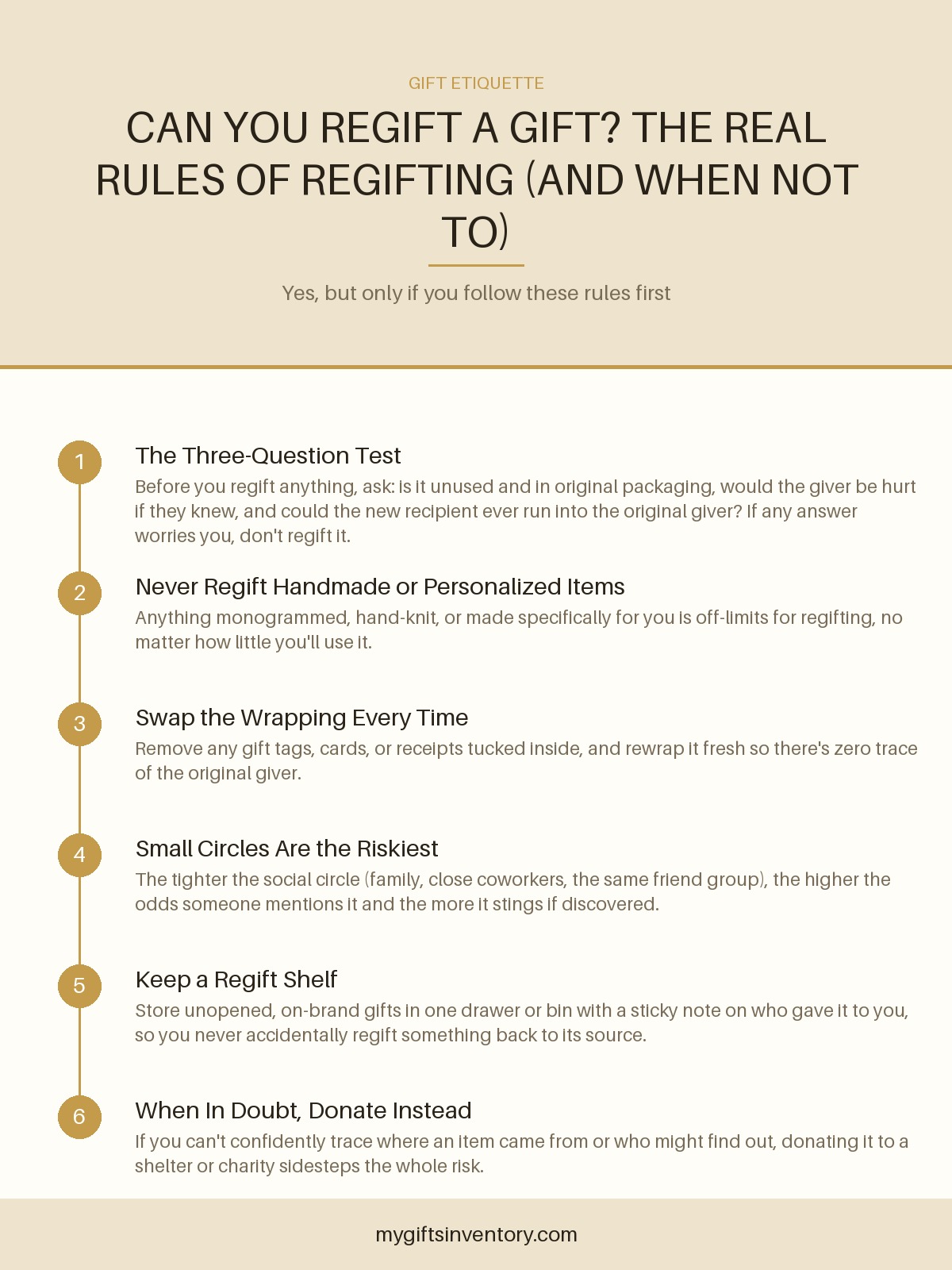
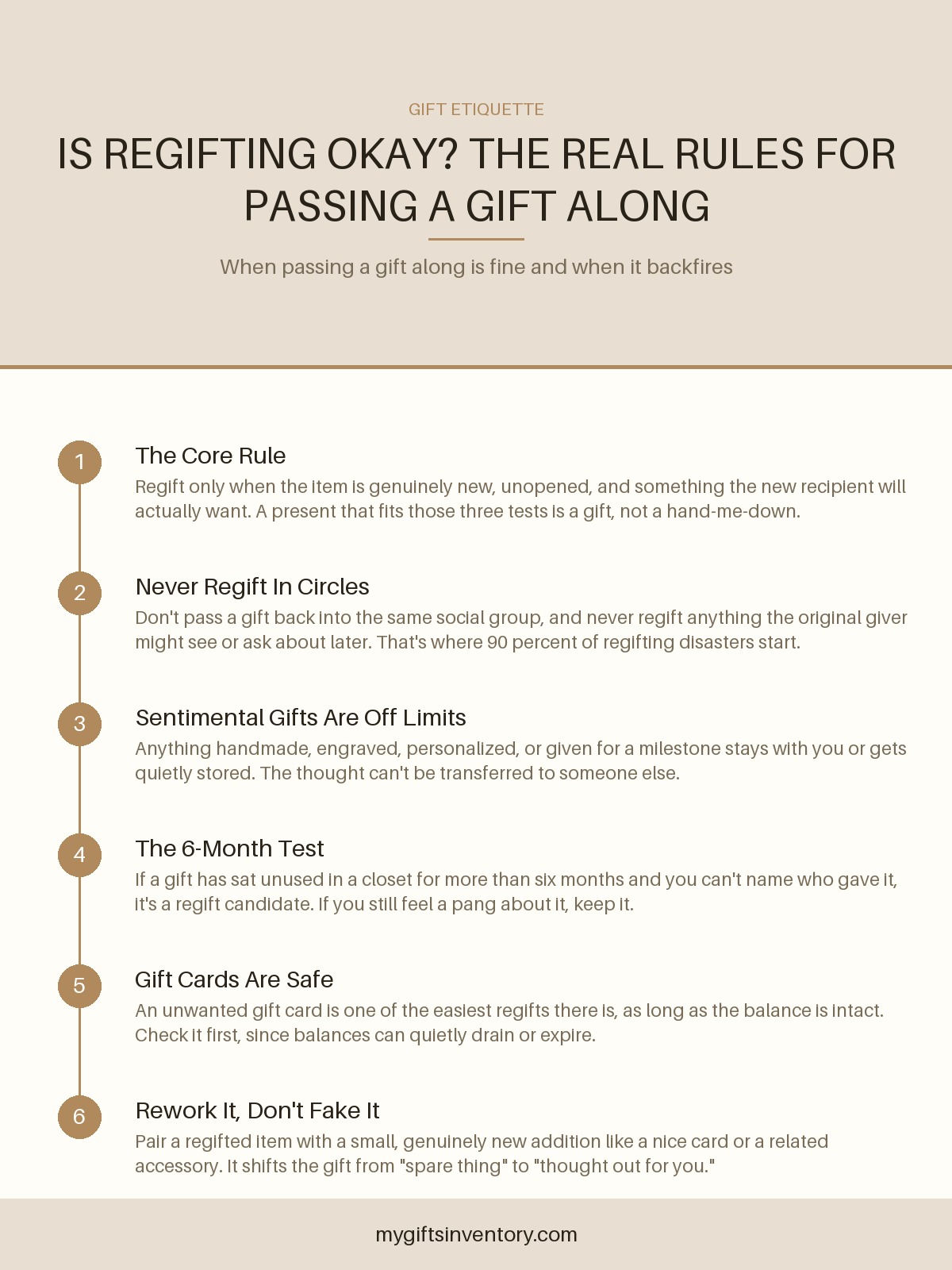
The Five Rules That Actually Matter
Most of the anxiety around regifting dissolves if you follow the basics. Here's what we'd hold to.
1. It has to be new and unopened
Nobody wants a used gift. If you've worn the scarf, burned half the candle, or taken the tags off, it's no longer a regift. It's a hand-me-down, which is a different and generally more awkward gesture. Unopened, in the box, packaging intact: that's the bar.
2. It has to be something the new person will genuinely want
This is where most regifting goes wrong. The test isn't "do I not want this?" It's "does this specific person actively want this?" If your friend has been eyeing a candle warmer for months, the unopened candle you received is now a thoughtful gift, because it fits a gap they've already told you about. If you're handing over a random item just so you don't show up empty-handed, you're not regifting. You're unloading, and the recipient will feel it.
3. Keep it out of the same social circle
The cardinal rule: never regift within the group where the original gift came from. That means not gifting to the same person who gave it (obviously), not gifting to a mutual friend they'll see, not gifting to a family member who talks to the original giver, and not regifting at the event where the giver is present. A coworker's gift becoming a gift for a cousin in another state is low risk. A coworker's gift becoming a gift for another coworker three desks away is a ticking time bomb.
4. Never regift anything personalized or sentimental
Engraved, monogrammed, handmade, or tied to a milestone: these stay with you. The thought behind them doesn't transfer, and if the original giver sees the item in someone else's hands, the hurt is real and lasting. Even if you don't love the item, keep it, store it, or quietly donate it later. Passing it along is a different category of mistake.
5. Don't regift while the memory is fresh
Give the item six months. If a gift from last Christmas shows up at a friend's birthday party in March, it's possible nobody notices, but why risk it? Time and distance dilute the awkward. If a gift has been sitting unloved for a year and a half, that's a much cleaner regift.
When Regifting Really Works
Some categories are practically built for it. A few reliable cases:
Unwanted gift cards
An unused gift card that isn't a fit for you is one of the safest regifts in the book, because it's still worth its full value and doesn't carry the same "I received this and rejected it" energy as a physical item. The one thing to check first: balances. Some cards decay down over time or get drained if the card was ever almost used. Before you pass one along, verify what's actually on it. Our walkthrough on how to check a Victoria's Secret/PINK gift card balance covers the general process, and the same steps apply whether it's a store card or a restaurant one.
Wine, coffee, and consumables you don't use
If you don't drink, the bottle of wine you received at a holiday party is an easy gift for a friend who does. The same goes for coffee, tea, and chocolates, as long as they're unopened and the person actually likes them. Coffee and tea have long shelf lives and don't feel personal, so the stakes are low. If you want to make it feel intentional, see our picks for smooth coffee gifts under $50, which are exactly the kind of item people actually want rather than a random regift.
Duplicate items
Two silk pillowcases, two nice Bluetooth speakers, two versions of the same board game. Duplicates are the classic regift because you clearly don't have a use for the second one. Pass the newer, unopened one to someone who will use it, and keep the one you've already broken in. Speaking of which: our board game gift guide shows the kind of title that holds up as a regift, because it's a general-audience item with no sentimental weight.
Things that fit the recipient's actual hobby
If the regift matches a hobby or interest the person already has, it doesn't just pass. It feels targeted. A golf gift that lands in front of a golfer, a yoga accessory in the hands of someone who does yoga four times a week, a whiskey glass for a whiskey lover. The unopened item plus the right person closes the gap. For that specific scenario, our roundup of whiskey lover gifts is the kind of thing worth checking before you regift something vaguely bar-related, so you know whether the item actually fits.
When Regifting Backfires
Some situations are dangerous enough to skip the regift entirely. If any of these apply, buy something else or bake something.
- The original giver will be at the event. Even if they gave you the item years ago, it's a risk not worth taking. They may remember, or someone may mention it.
- The item was a gift for a milestone. Weddings, graduations, new babies, promotions. These gifts are charged with a relationship, and passing them along can wound the giver if it comes out.
- The item is uniquely recognizable. Handmade ceramics, one-of-a-kind art, anything with a maker's mark that the giver would spot from across a room. If the giver knows the item well, don't.
- It's a gift from your partner or a close family member. The math is different when the giver is someone who'll be in your daily life and could reasonably expect the item to be around. A regift here can feel like rejection of the person, not just the thing.
- The recipient is a close friend and the original giver is too. Small social worlds make this a bad bet, even if the odds seem low.
How to Regift Without It Feeling Like a Regift
The difference between a smooth regift and an awkward one is almost always in the execution. A few things that help it feel like a real gift.
Rewrap it properly
This is not the place to reuse the crumpled paper and the half-torn box. A regift should arrive looking like you bought it yesterday. Fresh wrapping, a real tag, a card. If the original box has a price sticker on it, remove it. If it has a gift receipt or a note from the giver, make sure neither ends up inside the new wrapping. We've all heard the horror story of the giver opening a present to find a card addressed to someone else.
Add one small new thing
Pair the regifted item with something genuinely new and small: a nice card, a related accessory, a treat the person loves. A candle gets wrapped with a new box of matches. A book gets paired with a bookmark. A coffee item arrives with a fresh bag of beans. The small addition shifts the gesture from "spare thing" to "I thought about you and I also had this nice item." The total cost is usually under $10, and it changes the entire tone.
Say nothing
Don't announce it. Regifting isn't a confession, and the recipient doesn't need to know the item's origin story. If they specifically ask where you got it, keep it light and brief: "I found it a while back and thought of you." No need to complicate. The one exception is if you think it might be spotted. In that case, be upfront: "I got this from a gift exchange and it's not my color, but I thought it might be yours." That kind of honesty lowers the stakes instead of raising them.
Consider the alternative
If you're not sure about the regift, there are other options. You can donate it (many charities accept new, unused items), sell it on a resale site, or keep it for an occasion that hasn't arrived yet. Regifting is a fine choice, but it's not the only one, and it's not always the first one worth reaching for.
The Gift Card Exception, Revisited
Gift cards deserve a special mention because people worry about them more than they need to. Regifting a card isn't rude, and it's often the cleanest option: no wrapping, no mismatched recipient, no awkward moment about origin. The only thing that can go wrong is a balance issue. If the card was ever used, partially, or bought years ago, its value may have shrunk. Before you pass it along, do a quick check.
Our brand-specific walkthroughs will get you there for any store in a few clicks. For example, checking a Trader Joe's gift card balance takes less than a minute, and the process is essentially the same whether the card is for a grocery store, a restaurant, or a clothing retailer. If you find the card has a full balance, you've got a guaranteed-value regift on your hands. If it doesn't, you've spared yourself an embarrassing moment.
Regifting in Specific Situations
The general rules are the same, but a couple of scenarios come up often enough to deserve their own answer.
White elephant and gift exchanges
Here regifting is practically the whole point. These events are built around low-stakes, quirky gifts, and an unopened item from last year's exchange is fair game as long as it's fun rather than actual junk. The bar is lower, but the "would someone want this" test still applies. For ideas that land, our white elephant and gift exchange ideas under $30 shows what actually gets stolen from the pile.
Coworker and acquaintance gifts
Coworker gifts are one of the safest places to regift, because the relationships are usually shallow enough that nobody's tracking item provenance. An unopened item that's genuinely nice goes a long way in an office setting. Our guide to Christmas gifts for coworkers between $25 and $50 is worth a look before an office exchange, both for what to buy and for which regifts would fit naturally.
Family gifts
Family is highest risk, because families talk and memories are long. That doesn't mean you can never regift within a family, but it does mean the item should go to someone in a completely different branch who doesn't know the original giver. A gift from your mother-in-law, regifted to your college roommate in another state, is fine. A gift from your mother-in-law, regifted to your sister-in-law at the same Christmas dinner, is a bad idea.
Kids' gifts
Kids are surprisingly good regift recipients, because they grow out of things fast and their social circles overlap less than adults'. An unopened toy, book, or game that your child has aged out of, passed to a younger cousin or family friend, works cleanly. The one exception is anything your child is attached to or anything with a photo, name, or inscription.
When to Just Buy Something New
There's a version of regifting that's actually just avoidance, and it's worth naming. If the regift is a way to avoid spending money on someone you'd otherwise feel obligated to spend on, it's usually better to buy a small, genuinely new gift than to wrap up a random item. A $15 or $20 new gift, chosen with a little thought, usually lands better than a $40 regift that feels like a placeholder. Regifting works best when it solves a mismatch, not when it solves a budget problem. For budget problems, the better answer is to spend less, not to redirect the clutter.
That said, budget and regifting aren't enemies. The sweet spot is when a regift saves you money and lands with the right person at the same time. That's not lazy. That's smart gift-giving, and it's the version we'd happily defend to anyone.
Gift Ideas to Go With This


Want more ideas? Browse our full guide: 20 Best Gifts Under $100 (2026): Thoughtful Picks They'll Actually Use
Frequently Asked Questions
Is it rude to regift something?
No, regifting is not inherently rude. It becomes rude only when the item is used, when it's passed along to someone who won't want it, or when the original giver is likely to find out. Do a little screening and the gesture is fine.
Should I tell someone I regifted their gift?
You don't owe anyone an announcement, and a quiet regift is totally reasonable. If you think the original giver might see the item in its new home, it's a courtesy to say so upfront: "I got this from a gift exchange and thought you'd use it more than I would." Directness beats surprise.
Can I regift a gift card?
Yes, and it's one of the safest regifts. The one step worth taking first is checking the balance, since a card that's partially used or expired isn't the same gift. Verify the amount, then wrap it or add a small card, and it's indistinguishable from a new card.
Is it okay to regift a wedding or baby gift?
No. Wedding and baby gifts are tied to a milestone and to a specific relationship, and the original giver is much more likely to notice. Pass along an everyday gift instead, and keep anything milestone-related either with you or in a storage box.
What if I'm regifting to the same person who gave me the gift?
Never. Even if you're sure they'll love it, handing a gift back to the person who gave it to you reads as rejection. Gift it elsewhere, donate it, or store it. This is the one rule with no exceptions.
Looking for an Actual Gift Instead?
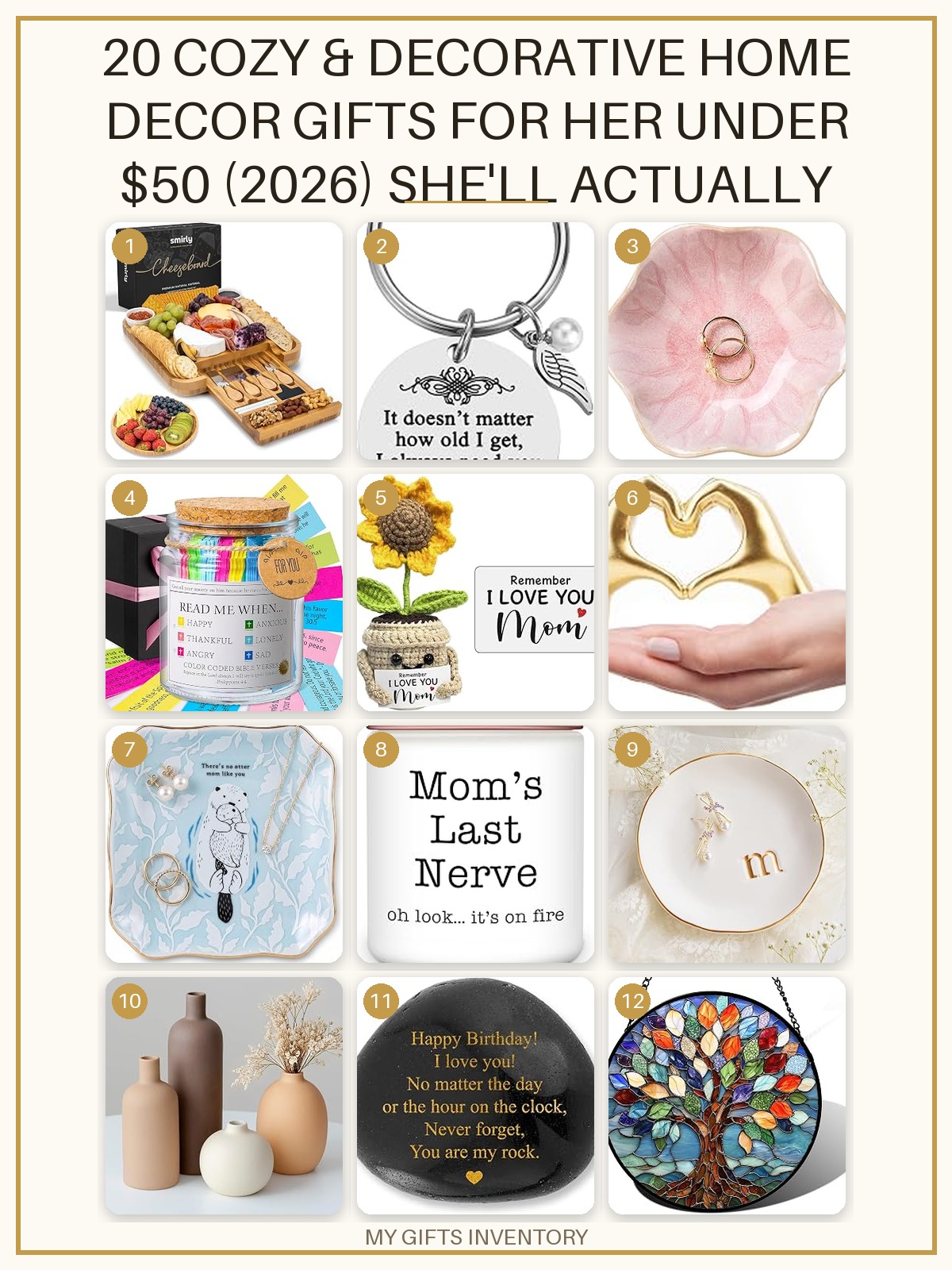

Gift Sets We Love Right Now
Every item picked, priced and linked, ready to buy.
More Gift Advice