What to Get the Mom Who Has Everything: 7 Gift Angles That Aren't Just Another Mug
She doesn't need more stuff. Here are seven gift angles that actually work for the mom who buys herself what she wants, plus budgets, card wording, and what to do when you're truly stuck.
As an Amazon Associate, My Gifts Inventory earns from qualifying purchases. We only recommend products we'd genuinely consider buying ourselves.
Nobody is actually hard to shop for. The mom who "has everything" usually has plenty of objects and very little room for more of them, which is why another mug, another scented candle, and another decorative tray all land in the same donation box by February. The real question behind this search isn't what to buy. It's how to give her something that doesn't feel like an obligation to be grateful for.
We've watched this play out in our own families enough times to have opinions. Below are seven angles that reliably work, with real budget ranges, what to write in the card, and honest advice for the years when you're completely stuck.
Start With the Right Question, Not the Right Product
Before you look at a single listing, ask yourself one thing: what does she already replace on a schedule? Everyone has a short list of things they buy over and over, and those items are almost always upgradeable. Coffee. Olive oil. Towels. Pillows. Kitchen shears. Hand cream. A cheap version and a good version of the same item feel like different categories to the person using them.
That reframing solves most of the "she has everything" problem, because you're no longer adding to her house. You're improving something already in it. It's also the single best defense against the gift that gets politely thanked and quietly shelved.
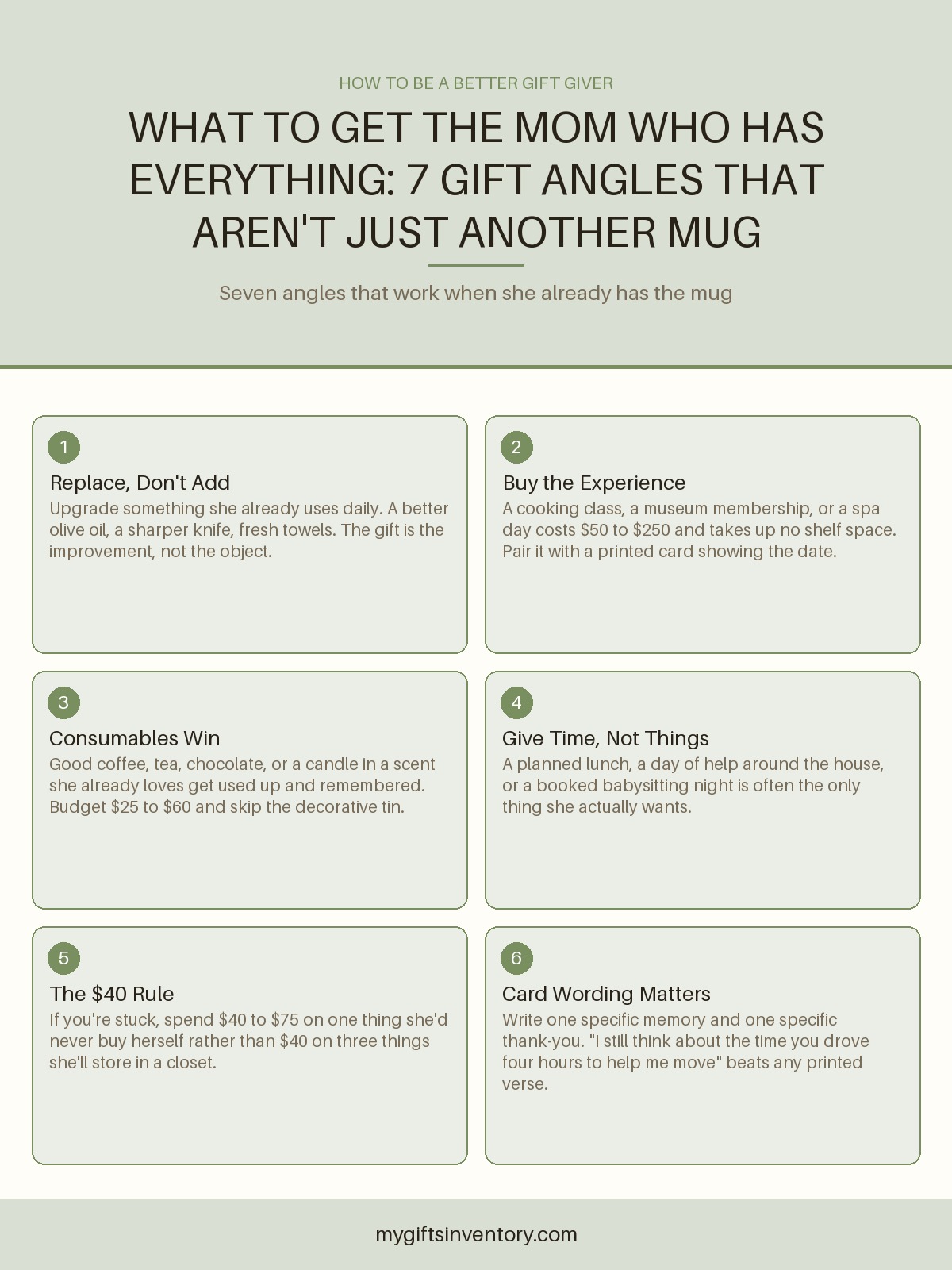
Angle 1: Upgrade Something She Uses Daily
This is the highest-hit-rate angle we know. Find the thing she uses constantly and buy the version she'd never buy herself. Not a fancier version of something she doesn't use. The same item, better made.
Good candidates, roughly in order of how often they land:
- Kitchen shears or a chef's knife ($60 to $150). Most households are working with a dull blade and don't know it.
- Olive oil or a good vinegar ($25 to $45). She'll use it within a month, which is the whole point.
- Bath towels ($80 to $150 for a set). The upgrade from a seven-year-old towel to a heavy cotton one is startling.
- Pillows ($50 to $120 each). Unsexy, wildly appreciated.
- A real coffee setup. If she's still using a drip machine she hates, an espresso machine or a better grinder is a genuine lifestyle change. Our coffee maker and espresso machine gift guide covers the Breville, Nespresso, and Keurig options by price tier if you want to compare before committing.
The one rule here: pick something she uses at least three times a week. If you're guessing at her routine, this angle backfires.
Angle 2: Buy the Experience Instead of the Object
Experiences work for the mom who has everything because they take up zero square footage and produce a memory instead of a storage problem. They also sidestep the awkwardness of a physical gift she has to pretend to need.
What actually works, at real prices:
- A cooking or pottery class, $60 to $150 per person. Book it for a specific date so it doesn't become a vague intention she has to schedule herself.
- A museum or botanical garden membership, $75 to $200 annually. The gift keeps arriving all year, which is the appeal.
- A spa or massage appointment, $100 to $250. Book it. A gift certificate with no date is a to-do list item.
- A concert or theater ticket for the two of you, $50 to $300 depending on the show. The second ticket is the actual gift.
- A weekend away, if siblings are splitting it, $150 to $400 per person. This is where pooling money pays off most.
If she's the kind of person who'd rather have the thing than the outing, don't force it. Some people genuinely find experiences stressful to schedule. You'll know which mother you're dealing with.
Angle 3: Go Consumable, and Go Specific
Consumables are the safest category for someone who wants for nothing, because the gift disappears when it's done. No shelf, no guilt, no re-gifting dilemma. The catch is that generic consumables feel generic. Specific ones don't.
Spend $25 to $60 on one thing she actually consumes rather than $50 on a sampler she'll open once. A single-origin coffee she can't get locally. A tea she mentioned once. Chocolate from a shop she likes. If tea is her thing, our tea lover gift guide breaks down sampler boxes, gooseneck kettles, and matcha sets by what a person actually uses versus what just looks nice in a box.
One warning: avoid anything that requires her to develop a hobby to use it. A sourdough starter kit given to someone who doesn't bake is a chore in a box. If she does bake, though, it's a great gift, and our baking gifts guide covers stand mixers, sheet pans, and sourdough kits at every price point.
Angle 4: Give Time and Labor, Which Is Usually What She Wants
Ask most mothers what they'd actually like and the answer is rarely an object. It's a clean house, an afternoon without errands, or a meal they didn't have to plan. This is a legitimate gift category, not a cop-out, as long as you actually deliver it.
Options that work:
- A booked house cleaning, $120 to $250 for a deep clean. Pay for it up front and schedule it. Don't hand her a voucher to redeem later.
- A meal service week, $80 to $150. Same rule: set it up yourself.
- A planned day together with the calendar already cleared. This is free and often the most remembered gift of the year.
- A yard or handyman day for the projects that have been sitting for two years.
The failure mode here is the "coupon book" gift, which asks her to chase you down to redeem it. Book it, pay for it, put the date on a card. The gift is the removal of a task, not the promise of one.
Angle 5: Pool Money and Buy One Real Thing
If you have siblings, this is the most underused move available to you. Three people contributing $60 each gets you a $180 gift that actually registers, instead of three $60 gifts that get absorbed into the closet.
Realistic pooled budgets and what they buy:
- $150 to $250: a quality piece of jewelry, a good handbag, a nice pair of boots, a Kindle or e-reader.
- $250 to $500: a piece of furniture she's mentioned, a really good coat, a spa weekend, a standing mixer.
- $500 and up: a trip, a laptop, a piece of art, a significant home upgrade.
The coordination is the hard part, not the money. Designate one person to collect and buy, and tell the others what's being purchased so nobody duplicates. If you want a starting point for the mid-range tier, our Kindle and e-reader guide covers the Paperwhite, Colorsoft, and Scribe plus the accessories that make the gift feel complete.
Angle 6: Give Her Something to Look Forward To
There's a particular kind of gift that works on people who have everything: the subscription or membership that keeps showing up. It solves the "one nice moment and then it's over" problem because it delivers repeatedly.
Good versions, with honest annual costs:
- A streaming or audiobook subscription, $60 to $150 a year.
- A magazine she actually reads, $30 to $80 a year. Rare and increasingly appreciated.
- A wine or cheese club, $200 to $400 a year, if she drinks and eats that way.
- A garden or arboretum membership, $50 to $150, which doubles as a place to take the grandkids.
If she's a gardener, a membership pairs well with a tool upgrade. Our gardening gifts guide covers hydroponic gardens, pruners, kneelers, and hori hori knives, which are the kind of tools that get used for a decade and never get bought for oneself.
Angle 7: When You're Truly Stuck, Give Her the Choice
Sometimes the honest answer is a gift card, and the etiquette around that is more forgiving than people think. A gift card given with thought is not lazy. A gift card given with no thought is. The difference is whether you've matched the card to something she actually does.
Match the card to her actual life. If she cooks, a Williams Sonoma or Crate & Barrel card makes sense. If she gardens, a nursery or home store card. If she reads, a bookstore card. If she's a homewares person, a Crate & Barrel card is a safe bet, and you can check a balance before you hand it over using our Crate & Barrel gift card balance guide so you're not gifting a card with $4 left on it.
Two rules for gift cards. First, put the amount on it that you'd have spent on a real gift, not less. A $25 card for a $75 relationship reads as an afterthought. Second, write the card message about her, not about the card. "For the trip to the nursery you keep talking about" turns a plastic rectangle into a gift.
And if you're still circling, our full 23 Gift Ideas for Mom Who Has Everything (2026) guide has specific products sorted by budget if you'd rather see options than read strategy.
What to Write in the Card
The card does more work than the gift for this particular recipient, because the gift itself is unlikely to be a surprise. What she'll remember is whether you noticed something.
Skip the printed verse entirely. Write two sentences: one specific memory or observation, one specific thank-you. Examples:
- "I still think about the time you drove four hours to help me move and then made dinner. I don't think I ever said thank you properly."
- "You have been the person everyone calls in a crisis for as long as I can remember. This is me trying to give something back."
- "I know you don't need anything, so this is just for the Tuesday afternoons you spend in the garden."
- "Thank you for always being the one who remembers everyone's birthday. I wanted to be the one who remembered yours this year."
Specific beats elaborate every time. If you can't think of a memory, describe something you've watched her do for years and say why you admire it.
Budgets, Honestly
There's no correct number, but there is a correct relationship between the number and the occasion.
- $25 to $50: consumables, a nice candle in a scent she wears, a single good kitchen tool, a stocking stuffer tier gift.
- $50 to $100: the upgrade tier. Towels, a knife, an experience for one, a quality hand cream set.
- $100 to $250: the real gift tier. Jewelry, a class, a booked spa visit, a pooled contribution.
- $250 and up: pooled sibling gifts, furniture, trips, electronics.
The mistake people make isn't spending too little. It's spending $80 on four small things instead of $80 on one thing she'll use. One good gift beats four adequate ones at the same total, every time.
What Not to Buy
A short list, based on what we've watched go unused:
- Anything that requires a hobby she doesn't have. A knitting starter kit for a non-knitter is a decoration.
- Decorative objects with no function. If she has everything, she has enough vases.
- Scented items in a scent she hasn't chosen. This is a migraine risk in gift form.
- Anything with a family photo printed on it, unless you know she wants one. Some people love this. Many do not.
- Gifts that imply self-improvement. A diet book, a fitness gadget, a skincare system for a "concern" she hasn't raised. Don't.
Gift Ideas to Go With This


Want more ideas? Browse our full guide: 18 Keepsake Gifts Worth Holding Onto (2026): Personalized Picks They'll Treasure Forever
Frequently Asked Questions
What do you get a mom who truly has everything?
Upgrade something she already uses daily rather than adding a new object. A better knife, fresh towels, good olive oil, or a replacement for something worn out. The gift is the improvement, not the item, and it's the angle that fails least often.
Is a gift card rude for a mom who has everything?
No, as long as it's matched to something she actually does and the amount is what you'd have spent on a gift. A gift card to a store she shops at, with a note explaining why you chose it, reads as thoughtful rather than lazy. A generic card with a token amount reads as an afterthought.
How much should I spend on a gift for my mom?
Most people land between $50 and $150, but the number matters less than the concentration. $75 spent on one thing she'll use beats $75 spread across three things she'll store. If siblings are splitting a gift, $150 to $250 pooled buys something that actually registers.
What if she says she doesn't want anything?
Believe her about objects and give her time, labor, or an experience instead. A booked cleaning, a planned day together, or a meal she didn't have to organize are all gifts that don't add clutter. The key is booking and paying in advance so the gift isn't a task she has to chase down.
What's a good last-minute gift for a mom who has everything?
A consumable she'll actually use, paired with a handwritten note. Good coffee, tea, chocolate, or a candle in a scent she already wears can be bought in an afternoon at most grocery stores and doesn't read as last-minute if the card is specific. A gift card to a store she genuinely shops at is a solid backup.
Looking for an Actual Gift Instead?
Shop Hand-Picked Gift Sets
Every item picked, priced and linked, ready to buy.
More Gift Advice