Gift Giving in India: Etiquette Rules Every Guest Should Know
From the shagun envelope to why white flowers are a mistake, here's what actually matters when you're giving a gift to someone Indian, at a wedding, Diwali, or just showing up to dinner.

As an Amazon Associate, My Gifts Inventory earns from qualifying purchases. We only recommend products we'd genuinely consider buying ourselves.
You've been invited to an Indian wedding, a Diwali dinner, or your partner's family home for the first time, and somewhere between excitement and packing you land on the real question: what do you actually bring, and what might accidentally offend someone who's been nothing but gracious to you? That worry is fair. Indian gift-giving customs carry small, specific rules that don't show up in general etiquette guides, and getting them right matters more than the price tag ever will.
India is enormous and religiously diverse, so no single rulebook covers every family, region, or faith. But there's a shared core of customs, rooted mostly in Hindu tradition but observed broadly across Sikh, Jain, and many Christian and Muslim households too, that will keep you on solid ground almost anywhere you're a guest.
The Numbers, Hands, and Colors That Actually Matter
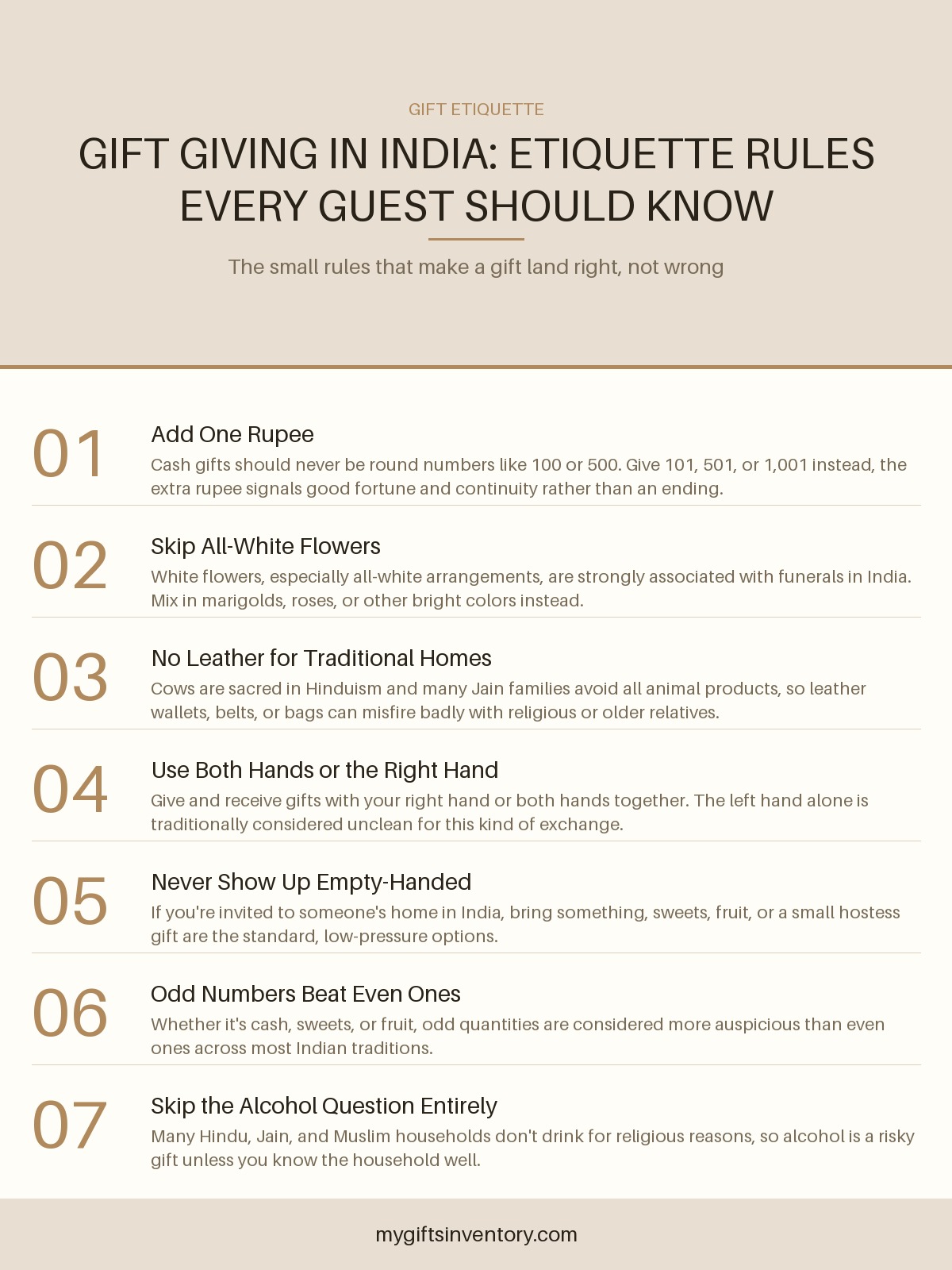
The single most useful thing to know before you give anything in India is the "one rupee more" rule. Cash gifts, and sometimes even the count of sweets or fruits in a basket, are traditionally given in odd numbers rather than round ones. So instead of handing someone 500 rupees, you'd give 501. Instead of 1,000, you'd give 1,001. The extra unit is thought to represent growth and continuity rather than a closed, finished amount, and round numbers can feel abrupt or even unlucky in this context. This shows up constantly at weddings, birthdays, and religious ceremonies, and it's one of those details that signals you actually paid attention.
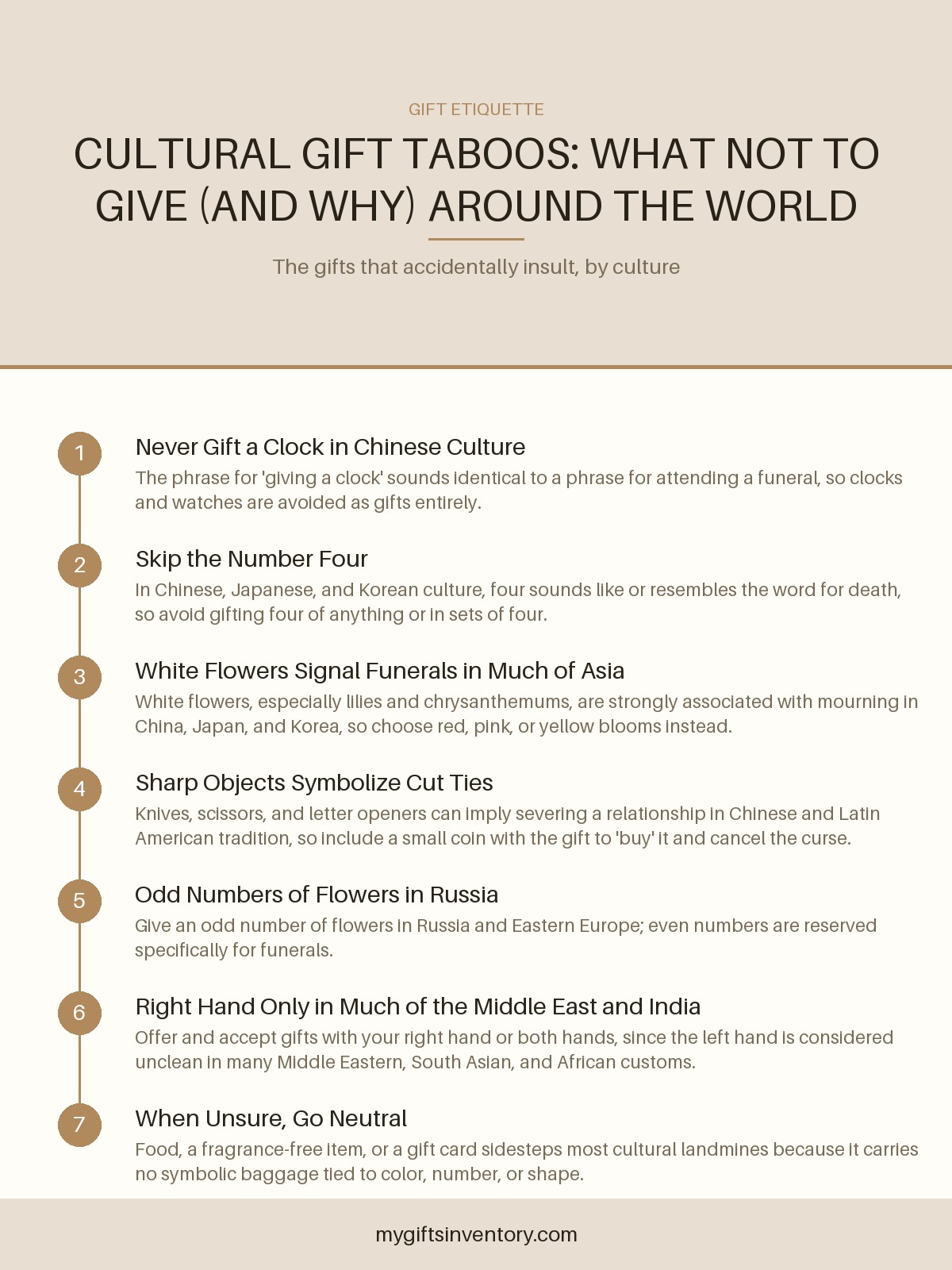
Hand use matters too. Gifts are typically given and received with the right hand, or with both hands together as a sign of respect, rather than the left hand alone, which is traditionally considered unclean for this kind of exchange. It's a small physical habit, but it registers.
Color carries meaning as well. Red, yellow, and green are associated with celebration, prosperity, and new beginnings, which is why you'll see them everywhere in wedding decor and festival gift wrapping. White, on the other hand, is heavily associated with mourning and funerals in Hindu tradition, so an all-white flower bouquet or an all-white gift wrap is worth avoiding, especially for weddings, births, or housewarmings. Black carries a similar association in many households and is often skipped for the same reason.
Gift Giving by Occasion
Weddings
Indian weddings are multi-day, multi-event affairs, and gift-giving is woven through several of them, not just one reception. Cash in an odd-numbered amount, presented in a decorated envelope known as a shagun envelope, is the most common and universally accepted gift, and it's genuinely preferred by most families over a physical item they may not need or have room for. If you'd rather give something tangible, household items, gold or silver jewelry, or high-quality home decor pieces are all traditional choices. If you're weighing something more curated for the couple's new home together, our guide to home decor gifts has options that travel well for this kind of occasion. And if you're gifting the couple down the road for their first anniversary rather than the wedding itself, our anniversary gift ideas by year guide breaks down what tends to suit each milestone.
Diwali
Diwali is arguably the biggest gift-exchange occasion on the Indian calendar, closer in spirit to a combination of Christmas and New Year's than to any single Western holiday. Boxes of Indian sweets, known as mithai, dry fruit assortments, and decorative diyas or candles are the classic gifts exchanged among family, friends, and neighbors. Many households also exchange gift hampers with home goods, snacks, or small decor pieces. The gesture matters more than the size of the gift here, and giving something to essentially everyone in your circle, including household staff and building neighbors, is common practice.
Raksha Bandhan
This festival celebrates the bond between brothers and sisters. Sisters tie a decorative thread called a rakhi around their brother's wrist, and in return brothers traditionally give a gift, often cash in that same odd-numbered format, alongside sweets or a small personal item. It's a warm, low-stakes occasion where thoughtfulness counts more than expense.
Housewarming (Griha Pravesh)
When someone moves into a new home, a housewarming ceremony called griha pravesh often follows, and guests typically bring something for the new house rather than the individual. Sweets, plants, small idols or religious items if you know the family's faith, and practical home items are all appropriate. Sharp objects like knives or scissors are one of the few hard nos here, since they're traditionally believed to symbolize cutting ties or inviting conflict into the new home.
Baby Showers and Naming Ceremonies
Baby-related celebrations vary a lot by region and religion, but small clothing items, silver items like spoons or anklets, and cash gifts are all safe. Silver in particular has strong traditional significance in Indian baby gifting and is rarely a wrong choice.
What to Avoid Giving
A few categories are worth steering around unless you know the household well. Leather goods, wallets, belts, bags, can be genuinely uncomfortable gifts for religious Hindu or Jain families, since cows are sacred in Hindu tradition and many Jains avoid animal products entirely for religious reasons. Alcohol is another one to think twice about. Plenty of Indian households drink socially, but many Hindu, Jain, Muslim, and some Sikh and Christian families don't, for religious reasons, and offering alcohol as a gift can put a host in an awkward spot even if they'd never say so. Sharp objects, as mentioned above, carry a symbolic weight around severing relationships, so knives, scissors, and even letter openers are best skipped as gifts. And if you're bringing food, always ask about dietary restrictions first. Vegetarianism is extremely common across India for religious reasons, and a gift basket with anything containing meat, or even eggs in some strict vegetarian or Jain households, can be more of a burden than a treat.
Money as a Gift, Done Right
Giving cash isn't seen as impersonal in India the way it sometimes is in the West. It's actually one of the most standard and welcomed gifts across nearly every occasion, from weddings to festivals to a child's first day of school. The presentation matters, though. Cash is typically placed in a small decorated envelope, sometimes printed with "Shagun" or festive motifs, rather than handed over loose or in a plain envelope. And again, the amount should land on an odd number, one rupee over a round figure, whether that's 101, 501, or 1,001. If you're sending a gift from abroad and cash or a physical item feels complicated logistically, a digital gift card is an increasingly accepted substitute among younger, more urban Indian families, particularly for something like an Amazon gift card, since Amazon operates widely in India and the recipient can choose exactly what they want.
Corporate and Professional Gift Giving in India
Business gifting in India leans heavily on relationship-building rather than transaction. Diwali is the single biggest occasion for corporate gifts, and companies routinely send hampers of sweets, dry fruits, or branded items to clients, vendors, and employees around that time. The etiquette here is to keep gifts modest and clearly relational rather than lavish, since anything that looks like it's trying to influence a decision can be read as inappropriate or even improper depending on the industry and the company's policies. If you're sourcing something for clients or coworkers with Indian business ties, our roundup of corporate gift ideas under $50 leans toward exactly that register, useful, well-made, and not showy.
Wrapping and Presentation
Presentation carries real weight in Indian gift culture. Bright, festive wrapping in red, gold, green, or yellow is the norm for happy occasions, and many gifts arrive in decorative boxes or fabric wraps rather than plain paper. Ribbons, small bells, or traditional prints are common touches, especially around Diwali. If you're unsure what to use, steering toward warm, saturated colors and away from stark white or black wrapping paper is the safest call, for the same reasons those colors carry mourning associations elsewhere in this etiquette.
When You're Genuinely Not Sure
If you're meeting a partner's family for the first time, attending your first Indian wedding, or invited to a home for a religious occasion you don't know well, the safest move is always to ask a friend from that specific family or community rather than generalize from what you've read, since customs shift by region, religion, and even individual family tradition. Beyond that, a thoughtful, well-chosen gift that isn't trying too hard tends to land better than an expensive one that misses the cultural cues. Our broader guide to choosing the perfect gift walks through how to read a relationship and an occasion correctly, and those same instincts apply here, just filtered through the specific customs above.
Gift Ideas to Go With This


Want more ideas? Browse our full guide: 20 Best Gifts Under $100 (2026): Thoughtful Picks They'll Actually Use
Frequently Asked Questions
Is it rude to give a round number of money as a gift in India?
It's not considered rude exactly, but it's seen as less auspicious than an odd number. The custom is to add one rupee to a round figure, so 500 becomes 501 and 1,000 becomes 1,001, since the extra unit symbolizes continued growth rather than a finished amount.
Should I bring a gift when visiting an Indian family's home for the first time?
Yes, showing up empty-handed is generally considered impolite when visiting someone's home in India. Sweets, fruit, or a small box of dry fruits are the classic, low-pressure choices that work regardless of the family's religion or region.
Can I give flowers as a gift in Indian culture?
Flowers are perfectly fine, but avoid all-white arrangements since white flowers are strongly associated with funerals and mourning in Indian tradition. Marigolds, roses, and mixed bright colors are the safer, more celebratory choice.
Is it okay to give alcohol as a gift in India?
It depends heavily on the household, so it's worth thinking twice unless you know them well. Many Hindu, Jain, and Muslim families don't drink for religious reasons, and offering alcohol can put a host in an uncomfortable position even if they never say so directly.
What's the etiquette around opening gifts in front of the giver?
In many traditional Indian households, gifts aren't opened immediately in front of the giver, though this has loosened considerably in urban and younger households. If you're unsure, follow the host's lead rather than assuming either way.
Looking for an Actual Gift Instead?




Gift Sets We Love Right Now
Every item picked, priced and linked, ready to buy.



More Gift Advice