How to Return a Gift Without Offending Anyone: Scripts, Timing & Store Policies
There's a right way to return a gift you can't use, and it usually comes down to timing, a little white lie, and knowing the store's policy before the return window closes.
As an Amazon Associate, My Gifts Inventory earns from qualifying purchases. We only recommend products we'd genuinely consider buying ourselves.
You opened the box, smiled, said thank you, and now the sweater sits in your closet with the tags still on and the receipt nowhere in sight. Returning a gift feels like a small betrayal of the person who gave it, which is exactly why most of us just leave it in a drawer for a year and then quietly donate it. But there is a middle path that keeps the relationship intact and gets something you'll actually use out of the exchange, and it mostly comes down to timing, wording, and knowing the store's rules before you walk in the door.
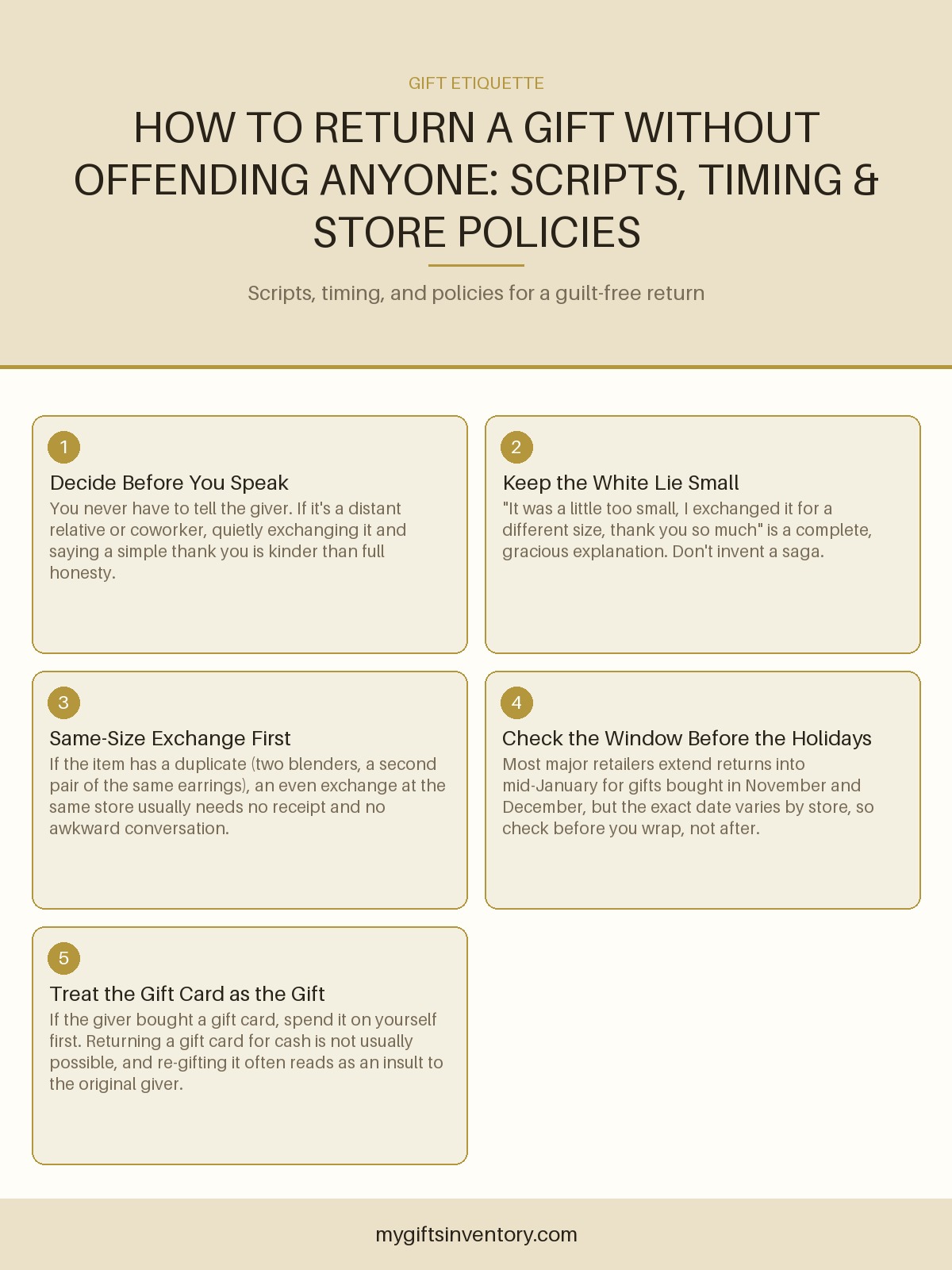
First, decide whether the giver ever needs to know
This is the question that drives all the anxiety, and the honest answer is that in most cases they don't. If a coworker, a distant aunt, or a friend-of-the-family gave you a candle you're never going to light, the kindest move is to thank them warmly when you receive it and handle the exchange on your own. Telling the giver that you didn't like their present buys you nothing except a slightly bruised moment.
The calculus changes with people who are close to you and likely to notice. A partner, a parent, or a sibling who will ask "where's the thing I got you?" next month deserves a gentle heads-up rather than a discovery. In those cases, keep the explanation short and lead with the thought, not the item.
When to tell the giver
Tell them if any of these are true: they gave something expensive, they gave something personalized, they'll see you use (or not use) it regularly, or they bought it somewhere easy to exchange and would probably offer to help. Telling them looks like this: "I love that you thought of me. I tried it on and the fit isn't quite right. I'm going to swap it for the next size up, and I wanted you to know rather than wonder where it went."
Don't tell them if the gift came from a professional relationship, a secret santa, a gift exchange at work, or someone you see two or three times a decade. Quiet exchange, loud thank-you.
What to actually say
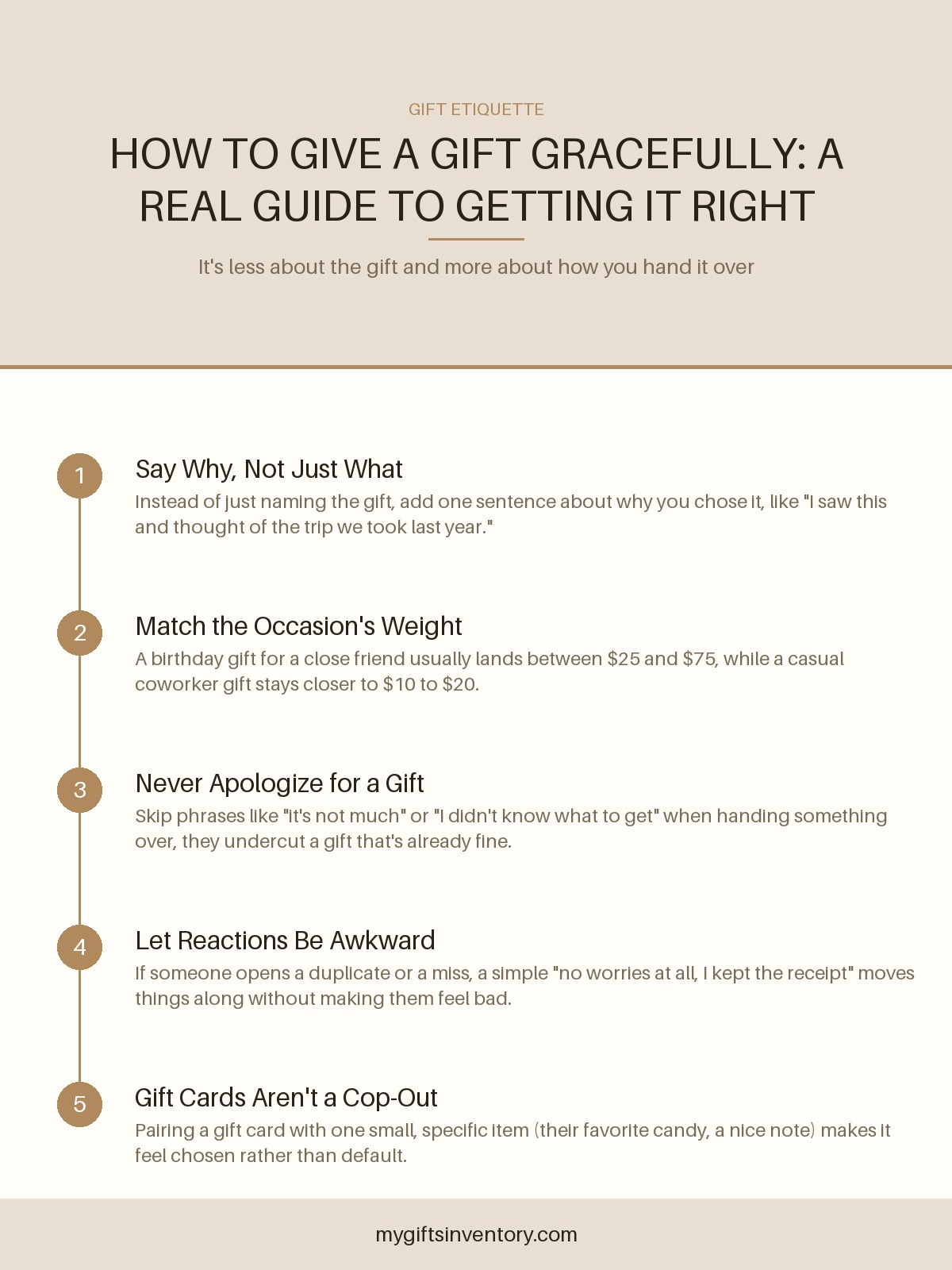
The single best sentence template for almost any gift return is: "Thank you so much for [specific thing]. It ended up [small practical reason, not aesthetic complaint], so I exchanged it, and I'm so grateful." That's it. No over-explaining, no apology spiral, no suggestion that they made a bad choice. The gift was thoughtful; the fit was off; the relationship is fine.
Avoid anything that reads as a critique of the item itself. "It's not really my style" lands as rejection. "I already have something very similar" lands as "you don't know me." A neutral, factual, slightly boring reason goes down easiest because it gives the giver nothing to defend.
Sample scripts by situation
For a partner: "I'm obsessed with the color, and it's a little small. Can we go together and swap it Friday? I want to make sure I actually wear it."
For a parent: "That's so generous. The size isn't right for me, and I didn't want to sit on it. I'm going to exchange it this week and I love you."
For a friend: "Thank you for the earrings. I already have a pair almost exactly like them, so I'm going to trade them in for the necklace from the same line. You have great taste, clearly."
For a coworker: "Thank you so much, this is so thoughtful." Full stop. There is no version of an office gift exchange where announcing you're returning the item helps anyone.
The store side: policies, windows, and receipts
Before you say a word to anyone, find out whether the return is even possible. That's the part most people skip, and it's where the awkward moments actually come from. Stores have wildly different rules on how long you can return something, whether a gift receipt is required, and whether the refund goes back to the original payment method or onto a store credit.
Your checklist, in order:
- Look for a gift receipt. It's a slip that shows the price but hides the buyer's payment information, and it's the single easiest way to make a gift return. If you find one, has it already expired?
- Check the return window. Standard policy at many large retailers is 30 to 90 days from purchase, with extended windows for gifts bought during the holiday season. The extended dates usually run into mid-January, but they change every year and vary by store, so check the retailer's site rather than assuming.
- Know what happens without a receipt. Many stores will accept the item for store credit at the current selling price or the lowest recent price, which can be significantly less than what was paid. If the item looks like it has been used, or is missing the packaging, the store can refuse even with a receipt.
- Bring ID. A surprising number of retailers log returns against your driver's license or state ID, and they may cap how many no-receipt returns you can make in a given period.
If the item is from a specialty store
Smaller boutiques and specialty retailers tend to be more flexible in person and less flexible in writing. If the giver bought from a local shop or an independent maker, calling ahead to ask about their policy is worth a five-minute phone call. Some won't accept returns at all, only exchanges, and some will only issue store credit. Knowing that before you drive over saves you a frustrating trip.
And if the gift was a gift card you won't use, that's a different problem. Most retailers won't convert a gift card back to cash, and many cards carry expiration dates or inactivity fees. Before you re-gift a card, check the balance so you're not handing over something partially spent or expired: for example, our guide to checking a Trader Joe's gift card balance walks through exactly where to look. The same approach applies to almost any brand.
When the gift is a duplicate
Duplicates are the easiest category, and the least offensive. Two people independently bought you the same blender, or the same cookbook, or the same pair of running shoes. The gift was clearly a good idea, which is why it happened twice, and the giver usually finds that reassuring rather than insulting.
In these cases, an even exchange at the store where the second one was purchased is usually painless, and many stores will accept the item for credit at its current price with no receipt required. If the store happens to be out of something better, this is also where you get to nudge toward a gift you actually wanted. Our roundup of the best baking gifts is a good example of a category where duplicates are common, since stand mixers and sheet pan sets get bought by well-meaning relatives over and over. Knowing that ahead of time can save everyone a return trip.
The regift question
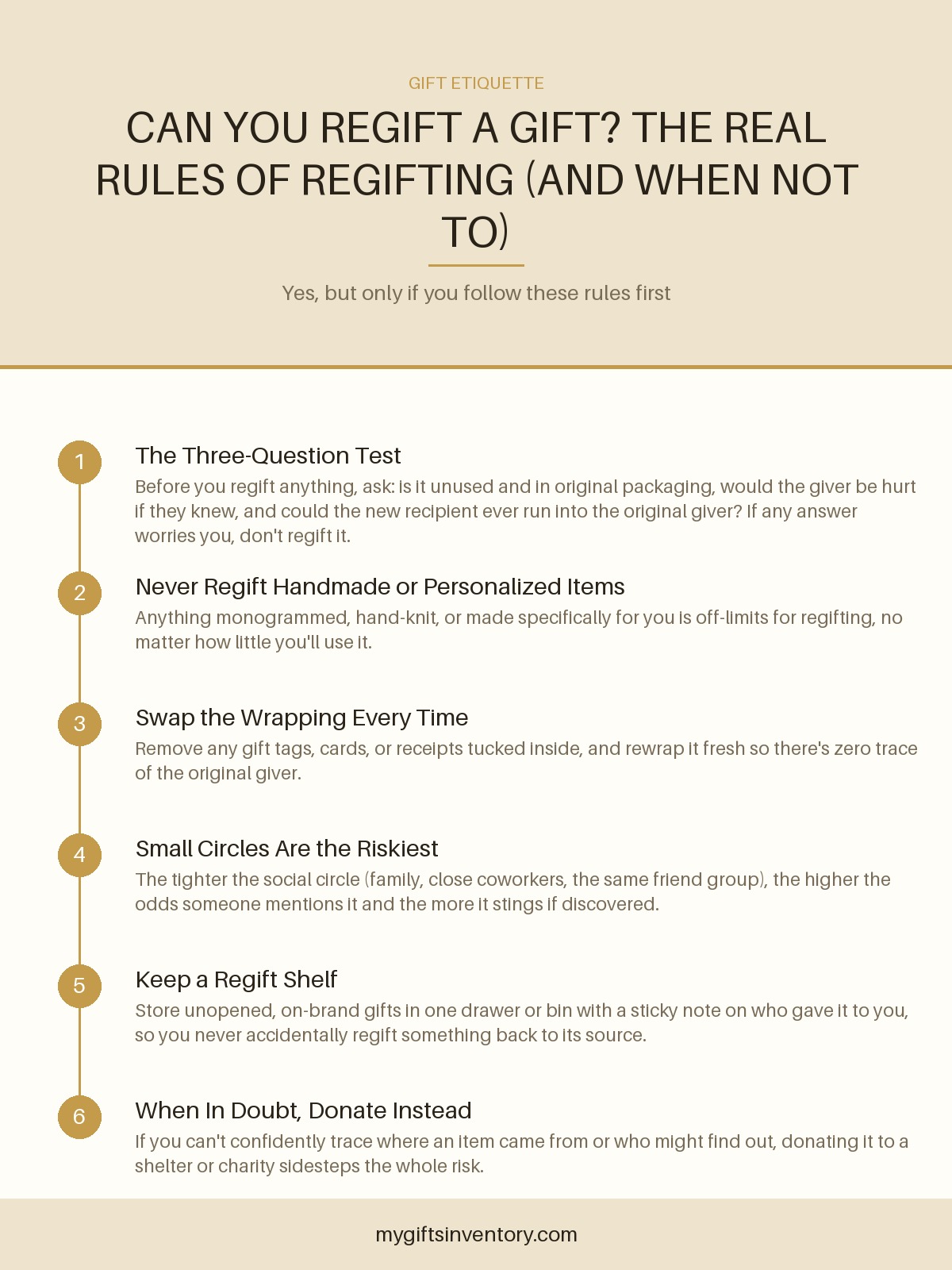
We won't pretend regifting never happens. Sometimes another person in your life will genuinely love a gift you couldn't use. But a few guardrails keep regifting from becoming an insult. The item should be new and in its original packaging. It should go to someone far outside the giver's social circle, ideally in a different city or a different part of your life. It should not be personalized, engraved, or handmade. And if you have any doubt that the original giver could ever cross paths with the recipient, don't do it. A donation with a clear conscience is often the better move.
Timing matters more than wording
The one rule that prevents most hurt feelings is this: don't wait. A gift exchanged three weeks after you receive it reads as a practical errand. The same gift exchanged nine months later, after the return window has closed and the giver asks where it went, reads as deception. If you're going to return, do it while the item is still in season and the story is simple.
The second timing rule is about when you speak, not when you return. Never bring up a return at the moment of gifting. Thank them, enjoy the moment, and if a conversation is needed, have it a few days later in a quieter setting, out of earshot of anyone else. That one adjustment alone spares most gift-givers the public embarrassment that makes returns feel cruel.
What if the giver is a gift-giver who will be hurt no matter what
Some people tie their identity to their gifts. A parent who gives you a coat every year and wants to see you in it, or a friend who puts enormous thought into a personalized gift, may take a return personally even when you handle it perfectly. In these cases, the return is not worth the relationship. Keep the item, use it occasionally, and let it do its job. If you truly can't use it, quietly donating it later and mentioning that you "passed it along to someone who needed it" is a softer landing than the word "return." Gifts are gestures first and objects second.
Better gift-giving, so returns happen less often
The most elegant solution to a gift return problem is to give things that are easy to return in the first place. The next time you're on the giving end, favor items that come with easy exchange policies and universal appeal. Our guides to gifts for runners and aromatherapy diffuser gifts both include a mix of universally useful items where the recipient is unlikely to need to swap anything. When in doubt, a gift card to a store you know they love beats a specific item they might not need. If that card goes unused, at least it's a problem the recipient can solve without talking to you, and our guides like this one on checking a Spotify gift card balance can help them get the value out of it.
Gift Ideas to Go With This


Want more ideas? Browse our full guide: 20 Best Gifts Under $100 (2026): Thoughtful Picks They'll Actually Use
Frequently Asked Questions
Is it rude to return a gift?
Returning a gift is not rude. Being caught hiding it or lying about it is what creates hurt. Exchanging an item you can't use, quietly and without commentary, is a normal part of gift-giving and almost no one is offended by it as long as the thank-you was genuine.
Do I need to tell the person I returned their gift?
Usually no. Tell a partner, parent, or close friend who will notice the item is gone, and skip the conversation for coworkers, casual acquaintances, and gift-exchange participants. A warm thank-you covers the etiquette in both cases.
Can I return a gift without a receipt?
Yes, at many large retailers, but usually for store credit rather than cash, and often at the current or lowest recent selling price. You may need to show ID, and some stores limit how many receiptless returns you can make in a year. Policies vary, so check the retailer's site first.
How long do I have to return a gift?
Standard windows at major retailers range from about 30 to 90 days from the purchase date, with extended windows for holiday gifts that often run into mid-January. Check the specific store's policy online before you go, since the exact cutoff changes year to year.
What should I do with a gift card I won't use?
Check the balance first, since you may be able to give it to someone who will use it or spend it on something small you can put to use. Most gift cards can't be converted to cash, and re-gifting one that has been partially spent or is nearly expired can cause more awkwardness than it solves.
Looking for an Actual Gift Instead?
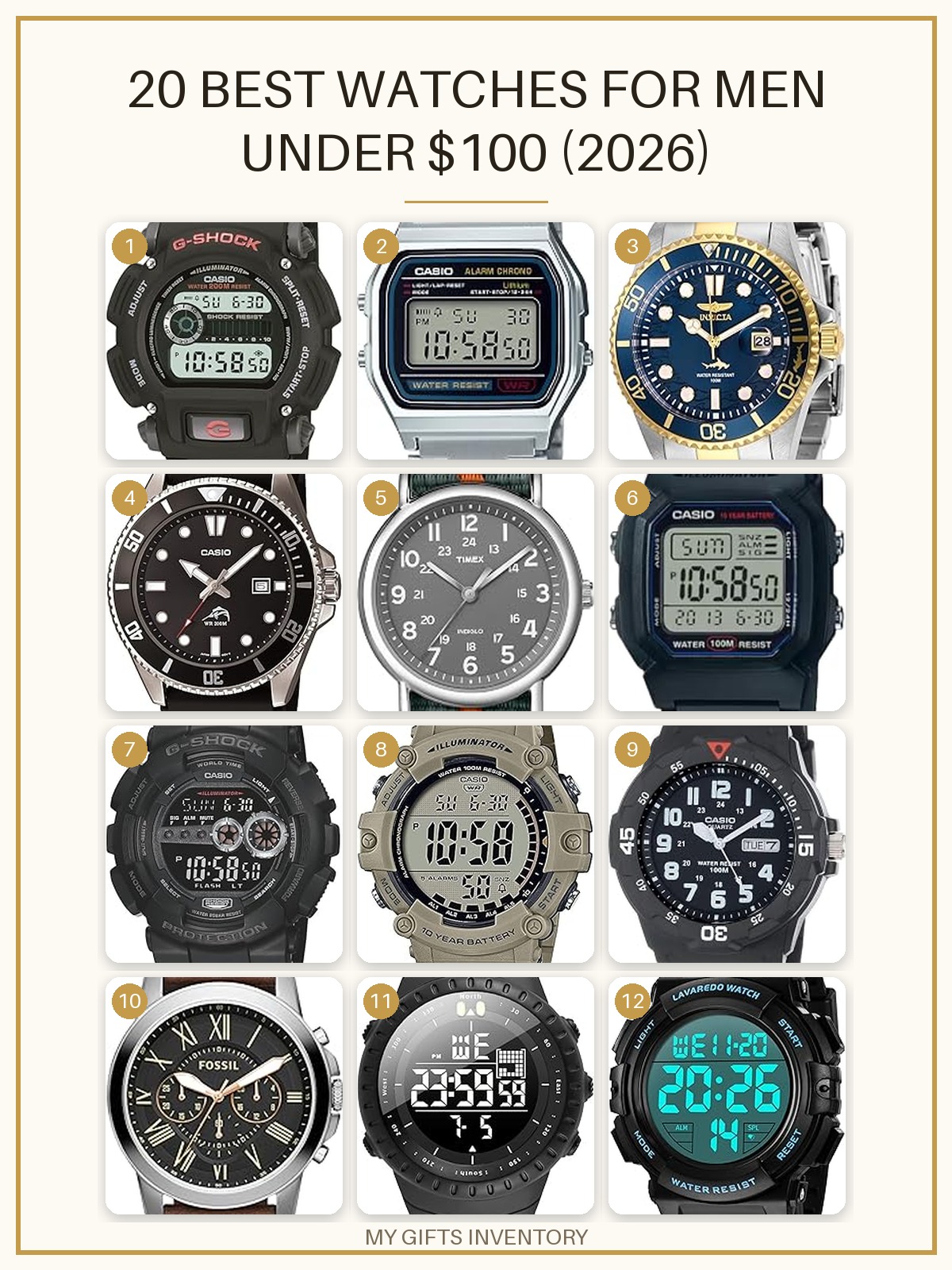
Gift Sets We Love Right Now
Every item picked, priced and linked, ready to buy.

More Gift Advice