Regifting Etiquette Rules: When It's Fine, When It's Tacky, and How to Do It Right
Regifting gets a bad reputation, but done thoughtfully it can be generous rather than lazy. Here are the rules we actually follow, from the one-item test to the card wording that keeps things warm.
As an Amazon Associate, My Gifts Inventory earns from qualifying purchases. We only recommend products we'd genuinely consider buying ourselves.
Nobody wants to admit they regift. And yet almost everyone does it, usually at 11 p.m. the night before a party, standing in the closet with a candle that does not smell like their house. The question behind this search is almost never "is regifting morally okay?" It is usually something much more specific: is this particular object, going to this particular person, actually fine, or is it the kind of thing that gets talked about later? Here is how we think through it. Short version: regifting is a tool, and tools are only tacky when they are used badly.
The honest case for regifting
An unwanted gift that sits in a closet is waste. A candle, a bottle of wine, a scarf, a coffee table book, a gift card with money still on it. These things have value, they just landed with the wrong person. Moving an unwanted item to someone who will actually use it is not stingy. It is a second chance for the object and a real gift for the recipient, provided you do it with actual care.
The problems start when regifting becomes the easy option instead of the thoughtful one. The difference between the two is not complicated, but it is also not invisible, and people on the receiving end usually know which one they got. The rules below are how we keep on the right side of the line.
The hard lines: never do these
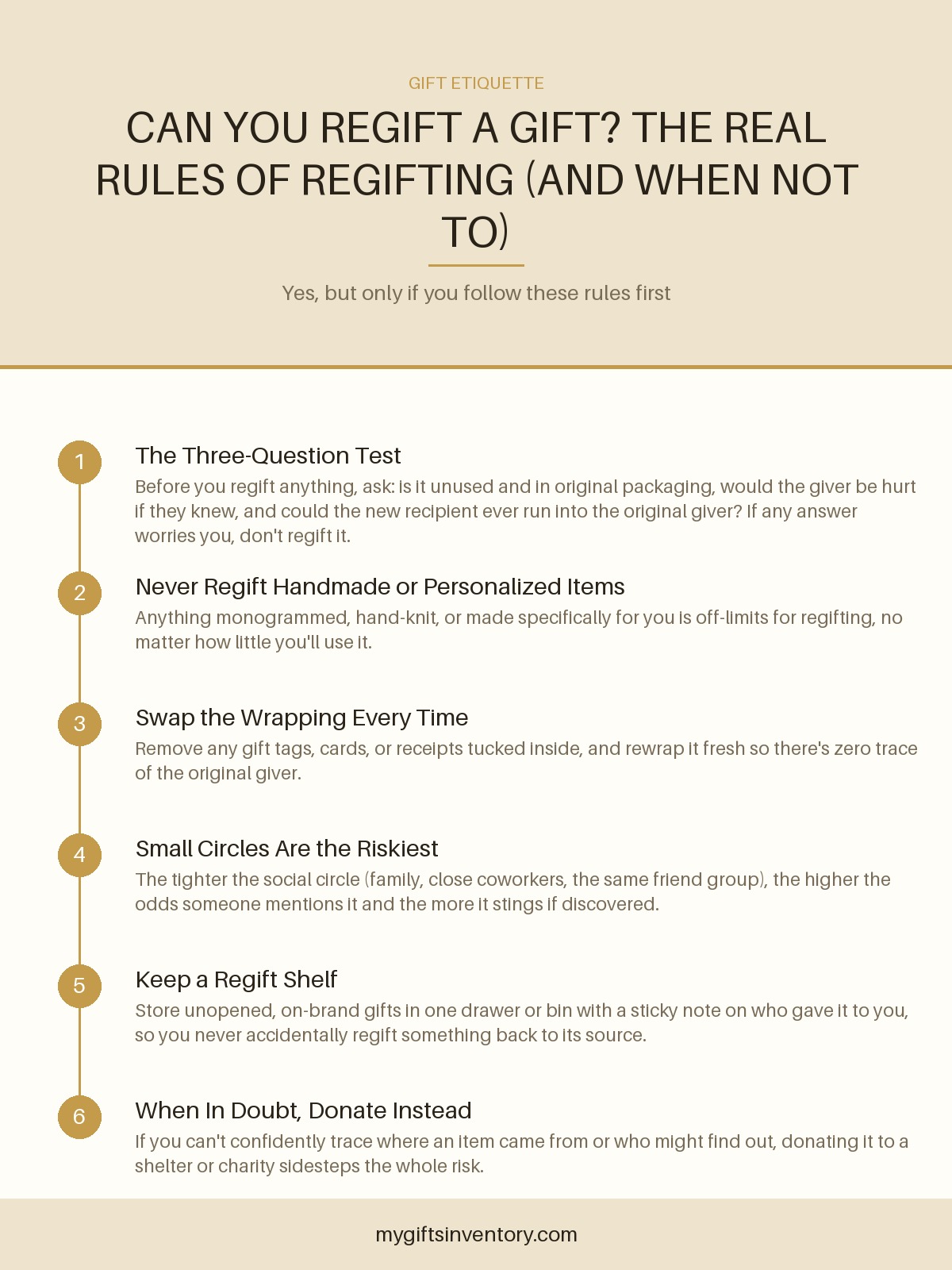
Never regift to the person who gave it to you
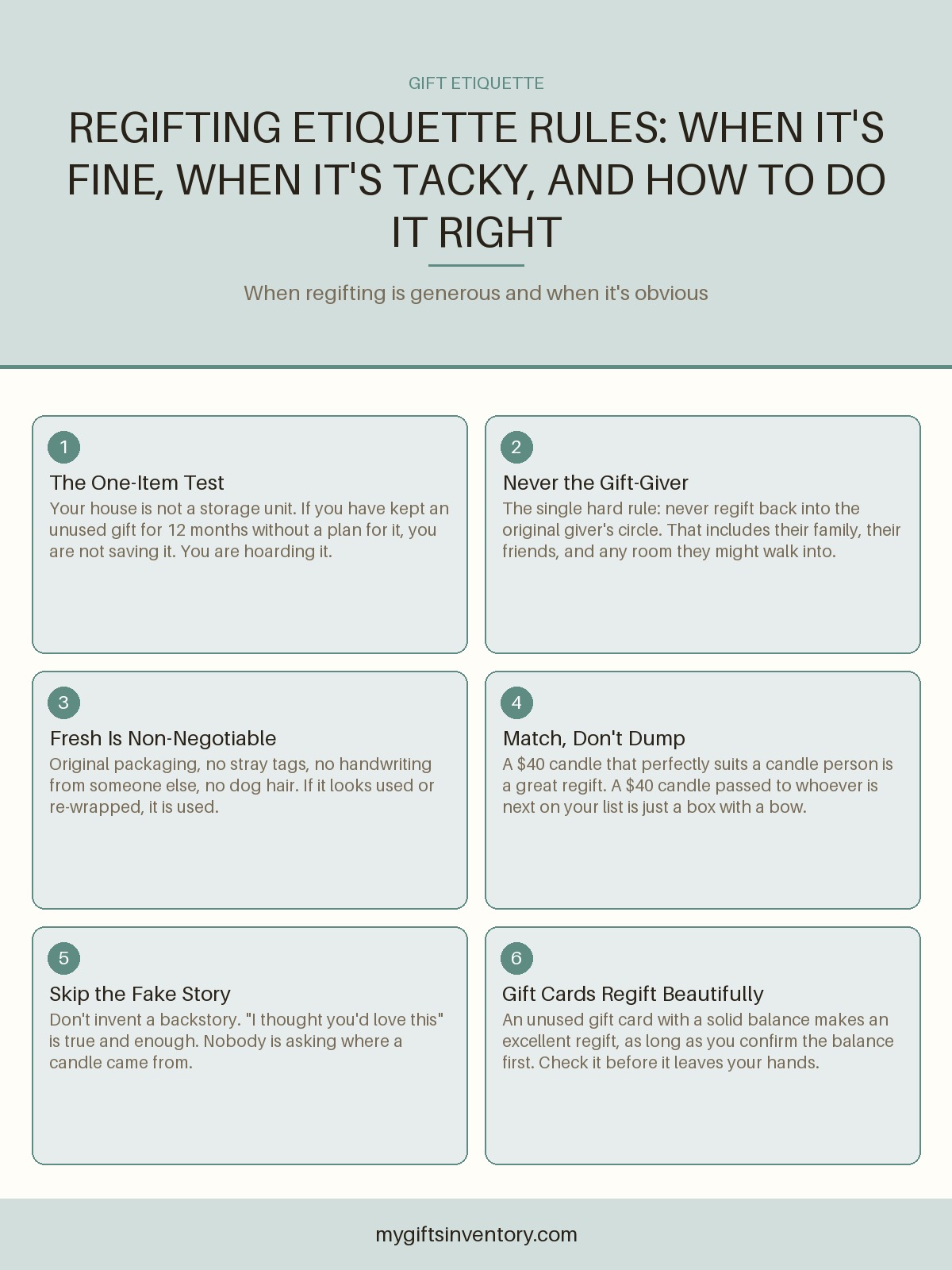
This sounds obvious and people still do it. The rule is broader than just the original giver. Do not regift back into the giver's circle, meaning their spouse, their siblings, their close friends, and anyone they might talk to at the next holiday party. If there is any chance the original giver will see the item on someone else and recognize it, it is not a regift candidate. This is the one rule we treat as non-negotiable.
Never regift something that looks used
Original packaging, no stray price tags, no handwritten note still inside, no dog hair on the box, no candle wick that has been lit once. If it looks like it lived at your house for a while, it did, and the recipient will notice. A slightly crumpled box is a small deal. A used item is a big one. If you have to smooth something out or tape it shut again, pick something else.
Never regift a personalized item
Monograms, engraved anything, photo frames with someone else's face, a book signed "to Sarah, with love." Custom items cannot be regifted; they can only be donated or returned, and even returning can be a whole thing. If your name is on it and the item is not something you want, the correct move is usually the donation bin, not the gift pile.
Never fake a story
You do not need a cover story. Do not invent a "I saw this and thought of you" when you did not. The card line we use is some version of "thought you would like this" or "this seemed like your kind of thing," which is true without claiming you spent a weekend shopping for it. If someone directly asks where it came from, a light "oh, it crossed my path and I thought of you" is enough. No one is running a forensic investigation into a bar of soap.
Gift swaps are where regifting gets complicated fast, because the whole point is anonymous and the stakes are low. If you need a genuinely safe starting point for a party like that, our white elephant and gift exchange ideas under $30 are a realistic place to look before you raid the closet.
The one-item test (and the twelve-month rule)
Before anything becomes a regift, it has to pass a simple check. Ask yourself: if this item were on a shelf at a store where the recipient happened to be shopping, would they pick it up and buy it with their own money? If the honest answer is yes, it is a candidate. If the answer is "well, it is a nice thing and it needs a home," it is not a gift, it is logistics.
The twelve-month rule is the backup test. If an unused gift has sat in your house for a year and you still do not have a plan for it, it is not being saved. It is being stored. At that point regifting, donating, or returning it is the correct move for everyone. Keeping it is not generous, it is just clutter with a nicer name.
Match the item to the person, not the person to the item
This is where most bad regifts happen. The lazy move is to look at the pile of unused gifts and figure out which one fits the next event. The good move is to think about the recipient first, then check whether anything in your regift pile actually suits them. A $40 candle that is perfect for a candle person is a great regift. A $40 candle that gets passed to whoever is next on the list is not thoughtful, it is a box.
To give you a sense of where regifts go wrong: if you are regifting a teen or a young adult, they will almost always know. Younger recipients are the fastest to spot a regift, and the most likely to be hurt by a bad one. If you are short on time and genuinely unsure, a small, sharp, specific gift lands better than an expensive item that clearly was not chosen for them. This is where browsing with the recipient's actual interests in mind genuinely helps, and it is the approach behind our gifts for 20-year-old young women guide. Same idea applies to the teenage years. Our gifts for 13-year-old teen girls list is a useful reference for what younger recipients actually want, which is usually not "whatever was in the closet."
The gray zone: when it's fine, when it's not
Fine to regift
Unopened wine, candles, boxed chocolate, bath and body sets still in the shrink wrap, unopened coffee and tea, kitchen gadgets you already own, board games still in the cellophane, unused gift cards with a confirmed balance, books that were never opened and are not inscribed. Matching linens and dishware where you already have a set. Small electronics still sealed in the box.
Not fine to regift
Anything personalized, any food that is homemade (it cannot be regifted, but "oh, I made too much, take some" is its own thing), anything used even slightly, anything that has clearly been displayed, anything that was a gift from someone in the recipient's circle, and anything that comes with a note or card still inside from the original giver.
The special case of gift cards
An unused gift card is one of the cleanest regifts there is. It is small, it is genuinely useful, and nobody thinks twice about it. The one piece of etiquette to follow: check the balance before you give it. A card you think has $50 that turns out to have $8 is worse than no card, and the recipient finds out at the register. We have a whole library of balance checks, including Victoria's Secret / PINK and Spotify, if the card in your drawer is for either brand. Those two pages walk through how to check a balance quickly so you are not handing over a mystery card.
How to regift without it showing
When a regift is going to happen, the wrapping and the card do the heavy lifting. This is where the whole thing succeeds or fails, and it is also where you can either put in ten minutes of real effort or skip it and take your chances.
Wrapping and presentation
Rewrap it. Properly. Fresh paper, a clean box if the original box is dented, a new ribbon. Remove every trace of the original wrapping, including any tag or sticker the giver left on. If the item is the kind of thing that comes with a bag from a specific store, use a plain gift bag instead. You do not need to spend $30 on packaging for a regift, but you do need the item to look like someone chose it for this person and this occasion. A wrinkled, reused bag from another event is a tell, and a cheap tell at that.
Wording for the card
The card should be warm and short. Do not over-explain. Do not mention the item's origin. Here is the wording we actually use:
- For a friend: "Saw this and thought of you. Hope it's a good one!"
- For a coworker: "Thank you for everything this year. This seemed like your kind of thing."
- For a family member: "Happy birthday. I hope this is something you'll actually use. Love you."
- For a host or hostess: "For the house, and for you. Thanks for having us!"
- For a gift exchange with a limit: "Merry merry. Hope this one's a winner."
Notice that none of these are confessional. You are not claiming you drove to a store, and you are not admitting you did not. You are simply being kind and direct. That is the whole tone.
When regifting is actually the wrong call
There are moments where the correct answer is to buy something, or to not give anything, and regifting quietly is a bad idea. Weddings and showers with registries are one. If the couple took the time to make a registry, the gift should come from it or be genuinely thoughtful, not a leftover. Big milestone occasions (a 40th, a retirement, a graduation) are usually the same. If the relationship matters and you know the gift will be remembered, the regift needs to be genuinely excellent, not merely convenient.
Gifts for a partner or spouse fall into the same category. A regifted item there is rarely worth the risk, and most people would rather get something small and clearly chosen for them than something nicer with a faint "wait, where have I seen this?" energy. The safest rule is this: the closer the relationship, the less room there is for regifting, and the more it has to be a true match to be worth doing.
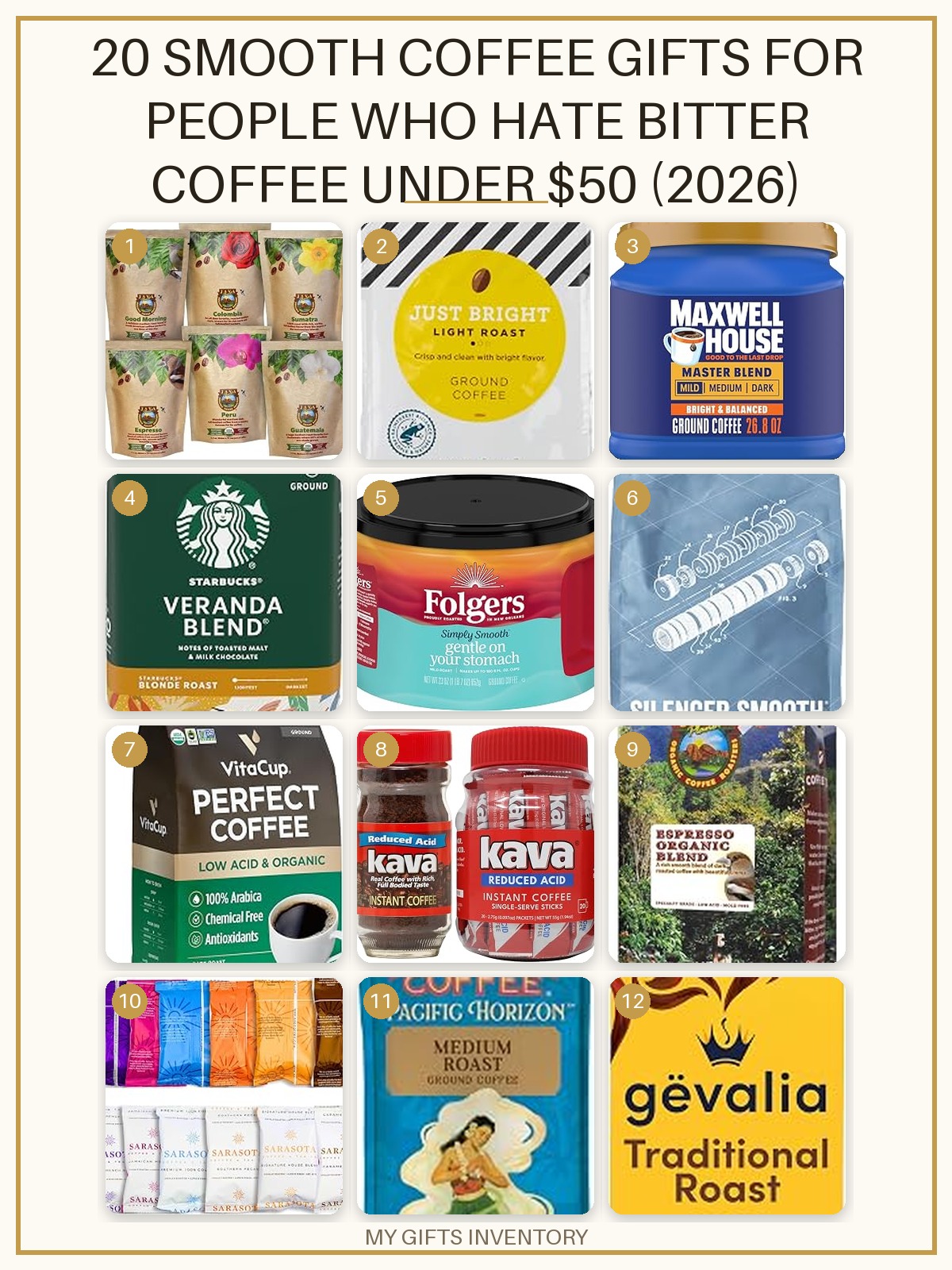
On the reverse side, when you are choosing gifts to give in the first place, thinking about what the person actually wants reduces the regift problem entirely. If you are shopping for a golfer, or someone who lives in coffee, there are guides designed to keep you out of the "generic gift" pile. Our golf gifts for him and our smooth coffee gifts under $50 are both examples of the kind of shopping that solves the problem before it starts, so nothing needs to be regifted next December.
A quick working checklist
Before anything goes in a gift bag, run through this. It takes about thirty seconds and catches most mistakes.
- Is the item new, unused, and unpersonalized?
- Would this person actually buy it for themselves?
- Is there any chance the original giver will see it?
- Has it been living in the closet for more than a year?
- Is there a gift card hiding in a drawer that would work better, and have I checked the balance?
- Does it look like it was wrapped with care, not recycled with a sigh?
- Is the card warm and honest and free of invented backstory?
If every answer is the right one, you are good. Regifting is not sneaky, and it does not need a confession. It just needs to feel like a gift, not like a cleanout.
Gift Ideas to Go With This


Want more ideas? Browse our full guide: 20 Best Gifts Under $100 (2026): Thoughtful Picks They'll Actually Use
Frequently Asked Questions
Is it rude to regift?
No, it is not rude to regift when the item is new, fits the recipient, and is wrapped and presented with real care. It becomes rude when the regift is obviously a way to avoid shopping, when it goes back into the original giver's circle, or when the recipient can tell the item was not chosen for them. The etiquette is in the execution, not the act itself.
Can you regift a gift card?
Yes, an unused gift card is one of the most acceptable regifts there is, as long as you check the balance before you hand it over. A card that turns out to be mostly depleted is worse than giving nothing, because the recipient finds out at the register. Check the balance first, then present it in a fresh card or a plain envelope.
How do you regift without getting caught?
The most reliable way is to follow the hard rule: never regift back to the original giver or anyone in their circle. Beyond that, rewrap it cleanly, remove every tag and sticker from the first giving, do not invent a backstory, and keep the card line simple. Most regifts that get noticed were noticed because of presentation, not detective work.
What is the one-year rule for regifting?
The idea is that if an unused gift has sat in your home for about a year with no plan, it is not being saved, it is being stored. At that point, regifting, donating, or returning it is the reasonable thing to do rather than letting it sit longer. The year is a guideline, not a law, but it is a genuinely useful nudge.
Should you tell someone you regifted their gift?
Generally no, and especially not the original giver. The kind thing is to let the second recipient receive it as a gift without ceremony, and to let the original giver live without a weird detail. If someone directly asks where an item came from, a light "it crossed my path and I thought of you" is enough. Confessing to a regift is almost never the good move.
Looking for an Actual Gift Instead?
Gift Sets We Love Right Now
Every item picked, priced and linked, ready to buy.
More Gift Advice