Regifting Etiquette: When It's Okay and How to Do It Right
Regifting can feel awkward, but with clear rules it saves money and keeps good gifts in circulation. Here's exactly when it works, when it backfires, and how to pull it off without anyone knowing.
As an Amazon Associate, My Gifts Inventory earns from qualifying purchases. We only recommend products we'd genuinely consider buying ourselves.
We've all been there: a perfectly nice candle, scarf, or kitchen gadget arrives, and you already own three just like it. The guilt hits fast. Is it rude to pass it along? Will someone find out? We wrote this because that exact knot in the stomach is why people search for regifting etiquette right before the holidays, birthdays, or office gift exchanges. The short answer is that regifting can be kind and practical when you follow a few non-negotiable rules. Done wrong, it becomes a story people tell for years.
Below we lay out the real boundaries, the step-by-step process that keeps you safe, specific scenarios that trip people up, and cleaner alternatives when regifting simply isn't worth the risk. No judgment, just clear guidance so the gift still feels thoughtful.
The Core Rule of Regifting Etiquette
Regifting is acceptable when three conditions are all true at the same time: the item is brand-new and unused, it genuinely suits the new recipient better than it suited you, and there is zero realistic chance the original giver and the new recipient will ever compare notes. If any one of those fails, stop and choose something else.
We treat regifting as a quiet act of matching the right object to the right person rather than a sneaky way to clear clutter. The moment it feels like unloading junk, it stops being etiquette and starts being disrespectful. Keep the spirit generous and the logistics airtight.
When Regifting Is Perfectly Fine
Certain situations make regifting almost the thoughtful choice. Duplicate wedding gifts, extra hostess presents from a party you attended, or an unopened bottle of wine that doesn't match your taste are classic green-light cases. The same goes for generic items that many people enjoy: nice candles, quality kitchen towels, a stylish notebook, or a small plant that never got planted.
White-elephant or Yankee-swap leftovers that you know someone else will love also work, provided the group is large and the original source is anonymous enough. Office Secret Santa gifts that missed the mark for you but would delight a coworker in another department can move along cleanly. The key is that the new person would reasonably believe you selected it with them in mind.
If the item is something you would happily buy new for this person, and it happens to already be sitting in your closet still sealed, you're on solid ground. That mental test keeps the gift from feeling recycled in a negative way.
Good candidates we often see work
- Unopened beauty or bath sets that simply aren't your scent
- Kitchen gadgets still in the box when you already own the same model
- Books you have already read or that fall outside your interests
- Home goods such as throws, frames, or decorative objects that clash with your style but would suit someone else's
- Gift cards to stores or restaurants you never use (more on those later)
In these cases the original giver's intention of giving something nice is still honored; you're just completing the match.
When You Should Never Regift
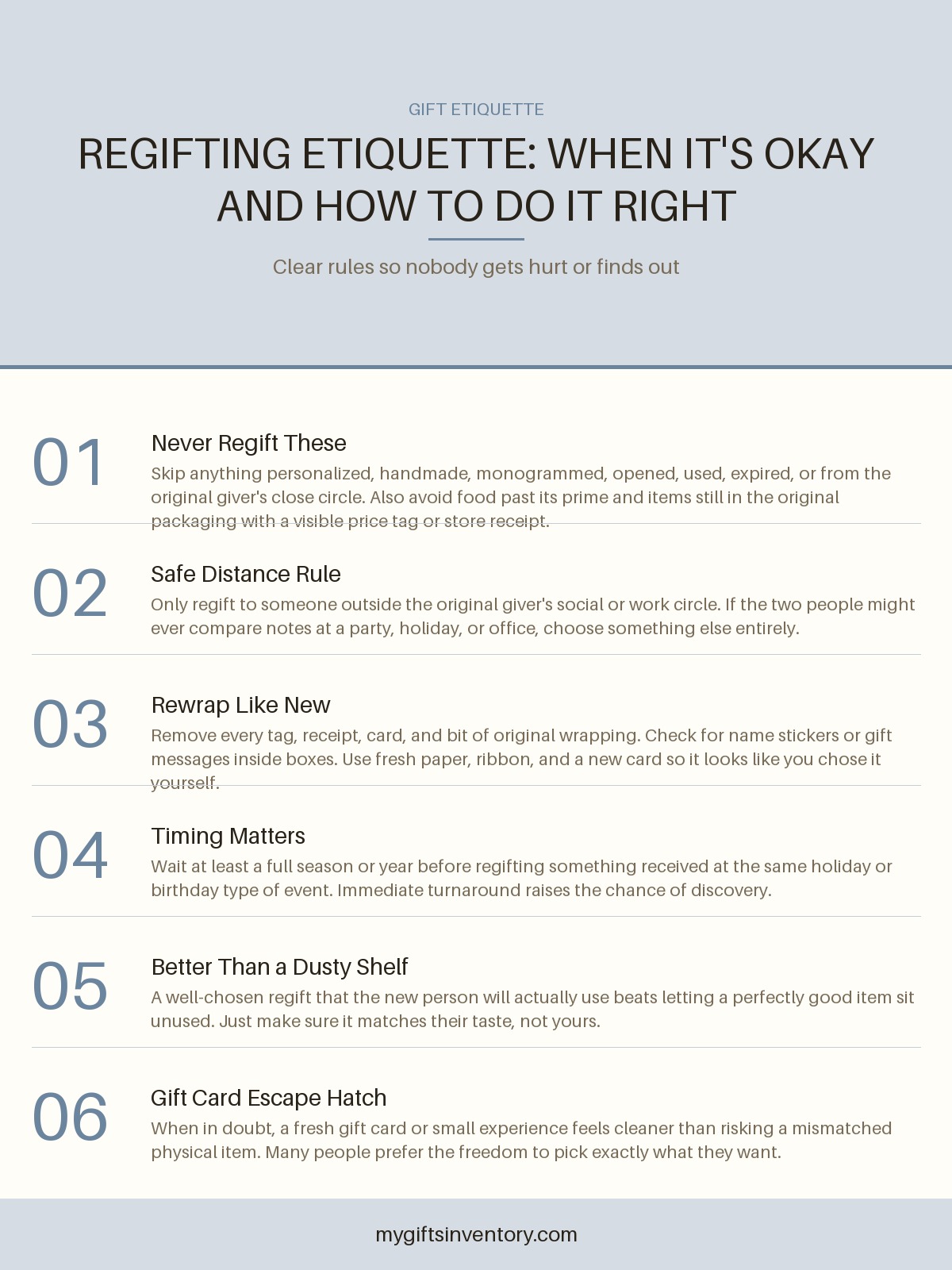
Some items carry too much personal weight or too much discovery risk. Never regift anything that was handmade, monogrammed, engraved, or clearly customized. A sweater knit by an aunt or a photo frame with a family picture inside is off-limits forever. The same applies to anything the original giver put real creative effort into.
Also skip anything that has been opened, used, worn, tasted, or partially consumed. Even if you carefully resealed it, the risk of someone noticing a missing piece or a used edge is too high. Expired food, candles that have been lit once, or cosmetics past their date are automatic noes.
Stay away from gifts that came from someone in the same social circle, workplace, extended family, or neighborhood. If there is any chance the two people will stand next to each other at a barbecue, school event, or holiday party and mention gifts, choose a different path. The awkwardness is never worth the few dollars saved.
Finally, never regift something you received very recently from the same type of occasion. Turning around a Christmas gift the following December or a birthday present three months later raises the odds of recognition dramatically. Let a full season or more pass at minimum.
How to Regift Without Getting Caught
Execution matters as much as the decision. Start by inspecting the item completely. Remove every original tag, price sticker, store bag, tissue paper, ribbon, and gift message. Look inside boxes, under lids, and in pockets for forgotten cards or name labels. If the packaging itself has the store name or a telltale look, consider transferring the item to plain new packaging when it makes sense.
Rewrap everything from scratch with paper, ribbon, or a bag that looks current and intentional. A fresh card is non-negotiable. Write a short, warm note that focuses on the recipient rather than the object. Something like "Saw this and immediately thought of your new place" or "Knew you'd put this to better use than I ever would" works when it is true. Avoid vague lines that sound like filler.
Store the item somewhere you will not accidentally pull it out in front of the original giver. Keep a quiet mental or written note of who gave you what and when so you never hand it back to the wrong person or their close friend years later. We have all heard the horror stories; a simple list prevents them.
Present the gift with the same warmth you would give something you bought that morning. Hesitation or over-explaining can signal that something is off. Confidence and a genuine smile do more work than perfect wrapping.
Real-Life Scenarios and How to Handle Them
Family holidays
Family is the highest-risk zone because people talk and memories are long. If your sister gave you a vase you hate, do not pass it to your cousin who sees her every month. Better to donate it or keep it in a closet. Distant relatives or in-laws who live across the country and rarely cross paths with the original giver are safer, but still double-check the social map.
Office and coworker gifts
Office cultures vary. In large companies with multiple floors or departments, a generic item can sometimes move quietly. In small teams or open-plan offices, skip it. The break-room conversation about "who got what" happens faster than you think. When the gift is a near-miss, a simple thank-you and private rehoming outside the company is cleaner.
Weddings and showers
Duplicate registry items are classic regifting candidates, but only after the thank-you notes are sent and enough time has passed. Never regift something back into the same friend group that attended the wedding. If you received two identical slow cookers, one can go to a coworker or neighbor who is not connected to the couple.
Hostess and thank-you gifts
These often arrive in multiples during party season. A nice bottle, candle, or set of coasters that doesn't fit your home can move to the next dinner party you attend, provided the original host will not be there. Keep the presentation elevated so it still feels like a proper hostess gift.
Smarter Alternatives When Regifting Feels Risky
Sometimes the cleanest move is to start fresh. If the item is nice but the social risk is real, set it aside for a charity donation or a future white-elephant party where the origin is irrelevant. Many thrift and consignment shops welcome sealed, quality goods.
When you want the new person to feel truly considered, a small experience or a flexible option often lands better than a physical object that might miss. We regularly point people toward thoughtful low-cost experiences because they create memories instead of clutter. Our roundup of 20 experience gift ideas under $50 is full of options that feel personal without requiring you to guess exact tastes.
Gift cards remain one of the most practical escapes. A card to a store the person actually likes removes all the matching anxiety. If you are leaning that direction, check current options and fees at places like Target gift cards or Walmart gift cards so you know exactly what you are handing over. Just make sure the card itself is new and the balance is full.
For cozy, usable presents that rarely go wrong, browsing ideas such as cozy home and comfort gifts under $75 or even smaller thoughtful gifts under $30 can spark something better than the item sitting in your closet. The goal is still generosity, not perfection.
What to Do If Someone Discovers the Regift
It happens. Someone recognizes the wrapping paper, the exact item they gave last year, or a tiny detail you missed. Own it lightly and move on. A simple "You caught me. It was too nice to leave unused and I knew you'd love it more" usually defuses the moment. Most people understand once they see the intention was good. Apologize if the original giver is upset, then change the subject. Dwelling makes it worse.
Prevent the situation by being stricter with the distance rule than you think you need to be. When in doubt, do not regift.
Special Notes on Gift Cards and Experiences
Regifting an unused gift card is generally lower risk than a physical object because cards look identical and carry no personal history. Still apply the same circle rule: do not hand a card back into the group that might have given it. Confirm the balance is intact and the card has not expired. Present it in a fresh envelope or small box with a real note.
Experiences you received but cannot use (tickets, class vouchers, hotel stays) can sometimes be transferred according to the vendor's rules. Check the fine print first. If transfer is allowed and the new person will genuinely enjoy it, that can be one of the kindest forms of regifting because the memory is new for them.
A Quick Decision Checklist
Before you wrap anything that did not start with you, run through these questions:
- Is it completely unused and in perfect condition?
- Would I happily buy this exact thing new for this person?
- Is there any realistic path for the original giver to find out?
- Has enough time passed that the item no longer feels "fresh from last month"?
- Can I rewrap and present it so it looks intentional?
If you answer no to any of them, choose a different gift. The few minutes of extra shopping or the cost of a simple alternative protect relationships that matter more than the object.
Regifting done well keeps good things circulating and reduces waste. Done carelessly it creates the exact awkwardness we all want to avoid. Follow the distance rule, rewrap with care, and match the item to someone who will actually light up when they open it. That combination turns a potentially sticky practice into something quietly generous.
Frequently Asked Questions
Is regifting considered rude?
Regifting is not automatically rude. It becomes rude only when the item is used, personalized, or given to someone who might discover the original source. When the gift is new, well-matched, and socially distant from the first giver, most people view it as practical rather than insulting.
How long should I wait before regifting something?
Wait at least one full season or a year for gifts tied to major holidays or annual events. For random hostess or thank-you gifts, a few months is usually enough as long as the social circles do not overlap. Immediate turnaround is the fastest way to get caught.
Can I regift a gift card?
Yes, unused gift cards are among the safest things to regift because they look generic and carry no sentimental markers. Confirm the balance, make sure it has not expired, and still avoid giving it to anyone connected to the original giver. Present it in fresh packaging with a personal note.
What should I do with a gift I cannot regift and do not want?
Donate sealed, quality items to a charity thrift shop, shelter, or community drive. Many organizations welcome unused home goods, clothing, and beauty products. If the item has value, consignment is another clean option. Keeping it in a closet for years helps no one.
Is it okay to regift to a close friend?
Only if the original giver is completely outside your shared world and will never hear about it. Even then, ask yourself whether your friend would feel differently knowing the history. For close friends, most of us prefer to buy something new so the gesture feels fully intentional.