What to Do When You Hate a Gift (Without Hurting Feelings)
You unwrapped it, your face fell for half a second, and now you need a plan. Here’s how we handle hated gifts with real grace: thank-yous that land, quiet returns, careful re-gifting, and better habits for next time.
As an Amazon Associate, My Gifts Inventory earns from qualifying purchases. We only recommend products we'd genuinely consider buying ourselves.
We’ve all been there. The paper comes off, you force a smile, and your brain starts scrambling: wrong size, wrong color, duplicate of something you already own, or just completely not you. The panic is real because you care about the person who chose it. Here’s the calm, practical path we use so no one gets hurt and you don’t end up stuck with something you dread seeing every time you open a closet.
Lead With Gratitude, Even If You Hate the Thing
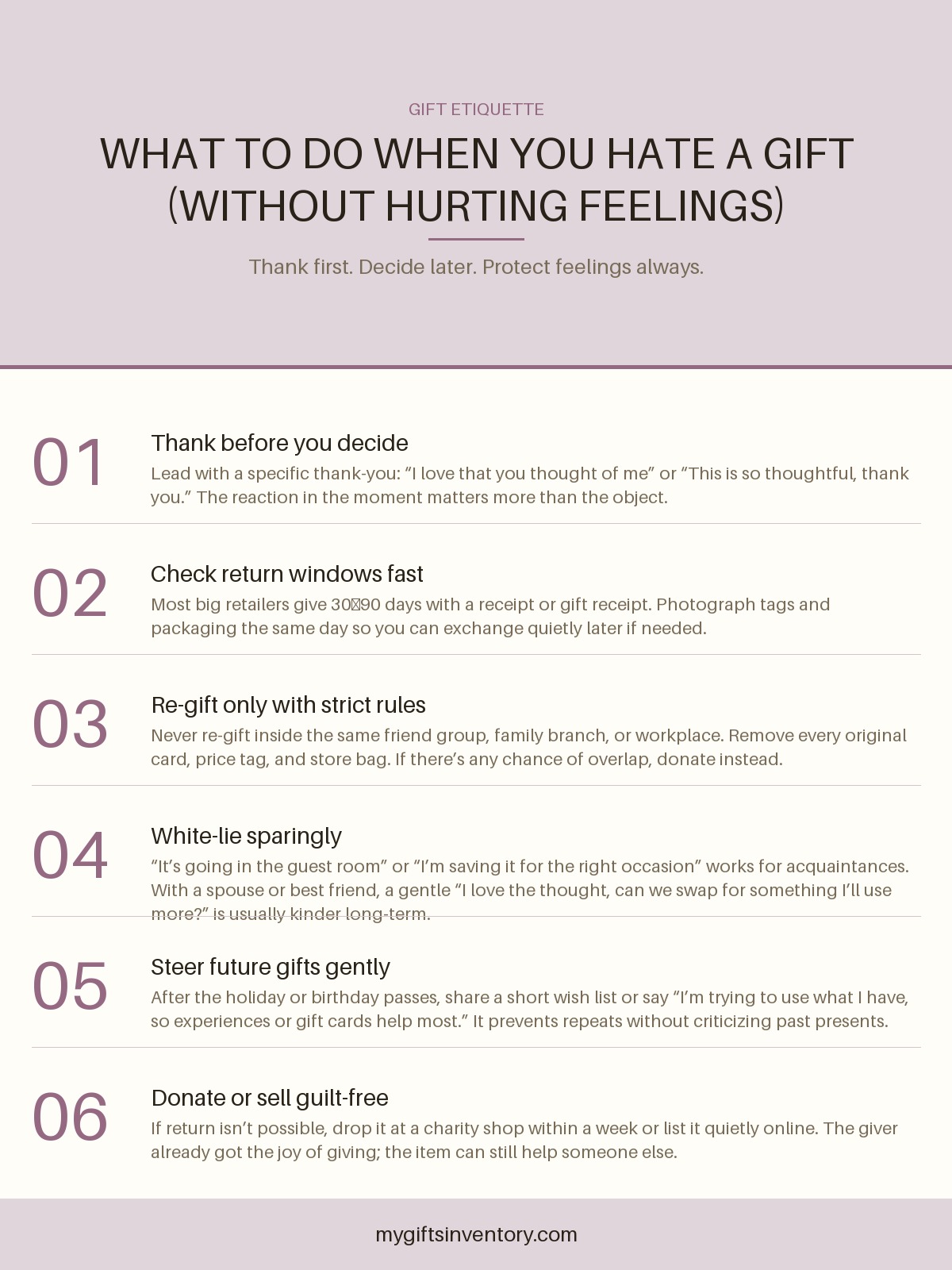
The first thirty seconds matter more than the gift itself. Most givers are watching your face, not cataloging whether you’ll actually use the item. A warm, specific thank-you buys you time and goodwill.
Skip the fake rave about the object if you can’t sell it. Focus on the person and the effort:
- “This is so thoughtful. Thank you for thinking of me.”
- “I love that you picked this out. It means a lot.”
- “You always put so much care into gifts. Thank you.”
If the giver is standing right there expecting more, add one true detail: the color is pretty, the packaging was fun, you appreciate them remembering your birthday. Then change the subject or move to the next present. You do not owe an immediate performance about how you’ll use it every day.
Write the thank-you note or text within 24–48 hours using the same approach. “Thank you so much for the sweater. It was really kind of you to think of me for the holidays” is complete. You are not required to invent a story about wearing it to brunch.
Give Yourself Permission to Decide Later
You do not have to choose the item’s fate while everyone is still in the room. Set it aside, enjoy the rest of the gathering, and evaluate privately the next day. Ask yourself three questions:
- Is there any realistic chance I’ll use or enjoy this within the next year?
- Would keeping it create clutter or quiet resentment every time I see it?
- Does the giver expect to see it in use (close family who visits often, a partner, a roommate)?
If the answer to the first is no and the second is yes, you have full permission to move it along. Guilt helps no one. The giver already received the pleasure of choosing and wrapping something. Your job now is stewardship of your own space and honesty with yourself.
Quiet Returns and Exchanges
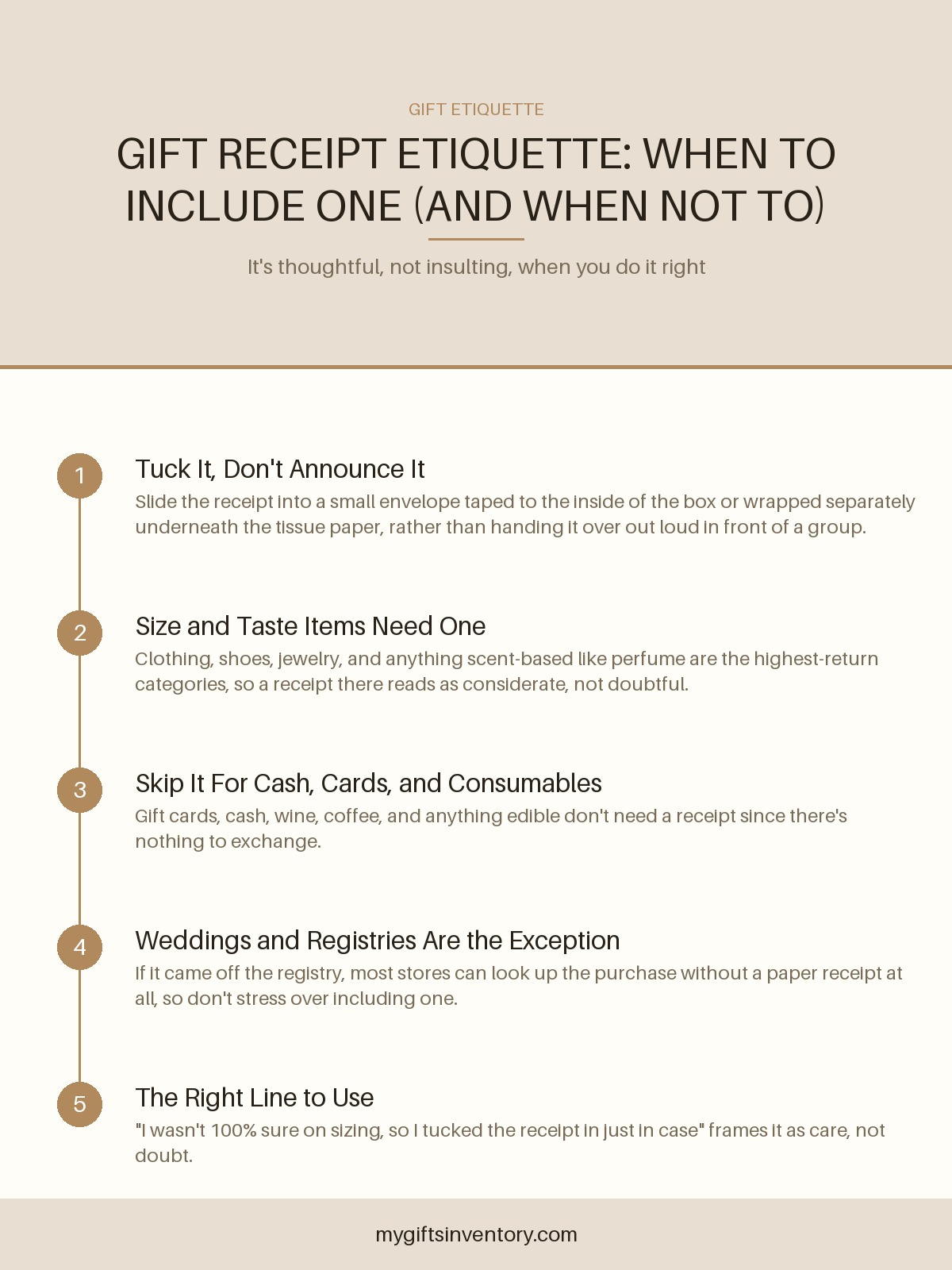
This is usually the cleanest option when the gift came with a gift receipt, or you know the store and the approximate price. Act quickly. Many major retailers offer 30 to 90 days for returns or exchanges, sometimes longer for holiday purchases made in November and December. Keep original tags, boxes, and any protective packaging intact until you decide.
If there is a gift receipt, use it. The return will typically show as store credit or an exchange without revealing the price to you in a way that feels awkward, and the original payment method stays protected. No gift receipt? Some stores will still accept the return for store credit with a photo ID, especially if the item is unopened and in current season. Call ahead or check the retailer’s current policy so you don’t waste a trip.
When the giver is likely to ask about the gift later, have a soft line ready: “I’m exchanging it for a different size” or “I’m swapping it for something that fits my kitchen better.” Most people understand sizing and practicality issues. You do not need to announce that you disliked their taste.
Store credit can turn into something you actually want. If you’d rather have flexibility, many people quietly convert returns into gift cards from places they already shop. Knowing exactly which brands and cards are available at big retailers helps; our breakdown of Gift Cards at Target (and the similar guides for other stores) makes it easy to see fees, popular brands, and how to buy without surprises.
Re-Gifting Without the Drama
Re-gifting gets a bad reputation only when it’s done carelessly. Done right, it is practical and kind: the item finds someone who will love it, and nothing useful sits in a closet. Follow these non-negotiable rules.
The hard boundaries
- Never re-gift within the same social circle, extended family branch, or workplace. The risk of the original giver finding out is too high and the embarrassment is permanent.
- Remove every trace of the original wrapping, card, price tag, store bag, and any personalized note.
- Only re-gift items that are brand-new, in perfect condition, and still something the new recipient would plausibly want.
- Do not re-gift anything handmade, monogrammed, or clearly chosen with intimate knowledge of the first recipient.
When re-gifting works well
A scented candle to a coworker in a different department, a kitchen tool to a friend who lives in another city, a bottle of wine to a host who wasn’t at the original party. Keep a small, private “re-gift shelf” or box so you’re not scrambling. If you’re ever unsure whether paths might cross, skip it and donate instead.
If the item is genuinely nice but wrong for you, it can still become part of a thoughtful present for someone else. Pairing a re-gifted item with something small and new often feels more intentional. For inexpensive additions that still feel considered, we like browsing lists such as 20 Best Gifts Under $30 That Actually Feel Thoughtful.
Donate, Sell, or Repurpose Without Fanfare
No return window and re-gifting feels risky? Charity shops, shelters, and community free groups take gently used or new items every day. Drop it off within a week or two so it doesn’t become a lingering guilt object in your home. Many organizations will even give you a donation receipt for tax purposes if you want one.
Selling is fine too. Local buy-sell groups, consignment, or online marketplaces work for higher-value items. List it discreetly, ship it, and move on. You are not obligated to keep something that doesn’t serve you just because it arrived as a gift.
Occasionally an item can be repurposed: a vase becomes storage, a too-formal scarf becomes wrapping ribbon, a gadget gets loaned permanently to a family member who will actually use it. Only do this if it genuinely solves a problem. Forcing a use you don’t want usually fails.
When (and How) to Be More Honest
Most of the time, silence and a graceful redirect are enough. There are a few relationships where a gentle conversation prevents years of repeated mismatches.
With a partner, spouse, or very close friend who gives you gifts regularly, honesty is usually a gift back to them. Try: “I love that you wanted to get me something special. I’ve realized I’m happiest with X or experiences. Can we steer that direction next time?” Offer concrete help: a short shared note on your phone, a couple of links, or a price range. Frame it as making their future shopping easier, not as criticism of past choices.
With parents or in-laws who keep giving clothes in the wrong size or style, a light touch often works after the holiday dust settles: “I’ve been trying to simplify my closet, so if you ever want ideas I’m happy to share a couple of go-to things.” Some families move successfully to group gifts, charitable donations in someone’s name, or “no gifts, just time together” agreements.
With coworkers or distant relatives, stay in the polite thank-you lane. The social cost of honesty is rarely worth it.
If the gift is offensive, inappropriate, or crosses a boundary (not just disliked), you can refuse it more directly or return it to the giver with a calm explanation. That situation is rarer and deserves its own clear response rather than the soft strategies above.
Special Situations
Gifts from kids
Children’s handmade or carefully chosen gifts almost always get kept or displayed for a while, even if the craft is lopsided. The point is their pride. Take a photo, put it on the fridge or a shelf for a season, then quietly retire it later if needed. Thank them with real enthusiasm focused on the effort.
Regifted or obviously last-minute gifts you receive
You can still say thank you. You are not required to pretend it was perfect. If it’s usable, great. If not, the same return/donate path applies. Mentally separate the gesture from the execution.
Expensive gifts you hate
Higher price tags raise the emotional stakes. Still start with gratitude. Then move faster on returns if a gift receipt exists. For luxury items, many retailers have excellent exchange policies. If return isn’t possible and the giver is close, a careful conversation may be kinder than letting a costly mistake sit unused. For context on when splurges actually land well, see thoughtful higher-end ideas in guides like our luxury gifts worth the splurge roundup, which focuses on pieces people genuinely keep.
Group or family gifts
When multiple people chipped in, the social pressure feels heavier. Thank the group warmly. If you need to exchange, you can often do so quietly and still mention the gift positively when it comes up (“You all were so generous”).
Prevent the Problem Next Time
Once the current gift is handled, a little upstream work saves everyone stress. Keep a running note on your phone with sizes, color preferences, stores you actually shop, hobbies you’re active in right now, and things you already own too many of. When someone asks for ideas, you can share two or three concrete suggestions without making them feel tested.
Wish lists (private or shared) work well for immediate family. So do experience requests, contributions to a bigger goal, or simply “gift cards to places I go every week.” If you want to get better at choosing for others so they never face this dilemma with your presents, the practical framework in Choosing the Perfect Gift: Tips and Ideas for Every Person and Occasion is a solid place to start. It walks through observing real life instead of defaulting to generic objects.
For people who are hard to buy for, a well-chosen small gift that shows you pay attention often beats a bigger generic one. Thoughtful options under tight budgets exist; lists like best gifts under $20 prove you don’t need to spend a lot to avoid the “what do I do with this” problem.
What Not to Do
- Do not post a photo of the unwanted gift with a passive-aggressive caption. It travels farther than you think.
- Do not announce in the group chat that you’re returning it.
- Do not leave the gift out in a way that forces the giver to notice it never gets used.
- Do not re-gift so sloppily that the original card is still inside.
- Do not let resentment build for years while smiling through the same wrong present every holiday. A gentle course-correction is kinder.
Handling a gift you hate is mostly about protecting the relationship while refusing to let an object become a burden. Thank them for the thought. Decide privately and promptly. Move the item to a better home through return, careful re-gifting, or donation. Then give future givers a little more information so the next round is easier for everyone.
You can be both gracious and practical. Those two things are not opposites.
Frequently Asked Questions
Is it rude to return a gift?
No. Returning or exchanging a gift is practical, not rude, as long as you thanked the giver sincerely and you do it quietly without broadcasting the return. Most people understand that sizes, colors, and duplicates happen. The rudeness would be making the giver feel their effort was worthless.
What should I say if the giver asks how I like the gift weeks later?
Keep it brief and kind: “It was so thoughtful of you” or “I’ve been meaning to thank you again for thinking of me.” If you exchanged it, “I swapped it for a different size and I love it” is usually enough. You do not need a long story.
Can I re-gift a present the same year I received it?
Yes, if you follow the rules: different social circle, perfect condition, all original packaging and notes removed, and zero chance the original giver will see it. Same-season re-gifting is common and fine when those boundaries are respected.
What if there is no gift receipt and the store won’t take it back?
Donate it, sell it, or carefully re-gift it. Many charities accept new unused items year-round. The goal is simply to get it out of your space without creating drama. Holding onto something you dislike helps no one.
How do I stop getting gifts I hate without sounding ungrateful?
After the occasion passes, offer forward-looking help: “I’m trying to be more intentional about what comes into the house, so if you ever want ideas I’m happy to share a couple of things on my list.” Pair it with appreciation for past generosity. Most people prefer clear guidance over guessing wrong again.