When Is Regifting Okay? Etiquette Rules, Card Wording, and What Not to Do
We share the clear etiquette lines for when regifting feels thoughtful, when it backfires, and how to handle the awkward parts like receipts, tags, and card messages.

As an Amazon Associate, My Gifts Inventory earns from qualifying purchases. We only recommend products we'd genuinely consider buying ourselves.
We know why this search pops up. Either we are staring at a closet full of “nice, but not for me” gifts, or we just realized we already gave this same item last year and now we need a clean, polite fix. The question is not whether regifting is “bad” or “good,” it is whether it will land as thoughtful instead of awkward.
This guide gives us a practical yes-or-no framework, plus card wording, timing rules, and the specific situations where regifting is usually a miss. We also cover gift cards, because that is where most people are trying to do the right thing while still keeping their effort and money both sensible.
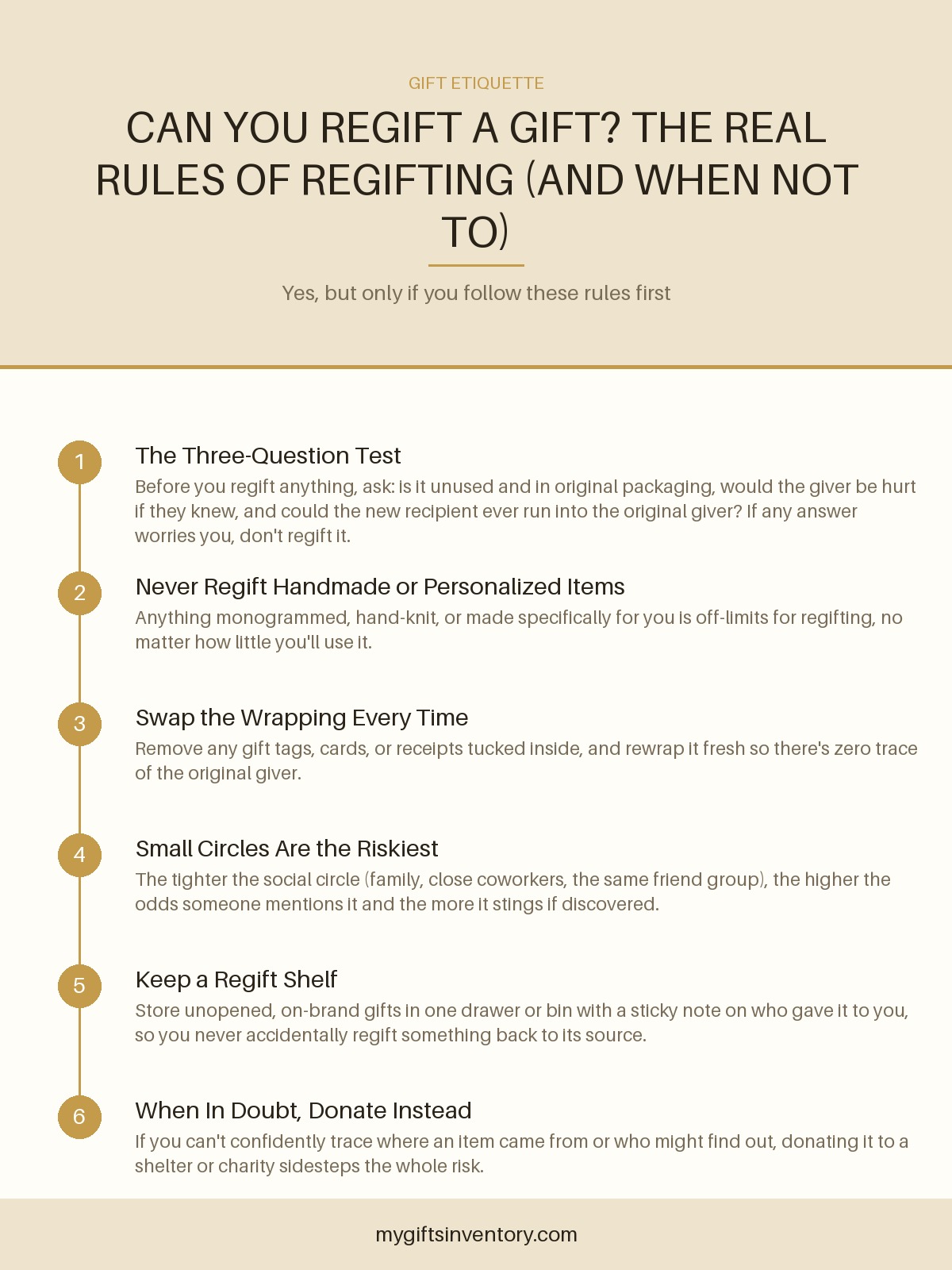
When regifting is okay (and when it’s not)
Regifting tends to be okay when it stays thoughtful
Regifting works best when the gift was never really about the original person and the item can clearly become “a gift for you” for the new recipient. In other words, we are not passing along clutter, we are redirecting something that was meant to be used.
- It matches the recipient’s real life. Think: someone who bakes will actually use kitchen tools, a coffee drinker will use coffee, a reader will use a book they genuinely want.
- It is unused and presentable. Brand new, still in the box, clean, and not missing pieces.
- It is appropriate for the occasion. A holiday candle might be perfect for a housewarming timeline, but it can feel random for a “just because” note if the recipient hates scents.
- We avoid anything that depends on a shared backstory. If the original gift came with a personal meaning only the first giver would understand, it is usually better not to redirect it.
Regifting is usually not okay when it feels like a shortcut
If the regift could make the recipient wonder if we were paying attention, we should rethink it. Regifting crosses the line when it becomes “I grabbed something off the shelf” instead of “I picked something that fits.”
- It is opened, used, or missing parts. Even if it is “only once,” people notice.
- It includes prior gift packaging that cannot be fully cleaned up. Old gift tags, handwritten notes, packing slips left inside, or receipts still stapled to the wrapping are red flags.
- It is personalized in a way that points back to the first recipient. Monogramming, custom photos, and anything that clearly references the original person should stay put.
- It could create a social tangle. If the regifter and recipient share a group chat, family calendar, or mutual friends who might compare stories, the risk of awkwardness goes up.
- It is a “new surprise” situation. If the gift is supposed to be the unique experience for the moment, regifting can feel like you are passing off something already “experienced” by another relationship, even if you never opened it.
Our regifting checklist (the quick version we actually follow)
When we decide whether we can regift, we run through a simple checklist in our heads. If any answer is “no,” we pivot to another option like a different gift or a gift card.
Step 1: Confirm it is truly unused
We only regift items that are still new or in like-new condition and that do not raise hygiene or quality questions. If it is cosmetics, food, candles that have been opened, or anything that might have been exposed to heat or storage humidity, we treat it as a no.
Step 2: Remove everything that signals it used to be someone else’s
We take off old tags and we avoid reusing wrapping paper with handwritten notes. If the item came with a card, we remove it. If there is a packing slip, we discard it.
Step 3: Make sure it fits this relationship
This is the core. The item can be totally “fine” and still wrong for the new person. We ask: would we give this if we bought it right now with no history attached?
If the answer is yes, regifting can be okay. If the answer is “maybe,” we either customize the meaning with a strong card message and an extra personal touch, or we choose a different gift.
Step 4: Choose the right replacement if anything feels off
Sometimes the easiest way to avoid regret is to pivot to a gift card. If we are going to do that, we like to be practical and specific about where the person shops. Our gift guides can help us choose a realistic gift card approach, like our pages on Gift Cards at Walmart, Gift Cards at Target, and Gift Cards at Kroger: The Complete List of Brands, Fees & Fuel Points (2026).
How to handle gift cards when regifting
Gift cards are one of the most common regifting tools because they remove the guesswork. The etiquette question becomes less “is it allowed?” and more “will it actually work for them?”
Regifting a gift card is usually okay if you do your due diligence
- It is still valid. If the recipient would be stuck with a card they cannot use, that defeats the purpose.
- The place makes sense for their routine. Think groceries, pharmacies, and big box stores they already use.
- You do not pretend it is a different card. We never hide the original origin in a way that would mislead.
If you are already comfortable with gift cards and you want a clearer sense of what to expect, we recommend checking our store-specific guides first, like Gift Cards at Meijer: The Complete List of Brands, Fees & Where to Buy (2026) and Gift Cards at Dollar General: The Complete List of Brands, Fees & Where to Buy (2026). They can help you avoid common mismatches.
What to write when regifting a gift card
We keep it simple and present-tense. We do not mention that we received it as a gift first. A card that feels like you picked it for them is what matters.
Examples that work:
- “I hope you can treat yourself to something you really want. Thinking of you.”
- “For you to use however you like. Hope your day is great.”
- “A little something toward your next shopping trip. Enjoy!”
If you worry the recipient might ask, we choose our wording to be calm and non-explanatory. If a question comes up, we can say: “I thought you would be able to use it for what you need.”
Card wording for regifts: what to say and what to avoid
Most people worry about card etiquette more than the gift itself. We get it. The goal is warmth without unnecessary details.
Good card messages for regifting
We write as if we are the giver. Present tense helps. We do not include a backstory.
- Warm and practical: “I picked this because I thought you would actually use it. Hope it makes your day a little easier.”
- Short and sincere: “Thinking of you. I hope this is something you can enjoy soon.”
- When you are gifting a home or comfort item: “For your space. I hope it feels like a small upgrade you get to look forward to.”
What to avoid writing
- Anything that sounds like confession: “I already had this,” “I got it from someone else,” or “I didn’t want it.”
- Anything that invites interpretation: “You might like this better” or “It’s not what I would have picked, but…”
- Anything that points to the original recipient’s identity. Even if it is a joke in our family, it can land weird outside the inner circle.
When you should add one extra personal line
If you are regifting something that is a little less “obvious,” one personal line can rescue it. For example, if it is a kitchen tool and you want it to feel intentional, we can tie it to something they said.
Example: “You mentioned you wanted to bake more this season, so I hope this helps.”
Timing and planning: when regifting is most likely to be smooth
Timing is where we can prevent most awkwardness. If regifting is a “last-minute panic,” it reads like one. If it is planned, wrapped nicely, and written carefully, it reads like someone who thought ahead.
We recommend doing this within a reasonable window
In practice, we feel safest regifting within the same general season or within months, not years. If an item is tied to a specific moment like a holiday decoration or a themed event item, we match that moment rather than letting it drift far into the future.
When something has been sitting for a long time, the question becomes whether you can honestly say it still feels current. If we cannot, we do not regift it.
Plan for the “receipt and returns” reality
There are two timelines happening at once. We are giving the gift, but we also need to consider whether we could support a return or exchange if the recipient hates it. Not every store policy is flexible, and not every gift can be returned without proof of purchase.
Our rule is simple: we do not gift with a secret plan that depends on us finding the receipt later. If the recipient might want to exchange sizing or preferences, we either gift something more flexible or we choose a gift card that fits their shopping habits.
If you want ideas for practical gifts that tend to be usable across seasons and budgets, you might also skim our guidance on choosing gifts by vibe and recipient needs in Choosing the Perfect Gift: Tips and Ideas for Every Person and Occasion. That mindset is the same thing we use before we decide to regift.
Common regifting scenarios (and what we would do)
Scenario: Someone gave us a “nice but wrong” version of a thing
Example: a coffee mug style we do not like, but the person we want to gift to drinks coffee daily. If the mug is unused and not personalized, we can regift.
Card approach: “I thought of you when I saw this. Hope you enjoy it.”
Scenario: We received a duplicate
Duplicate gifts can be easier because they were clearly not meant to be one-of-a-kind. We still remove packaging traces and we verify it is unused. We also avoid gifting duplicates if the first giver might be the same person who can easily remember what they gave.
Scenario: Regifting after a move
This is where regifting can feel mature instead of messy, because it is not about avoiding effort, it is about reducing clutter. We check condition, clean everything, and match gifts to the new home needs. For example, if a relative loves hosting, we can redirect unused serving items.
Scenario: We want to regift to keep budget tight
There is no shame in budgets. The etiquette line is still the same: regifting must feel like a deliberate choice. If we are cutting cost, we can do that by being smarter, not by being careless.
Sometimes it helps to choose a category that is less risky for preferences. Things like basic self-care sets under a certain price point can be easier to match to “use now” needs. If you want direction on items that often land safely, you can pair that mindset with our idea lists, like 20 Gift Ideas for Self-Care & Spa Gift Sets Under $50 (2026).
What about family regifting and “the unwritten rules”?
Every family has norms. Some people see regifting as practical and lighthearted. Others see it as a personal slight. We cannot fix someone else’s history, but we can control our approach.
- Know your audience. If regifting is a sensitive topic in your family, we treat “okay” as “only in rare situations.”
- Keep it private. We never announce the regift origin to relatives or in a group setting.
- Make the new gift feel intentional. That means wrapping neatly, adding a thoughtful card, and matching it to what the new recipient values.
If you have already mentioned to someone that you had gotten an item yourself, the risk goes up. In that case, we just do not regift. We choose another gift, even if it means buying something small.
When regifting could create a social problem
Even if the etiquette seems correct, there are moments when regifting creates unnecessary drama. We avoid it when there is a strong chance of comparison.
High-risk moments
- Gifting to someone who knows the original giver well. The original giver might have also told them the gift story.
- Gifting in the same social circle within the same year. People notice repeats.
- Gifting items that were clearly tied to a specific event. “This is for your graduation” becomes “wait, weren’t you the one who got it?”
If any of these apply, we treat regifting as a last resort, not our first choice.

Frequently Asked Questions
Is regifting ever rude?
Regifting is usually not rude when the item is unused, looks good, and is a genuine fit for the new recipient. It can feel rude when the recipient suspects you are giving away something you did not want or something that was meant for someone else.
Should we tell the recipient it was a gift we received?
No, we do not need to tell them. We treat it like any other gift: we give it with warmth and move on, without offering the backstory.
Can we regift a gift if it still has the original tag?
We avoid it. We remove old tags and any identifying notes so the recipient sees it as a fresh gift, not a rerouted package from someone else.
Can we regift gift cards?
Yes, gift cards can be a good regift when the recipient can actually use them and the value is still worth it. We recommend choosing a card for a store they shop for and writing a simple card message that does not reference the original source.
What should we write in a card for a regift?
We write like we are the giver, using warm, present-tense wording. Example: “I hope this is useful and brings you a little joy. Thinking of you.”
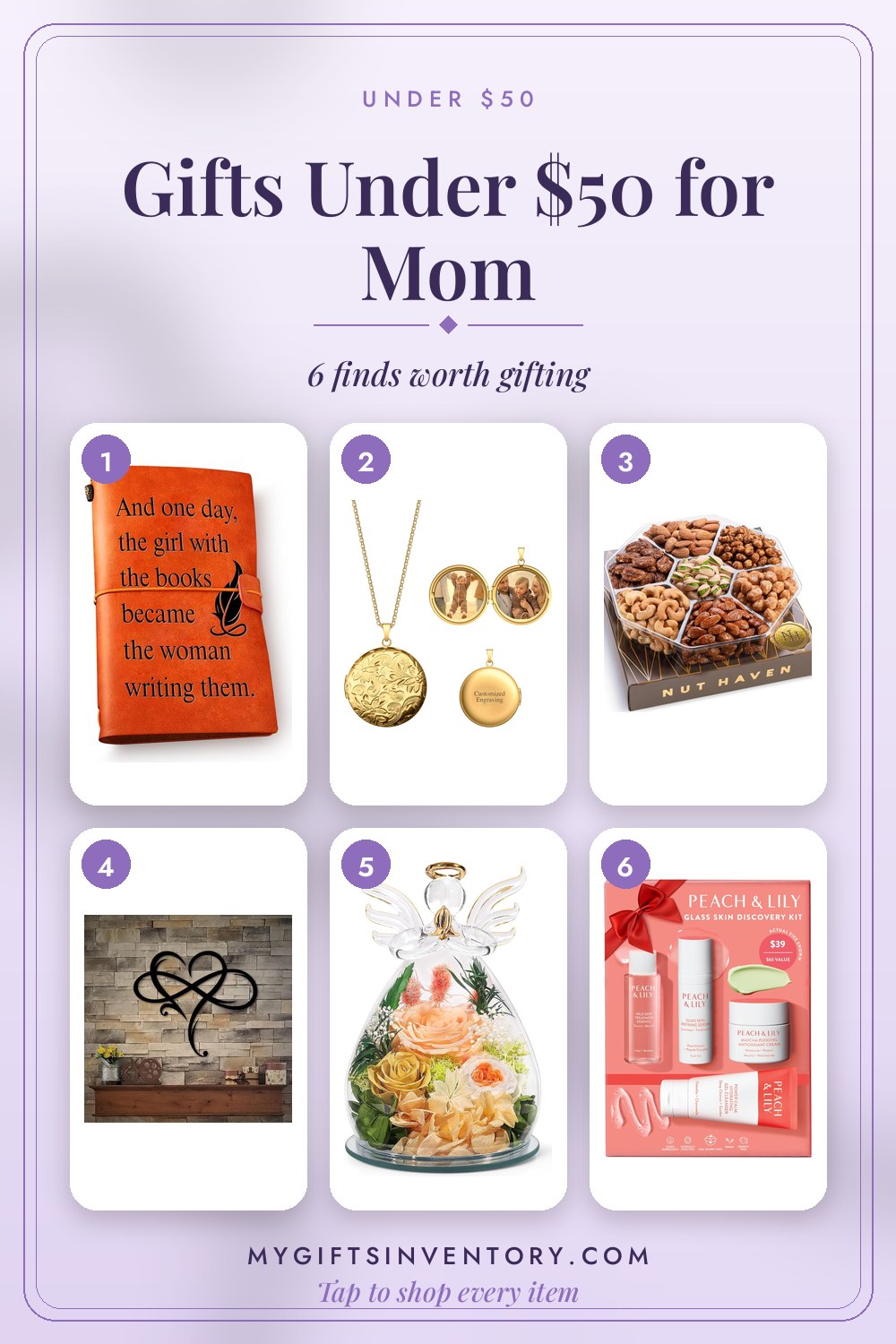
Looking for an Actual Gift Instead?
Gift Sets We Love Right Now
Every item picked, priced and linked, ready to buy.
More Gift Advice