White Elephant Gift Exchange Rules: The Complete Guide
Steal limits, turn order, budgets by group, what to buy and how to wrap it, what to write on the card, and how to settle the awkward moments, all in one place.

As an Amazon Associate, My Gifts Inventory earns from qualifying purchases. We only recommend products we'd genuinely consider buying ourselves.
Someone just told you there's a white elephant exchange at the office party this year, or you got stuck organizing your family's, and now you're picturing all the ways it could go sideways. Maybe you remember the year a gift got stolen four times and the mood turned tense, or you just don't want to be the person who shows up with a $60 gift when everyone else spent $15. Good news: white elephant only feels chaotic when nobody sets the rules ahead of time. Once the mechanics are clear, it's one of the easiest party games to host and one of the most fun to play.
White Elephant vs. Yankee Swap vs. Secret Santa
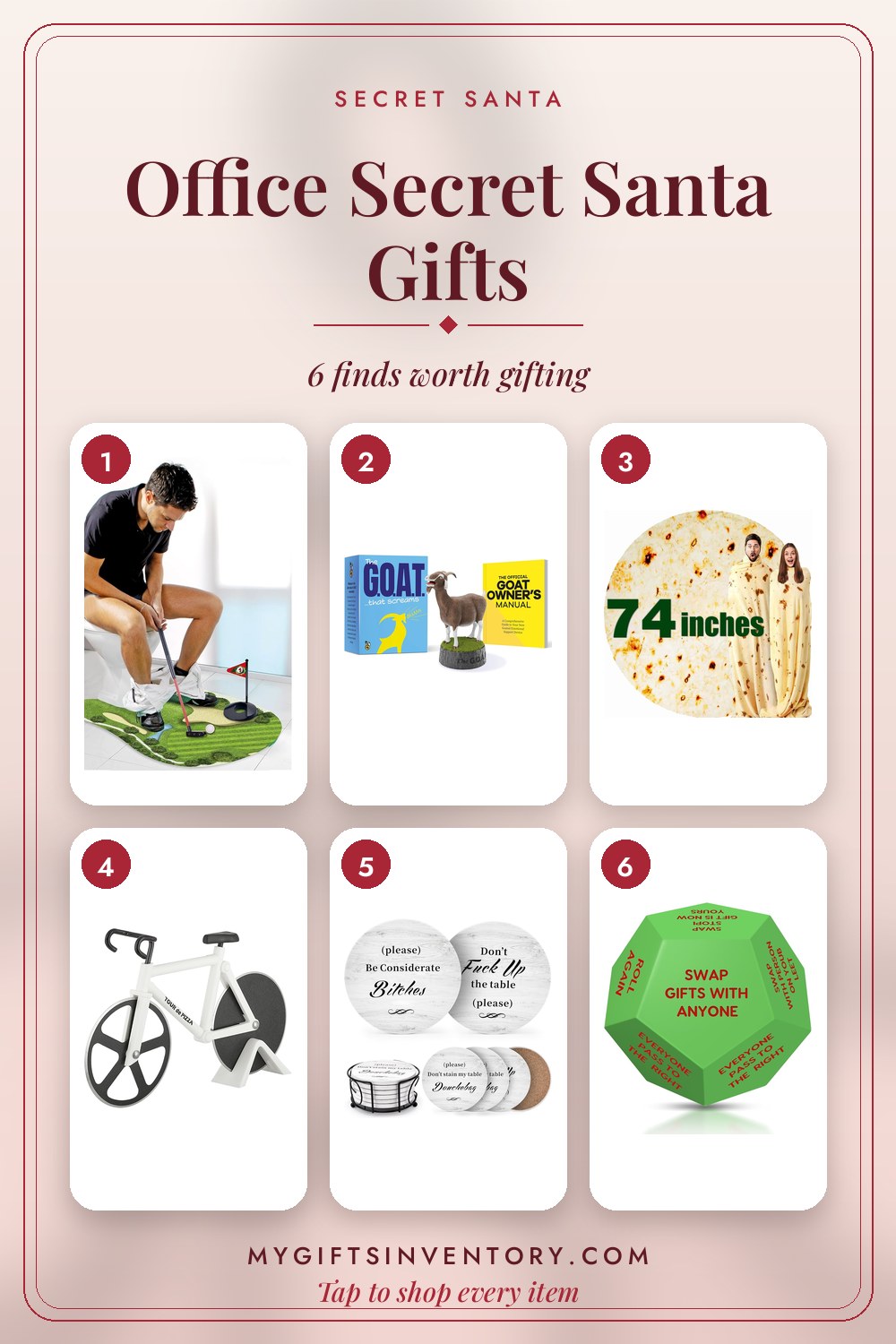
These get mixed up constantly, so sort it out before you send the invite. Secret Santa means everyone is assigned one specific person in advance and buys just for them, no stealing involved. Yankee swap and white elephant are basically the same game under different regional names: gifts go into a shared pile and get opened and stolen in turns. "White elephant" traditionally implies the gift should be a bit odd, funny, or impractical, though plenty of groups now run it as a straight swap with nice things. Pick a version, say so in the invite, and you'll avoid the classic mismatch where half the room brings a gag and the other half brings something they'd actually want to keep.
The Basic Rules, Step by Step
- Everyone brings one wrapped gift within the agreed budget and adds it to a central pile.
- Draw numbers or roll dice to set turn order.
- Player 1 picks a gift and unwraps it for the whole room.
- Player 2 either picks a new wrapped gift or steals Player 1's opened one. If they steal, Player 1 picks another wrapped gift or steals from someone else.
- Play continues in order, each person unwrapping something new or stealing an opened gift.
- The last player takes their turn with the option to steal anything, which is usually the best seat in the game. Some groups also give Player 1 a final "swap" turn to even things out.
Steal Rules: Where Most Disputes Start
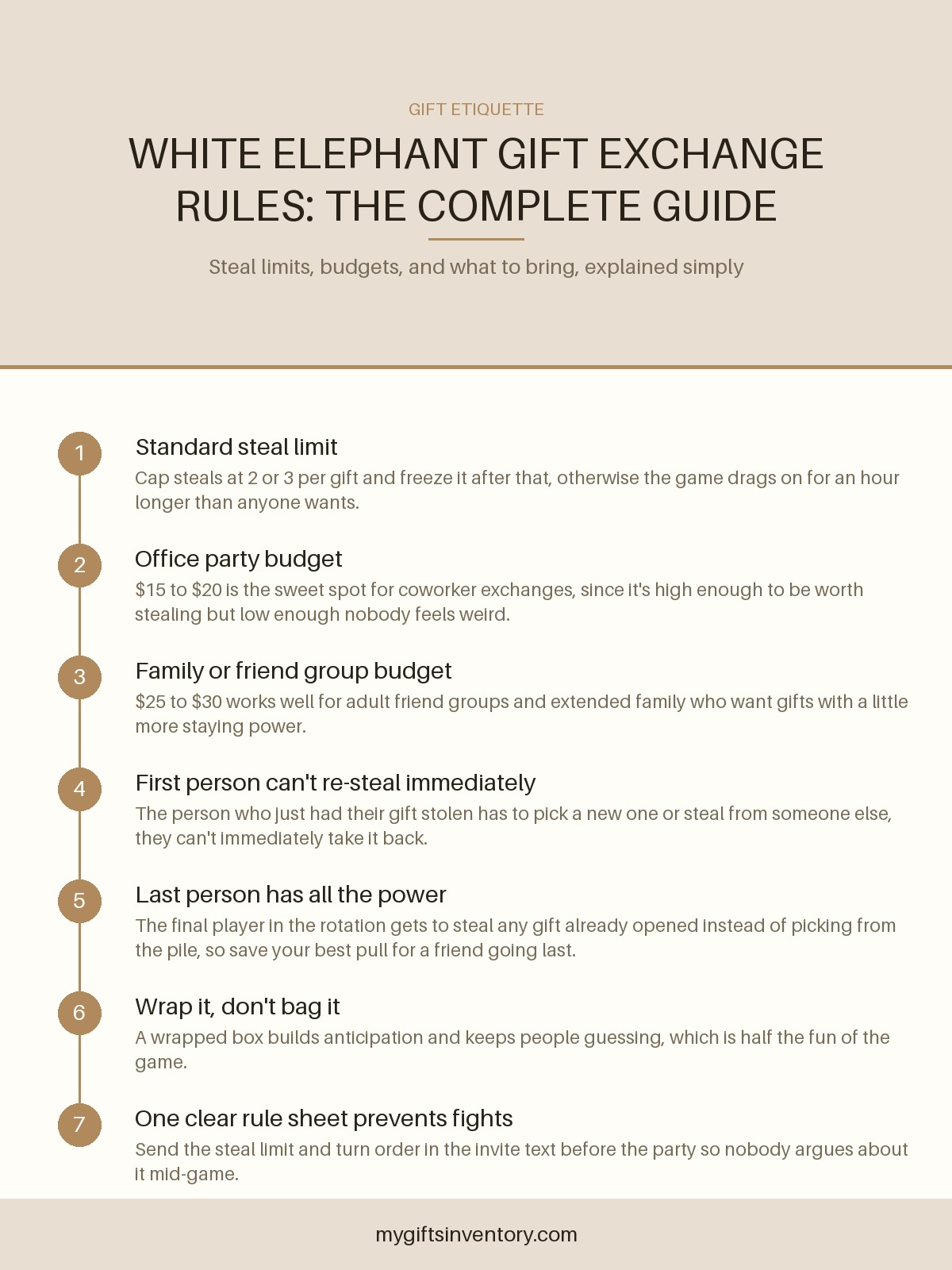
The most important thing to settle before the party is how many times a gift can be stolen before it's "frozen" and belongs to whoever holds it. Without a cap, a popular gift can bounce around the room for twenty minutes while everyone else waits.
Common steal limits
- Two steals and it's frozen: keeps things fast, good for groups of ten or fewer.
- Three steals and it's frozen: the most common version, gives popular gifts room to circulate without dragging.
- Unlimited steals: only works for small groups who don't mind a long game.
Other house rules worth setting
- No immediate steal-back: if your gift was just stolen, you can't take it right back on your next turn. Pick something new or steal from someone else.
- One steal per turn: stops a chain reaction where five people take the same item in a row.
- Frozen means frozen: once a gift is locked, it stays locked, no exceptions.
Whatever you choose, put it in writing in the invite or group text. "Three steals max, then it's frozen, no stealing back the gift you just lost" is one sentence, and it heads off nearly every argument.
Setting the Budget
Lock in one number before anyone shops, not a range. "$25 max" or "$25 including tax" leaves no wiggle room, and if you're a guest rather than the organizer, it's worth one message in the group chat to confirm. If someone blows past it anyway, don't call them out mid-game. Just keep play moving.
Office parties
$15 to $30 is the usual range for coworkers, with $20 the sweet spot. It's enough for something decent without pressuring anyone to spend real money on people they see forty hours a week but don't know well. If your office runs it as a nice-gift exchange rather than a gag one, our corporate gift ideas under $50 roundup has options that read as thoughtful rather than random.
Family gatherings
$20 to $30 is typical for adults, especially when the exchange replaces buying for every cousin, aunt, and uncle. Some families go to $40 or $50 for a "fancy" version where the whole point is bringing something people will fight over.
Friend groups
$20 to $30 is the norm, though plenty of groups have a running joke item that gets re-wrapped every year no matter what the official budget says. For a tight limit, our best gifts under $20 list helps because you're not guessing whether the item will feel worth stealing.
Kids and mixed-age groups
Keep it under $15 and be specific about what's appropriate. A game built around stealing can be genuinely upsetting for a seven-year-old whose new toy just got taken by an aunt for laughs. Decide in advance whether kids play their own separate round.
What Makes a Good White Elephant Gift
The gifts that get stolen most fall into a few buckets: something useful that anyone would want, something funny enough to get a laugh when it's opened, or something with a bit of inside-joke relevance for the group. A simple test: if someone ends up stuck with this, could they feel fine keeping it? If yes, it's a solid pick. If you can already picture them looking stuck, choose something else.
What tends to work
- Low-risk consumables: shelf-stable treats, hot sauce, nice tea, or coffee gear. Our coffee lovers gift guide and gourmet treats, wine and coffee ideas are good starting points because almost everyone enjoys a small treat.
- Small home upgrades: a well-sealed candle, a cozy throw, a quirky mug, a handy kitchen gadget.
- Gadgets: reliable steal-bait. Several picks in our tech gifts under $50 list would hold their own in any office exchange.
- Self-care that isn't personal: spa-style sets that feel like a treat rather than a comment on someone's habits. See self-care and spa gift sets under $50 or dorm-friendly picks under $20 for cheaper options.
- Easy experiences: activity vouchers work only if scheduling is simple.
What tends to backfire
- Super niche items that assume a fandom or hobby not everyone shares.
- Bulky or awkward gifts that need assembly or can't be held one-handed.
- Expensive electronics: if it gets stolen three times, the stress isn't worth it.
- Anything fragile, sharp, perishable, or tied to a subscription the recipient can't set up on the spot.
- Intimate or pointed items: anything that could read as romantic or as a critique, even as a joke.
Gift cards
Check with the host first, since some groups treat them as against the spirit of the game. If they're allowed, a gift card is a safe fallback, though it usually gets stolen once and then sits frozen since there's no surprise left. Put it in a simple envelope with a playful note, and pick a brand most people actually use, like the stores covered in our Walmart and Target gift card guides. If you go home with one, it's worth checking what's on it before it vanishes into a drawer; our Amazon gift card balance guide walks through it in under a minute, and there are similar ones for Walmart and Target.
For a broader refresher on matching a gift to a person, our guide to choosing the perfect gift still applies, even inside a silly party game.
Wrapping a Gift That Survives the Game
White elephant wrapping is about speed and durability, not perfection. Your gift may get unwrapped, handed around, and fought over, so wrap accordingly.
- Use sturdy paper or a box. Skip the gift bag if you can, since peeking in gives the surprise away before the game starts.
- Tape the seams where paper will get pulled.
- Pad anything breakable. Treat it like shipping.
- Keep it easy to hold. If it's awkward one-handed, it'll slow every turn.
- Don't put names on the outside. Part of the fun is not knowing whose gift is whose. If the host insists, tuck a small label inside.
What to Write on the Card
Cards are optional in most groups, but one short line makes a gift feel like a gift instead of an object. One warm sentence plus a joke that fits the item is plenty: "Hope this makes you laugh, enjoy!" or "May it be the one you keep." If your gift is good steal material, "If you don't love it, I'm fine with it being stolen again" fits the spirit of the game.
Skip backhanded compliments, jokes about someone's job, body, family, or relationship status, and long speeches. Nobody wants to read a paragraph while the line of turns waits. Sign with your first name if your group likes accountability, or "a fellow gift-gamer" if it likes mystery.
Hosting Checklist
- Send the rules with the invite, at least a week ahead: budget, steal limit, whether gag gifts or gift cards are allowed.
- Pick the drawing method (numbers from a hat, dice, straws) and stick with it.
- Keep a spare wrapped gift for the person who forgets, within budget.
- Plan the time. A group of 12 to 15 with a three-steal limit runs 45 minutes to an hour.
- Give the host final say on whether a gift gets pulled before the game, and say in the invite that gifts should be workplace-appropriate at office parties.
If You're Shopping Late
Treat it like any event with a deadline. A couple of weeks out, confirm the budget and steal rules with the organizer. A week out, buy the gift, check it for damage or missing pieces, and write your card. A couple of days before, wrap and tape it, and if you're using a bag, make sure the handles hold. On the day, carry it in your own tote so you aren't juggling wrapping paper, and arrive a few minutes early so you're not wrapping in the parking lot.
Keep the receipt if you can, and lean toward items with a normal return window. That said, the final recipient is the one who ends up with the gift, so don't count on returning something just because it got stolen away from you.
Handling the Awkward Moments
Two people want the same gift and it's already frozen
This is normal, and it means the gift was a hit. The frozen rule exists exactly so this doesn't become a standoff. A quick "that's the fun part, go pick something else" keeps it light.
Someone brings a gift well over budget
Don't shame them. Let the game run, and if it keeps happening, the host can restate the number in the next invite.
Someone brings two gifts, or none
Stick to one per person. An extra can go home or become a bonus prize at the host's discretion, and a forgetful guest can grab the spare you kept on hand.
Someone brings an inappropriate or unsafe gift
Quietly flag it to the host before it's opened. Don't argue in front of the room.
Someone doesn't want their gift stolen
Unless the host announced a no-steal rule, stealing is the game. Keep it good-natured, and if someone looks genuinely upset, shift the mood quickly rather than pushing the joke.
Nobody wants your gift
It happens, and it says more about turn order than about you.
A gift takes forever to open
Set a time limit per opening or let people cut the tape and go. Wrapping for speed prevents this in the first place.
Gift Ideas to Go With This


Want more ideas? Browse our full guide: 20 Best Gifts Under $100 (2026): Thoughtful Picks They'll Actually Use
Frequently Asked Questions
How many times can a gift be stolen in white elephant?
Most groups cap it at two or three steals before the gift is frozen and belongs to whoever holds it. Setting this before the game starts is the easiest way to keep things moving.
Can you steal your gift back right after someone takes it?
In most versions, no. The person who just lost a gift has to pick a new wrapped one or steal from someone else. This stops two gifts from ping-ponging back and forth.
What's a typical white elephant budget?
$15 to $20 is common for offices, and $20 to $30 for friends and family. What matters more than the number is that everyone agrees on it ahead of time.
Is white elephant the same as Yankee swap?
Yes, in most cases they describe the same game with a shared pile and a stealing mechanic. Secret Santa is different: each person buys for one assigned person, with no stealing.
Do white elephant gifts have to be funny?
No. Plenty of groups run it as a straight exchange with genuinely nice items. Just say which version you're playing in the invite.
What should I write on a white elephant gift card?
One warm sentence and one light joke that fits the gift. Avoid personal jokes and long notes.
Can I bring a gift card to a white elephant exchange?
Only if your group allows it. If so, present it neatly with a short note so it still feels festive.
Looking for an Actual Gift Instead?


Gift Sets We Love Right Now
Every item picked, priced and linked, ready to buy.
More Gift Advice